
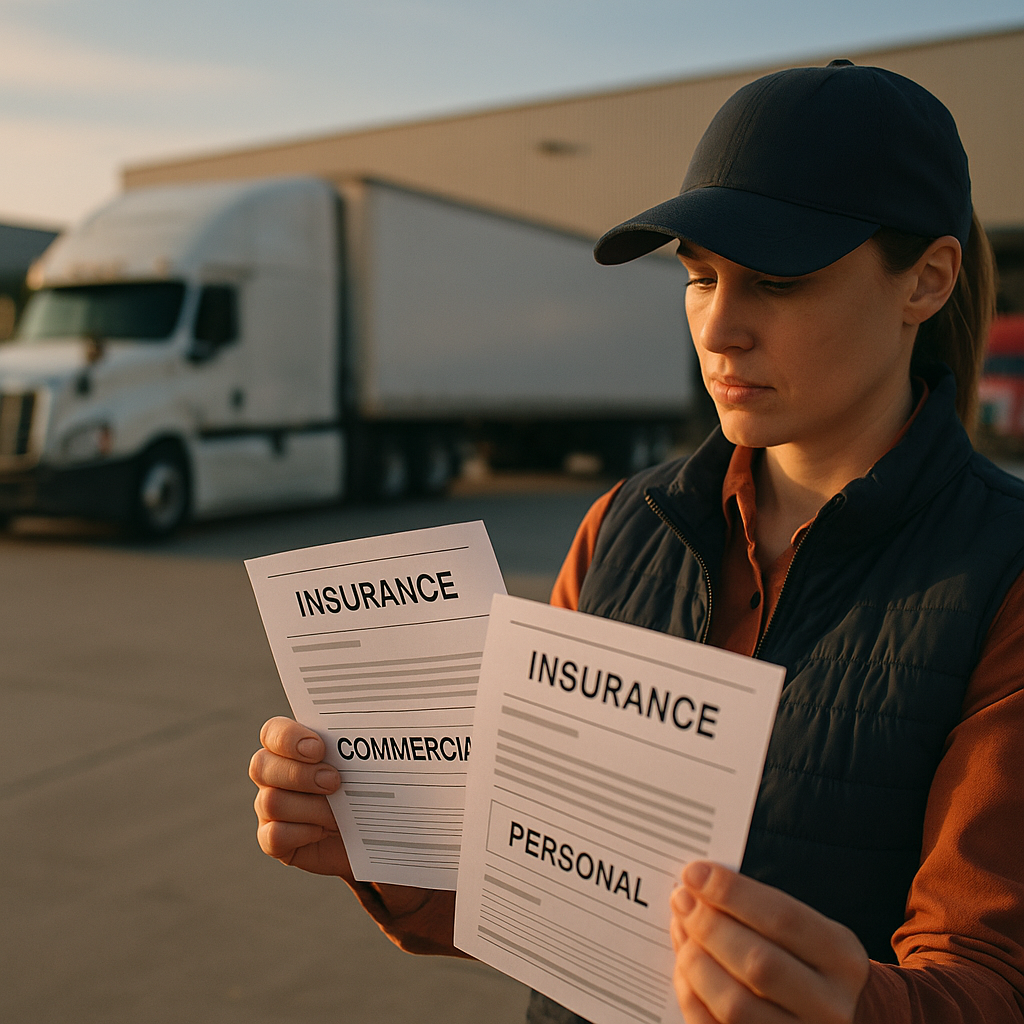
Commercial vehicle insurance vs personal: differences in use, limits, drivers, claims, and cost—plus 2026 decision rules. Get the right policy now.
Commercial vehicle insurance vs personal mainly comes down to how the vehicle is used at the time of loss: personal auto is written for household driving (commuting, errands), while commercial auto is built for business exposure like job sites, deliveries, multiple drivers, and contract-required limits and COIs. If your insurer rates you as “personal” but you’re driving for work, the real risk isn’t the premium—it’s a coverage gap when a claim hits.
If you’re an owner-operator, hotshot driver, contractor, or small business, this guide gives you practical decision rules to pick the right policy before a loss forces the issue—plus what changes in claims, pricing, and compliance in 2026.
Key Takeaways: Essential Commercial vs Personal Insurance
- The #1 difference is “use at the time of loss.” If you’re delivering, hauling, going job-to-job, or driving for the business, personal auto can fail you.
- Commercial auto typically means higher limits + more drivers allowed. That’s why it often costs more—because the exposure is bigger.
- Contracts beat state minimums. GCs, brokers, warehouses, and platforms often require higher limits and proof (COI).
- Classifying it right is cheaper than being denied. Misclassification can lead to claim denial, rescission allegations, or non-renewal—depending on the carrier, state, and facts.
Table of Contents
Reading time: 10 minutes
- Quick Comparison: Commercial vs Personal (1-minute answer)
- When you need commercial vehicle insurance (decision rules)
- Coverage & limits: what commercial adds or changes
- Cost in 2026: why commercial is often higher
- Can commercial cover personal use (and vice versa)?
- Claims differences: what changes when it’s commercial
- Telematics & dashcams: discounts and trade-offs (2026)
- Requirements & compliance: state rules, contracts, DOT/FMCSA
- Frequently Asked Questions
- Why Logrock: practical insurance that matches real-world operations
- Conclusion & CTA: classify it right and protect your cash flow
Quick Comparison: Commercial vs Personal Auto Insurance (1-Minute Answer)
Commercial auto is commonly written with higher business-ready limits (often $1,000,000 liability) and broader driver setups because it’s designed for business miles, job sites, and delivery/for-hire exposure.
If you’re busy, scan the table below and you’ll know where you land.
Side-by-Side Table (Best for Skimmers)
| Topic | Personal Auto Insurance | Commercial Auto / Commercial Vehicle Insurance |
|---|---|---|
| Primary use | Household driving: commuting, errands, leisure | Business use: job sites, deliveries, hauling, for-hire, regular business errands |
| Who’s covered | Typically household drivers + listed drivers | Often broader driver setups (employees, multiple drivers, scheduled drivers) |
| Limits | Often lower by default; can be increased | Often higher limits and more frequent COI/contract requirements |
| Underwriting focus | Individual driver + personal mileage | Business type, radius, mileage, drivers, garaging, operations |
| Claims scrutiny | Was it an accident covered under personal use? | Strong focus on use at time of loss + business records/logs |
| Best for | Personal cars, light use | Contractors, service fleets, delivery, hotshot, commercial truck insurance, semi-truck operations |
Bottom line: If you make money with the vehicle (or the vehicle makes money possible), treat insurance like business infrastructure—not a box to check.
When You Need Commercial Vehicle Insurance Instead of Personal
FMCSA financial responsibility rules require at least $750,000 in public liability for for-hire interstate carriers hauling non-hazardous property (general freight) in vehicles over 10,001 lbs (see 49 CFR §387.9), which is one clear line where “personal auto” isn’t the right tool.
This is the section that prevents “I thought I was covered” from turning into a five-figure problem.
1) Decision Rules (Plain English)
You usually need commercial auto insurance (not personal) if any of these are true:
- You drive to multiple job sites as part of the workday (not just commuting to one office).
- You deliver goods (food, packages, parts) or transport people for pay.
- The vehicle is owned/titled by a business (LLC/corp) or mainly used for business.
- You have employees or multiple non-household drivers using the vehicle.
- Your customer/GC/broker requires a COI or specific limits to work with them.
- You run a pickup/flatbed/hotshot setup and you’re effectively in for-hire territory (this is where personal policies commonly fall apart).
2) Industry-Specific Examples (Real-World)
- Contractors/trades (plumbing, HVAC, electrical): You’re driving between jobs all day with tools/materials, even if it’s “just a pickup.”
- Delivery/courier: High mileage + frequent stops + time pressure typically increases claim frequency risk (and pricing reflects that).
- Landscaping/cleaning: Employees driving between customers triggers driver eligibility and business liability concerns.
- Hotshot / light-duty hauling: Even with a 1-ton pickup, once you’re hauling for pay, you’re not in “personal errands” land.
- Real estate / sales: Sometimes this can fit under personal with proper classification or endorsements depending on carrier, but you must disclose it and get it confirmed.
Misclassification risk (don’t skip): If you tell an insurer “personal use” but you’re actually delivering, hauling, or running job-to-job daily, the biggest risk is a claim where they investigate and decide the vehicle was being used outside what you paid for.
Tip: The only fair comparison is “same vehicle + same drivers + honest use.” Anything else is a fake number that can backfire at claim time.
Coverage and Limits: What Commercial Policies Usually Add (or Change)
Commercial auto is frequently structured around higher liability limits—often $1,000,000 combined single limit (CSL)—because contracts, job sites, and for-hire exposure create larger third-party loss potential than household driving.
Commercial vs personal isn’t just “more expensive.” It’s often a different coverage design for a different risk.
1) Liability Limits—and Why Businesses Often Need More
What it is (plain English): Liability pays for injuries and damage you cause to others.
- More time on the road: Business driving often means more miles and more third-party exposure.
- Business loss framing: If you hit someone while on a delivery route or headed to a job site, it’ll be treated like a business loss (because it is).
- Contract requirements: Many GCs, warehouses, brokers, and platforms require higher limits than most people choose on a personal policy.
2) Common Commercial Add-Ons (Often Not on Personal)
- Hired & Non-Owned Auto (HNOA): Helps protect the business if employees use personal cars for work errands, or you rent/borrow vehicles.
- Broader driver structure: Policies can be written to match real staffing (scheduled drivers, employee drivers, etc.).
- Downtime/loss-of-use options (varies by carrier): Some programs offer add-ons that recognize you lose money when the unit is down.
If you’re trucking specifically, the conversation often expands into commercial truck insurance coverages like motor truck cargo, non-trucking liability, bobtail, physical damage, and trailer interchange—depending on authority and lease setup.
3) Exclusions to Watch on Personal Policies
Personal auto can be fine—until it isn’t—so watch for exclusions and limitations around:
- Delivery/for-hire use (very common)
- Regular job-site driving beyond “commute”
- Undisclosed business ownership/title
- Using the vehicle in a way that’s materially different than stated (mileage, radius, drivers)
Pro tip: Ask this exact question and get the answer in writing:
“What business uses are permitted under this personal policy for this driver and vehicle?”
Cost: Is Commercial Vehicle Insurance More Expensive in 2026?
Commercial auto premiums are commonly higher because insurers rate for higher exposure and higher limits (for example, moving from state-minimum liability to a $1,000,000 CSL changes the insurer’s maximum payout and expected loss cost).
Often yes—but it’s not just “because it’s commercial.” It’s because the insurer expects different frequency and severity.
1) Why Commercial Often Costs More (But Not Always)
Commercial pricing usually increases with:
- Annual mileage and time on the road
- Radius/territory (dense metro is priced differently than rural)
- Driver mix (multiple drivers, employee drivers, younger/inexperienced drivers)
- Vehicle class and build (van vs 1-ton vs box truck vs semi; upfits matter)
- Business type (delivery, passenger transport, job-site trades)
- Limits and deductibles
- Loss history (prior claims, tickets, at-fault accidents)
Sometimes a low-mileage, low-risk commercial use can price closer to personal—especially if limits are similar and drivers are clean. But most businesses don’t run low exposure in practice.
2) 2026 Pricing Reality Check (What to Do Instead of Chasing Averages)
National averages are almost useless because two “commercial” risks can be wildly different, so the better move is to quote it correctly and manage the cost drivers you control.
Insurers typically ask for:
- VIN(s) and garaging ZIP(s)
- Driver list + DOB/license + MVR checks
- Business type and clear operations description
- Estimated annual mileage
- Operating radius (local vs regional)
- Prior insurance and loss runs (if applicable)
Cash-flow move: If you can honestly tighten your radius, reduce night driving, and document driver coaching, you give underwriters a reason to treat you like a managed risk—not a gamble.
Can You Use a Commercial Policy for Personal Driving (and Vice Versa)?
Commercial auto policies often allow incidental personal use, but coverage still depends on the named insured, listed/scheduled drivers, and the policy’s stated permitted-use language.
This is where people get burned—because they assume “insurance is insurance.”
1) Does Commercial Auto Insurance Cover Personal Use?
Direct answer: Often it can cover incidental personal use, but it depends on policy wording, who’s listed, and what the insurer considers permitted use.
The common problems aren’t “you stopped for groceries.” They’re things like:
- A driver who isn’t listed/scheduled
- A use that conflicts with the declared operation
- Ownership/permission issues (especially when a vehicle is titled to a business)
2) Can a Personal Auto Policy Cover Business Driving?
Direct answer: Sometimes for limited “business errands,” but delivery/for-hire and regular job-site driving are common deal-breakers.
If you’re paid per trip, per delivery, or per load—or you’re hauling/transporting as the business—assume you need commercial until a licensed agent confirms otherwise.
3) Do You Need Both Policies?
Usually not for the same vehicle, but some businesses need a mix:

- Personal autos for owners/employees (personal policies)
- Commercial auto for company vehicles
- HNOA to protect the business when employees drive personal vehicles for work
Claims Differences: What Changes When a Vehicle Is Insured Commercially
Commercial claims investigations often require business documentation, and motor carriers subject to hours-of-service rules must keep supporting documents for 6 months under 49 CFR §395.8, which can become part of a claim file after a serious crash.
Claims is where the “use” question becomes real money.
What Insurers Look At in Commercial Claims
Commercial claims often involve more documentation, like:
- Who was driving (employee, contractor, permissive user)
- Where they were going and why (job ticket, dispatch note, delivery app logs)
- Vehicle maintenance records (especially for heavier units)
- Dashcam footage and telematics data (if used)
- Contracts/COIs (if a third party is involved)
Why Misclassification Gets Expensive Fast
After an accident, adjusters frequently investigate use at the time of loss, and a personal policy used for commercial work can lead to limited coverage or denial depending on policy language, state rules, and the facts.
- Coverage limitations or denial (varies by state/carrier and facts)
- Policy rescission allegations (in severe misrepresentation scenarios)
- Non-renewal and tougher shopping afterward
Post-Accident Documentation Checklist (Business-Smart)
If you have a crash while working, document like a business owner:
- Photos/video: vehicle positions, damage, plates, road conditions
- Driver info + witness contacts
- Police report number
- Proof of work context: job ticket, delivery confirmation, BOL (if applicable)
- Notes: time, location, weather, what happened
Pro tip: A dashcam isn’t about “spying.” It’s about not paying for an accident you didn’t cause.
Telematics, Dashcams, and Discounts (2026 Update)
Commercial telematics programs can record measurable driving data like speed events, harsh braking, rapid acceleration, mileage, and time-of-day, and many carriers advertise discounts commonly in the 5%–20% range for qualifying programs.
Commercial insurers are increasingly pricing based on behavior and exposure, not just your ZIP code.
What to Expect in 2026
- Telematics can track speeding, harsh braking, mileage, time-of-day, and route patterns.
- Dashcams can reduce claim disputes and may help with eligibility or discounts with some programs.
- Many carriers use this data for coaching and renewal pricing—good or bad.
How to Use It to Lower Premium (Without Handcuffing Your Operation)
- Set a simple driver policy: no phone use, seatbelts, following distance
- Do basic maintenance documentation (even spreadsheet-level)
- Reduce radius where possible
- Clean up driver eligibility (MVR monitoring, remove high-risk drivers)
Trade-off (straight talk): Telematics can raise pricing if it shows risky patterns, so use it as a coaching tool—not a “set it and forget it” discount.
Requirements and Compliance: State Rules, Contracts, and When Regulators Get Involved
For for-hire interstate trucking, FMCSA sets minimum public liability at $750,000 for non-hazardous property carriers (49 CFR §387.9), and many shippers/brokers contractually require $1,000,000 auto liability and sometimes cargo limits like $100,000 depending on freight.
There are three “bosses” here: the state, your customers, and (sometimes) DOT/FMCSA.
1) State Minimums vs Real-World Requirements
State minimum liability is a legal floor—not a business plan—and contracts often demand more than the state requires.
In the real world, you’ll often see requirements from:
- General contractors and property managers
- Warehouses and vendors
- Freight brokers and shippers (trucking)
- Delivery platforms
They may require higher limits and a Certificate of Insurance (COI), and sometimes additional insured wording.
2) If You’re For-Hire or Crossing State Lines (Trucking-Specific)
If you’re operating as for-hire trucking or under authority, you may run into:
- Federal insurance filing requirements (often satisfied via filings such as BMC-91/BMC-91X, depending on operation)
- Broker/shipper minimums (often higher than legal minimums)
- Cargo requirements tied to rate confirmations and contracts
Practical note: Don’t self-diagnose compliance from a forum thread. Your authority, commodity, vehicle weight, and lanes change the answer, so get it verified before you bind.
Frequently Asked Questions
Commercial auto insurance is designed for business use—like deliveries, job-site driving, employee drivers, and higher annual mileage—and it’s commonly written with higher limits such as $1,000,000 liability to meet contract and lawsuit risk. Personal auto insurance is designed for household driving (commuting, errands, leisure) and may restrict or exclude delivery/for-hire use. The practical divider is use at the time of loss: if the accident happens while you’re working (delivering, hauling, job-to-job), commercial coverage is typically the correct form.
Commercial auto insurance often covers incidental personal use, but coverage depends on the policy’s permitted-use language, the named insured, and whether the driver is listed/scheduled. The most common real-world problems are unlisted drivers, a vehicle being used outside the declared operation, or ownership/permission mismatches (especially when the vehicle is titled to an LLC). If you want certainty, ask the carrier/agent to confirm in writing whether personal use is allowed and which drivers are permitted.
Commercial auto insurance is frequently more expensive because it’s rated for higher exposure (more miles, more time in traffic, more drivers) and often higher limits like $1,000,000 CSL. It’s not automatic, though: a low-mileage business vehicle with clean drivers and modest radius can sometimes price closer to a personal policy with similar limits. The only reliable method is an apples-to-apples quote using the same vehicle, the same drivers, and the honest business use you’ll have at claim time.
You generally need commercial auto insurance if you deliver for pay, drive job-to-job, carry customers/passengers, have employees driving, the vehicle is owned by a business, or a contract requires a COI and higher limits (often $1,000,000). If you’re doing for-hire interstate trucking, FMCSA minimum public liability is $750,000 for non-hazardous property carriers under 49 CFR §387.9, which is a clear commercial trigger. If you’re hotshot or hauling for pay, assume commercial/trucking coverage applies until verified.
A personal auto policy can sometimes cover limited “business errands,” but many personal policies restrict or exclude delivery/for-hire and regular business operations, especially when you’re paid per delivery, per trip, or per load. The decision is made using the policy language and the facts of the loss, including use at the time of loss. If you’re relying on a personal policy for work driving, disclose the exact use (deliveries, job sites, tools/materials, mileage, who drives) and get written confirmation or the correct endorsement/program.
If employees use their own vehicles for work errands, the business typically needs Hired & Non-Owned Auto (HNOA) liability to protect the company if the employee causes a crash while acting for the business. The employee’s personal policy may be primary, but the business can still be pulled into a lawsuit because the trip was work-related. HNOA is usually an add-on to a commercial policy (or business owners package) and is often inexpensive compared to the cost of defense and settlement exposure.
If you crash while using your car for business on a personal policy, the insurer will investigate the use at the time of loss and compare it to what the policy allows and what you disclosed when you bought coverage. If the use is excluded (common for delivery/for-hire) or materially different from what was represented, coverage can be limited or denied depending on the policy language, state rules, and facts. Even when a claim is paid, misclassification can lead to non-renewal and harder shopping afterward, so fixing classification proactively is usually the cheaper move.
Why Logrock: Practical Insurance That Matches Real-World Operations
Small business fleets and owner-operators commonly need business-ready limits like $1,000,000 liability and fast COIs because contracts and job sites often won’t allow you to work without proof of coverage.
Owner-operators and small business fleets don’t have time for vague answers. You need:
- Clear guidance on classification (personal vs commercial vs trucking)
- Limits that satisfy contracts and COIs
- A policy built for how you actually run (radius, drivers, equipment)
- No surprises when a claim forces the “what were you doing?” question
That’s the standard we write to—because cash flow doesn’t care who was “supposed” to cover it.
Conclusion: Classify It Right and Protect Your Cash Flow
Commercial vehicle insurance vs personal isn’t an academic debate—it’s a coverage decision that gets tested after a crash, and misclassification can put your business on the hook for losses a correct policy would have handled.
If you’re using the vehicle to earn, deliver, haul, or run job-to-job, you’re operating a business exposure. Insure it like one.
Key Takeaways:
- Match the policy to the real use, not the cheapest checkbox.
- Set limits based on contracts and worst-case outcomes, not state minimums.
- Control what you can: drivers, radius, documentation, and safety tech.
If you tell us what you do, where you run, who drives, and what limits you need, we’ll help you quote it correctly—so your coverage holds when it matters.





