
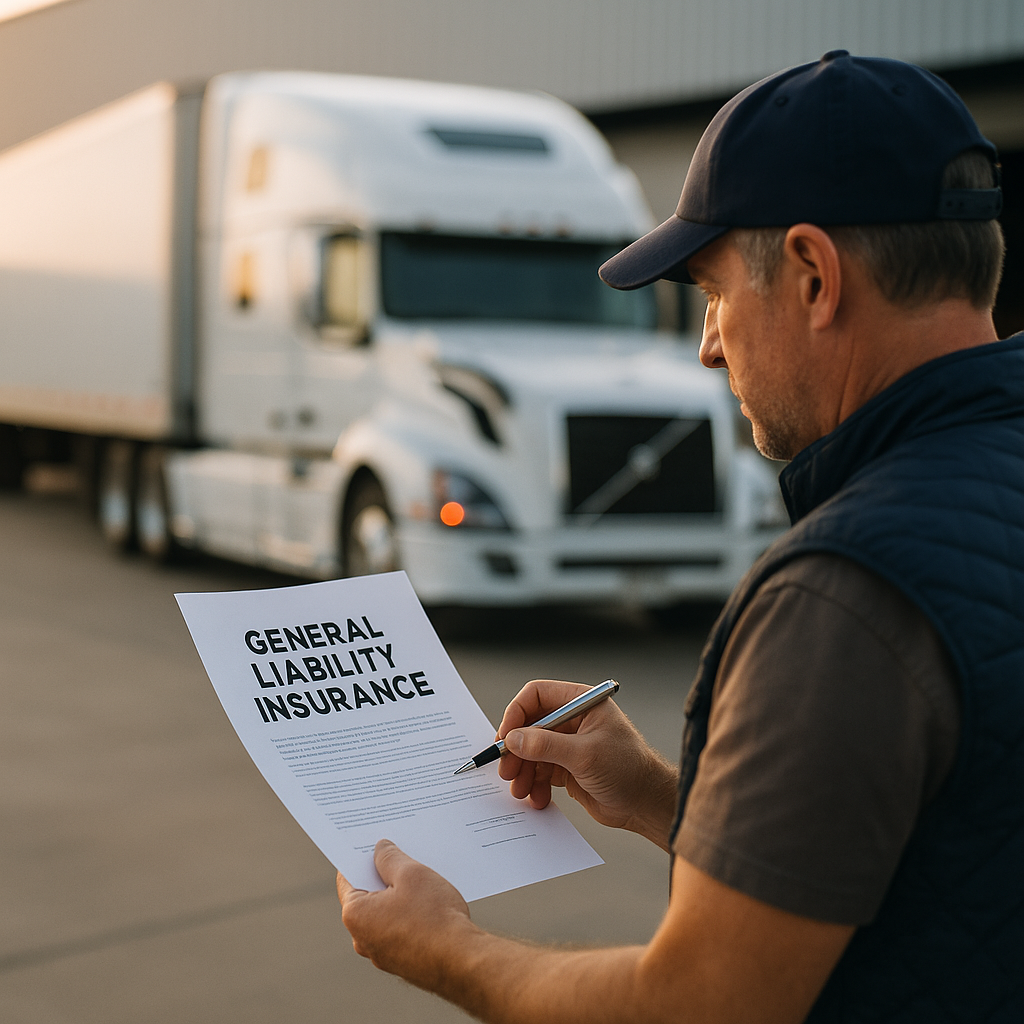
General liability truck insurance protects your trucking business off the road—slip-and-fall, loading claims, and property damage. Learn costs, limits, and requirements. Get a quote.
General liability truck insurance covers off-the-road business risks like customer injuries (slip-and-fall), third-party property damage at a dock or jobsite, and certain personal/advertising injury claims—not auto accidents on the highway. If you run under your own authority, it’s one of the cleanest ways to keep one dumb “yard incident” from turning into a cash-flow emergency.
Owner-operators don’t lose sleep over insurance theory—you lose sleep because one claim can freeze your business: missed loads, broker issues, and hours of paperwork instead of revenue miles. This guide breaks down what GL actually does in trucking, when shippers and brokers ask for it, typical limits, what it costs in 2026, and how to avoid the policy wording gaps that cause nasty surprises.
Key Takeaways: Essential General Liability Truck Insurance
- General liability is “off-the-road” protection: It handles slip-and-falls, dock/jobbyard property damage, and certain legal claims—not truck crashes (that’s auto liability).
- Usually not required by FMCSA, but often required by contracts: Many shippers, warehouses, and brokers want to see $1,000,000 general liability before you touch their freight.
- Cost is typically low compared to the risk: Many owner-operators see GL priced as a smaller add-on compared to semi truck insurance—especially with clean operations and organized COIs.
- The wrong policy wording can leave gaps: Loading/unloading, additional insured wording, and exclusions are where people get burned.
Table of Contents
Reading time: 8 minutes
- What Does General Liability Truck Insurance Cover (and Not Cover)?
- General Liability vs Auto Liability (Why Brokers Get This Wrong—and You Pay for It)
- Are You Required to Carry General Liability as a Trucker? (FMCSA vs Real Life)
- How Much Does General Liability Truck Insurance Cost in 2026?
- Coverage Limits Most Shippers Ask For (and What to Choose)
- Endorsements and Add-Ons That Actually Matter (Avoid the “Cheap Policy” Trap)
- Real Claim Scenarios (What Gets Paid vs What Gets Denied)
- Frequently Asked Questions
- The Logrock Difference: Trucking Insurance Built for Owner-Operators
- Conclusion & Get a Trucking Insurance Quote That Covers the “Dock Risks” Too
What Does General Liability Truck Insurance Cover (and Not Cover)?
General liability (GL) truck insurance is a commercial liability policy that pays for covered third-party bodily injury, third-party property damage, and related legal defense arising from your business operations when the claim is not caused by operating the truck on public roads.
1) What It Covers (Real-World Trucking Scenarios)
Plain-English definition: GL is for “business operations” claims—yard, dock, facility, and jobsite losses—where someone says your company caused an injury or damage off the roadway.
- Bodily injury (third party): A receiver trips over your straps or load securement you set down near the dock.
- Property damage (third party): You crack a customer’s glass door with a pallet jack or tag a bollard while moving equipment in a yard.
- Personal & advertising injury (limited): Certain libel/defamation-type claims (not common in trucking, but often included in many GL forms).
- Medical payments (often small limits): “Goodwill” payments for minor injuries without admitting fault (availability and limits depend on the policy).
These claims are usually small enough to happen often and big enough to wreck a month’s profit—especially once attorneys get involved.
Who typically needs it: owner-operators under their own authority, small fleets, and hotshot operators doing jobsite deliveries (construction yards are claim factories).
2) What General Liability Does NOT Cover (Common Misunderstandings)
- Auto accidents / on-road crashes: That’s primary auto liability, not GL.
- Damage to your own truck or trailer: That’s physical damage (comprehensive/collision).
- Cargo claims (freight damage): That’s motor truck cargo coverage.
- Employee injuries: That’s typically workers’ comp (or occupational accident, depending on your structure and state rules).
- Professional mistakes: “Professional liability / E&O” is separate if your contracts require it.
General Liability vs Auto Liability (Why Brokers Get This Wrong—and You Pay for It)
Primary auto liability applies to injuries and property damage caused by operating your truck on public roads, while general liability applies to non-auto business operations claims at docks, yards, and facilities.
A lot of customers say, “We have $1M liability,” and a shipper replies, “Not that—general liability.” They’re talking about two different buckets of risk.
| Coverage Type | What It’s For | Example Claim | Usually Required By |
|---|---|---|---|
| Primary Auto Liability | Injury/property damage from operating the truck on public roads | You rear-end a passenger vehicle in traffic | FMCSA filing requirements + brokers |
| General Liability Truck Insurance | Business operations claims not caused by driving | Slip-and-fall at dock; damage inside a facility | Warehouses, shippers, some brokers |
| Motor Truck Cargo | Freight loss or damage | Load shifts and products arrive damaged | Brokers/shippers almost always |
Pro tip (veteran advice): If a facility wants to be listed as Additional Insured on your GL certificate, don’t wing it. Get the entity name and endorsement wording right or you’ll be stuck in back-and-forth while your truck sits (and sitting is negative CPM). If you need help with certificates, see Certificates of Insurance (COIs) for owner-operators.
Are You Required to Carry General Liability as a Trucker? (FMCSA vs Real Life)
FMCSA generally requires motor carriers to maintain primary auto liability (and certain filings), but it does not typically require general liability insurance for standard interstate trucking operations.
- FMCSA / federal focus: Auto liability (and filings like BMC-91X/92 depending on operation) plus commodity-specific rules for certain hauls.
- Real-life contracts: Many shippers, receivers, warehouses, and some brokers require GL to protect premises risk and reduce dock disputes.
- Leased-on scenarios: Some carriers or leases require GL based on their customer agreements.
Bottom line: Even when it’s not “required,” GL can be load-access insurance. No GL often means fewer doors open.
How Much Does General Liability Truck Insurance Cost in 2026?
In 2026, many owner-operators see general liability truck insurance priced around $40–$125 per month, with higher-exposure operations often landing $125–$250+ per month depending on limits, endorsements, and loss history.
GL is often one of the more affordable line items in a commercial truck insurance program, but pricing still depends on how and where you operate.
Typical 2026 Cost Ranges (Owner-Operator Reality)
- Many owner-operators: roughly $40–$125/month (often billed as part of a package)
- Higher-risk operations: $125–$250+/month (more jobsite exposure, higher foot traffic, specialized work)
- Annualized ballpark: $500–$3,000/year depending on limits, endorsements, and loss history
These are real-world ranges—not a promise. Your quote depends on the underwriter’s appetite and your operation details.
What Drives the Price Up (and Down)
- Business type & exposure: hotshot jobsite deliveries vs clean drop-and-hook lanes
- Claims history: prior premises/property claims matter
- Limits & deductibles: higher limits typically raise premium (not always dollar-for-dollar)
- Additional insureds & contract requirements: more COIs and endorsements can add cost
- Operations & radius: more stops and touchpoints usually means more exposure
Cost control tip: If you’re hunting affordable trucking insurance, don’t slash limits blindly. Tighten operations: clean contracts, fewer uncontrolled jobsite activities, better documentation, and consistent COI handling. Underwriters price risk, not just vehicles.
Coverage Limits Most Shippers Ask For (and What to Choose)
A common general liability requirement in trucking contracts is $1,000,000 per occurrence with a $2,000,000 general aggregate, and larger facilities may require higher limits or specific endorsements.
Common limit structures you’ll see:
- $1,000,000 per occurrence / $2,000,000 aggregate (very common)
- $1,000,000 per occurrence / $1,000,000 aggregate (sometimes accepted, sometimes not)
Higher limits are more common when you:
- Work high-traffic facilities with tighter vendor standards
- Do inside delivery or touch freight regularly
- Haul for larger shippers that mandate strict insurance templates
Practical advice: Choose limits based on (1) what your customers require and (2) what a realistic claim could cost in your world. One serious injury claim can go nuclear fast once attorneys get involved.
Endorsements and Add-Ons That Actually Matter (Avoid the “Cheap Policy” Trap)
General liability endorsements—especially Additional Insured and Waiver of Subrogation—are often the difference between a COI that gets accepted the first time and one that gets rejected at the gate.
Not every operation needs every add-on, but these are the usual decision points in trucking.
1) Additional Insured + Waiver of Subrogation (Contract-Driven)
- Why it matters: warehouses and shippers often want protection if they get pulled into a claim
- Where people get burned: wrong entity name, wrong address, or missing endorsement language = rejected COI = lost time and missed appointments
2) Loading/Unloading Exposure (Know Your Role)
If you touch freight—pallet jacks, liftgates, straps/chains, tarps, jobsite handling—you’ve got more GL exposure than a pure drop-and-hook runner.
3) Pollution Liability (Situational, but Serious)
Pollution liability is not automatically included in many GL policies, and some auto policies also contain pollution exclusions. If you haul fluids, hazmat-adjacent commodities, or operate where spill response is expensive, ask your agent about pollution options that match your contracts.
Real Claim Scenarios (What Gets Paid vs What Gets Denied)
General liability may respond to covered dock and premises claims (including legal defense), but it typically will not pay for on-road crashes or cargo damage because those exposures fall under auto liability and motor truck cargo insurance.
Scenario A — Slip-and-Fall at Receiver (Often Covered)
You’re unstrapping at the dock. A warehouse worker trips over equipment placed in a common area and gets injured.
Potential outcome: GL may respond for legal defense and damages, subject to policy terms, exclusions, and who was actually responsible.
Scenario B — You Back Into a Customer’s Parked Trailer (Not GL)
This is a vehicle operation loss.
Potential outcome: typically handled under auto liability (and sometimes physical damage, depending on what was hit and who owns it), not general liability.
Scenario C — Freight Arrives Damaged (Not GL)
Load shifts, product damage happens, receiver rejects it.
Potential outcome: that’s cargo (and contract language), not GL. If you need a refresher, start here: Motor truck cargo insurance basics.
Need general liability that passes broker/shipyard requirements? Logrock quotes trucking insurance like a business tool—built around your lanes, your customers, and your cash-flow reality. We’ll help you set the right GL limits, clean up COIs, and avoid coverage gaps that cause claim denials.
- Fast COIs
- Right limits for your contracts
- No-fluff coverage review
Frequently Asked Questions
General liability truck insurance covers off-the-road business claims like slip-and-fall injuries, third-party property damage at a dock or jobsite, and certain personal/advertising injury allegations, plus legal defense for covered claims. It generally does not cover on-road crashes (auto liability does), cargo damage (motor truck cargo does), or damage to your own truck (physical damage does). If you do touch freight, liftgate work, pallet jack moves, or jobsite deliveries, GL matters more because you have more foot traffic and premises exposure than a drop-and-hook operation.
General liability is usually not required by FMCSA to operate as an interstate motor carrier, because federal compliance focuses on primary auto liability (and required filings) rather than premises liability. In real life, GL is often required by shippers, warehouses, receivers, and some brokers as a contract condition—especially when you’re operating on their property. Think of GL as contract-compliance coverage: without it, you may be turned away or lose access to better freight.
General liability for truckers often costs about $40–$125 per month for many owner-operators, while higher-exposure operations can run $125–$250+ per month depending on limits, endorsements (like Additional Insured), claims history, and how much touch freight or jobsite work you do. When comparing quotes, confirm you’re matching the same limits (for example, $1M per occurrence / $2M aggregate), endorsement wording, and exclusions—because the cheapest monthly payment can be the most expensive denial later.
Brokers and shippers often require general liability, and a very common contract requirement is $1,000,000 per occurrence / $2,000,000 aggregate plus being named as Additional Insured on your GL. If your certificate of insurance (COI) doesn’t match their template—wrong entity name, missing endorsement wording, or incomplete limits—you can lose time at check-in, miss appointments, and risk chargebacks. If you’re also sorting out off-duty coverage gaps, this guide helps: Non-trucking liability vs bobtail insurance.
The Logrock Difference: Trucking Insurance Built for Owner-Operators
Logrock builds trucking insurance programs by matching your lanes, contracts, and certificate requirements to the correct auto, cargo, and general liability coverages so you stay dispatchable and claim-ready.
We’re not here to sell you a policy you don’t need. We’re here to protect your revenue and your authority with commercial truck insurance that fits how you actually run.
- We translate contracts into coverage so your COIs get accepted
- We look for gaps between auto liability, cargo, and general liability (where claims get denied)
- We keep it practical—limits, deductibles, endorsements, and a clean paper trail
Whether you’re running a semi, a one-ton hotshot setup, or building toward a small fleet, the goal stays the same: control risk, protect cash flow, and keep the wheels turning.
Conclusion & Get a Trucking Insurance Quote That Covers the “Dock Risks” Too
General liability truck insurance is the coverage that protects your business when the claim happens outside the cab, and it’s often the difference between an annoying incident and an expensive lawsuit.
If you want affordable trucking insurance without gambling on coverage gaps, get a quote built around your lanes and contracts—and make sure your COIs and endorsements match what customers actually demand.
Key Takeaways:
- General liability covers premises/jobbyard risks, not highway crashes.
- It’s usually contract-required, not FMCSA-required—but it can unlock better freight.
- The best value comes from correct limits + correct endorsements + clean COIs, not the cheapest monthly bill.
Related reading: Motor truck cargo insurance basics, Certificates of Insurance (COIs) for owner-operators, and Non-trucking liability vs bobtail insurance.



