
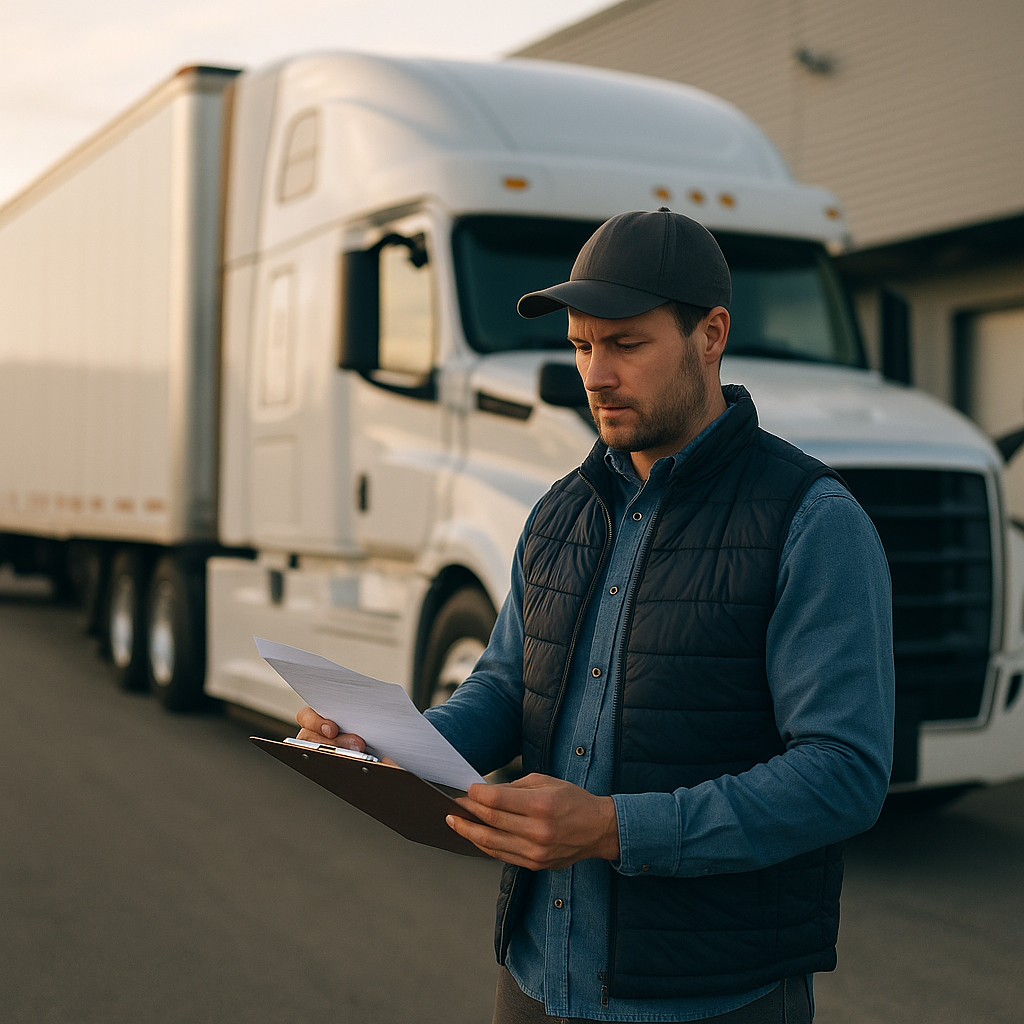

General liability trucking insurance covers off-the-road claims such as dock damage, slip-and-falls, and customer property damage, not truck crashes. Many owner-operators pay roughly $40-$120 per month in 2026 for a $1M per occurrence and $2M aggregate policy. Auto liability often does not respond to these claims.
General liability trucking insurance is the coverage that protects your business from “off-the-road” claims—like dock damage, slip-and-falls, and customer property damage—when it’s not a truck crash situation. In 2026, many owner-operators pay about $40–$120 per month for a common $1M per occurrence / $2M aggregate general liability (GL) policy, depending on operations, payroll, claims history, and endorsements.
As an owner-operator, you can run a clean logbook and still get hit with a claim that has nothing to do with an accident: a damaged dock door, a heated argument that turns into a lawsuit, or a visitor who slips near your work area. The frustrating part is that commercial auto liability (the FMCSA-required coverage) often won’t respond to these non-auto claims—so you’re exposed, or you lose the load because you can’t produce the right COI.
If you’re mapping the full insurance stack (auto, cargo, physical damage, plus the “contract paperwork” pieces), start with this: commercial truck insurance coverage checklist.
Table of Contents
Reading time: 10 minutes
- What Is General Liability Trucking Insurance?
- General Liability vs. Auto Liability vs. Cargo: What’s the Difference?
- Do Owner-Operators Need General Liability Insurance? (When It Matters)
- How Much Does General Liability Insurance Cost for Trucking in 2026?
- State-by-State Reality Check: Requirements vs. Contract Demands
- Real-World Claim Examples (What GL Actually Pays For)
- How to Get Affordable Trucking Insurance Without Cutting Coverage
- Frequently Asked Questions
- The Logrock Difference: Insurance Built for Owner-Operators
- Conclusion & CTA: Get Your GL + Trucking Insurance Quote

What Is General Liability Trucking Insurance?
General liability trucking insurance is a commercial policy that typically provides $1,000,000 per occurrence and $2,000,000 aggregate protection for non-auto claims like third-party bodily injury, third-party property damage, and related legal defense arising from your business operations.
Think “you’re working,” but the problem isn’t a traffic accident. It’s something that happens at a shipper, receiver, yard, terminal, office, or job site—where someone says, “Your business damaged my property,” or “I got hurt because of your operations.”
Where GL fits in your trucking insurance stack
- Separate from primary auto liability: Auto liability is built for vehicle-caused injuries and property damage (crash-type exposures).
- Separate from motor truck cargo: Cargo covers the freight you’re hauling, not the customer’s building or a third party’s injury claim.
- Often requested for paperwork reasons: GL is a common “vendor compliance” item in broker/shipper packets and landlord leases.
If you want the simplest version: GL is the policy that helps when someone alleges your business caused injury or property damage off the road, and you need defense and/or settlement money to keep it from turning into a bigger mess.
General Liability vs. Auto Liability vs. Cargo: What’s the Difference?
FMCSA financial responsibility rules (49 CFR Part 387) require public liability coverage starting at $750,000 for many for-hire interstate carriers hauling non-hazardous property, which is auto liability—not general liability.
This is where new authorities get burned: they assume “liability is liability.” In trucking, it’s not. Each policy is designed for a different kind of claim, and contracts often require multiple coverages at once.
| Coverage | What it’s for | Common trucking examples | Usually required by |
|---|---|---|---|
| Primary Auto Liability | Injury/damage you cause while operating the truck | You hit a passenger vehicle; you rear-end someone; you damage property in a traffic accident | FMCSA + broker/shipper contracts |
| Motor Truck Cargo | Damage to the freight you’re hauling | Load shift, theft, wet damage, reefer breakdown (if endorsed) | Brokers + shippers |
| General Liability (GL) | Off-the-road business liability (non-auto) | Dock door damage; slip-and-fall; customer property damage tied to operations | Shippers/warehouses/landlords (contract-based) |
Where the confusion happens (and costs money)
- Backing claims can get messy: A dock incident might be handled under auto liability in some scenarios, but contractual language and claim facts can push it into a dispute fast.
- GL doesn’t replace auto liability: GL is a gap-filler for non-auto exposures, not a substitute for FMCSA-required auto liability.
- Paperwork wins or loses loads: If a shipper packet demands GL, you can debate the theory—or you can show the COI and keep moving.
Do Owner-Operators Need General Liability Insurance? (When It Matters)
FMCSA does not require general liability insurance to get or keep motor carrier authority, but many broker and shipper contracts require $1,000,000 per occurrence GL (often with Additional Insured) before you can haul.
GL is one of those coverages that feels optional—right up until a customer facility turns you around at the gate or a small incident becomes an attorney letter.
1) You haul under your own authority (common broker/shipper requirement)
- What it means: Your name is on the contract and your MC is on the load.
- Why it matters: A denied claim can turn into withheld pay, chargebacks, or getting removed from a shipper’s approved carrier list.
- Who typically needs GL: New authorities, small fleets, and anyone pursuing direct shipper freight or larger broker networks.
2) You enter facilities that demand a COI
Warehouses, distribution centers, ports, and construction sites commonly require a COI showing:
- General liability limits (often $1M/$2M)
- Additional Insured (so they’re protected under your policy for certain claims)
- Waiver of Subrogation (sometimes requested to reduce post-claim finger-pointing)
If you show up without the right COI wording, you can lose hours—or lose the appointment entirely. That’s deadhead plus lost revenue.
3) You have a yard, a small terminal, or even a home office setup
Slip-and-fall exposure is real anytime people interact with your business location or equipment. Landlords also commonly require GL in the lease when you rent office or yard space.
4) You run hotshot loads or mixed operations
Hotshot programs often focus on auto + cargo, but GL still matters when you’re loading/unloading, working around customer property, or operating on job sites.
If you’re pulling a gooseneck or doing mixed-use work, review: hotshot insurance essentials.
How Much Does General Liability Insurance Cost for Trucking in 2026?
In 2026, general liability trucking insurance typically costs about $40–$120 per month for many owner-operators purchasing $1M per occurrence / $2M aggregate, while higher limits and higher-exposure operations can push pricing closer to $90–$200+ per month.
Compared to auto liability, GL is usually a smaller line item—but it can solve big contract problems and protect you from business-risk claims that don’t involve a crash.
2026 cost benchmarks (realistic ranges)
- Owner-operator (no employees): often ~$40–$120/month
- Small fleet (employees/drivers): typically higher due to payroll and exposure
- Higher-risk operations: more job-site work, more loading/unloading, or specialty work can raise the premium
| GL Limit | Typical use case | Common 2026 price range (owner-op) |
|---|---|---|
| $1M / $2M | Most broker/shipper packets | ~$40–$120/month |
| $2M / $4M | Larger customers and stricter vendor requirements | ~$90–$200+/month |
What moves your GL price the most
- Claims history: even “small” claims can affect pricing and eligibility
- Business setup: payroll and use of helpers/employees changes exposure
- Operations: job sites, towing-related work, and higher-risk activities typically cost more
- Endorsements and contract terms: Additional Insured and Waiver of Subrogation are common requests, and your policy needs to match the packet
Contract reality: If your customer demands GL on the COI, the “right” limit is the one that matches the contract—so you can book the freight and get through the gate without delays.
State-by-State Reality Check: Requirements vs. Contract Demands
General liability insurance is usually not mandated by state trucking law for most carriers, and it is not required by FMCSA, but it is frequently required by contracts (brokers, shippers, warehouses, and landlords) to access freight and facilities.
In other words: legal requirements set the floor, but contracts set the day-to-day rules that decide whether you get loaded.
| State | Is GL legally required for most trucking companies? | What commonly drives GL demand? | Practical takeaway |
|---|---|---|---|
| Texas (TX) | Usually no (varies by operation) | Oilfield/construction sites, warehouses, shipper contracts | If you touch job sites, expect GL requirements |
| California (CA) | Usually no (varies by operation) | Ports/terminals, strict vendor compliance, large 3PL packets | Have COIs ready; facilities often enforce paperwork |
| Florida (FL) | Usually no | Freight brokers, warehouses, landlord leases | GL is often a “ticket to play” for better contracts |
| Illinois (IL) | Usually no | DC networks and 3PL compliance | GL reduces contract friction and wasted time |
| Colorado (CO) | Usually no | Construction exposure, facility requirements | GL is commonly contract-required, not state-required |
Bottom line: Shop GL like a contract tool that keeps you moving—not a checkbox you buy once and forget.
Real-World Claim Examples (What GL Actually Pays For)
General liability claims in trucking most often involve third-party property damage, third-party bodily injury, and legal defense arising from day-to-day operations at customer facilities, yards, or offices—subject to policy terms, conditions, and exclusions.
GL feels optional until a normal workday turns into a bill, a demand letter, or a lawsuit.
1) You damage a dock door or building while working
- Scenario: You’re handling equipment, walking a dock, or operating around a customer’s property and something gets damaged.
- What happens next: The customer invoices you, and if it isn’t paid quickly, it can escalate to collections or legal demand.
- GL role: GL can respond to certain property damage claims tied to operations (depending on facts and wording).
2) Slip-and-fall while you’re onsite (or at your yard)
- Scenario: A shipper employee, visitor, or vendor slips near your work area and alleges your business created the hazard.
- GL role: GL can cover covered bodily injury claims and legal defense costs, subject to exclusions and investigation.
3) You spill fuel/oil/DEF and create cleanup costs
- Scenario: A minor spill leads to cleanup costs and possibly downtime allegations.
- Why it’s tricky: Many GL forms include pollution exclusions, and coverage may require specific endorsements depending on exposure.
- Best move: If a contract has environmental language, ask your agent to confirm how your policy responds in writing.
4) Personal and advertising injury (less common, still real)
Many GL policies include “personal and advertising injury,” which can apply to certain claims involving reputation, communications, or marketing-related disputes. It’s not the most common trucking claim, but it’s part of what makes GL a broader business policy.
How to Get Affordable Trucking Insurance Without Cutting Coverage
Affordable trucking insurance comes from matching limits and endorsements to your contracts and removing avoidable exposures, not from buying the cheapest policy with the wrong class code or missing COI language.
1) Bundle smart (but don’t blind-bundle)
Bundling GL with other coverages can reduce headaches and sometimes improve pricing—especially when you also need physical damage, cargo, and other policies.
If off-duty use is part of your setup, read: Non-Trucking Liability vs. Bobtail insurance.
2) Get COIs and endorsements tight (this prevents gate rejections)
Many “insurance problems” in trucking are really paperwork problems. A COI that doesn’t match the packet can cost you hours.
- Entity name mismatch: LLC vs DBA vs personal name
- Missing Additional Insured: the facility won’t accept the certificate
- Wrong limits displayed: contract says $1M/$2M, COI shows something else
- No Waiver of Subrogation: when the contract requires it
3) Choose limits based on contracts, not fear
- If your customers require $1M/$2M, don’t pay for $2M/$4M “just because.”
- If you’re targeting larger accounts with higher limit requirements, price that cost into your rates (or pass on the freight).
4) Reduce exposure with simple, owner-operator-friendly process
- Photo habit: Take timestamped pickup/delivery photos, including existing dock or property damage.
- Quick notes: If anything happens, note date/time, who you spoke with, and what was said.
- Clear boundaries: Don’t touch customer equipment unless asked and it’s safe to do so.
Frequently Asked Questions
No, truckers do not always need general liability insurance by law, but many carriers need it to meet broker, shipper, warehouse, or landlord requirements—most commonly $1,000,000 per occurrence / $2,000,000 aggregate shown on a COI. FMCSA focuses on auto liability for crash-related claims, while GL is used for off-the-road exposures like dock/property damage allegations and slip-and-fall claims. If you’re leased on to a motor carrier, check the lease and their COI rules because some carriers provide GL and some push that requirement back to the owner-operator.
In 2026, general liability trucking insurance commonly costs about $40–$120 per month for many owner-operators buying a $1M per occurrence / $2M aggregate policy. Pricing can increase with employees and payroll, higher-risk operations (job sites, frequent loading/unloading), prior claims, and stricter contract endorsements (like Additional Insured or Waiver of Subrogation). GL is usually cheaper than auto liability, but it’s often the coverage that fixes contract issues and prevents gate turnarounds when a facility demands a compliant COI before loading.
General liability covers certain non-auto claims—such as third-party bodily injury (like a slip-and-fall) and third-party property damage tied to business operations—while auto liability is designed for injuries or property damage caused by operating the truck (crash-type exposures). Both policies can include legal defense for covered claims, but they respond to different triggers. If a claim happens at a dock or facility, the facts and contract language can affect whether it’s treated as auto-related or operations-related, which is why many carriers carry both.
No, general liability insurance is not required by FMCSA for most trucking authorities. FMCSA financial responsibility requirements focus on public (auto) liability under 49 CFR Part 387, with minimums that commonly start at $750,000 for many for-hire interstate carriers hauling non-hazardous property (and higher limits for certain hazardous materials). General liability is usually required by contracts—brokers, shippers, warehouses, and landlords—because they want protection for non-auto incidents like onsite injuries or property damage allegations tied to your operations.
Many brokers and shippers commonly require $1,000,000 per occurrence and $2,000,000 aggregate general liability, plus a COI showing Additional Insured for the broker/shipper or facility. Larger accounts can require higher limits (such as $2M/$4M), especially for job-site exposure, specialty operations, or strict vendor compliance programs. The practical play is to match your GL limits and endorsements to the exact packet language, so you don’t overbuy limits you can’t recover in your rate—and you don’t underbuy and lose the account.
The Logrock Difference: Insurance Built for Owner-Operators
Owner-operators typically need GL, cargo, and auto liability to work together without coverage gaps, certificate delays, or mismatched endorsements that trigger rejected broker packets.
Logrock is built for the way you actually operate:
- Coverage that lines up: We help structure your commercial truck insurance so GL, cargo, and auto aren’t fighting each other when a claim happens.
- COI support: Fast COIs and cleaner paperwork so you’re not stuck at a facility over missing Additional Insured wording.
- Straight talk: You’ll get real guidance on limits, endorsements, and exclusions based on how you run.
If you’re building the full stack (auto + cargo + physical damage), start here: semi truck insurance options.
Conclusion & CTA: Get Your GL + Trucking Insurance Quote
General liability trucking insurance is not FMCSA-required, but it’s commonly contract-required at $1M per occurrence / $2M aggregate and often costs $40–$120 per month for many owner-operators—cheap compared to one off-the-road claim or a lost contract.
GL is the policy that keeps a small onsite incident from becoming a big business hit, and it helps you meet the COI requirements that keep freight moving.
Key Takeaways:
- GL covers off-the-road claims (dock damage allegations, slip-and-fall, some legal defense), not highway crashes.
- It’s usually contract-driven (brokers/shippers/warehouses/landlords), even though it isn’t federally mandated like auto liability.
- Match limits to the packet (often $1M/$2M) so you don’t overpay—or show up with the wrong COI and lose the load.
If you want GL set up the right way—limits and endorsements that match your real contracts—get a quote and we’ll help you tighten the whole program.





