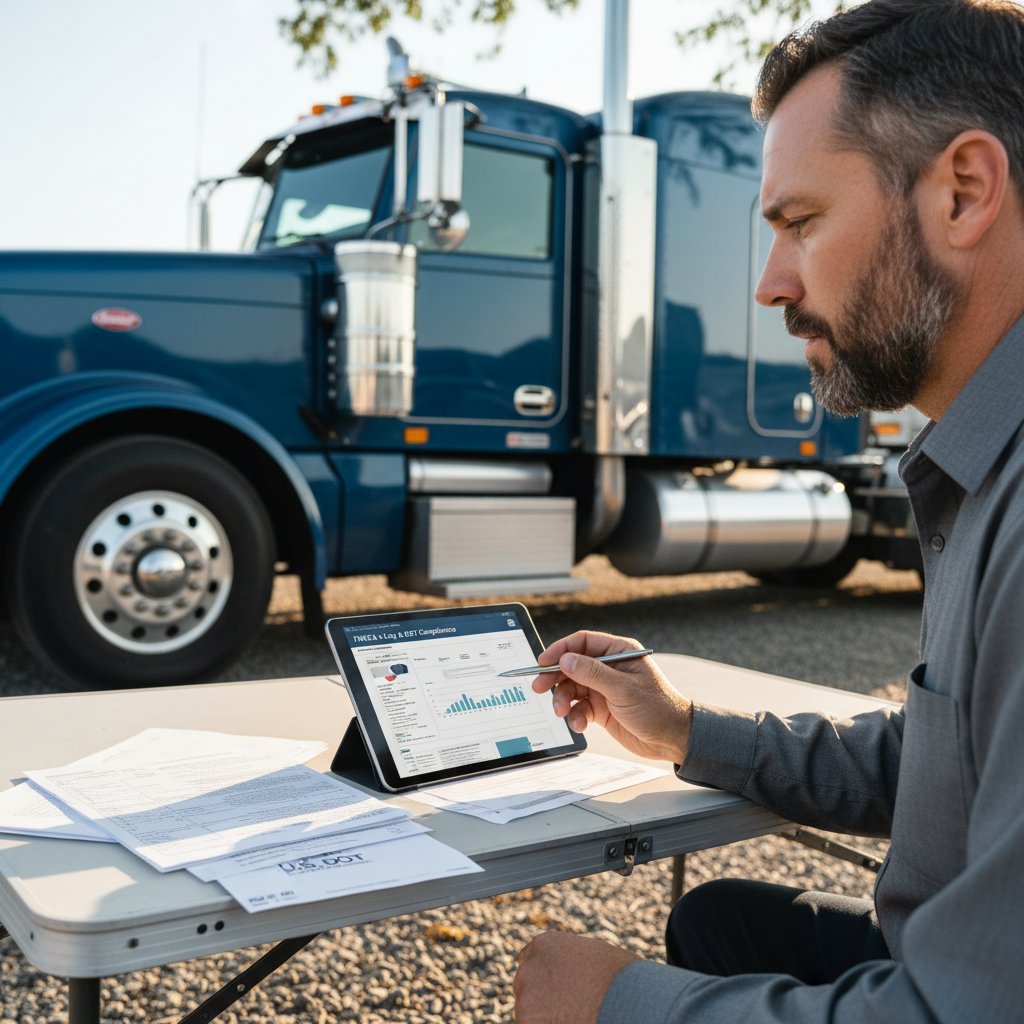
Insurance for owner operator truckers in 2026: required coverages, real monthly costs, FMCSA filings, and proven ways to cut premiums. Get a quote.
Insurance for owner operator truckers isn’t “just a bill” in 2026—it’s the gatekeeper to loads, broker packets, and cash flow. Most owner-operators need commercial truck insurance built around auto liability, cargo insurance, and physical damage, then add-ons like bobtail/non-trucking liability, general liability, trailer interchange, or occupational accident based on how they operate.
Before you chase a low rate, compare “legal minimum” vs. “freight-ready” limits using this baseline on insurance requirements for owner-operators, because a COI mismatch can park your truck even if you paid the premium.
Key Takeaways: Essential Insurance for Owner Operator Truckers
- Your operation determines the stack: leased-on vs. own authority changes what’s primary—and what gaps you still own.
- Brokers set the practical minimums: you can be legal and still be unbookable if your COI doesn’t match broker requirements.
- Budget using a range: new ventures, long radius, and certain cargo types can push premiums fast.
- Paperwork is part of the policy: filings (BMC forms), MCS-90, and COIs are operational, not optional.
Table of Contents
Reading time: 9 minutes
- Insurance Basics: Leased-On vs. Own Authority
- Coverage Stack: What to Carry (and Why)
- 2026 Costs: Real Ranges + How to Keep It Affordable
- Filings & COIs: BMC-91/91X, MCS-90, and Broker Packets
- Frequently Asked Questions
- Why Logrock: Practical Help for Busy Owner-Operators
- Conclusion: Get Freight-Ready Coverage (Without Overpaying)
Coverage Stack: What to Carry (and Why)
FMCSA requires for-hire motor carriers to meet federal financial responsibility minimums that commonly start at $750,000 for non-hazardous property carriers (49 CFR §387.9), and many brokers practically require $1,000,000 auto liability to book freight.
Think in stacks, not single policies. Your goal is simple: (1) stay legal, (2) stay bookable, and (3) stay solvent after a loss.
For a deeper cost-and-coverage view specific to semi trucks, see owner-operator semi truck insurance costs.
Coverage Stack Cheat Sheet (who requires it)
| Coverage | What it protects | Usually required by | “Gotcha” to watch |
|---|---|---|---|
| Auto Liability (Primary) | Injuries/damage you cause to others | FMCSA/state + brokers | “Minimum legal” may not meet broker packet |
| Cargo | Freight you’re hauling | Brokers/shippers | Exclusions (reefer spoilage, unattended, improper securement) |
| Physical Damage (Comp/Collision) | Your truck | Lender/lease + you | Deductible too low can inflate premium |
| General Liability | Off-truck incidents (loading dock, premises) | Some brokers/warehouses | Not the same as auto liability |
| Bobtail / Non-Trucking Liability | Off-dispatch liability | Often leased-on contracts | Definitions vary; confirm trigger |
| Trailer Interchange | Non-owned trailer physical damage | If you sign interchange agreement | Needed only if you’re responsible for trailer |
| Occupational Accident | Your injury benefits | Carrier/lease contract | Benefits vary a lot; read the schedule |
3) Primary Liability: the “can’t run without it” coverage
What it is: The core of commercial truck insurance that pays for bodily injury and property damage you cause to others.
Why it’s essential: One at-fault crash with a passenger vehicle can wipe out years of profit, and it can also threaten your ability to keep operating.
Who needs it: Everyone operating commercially.
4) Cargo insurance: the “freight access” coverage
What it is: Coverage for freight you’re contractually responsible for if it’s damaged or stolen.
Why it’s essential: Many brokers won’t tender loads without it, especially higher-value commodities and lanes.
Who needs it: Anyone hauling freight where the contract puts cargo responsibility on the carrier.
Common problem areas to review before you sign:
- Unattended vehicle limitations (parking reality vs. policy language)
- Reefer spoilage: often requires a specific endorsement
- Improper securement and wear/tear exclusions
5) Physical damage: protect the asset that makes you money
What it is: Comprehensive and collision coverage on your tractor (and sometimes scheduled equipment).
Why it’s essential: A totaled unit can kill cash flow, especially if you’re financed.
Who needs it: Most owner-operators who own or finance their truck.
Deductible strategy (business-first): If you can’t write the deductible check the same day, you picked the wrong deductible.
2026 Costs: Real Ranges + How to Keep It Affordable
In 2026, many single-truck owner-operators with their own authority see commercial truck insurance packages quoted at roughly $750 to $2,500+ per month per truck, depending on state, radius, cargo, experience, vehicle value, and loss history.
Owner-operators get burned when they budget insurance like it’s a flat number. Insurance is a risk-priced operating cost—like fuel, it moves based on how you run.
6) What owner-operator trucking insurance costs per month (realistic ranges)
- Leased-on owner-operator (supplemental coverages): often lower out-of-pocket, depending on what the carrier provides (physical damage + NTL/bobtail + occ/acc, etc.).
- Own authority (full stack): commonly $750 to $2,500+ per month per truck depending on state, cargo, radius, experience, truck value, filings, and loss history.
If your goal is to lower premium without breaking COI requirements, start with affordable trucking insurance in 2026.
Quick cost scenarios (so you can budget cash flow)
| Scenario | Operation | What usually drives price |
|---|---|---|
| New authority, OTR, general freight | Full stack | New venture surcharge + radius + limited history |
| Established authority, regional | Full stack | Better markets open up with clean loss runs |
| Leased-on, off-dispatch exposure | Supplemental | NTL/bobtail definitions + physical damage value |
| Hotshot (pickup + trailer) | Commercial | Cargo type + radius + vehicle class + claim frequency |
7) Keeping premiums down without creating coverage gaps
Underwriters don’t reward “cheap”—they reward predictable.
- Match radius to reality: Don’t claim local then run OTR; that can become a claim problem.
- Keep continuous coverage: Lapses are premium rocket fuel.
- Pick deductibles you can fund: Higher deductibles can help, but only if you can pay them fast.
- Bring clean data: MVR, inspections, claims, and a clear operation description all matter.
If you’re shopping for the lowest number, read cheapest commercial auto insurance (2026) for trucking first—the goal is lower premium without weakening your COI or buying a policy that won’t respond the way you think.
Filings & COIs: BMC-91/91X, MCS-90, and Broker Packets
FMCSA for-hire authority is not considered compliant unless required liability proof is filed by the insurer (typically via BMC-91 or BMC-91X) and the carrier’s process agents filing (BOC-3) is on record.
Insurance is only “real” to the FMCSA and brokers when the paperwork is right.
8) Filings (plain English) and why they stop trucks
- BMC-91 / BMC-91X: Liability filing submitted by your insurer to the FMCSA to prove financial responsibility for authority-holders.
- MCS-90: An endorsement attached to many motor carrier liability policies; it’s not “extra coverage,” and it has rules every authority-holder should understand at a high level.
- COI (Certificate of Insurance): What brokers/shippers request for onboarding. Wrong limit, wrong name, wrong holder—no load.
- BOC-3: Not insurance, but commonly confused with it; it’s your process agent filing.
9) Step-by-step: how to avoid the “my authority isn’t active” mess
If you’re getting authority (or restarting), timing matters—use FMCSA authority application prep to line up your insurance bind, filings, and go-live date.
Operational checklist:
- Define your operation (cargo, states, radius, trailer type, drivers).
- Bind the right limits (don’t bind “minimum legal” if your brokers require higher).
- Confirm filings were submitted (don’t assume the clock starts when you pay).
- Build a COI routine (who requests, turnaround time, certificate holders).
- Re-check at renewal (limits, endorsements, garaging, radius, VINs).
10) Broker packet “freight-ready” checklist (typical)
What brokers commonly want to see (varies by broker and shipper):
- $1,000,000 auto liability (common practical minimum)
- Cargo limits that match the freight you target
- General liability (sometimes requested for certain facilities/contracts)
- Trailer interchange (if you’re responsible for non-owned trailers under agreement)
- COI matches legal entity name and shows correct effective dates
Pro tip: Your insurance stack is part of your sales process. A clean COI gets you booked faster.
Frequently Asked Questions
Most owner-operators need auto liability, cargo insurance, and physical damage to operate like a freight-ready business, and many brokers expect $1,000,000 liability on the COI even when the legal minimum is lower.
If you’re leased-on, the carrier may provide primary liability while under dispatch, but you may still need bobtail/non-trucking liability and occupational accident depending on your contract. If you run your own authority, you’re responsible for the full stack plus filings and COIs, so use insurance requirements for owner-operators to confirm you’re both legal and bookable.
In 2026, many owner-operators with their own authority commonly see commercial truck insurance quoted around $750 to $2,500+ per month per truck, with new ventures, long-haul radius, high-value cargo, and poor loss history pushing the price higher.
The monthly number depends on state, garaging ZIP, cargo class, operating radius, truck value, driver experience, violations, and claims. When you compare quotes, match the limits and deductibles exactly (especially liability and physical damage deductibles), and sanity-check your plan against affordable trucking insurance in 2026 so you don’t “save” money by buying a stack that blocks loads.
Leased-on owner-operators often have primary auto liability provided by the carrier while under dispatch, but they’re still commonly required to carry coverages like physical damage and non-trucking liability for off-dispatch exposure.
Owner-operators with their own authority are responsible for the full coverage stack plus filings and COIs, including insurer-submitted filings (commonly BMC-91/BMC-91X) tied to authority compliance. The practical difference is operational: with your own authority, your insurance isn’t “set it and forget it”—it’s part of dispatch, broker onboarding, and renewal planning. If you’re uncertain, compare like-for-like using owner-operator semi truck insurance costs as a checklist for what should be included.
Owner-operators can reduce insurance costs without losing loads by keeping continuous coverage (no lapses), using an accurate radius and cargo classification, choosing deductibles they can actually fund, and maintaining clean MVR/inspection history—because underwriters price predictability.
Cost-cutting that breaks a broker packet usually shows up as the wrong limits on the COI (often liability below $1,000,000) or missing coverages like cargo or general liability when a facility requires it. For a practical playbook that focuses on “cheaper and still bookable,” read cheapest commercial auto insurance (2026) for trucking.
Why Logrock: Practical Help for Busy Owner-Operators
Insurance pricing can swing by thousands per year for the same truck when details like radius, garaging, cargo class, deductibles, and filings are entered differently, so apples-to-apples quote comparisons are one of the fastest ways to avoid overpaying.
You don’t need a motivational speech—you need a coverage stack that keeps your truck moving, clears broker packets, and doesn’t waste premium on stuff that won’t pay when you need it.
That’s why we focus on:
- Quote comparisons that are actually apples-to-apples
- Operation-matched coverage (radius, cargo, authority type)
- COI-ready limits so you’re not scrambling at dispatch time
If you’re a one-truck business, use best insurance for one-truck owner-operators as your shopping checklist—because the cheapest policy is worthless if it blocks freight or denies claims.
Conclusion: Get Freight-Ready Coverage (Without Overpaying)
Insurance for owner operator truckers works best when your coverage stack matches your operation, your limits meet broker expectations (often $1,000,000 liability), and your filings and COIs are accurate from day one.
Buy what keeps you bookable, protect the truck that makes you money, and treat filings/COIs like part of operations—because they are.
Key Takeaways:
- Build your stack around liability + cargo + physical damage, then add only what your operation truly needs.
- Budget using ranges, and expect new authority to cost more upfront in many markets.
- Keep paperwork tight: filings and COIs can shut you down faster than a breakdown.
Related reading: affordable trucking insurance in 2026 and FMCSA authority application prep.