
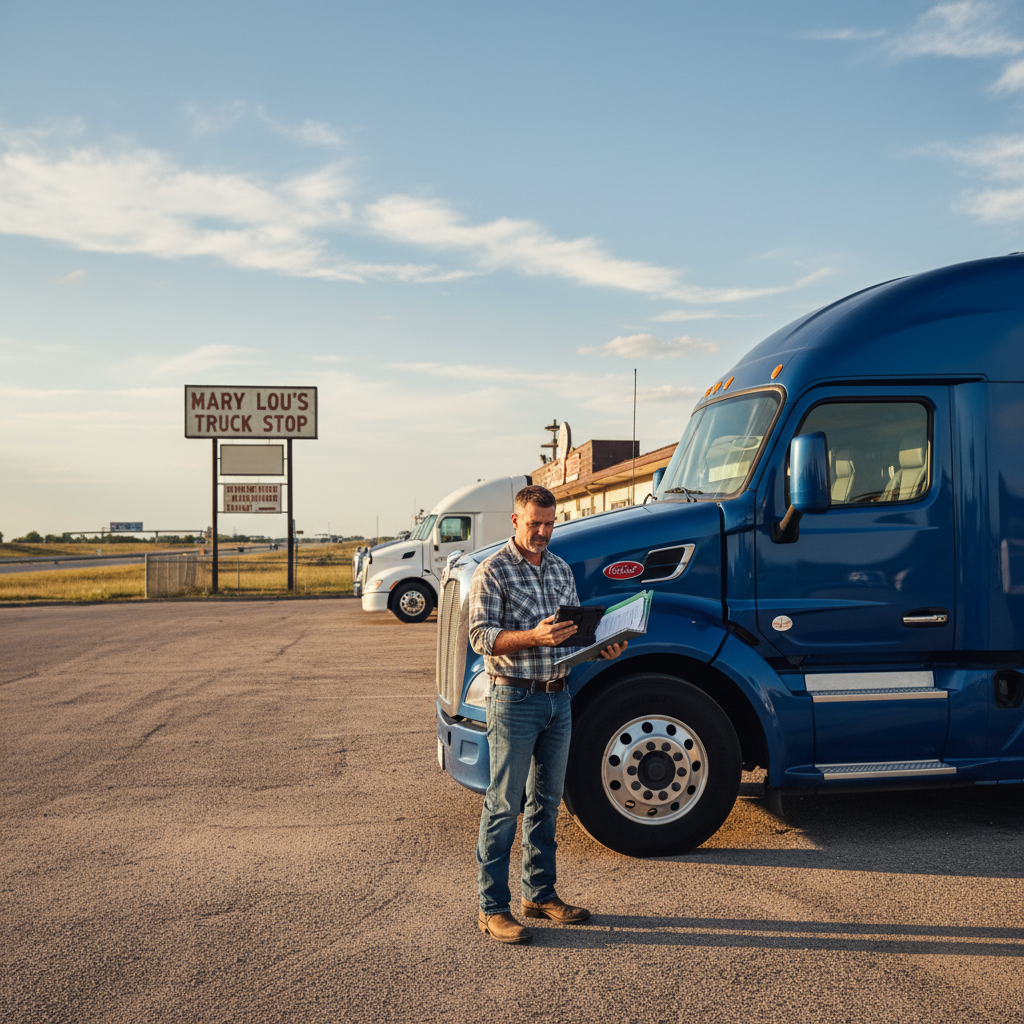

Learn what occupational accident (Occ/Acc) insurance covers for truckers, typical 2026 costs, contingent liability, state considerations, and workers’ comp differences.
If you’re a 1099 driver, occupational accident insurance for truckers is often the difference between a short setback and a cash-flow problem that snowballs. One slip on an icy catwalk or a shoulder injury while tarping can sideline you fast—and your truck note doesn’t pause.
Featured snippet answer: Occupational accident (Occ/Acc) insurance for truckers is an accident-benefit plan that typically helps pay medical bills, weekly disability income, and accidental death & dismemberment (AD&D) after a covered work-related accident. It’s not the same as workers’ compensation, and benefits depend on plan limits, covered activities, deductibles, and exclusions.
This guide breaks down what Occ/Acc usually covers, what it doesn’t, how it compares to workers’ comp, what it can cost in 2026, and how to buy it without getting surprised by fine print. For the bigger picture, see The Owner-Operator’s Insurance Checklist: 6 Critical Coverages Explained.
Key Takeaways: Essential Occupational Accident Insurance for Truckers
- Occ/Acc protects your income, not your authority: It can help with medical and disability after an accident, but it’s not a substitute for required trucking filings like auto liability.
- Limits and definitions matter more than the price: “Covered activity,” waiting period, and max weekly disability benefit decide whether you can keep paying expenses.
- Workers’ comp rules are state-driven: Occ/Acc may fit an independent contractor model, but it usually doesn’t satisfy workers’ comp requirements for employees.
- Buy it like a CFO: Choose benefits based on your real weekly take-home and fixed costs—not what’s “affordable” this month.
Table of Contents
Reading time: 9 minutes
- What Is Occupational Accident (Occ/Acc) Insurance for Truckers?
- What Occupational Accident Insurance Typically Covers (Benefits Breakdown)
- What Occ/Acc Usually Does NOT Cover (Common Exclusions Truckers Miss)
- Occupational Accident vs. Workers’ Compensation: Can It Replace Workers’ Comp?
- How Much Does Occupational Accident Insurance Cost for Truckers in 2026?
- Who Needs Occupational Accident Insurance? (Owner-Operators, Hotshot, and Small Fleets)
- Is Occupational Accident Insurance Required by Law? (State-by-State Considerations)
- Contingent Liability & Real-World Claim Scenarios (Why It Matters)
- How to Choose the Best Occupational Accident Insurance Plan (Buying Checklist + Carrier Comparison Template)
- Frequently Asked Questions
- The Logrock Difference: Insurance Built for Business Owners
- Conclusion: Protect Your Income If You Get Hurt on the Road
What Is Occupational Accident (Occ/Acc) Insurance for Truckers?
Occupational accident (Occ/Acc) insurance for truckers is an accident-benefit policy commonly used for 1099 and leased-on independent contractors that pays scheduled benefits (medical, disability income, and AD&D) after a covered work-related accident.
Plain-English definition
Think of Occ/Acc as a benefit plan that kicks in when you’re hurt while doing covered work tasks. It’s designed to help keep you afloat financially while you’re dealing with the injury.
- What it is: A scheduled benefit plan (medical + disability + AD&D) for injuries from a covered accident while working.
- What it isn’t: Not primary auto liability, not a federal filing, and not the same as workers’ compensation.
Who it’s built for (and who it’s not)
- Usually built for: Leased-on owner-operators, 1099 contractors, and small fleets using an independent contractor model.
- Usually not for: True employee drivers who should be covered under a state workers’ comp policy.
Business reality: if you’re an IC and you get sidelined, your truck payment still comes due. Occ/Acc is one way to keep a bad week from turning into a long-term money problem.
What Occupational Accident Insurance Typically Covers (Benefits Breakdown)
Most occupational accident insurance plans for truckers bundle three core benefits—medical expense, weekly disability income, and AD&D—each capped by stated limits (for example $25,000–$2,000,000 medical and $250–$1,500+/week disability).
Medical expense benefit
This benefit helps pay medical costs after a covered accident—ER, hospital, surgery, ambulance, follow-ups—subject to the plan’s rules.
- Per-accident medical limit: Example ranges can run from $100,000 to $1,000,000+ depending on the tier.
- Deductible: Some plans have one; some don’t.
- Network rules: PPO-style networks may pay very differently in-network vs. out-of-network.
Out-of-network bills can turn into balance billing fast if the plan is tight on allowed amounts.
Disability income (temporary & permanent)
This is the “I can’t work, but the bills still hit my account” part of Occ/Acc.
- Elimination period / waiting period: Common options include 7, 14, or 30 days before checks start.
- Weekly max benefit: Common ranges are $500/week, $1,000/week, or $1,500/week.
- Max duration: Often 52 weeks or 104 weeks, depending on plan design.
Practical tip: Pick the weekly benefit based on your fixed costs (truck, insurance, rent/mortgage, utilities) plus your personal baseline—not hope.
Accidental death & dismemberment (AD&D)
AD&D pays a lump sum for severe outcomes (death, loss of limb, loss of sight, and other defined losses).
Always review the schedule of loss—that’s where “sounds good” turns into “pays less than I expected.”
| Benefit type | Typical limit range (example) | Common gotchas |
|---|---|---|
| Medical expense | $25,000–$2,000,000 | Network rules, per-service caps, deductibles |
| Weekly disability | $250–$1,500+/week | Waiting period, max duration, documentation requirements |
| AD&D | $10,000–$500,000+ | Schedule of loss, covered accident definition |
Occ/Acc is separate from required commercial auto liability and other commercial truck insurance coverages. If you’re sorting out regulatory vs optional coverages, this compliance overview helps: 4 Key DOT Regulations Affecting Your Trucking Insurance in 2025.
What Occ/Acc Usually Does NOT Cover (Common Exclusions Truckers Miss)
Occupational accident policies commonly exclude occupational disease, off-duty injuries, substance-related incidents, and claims outside the policy’s defined “covered activities,” so the exclusions page matters as much as the benefit limits.
This is where drivers get burned—because “I have Occ/Acc” isn’t the same as “I’m covered for what I do all day.”
- Occupational disease / repetitive stress: Some plans limit or exclude repetitive-motion injuries and conditions that develop over time.
- Outside covered activities: If the plan only covers you “under dispatch,” an injury during a personal errand may be excluded.
- Substance-related exclusions: Injuries involving drugs/alcohol can be denied.
- Criminal acts / intentional self-harm: Standard exclusions.
- Pre-existing conditions: Many plans have lookback language or limitations.
- Out-of-network limitations: You may still face significant out-of-pocket costs.
Bottom line: Don’t just ask, “Do I have Occ/Acc?” Ask, “Does this plan cover me while I’m loading, tarping, chaining, inspecting, or walking a shipper yard at 4 a.m.?”
Occupational Accident vs. Workers’ Compensation: Can It Replace Workers’ Comp?
Workers’ compensation is a state-regulated statutory system that is required for employees in most states, while Occ/Acc is a contract-based benefit plan typically used for independent contractors and does not automatically satisfy workers’ comp requirements.
TL;DR: For employees, usually no—Occ/Acc generally doesn’t replace workers’ comp. For true independent contractors, Occ/Acc is commonly used as an alternative benefit plan, but state rules and classification are the gatekeepers.
Key differences (simple comparison)
| Topic | Workers’ compensation | Occ/Acc |
|---|---|---|
| Who regulates it | State-regulated statutory system | Contract/plan-based (varies by program wording) |
| Who it’s for | Employees (generally required) | Often used for independent contractors |
| Benefits | Statutory benefits (varies by state) | Capped by plan limits and definitions |
| Certainty | More standardized | More variability between plans |
| Employer protections | Often includes “exclusive remedy” structure | Doesn’t automatically provide the same protections |
When Occ/Acc is used instead of workers’ comp (and when it shouldn’t be)
Occ/Acc is commonly used when a carrier operates an independent contractor model and the contractor is not required by state law to be covered the same way an employee is.
Occ/Acc is a bad bet when a driver is really functioning as an employee (misclassification risk) or when a shipper/customer contract explicitly requires workers’ comp.
Misclassification risk is a business risk, not an insurance detail. If a state or court later treats an “IC” as an employee, Occ/Acc may not satisfy workers’ comp obligations.
How Much Does Occupational Accident Insurance Cost for Truckers in 2026?
In 2026, occupational accident insurance for truckers commonly costs about $40–$300+ per month, depending on medical limit, weekly disability amount, waiting period, maximum duration, state, and the risk class of your operation.
Typical pricing ranges (examples, not promises)
- Basic tier: $40–$90/month (lower medical limits + lower weekly disability)
- Mid tier: $90–$160/month (more realistic medical + weekly disability)
- High-limit tier: $160–$300+/month (higher medical limits and/or stronger disability benefits)
Cost example (simple math): If you net $1,800/week and you’d be okay with $900/week disability after a 14-day waiting period, price that plan—not the cheapest one. Cheap coverage can be expensive when it actually has to pay.
What drives Occ/Acc premiums
- Higher medical limits and higher weekly disability increase premium.
- Shorter waiting periods (faster benefits) increase premium.
- Higher-risk operations (more physical work, jobsite exposure) increase premium.
- Optional add-ons like 24-hour coverage (off-duty accidents too) can increase premium.
If you want broader pricing drivers that affect most trucking coverages, read: Truck Insurance Costs: Factors Every Trucker Must Know.
Who Needs Occupational Accident Insurance? (Owner-Operators, Hotshot, and Small Fleets)
Occupational accident insurance is most often used by leased-on owner-operators, 1099 contractors, and small fleets that use independent contractors and want defined injury benefits without buying employee workers’ compensation for every driver.

Leased-on owner-operators (under dispatch)
If you’re leased to a motor carrier, Occ/Acc usually comes up during onboarding because injuries create disputes, downtime, and sometimes lawsuits.
Hotshot and specialty operations
Hotshot drivers often do more hands-on work—straps, chains, winches, load checks—and spend time in shipper yards. If you’re running hotshot-style operations, confirm the Occ/Acc plan covers your real tasks (not just “driving”).
Small fleets using contractors (2–10 trucks)
Small fleets using ICs often use Occ/Acc to standardize benefits and reduce injury-related conflict, but classification and state law still matter more than the product.
Higher-risk niches (construction, local dump, jobsite work) should be extra careful because injuries are more common. Niche resource: Dump Truck Insurance for Owner-Operators: Protecting Your Business.
Is Occupational Accident Insurance Required by Law? (State-by-State Considerations)
FMCSA does not require occupational accident insurance, and most real-world “requirements” come from state workers’ comp statutes for employees and from carrier/shipper contracts.
Instead of pretending there’s one clean state-by-state rule (there isn’t), think in buckets:
- Bucket A (common): Employees must be covered by workers’ comp; Occ/Acc is not a substitute for employee WC.
- Bucket B (varies widely): Independent contractors/owner-operators may be exempt, may opt out, or may be treated differently depending on the state and contract structure.
- Bucket C (higher enforcement/stricter tests): States with stricter IC tests can create misclassification exposure if the paperwork and reality don’t match.
State considerations template for reviewing legal/compliance requirements
| State | IC allowed? | WC required for employees? | Common carrier/shipper contract requirement | Notes |
|---|---|---|---|---|
| Your state | Varies | Usually yes | Varies | Confirm IC test + contract language |
| State 2 | Varies | Usually yes | May require WC or Occ/Acc | Don’t rely on “what everyone does” |
| State 3 | Varies | Usually yes | Often contract-driven | Review onboarding packet carefully |
Compliance is not just paperwork—it’s risk management. Related read: DOT English Proficiency: New Enforcement for Truck Drivers.
Important note: This section is educational, not legal advice. State rules and classification tests change and can be fact-specific.
Contingent Liability & Real-World Claim Scenarios (Why It Matters)
Contingent liability occupational accident arrangements are program-specific add-ons that may respond to certain injury-related allegations involving contractor drivers, but they do not replace required auto liability filings such as the $750,000 federal minimum public liability for many interstate for-hire carriers under 49 CFR Part 387.
What “contingent liability” means in trucking programs
In some contractor programs, you’ll hear about contingent liability tied to Occ/Acc. The details are always in the plan wording, and it should be read like a contract—not a brochure.
- Contingent liability is not primary auto liability. It doesn’t replace your commercial auto liability filing.
- It’s program-specific. Two “similar” programs can behave very differently in a claim.
Three scenarios truckers actually face
- Slip/trip/fall at a shipper while securing freight: Medical may pay up to the plan limit; disability may pay after the waiting period. Common issue: out-of-network limits or “covered activity” disputes.
- Injury during tarping/strapping (flatbed reality): Often covered if securement is included in “covered activities.” Common issue: narrow language like “operating the vehicle” can complicate claims.
- Non-occupational injury at home (off-duty): Often not covered unless you purchased a 24-hour/non-occupational option. If you carry your own health insurance, coordinate the two.
To cut costs without cutting coverage, use Affordable Trucking Insurance: Save Without Losing Coverage and avoid the common traps in Top 5 Mistakes Truckers Make That Increase Insurance Costs — And How to Avoid Them.
How to Choose the Best Occupational Accident Insurance Plan (Buying Checklist + Carrier Comparison Template)
The best occupational accident insurance plan is the one whose medical limit, weekly benefit, elimination period, and covered-activity definition match your real duties and fixed costs, because a 14-day vs. 30-day waiting period can shift your cash-flow risk by thousands.
Buying checklist (use this when comparing quotes)
- Medical limit (per accident)
- Disability weekly benefit (income replacement)
- Maximum disability duration (how long it pays)
- Waiting period / elimination period (7/14/30 days)
- AD&D limit and schedule of loss
- Deductible (if any)
- Network rules (PPO? out-of-network caps?)
- Covered activities (driving + loading/unloading + tarping/strapping + inspections?)
- Exclusions (substance-related, off-duty injuries, pre-existing)
- Claims process (how to report, required docs, timeline expectations)
- Portability (what happens if you switch carriers/contracts)
- Optional 24-hour coverage (if you want off-duty accident coverage)
Carrier comparison template (compare apples-to-apples)
| Carrier/Program | AM Best rating (if available) | Claims reporting method | Typical limits offered | Notes |
|---|---|---|---|---|
| Option A | A-/A+/N/A | App/phone/email | Medical + weekly disability | Confirm covered activities language |
| Option B | A-/A+/N/A | Portal/app | Higher medical | Compare waiting period + max duration |
| Option C | A-/A+/N/A | Phone/email | Budget tier | Watch exclusions and network limits |
Questions to ask before you sign
- “What exact activities are covered—driving only, or also loading/securement/tarping?”
- “Is the medical benefit per accident, and are there per-service caps?”
- “What’s the waiting period, and what proof do you require for disability?”
- “What’s the max duration on disability payments?”
- “Do you offer 24-hour/non-occupational coverage?”
- “What’s excluded that drivers assume is covered?”
- “How do I file a claim at 2 a.m. from the road?”
If you want a modern way to compare options across carriers/programs, see: Logrock x GEICO: Driving Smarter Insurance for Truckers.
Frequently Asked Questions
These occupational accident insurance FAQs cover the biggest decision points for truckers: benefits, limits, exclusions, workers’ comp differences, and how to compare plans before you buy.
Occupational accident insurance for truckers is an accident-benefit plan (not workers’ comp) that typically pays medical benefits, weekly disability income, and AD&D after a covered work-related accident, up to the plan’s stated limits. Most plans are built for leased-on owner-operators and 1099 contractors, so coverage hinges on the policy’s “covered activities” definition, waiting period (often 7–30 days), and maximum weekly benefit (commonly $250–$1,500+). It does not replace required commercial auto liability filings, and it may not satisfy contracts that require workers’ compensation.
Occupational accident insurance for owner-operators commonly covers (1) medical expenses after a covered accident, (2) weekly disability income after an elimination period, and (3) accidental death & dismemberment (AD&D) based on a schedule of loss. In practice, the plan design matters: a $100,000 medical limit works very differently than a $1,000,000 limit, and a $1,000/week disability benefit after 14 days protects cash flow more than a $500/week benefit after 30 days. Always confirm loading/securement tasks (tarping, strapping, chaining) are included in “covered activities.”
Occupational accident insurance is generally not required by federal law, and FMCSA does not list Occ/Acc as a mandatory filing like auto liability. Most “requirements” come from (1) state workers’ compensation rules that apply to employees and (2) contract terms from motor carriers, brokers, and shippers. If you are classified as an employee, your employer typically must carry workers’ comp under state law, and Occ/Acc is usually not a legal substitute. If you are a true independent contractor, rules vary by state and contract structure, so confirm the agreement language before you assume you’re compliant.
Occupational accident insurance for truckers often costs about $40–$300+ per month in 2026, with pricing driven by medical limit, weekly disability amount, waiting period, maximum benefit duration, state, and your operation’s risk class. A basic tier might be $40–$90/month, a mid tier $90–$160/month, and higher-limit tiers $160–$300+/month depending on benefits and add-ons like 24-hour coverage. To compare fairly, quote the same limits and the same waiting period across programs. For broader cost drivers across trucking coverages, see Truck Insurance Costs: Factors Every Trucker Must Know.
Occupational accident insurance usually cannot replace workers’ compensation for employees because workers’ comp is a state-mandated statutory system and Occ/Acc is a contract-based benefit plan with capped limits and exclusions. Occ/Acc may be used in certain independent contractor programs where state rules and contracts allow it, but it is not automatically a legal substitute for workers’ comp. The biggest practical risk is driver classification: if a contractor is later treated as an employee, an Occ/Acc plan may fail to meet workers’ comp obligations, creating serious financial exposure for the business and potential disputes after an injury.
The most important Occ/Acc items to review are the “covered activities” definition, medical limit per accident, weekly disability benefit, waiting period (often 7/14/30 days), and maximum payment duration (commonly 52 or 104 weeks). Next, check network rules (in-network vs out-of-network), exclusions (substance-related, pre-existing, off-duty injuries), and the claim filing process and documentation requirements. If you want to place Occ/Acc correctly alongside liability, physical damage, cargo, and other coverages, start with The Owner-Operator’s Insurance Checklist: 6 Critical Coverages Explained.
The Logrock Difference: Insurance Built for Business Owners
Logrock helps owner-operators and small fleets evaluate Occ/Acc like a business decision: what can break cash flow, what contracts require, and what limits actually protect you.
- Fit Occ/Acc into your full commercial truck insurance and compliance stack
- Compare plans with matching limits so you see real value (not noise)
- Keep coverage aligned with your operation—regional, local, or specialty work
Conclusion: Protect Your Income If You Get Hurt on the Road
Occupational accident insurance can be a smart tool for contractors to cover medical bills and lost income after an accident, but it’s not identical to workers’ comp—and the fine print (covered activities, waiting periods, and limits) is where the real risk lives.
Key Takeaways:
- Choose benefits based on your weekly income and fixed costs, not the cheapest premium.
- Treat “covered activities” like a contract term—because it is.
- Confirm your classification and state/contract expectations before you assume you’re “good.”
If you want to sanity-check your stack beyond Occ/Acc (liability, cargo, physical damage, NTL, and more), start here: The Owner-Operator’s Insurance Checklist: 6 Critical Coverages Explained.
If you’re comparing occupational accident insurance as part of your trucking coverage stack, LogRock can help you review benefits, limits, waiting periods, and how the plan fits alongside liability, cargo, physical damage, and other coverages. Talk to our team to ask questions and request a quote based on how you actually operate.





