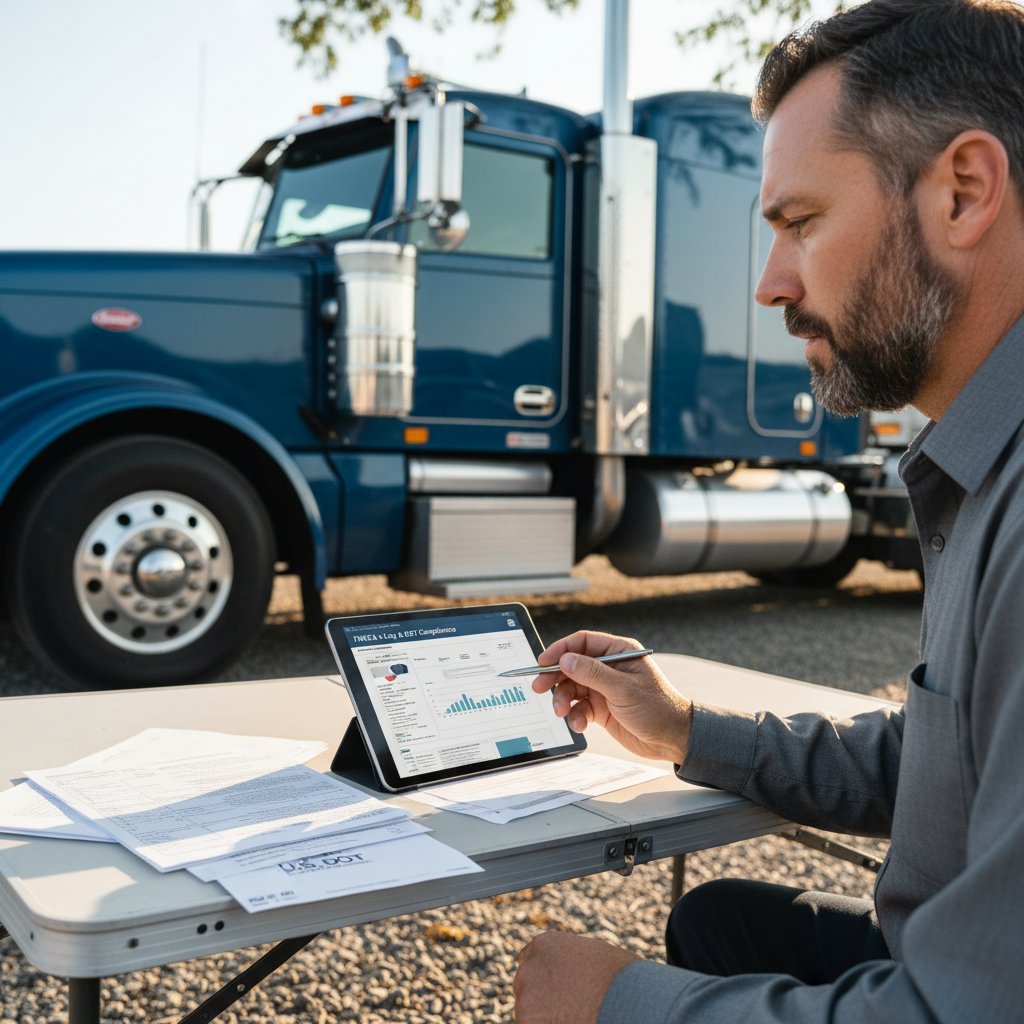
Owner-operator in trucking means you own the truck and run the business—revenue, compliance, and trucking insurance included. Learn models, costs, and risks—get a quote.
As an owner operator, you’re not just driving—you’re running a small business where one breakdown, one bad claim, or one slow-paying broker can wreck cash flow fast. An owner-operator is a truck driver who owns (or finances) their truck and operates as a business, either leased to a carrier under their authority or running under their own motor carrier authority.
This guide is built like a business tool: models, real-world costs, compliance steps, and the commercial truck insurance stack that keeps one accident from turning into bankruptcy.
Table of Contents
Reading time: 10 minutes
- What Is an Owner-Operator (and What You’re Actually Signing Up For)
- Owner-Operator Business Models: Lease-On vs Own Authority (Plus Hotshot)
- Owner-Operator Costs: Startup, Monthly Overhead, and CPM Reality
- Compliance Checklist: DOT, MC, IFTA, IRP, ELD, and More
- Commercial Truck Insurance for Owner-Operators: The Coverage Stack
- Tools & Habits That Keep You Profitable (Not Just Busy)
- Your Questions Answered: “People Also Ask” FAQs
- The Logrock Difference: Insurance Built for Business Owners
- Conclusion & Get a Quote That Won’t Blow Up Your Cash Flow
What Is an Owner-Operator (and What You’re Actually Signing Up For)
An owner-operator is a truck driver who owns or finances a truck and is legally responsible for operating costs like fuel, maintenance, permits, and insurance, whether they’re leased to a carrier or running their own authority.
Your “paycheck” isn’t a paycheck—it’s gross revenue. From that, you pay fuel, maintenance, tires, insurance, permits, and the invisible costs like deadhead, downtime, and admin time for compliance.
Most owner-operator talk skips the real question: are you buying freedom, or buying risk? You can do well, but only if you run it like a business with controls (cost-per-mile, maintenance plan, claims prevention, and tight billing).
Owner-Operator vs Company Driver (Quick Reality Check)
- Company driver: Lower risk, fewer bills, less control over freight and schedule.
- Owner-operator: Higher upside, but you eat the variance (fuel spikes, rate drops, breakdowns, claims, slow pay).
If you want independence, that’s valid. Just don’t confuse independence with “less work.” It’s usually more work—on your schedule.
Owner-Operator Business Models: Lease-On vs Own Authority (Plus Hotshot)
Owner-operators typically run in one of three models—leased-on to a carrier, operating under their own FMCSA authority, or hotshot—and the model you choose changes compliance workload, insurance structure, and liability exposure.
The best setup depends on risk tolerance, cash reserves, and whether you want to spend your evenings on compliance portals.
| Model | Who holds authority? | Who pays cargo/liability filings? | Your control | Best for |
|---|---|---|---|---|
| Lease-on to a carrier | Carrier | Typically the carrier (varies by contract) | Medium | New O/Os who want fewer plates to spin |
| Own authority (motor carrier) | You | You | High | Operators who want maximum control + direct broker relationships |
| Hotshot (weight/GVWR varies) | You or carrier | You or carrier | Medium–High | Lighter equipment, faster entry, niche freight |
1. Leasing On to a Carrier (Pros/Cons)
Leasing on means you operate under a carrier’s DOT/MC authority while you still own the truck and pay most business expenses.
- Why it works: Fewer compliance mistakes early on, and you learn operations without drowning in filings.
- Who it fits: First-time owner-operators, or anyone who wants to drive more and admin less.
- Pro tip: Read the lease agreement like it’s a loan—watch chargebacks, escrow deductions, and who pays what when there’s a claim.
2. Running Under Your Own Authority (Pros/Cons)
Own authority means you are the motor carrier, so you book loads, manage compliance, and maintain required insurance and active filings.
- Why it’s higher risk: A missed renewal, incorrect limit, or audit issue can stop you from hauling.
- Who it fits: Operators with cash reserves, admin discipline, and a plan for insurance, billing, and safety.
- Pro tip: Set a weekly “compliance Sunday” for IFTA, ELD review, maintenance records, and certificates of insurance (COIs).
3. Hotshot Owner-Operator (Where It Fits)
Hotshot trucking typically uses a pickup and trailer to haul time-sensitive or niche freight, and depending on weight and operation you may still be subject to DOT compliance and commercial insurance requirements.
Hotshot margins get crushed by deadhead and underpriced freight, so discipline on lanes and load selection matters.
Learn the basics at Hotshot Insurance Guide.
Owner-Operator Costs: Startup, Monthly Overhead, and CPM Reality
Cost per mile (CPM) is the core owner-operator metric because it converts gross rate-per-mile into a real “keep or pass” decision after fuel, maintenance, truck payment, and insurance.
If you only look at “rate per mile,” you’ll get fooled—especially when deadhead, downtime, and surprise repairs hit in the same week.
The Big Cost Buckets (What Actually Drains Cash)
- Fuel: Your #1 variable cost; route planning and idle discipline show up on the bottom line.
- Maintenance & tires: Not “if,” but “when,” so a reserve isn’t optional.
- Truck payment/lease: Fixed cost that doesn’t care about the spot market.
- Insurance: Often one of the biggest monthly checks (liability, physical damage, cargo).
- Permits & compliance: IFTA, IRP, UCR, HVUT 2290, drug/alcohol consortium, ELD.
- Deadhead & downtime: The silent killer—loaded miles don’t tell the whole story.
Sample Monthly Overhead (Realistic Ranges, Not Fantasy)
These ranges are common for a one-truck operation and help you sanity-check your plan.
| Expense | Typical monthly range (1 truck) | Notes |
|---|---|---|
| Truck payment | $1,500–$3,500+ | Depends on truck age/terms |
| Fuel | $6,000–$18,000+ | Depends on miles, MPG, and price |
| Maintenance reserve | $1,000–$3,000 | More if older truck/high miles |
| Tires reserve | $300–$800 | Averaged over time |
| Insurance | $900–$2,500+ | New authority can be higher |
| ELD + tech | $30–$150 | Plus apps, dashcam, etc. |
| Permits/compliance | $100–$400 | Averaged; spikes at renewals |
Business rule: If you can’t float an $8,000–$15,000 surprise (tow + repair + lost revenue), you’re under-capitalized.
CPM: The One Number You Must Know
Use a simple CPM formula you can update weekly:
All-in CPM = (fixed monthly costs ÷ monthly miles) + variable CPM
- Fixed costs: truck payment, insurance, ELD, base plates allocation
- Variable costs: fuel, maintenance, tires, tolls, DEF, scales, lumper fees
If you don’t know this number, you can’t price freight, evaluate lanes, or decide whether to deadhead 120 miles for a “better” load.
Compliance Checklist: DOT, MC, IFTA, IRP, ELD, and More
FMCSA requires a USDOT number for interstate commercial carriers, and operating authority (MC) is required for for-hire carriers hauling regulated freight across state lines.
Compliance isn’t about being perfect—it’s about not getting shut down at the scale house and not getting hammered in audits.
1. Core Registrations & Filings (Own Authority)
- USDOT number (FMCSA)
- MC number / Operating Authority (for for-hire regulated freight)
- BOC-3 (process agent filing)
- UCR (Unified Carrier Registration)
- HVUT Form 2290 (generally applies at 55,000+ lbs taxable GVW)
- IRP (apportioned plates for multi-jurisdiction operations)
- IFTA (fuel tax reporting for qualified vehicles traveling in multiple jurisdictions)
- State permits (as required by lanes/operations)
2. Safety & Operations (Where Tickets Become Premium Increases)
- ELD + HOS compliance: Don’t let “just this once” turn into a pattern.
- Driver qualification file (DQF): Even if it’s just you, keep it clean and current.
- Drug & alcohol consortium: Required for CDL drivers in DOT drug/alcohol testing programs.
- Maintenance records: Make them audit-ready, not “somewhere in the cab.”
Pro tip: A good dashcam and maintenance tracking app often pays for itself in one avoided claim or one disputed incident.
Commercial Truck Insurance for Owner-Operators: The Coverage Stack
FMCSA financial responsibility rules set a $750,000 minimum public liability limit for many for-hire interstate motor carriers of non-hazardous property (49 CFR §387.9), while many brokers and shippers commonly require $1,000,000.
Insurance isn’t just a bill—it’s your ability to keep operating after something goes sideways. The goal isn’t “cheapest.” The goal is correct coverage, correct limits, clean filings, and no gaps.
If you’re shopping for affordable trucking insurance, remember: affordable only counts if it protects your business and still meets broker/shipper requirements.
1. Primary Auto Liability (The Non-Negotiable)
- What it is: Covers bodily injury and property damage you cause to others.
- Why it matters: One serious accident can turn into a business-ending lawsuit.
- Real-world requirement: Many brokers expect $1M liability, even if the legal minimum is lower for your operation.
2. Physical Damage (Protects Your Truck)
- What it is: Collision + comprehensive for your tractor (and sometimes trailer by endorsement).
- Why it matters: If your truck is totaled and you’re still making payments, cash flow can collapse fast.
- Who usually needs it: Anyone who can’t replace their truck out-of-pocket.
3. Motor Truck Cargo (Protects the Freight You Haul)
- What it is: Coverage for cargo loss/damage (subject to exclusions and conditions).
- Typical broker ask: Many brokers commonly require $100,000 cargo, but requirements vary by commodity and contract.
- Why it matters: Cargo claims can wipe out months of profit and hurt your ability to book loads.
4. Non-Trucking Liability (NTL) vs Bobtail (Don’t Confuse These)
Non-trucking liability generally applies when you’re not under dispatch for business, while bobtail coverage applies when you’re driving the tractor without a trailer, and both are heavily defined by policy language and your lease agreement.
| Coverage | When it applies | Typical use case |
|---|---|---|
| Non-Trucking Liability (NTL) | Off-dispatch / personal use (varies by policy) | You’re not under load and not operating for business |
| Bobtail | Operating without a trailer (varies by policy) | Driving the tractor to/from parking, service, or pickup |
Gaps here lead to denied claims—the worst kind of “cheap insurance.” See the deeper breakdown: Non-Trucking Liability vs Bobtail.
5. General Liability (For the Stuff Auto Doesn’t Cover)
- What it is: Slip-and-fall and certain third-party property damage not tied to auto liability.
- Why it matters: Many facilities and contracts require it for access.
6. Occupational Accident vs Workers’ Comp (Protecting the Driver)
Occupational accident and workers’ compensation are two different ways to address driver injury risk, and state rules plus your business structure determine what’s required and what’s optional.
If you’re the business and you go down injured, revenue stops—so this decision isn’t “extra,” it’s continuity planning.
7. Trailer Interchange (If You Pull Other People’s Trailers)
Trailer interchange covers physical damage to a non-owned trailer you’re responsible for under a written interchange agreement.
Without it, a simple trailer incident can become a contract breach and a direct bill.
How to Keep Trucking Insurance Costs From Eating You Alive
- Run a dashcam and keep it maintained (it can change fault outcomes).
- Avoid bad freight + bad lanes that spike claims exposure.
- Keep MVR/PSP clean and fix small compliance issues before they turn into patterns.
- Choose deductibles intentionally: higher deductibles can reduce premium but raise your self-insured risk.
- Don’t underinsure cargo: a denied cargo claim can cost more than the premium savings.
If you want a straight quote process focused on your operation, start with Commercial Truck Insurance Basics.
Tools & Habits That Keep You Profitable (Not Just Busy)
Profit-first owner-operators use repeatable weekly systems—dispatch discipline, maintenance tracking, and basic accounting—to reduce deadhead, prevent downtime, and protect safety scores.
Being an owner-operator isn’t about working more hours—it’s about running tighter.
Dispatch, Routing, and Parking (Reduce Deadhead + Violations)
- Trucker Path: Parking, scales, and routing intel
- ELD analytics: Spot HOS waste and fix it
- Lane discipline: Stop chasing “cool loads” that blow up deadhead and reload time
Maintenance Discipline (Downtime Is a Tax)
- Pre-trip and post-trip like you’re trying to keep the truck out of the shop (because you are).
- Track PM intervals, tire tread/alignment, DEF and fuel system issues, and regen patterns (if applicable).
Money Systems (So the Business Doesn’t Starve)
- Separate business and personal accounts.
- Do a weekly P&L check (a simple spreadsheet works).
- Auto-transfer a maintenance reserve amount per load.
- Control paperwork: rate cons, detention, TONU, lumper receipts.
Frequently Asked Questions
An owner-operator is a CDL driver who owns or finances their truck and runs the operation as a business, either leased to a carrier or operating under their own motor carrier authority. That means you control equipment decisions and gross revenue, but you also pay operating costs like fuel, maintenance, permits, and insurance. If you run your own authority, you’re also responsible for FMCSA-related items like keeping your USDOT/MC active, maintaining filings, and staying audit-ready. The biggest difference from a company driver is risk: your upside increases, but you carry the downside when rates drop, repairs hit, or a claim shuts you down.
An owner-operator typically runs one truck and drives it, while a fleet owner manages multiple trucks and usually multiple drivers, payroll, and safety systems. In practice, owner-operators have concentrated risk because one breakdown or claim can stop 100% of revenue, but they also have simpler operations. Fleet owners spread revenue across assets, but they take on additional exposure like hiring, driver turnover, and more compliance workload. If you want to stay behind the wheel most days, owner-operator is the fit; if you want to scale, you need dispatch, maintenance, and safety processes that work without you driving.
An owner-operator operates either by leasing on to a carrier and running under the carrier’s DOT/MC authority, or by obtaining their own FMCSA operating authority and running as the motor carrier. Leasing on usually reduces administrative burden because the carrier handles major compliance functions and may control some insurance structure (depending on the lease). Running your own authority gives you maximum control over brokers, rates, and lanes, but you must keep coverage active with no filing lapses, maintain compliant records, and be prepared for audits. Either way, your lease agreement and insurance policy wording decide what’s covered and when.
Semi truck insurance for many owner-operators commonly falls around $900 to $2,500+ per month for a one-truck operation, and new authorities can price higher based on experience, radius, cargo, and loss history. Liability limits are often driven by market requirements—many brokers want $1,000,000—even though federal minimums for certain carriers can be $750,000 (49 CFR §387.9). If a quote looks unusually cheap, verify what’s missing: cargo limit (often $100,000 by contract), deductibles, exclusions, radius, and whether filings/COIs can be provided quickly. “Affordable” only matters if it still gets you loaded.
The Logrock Difference: Insurance Built for Business Owners
A trucking insurance partner should be able to issue certificates of insurance (COIs) quickly, keep filings current, and match liability/cargo limits to broker requirements without leaving coverage gaps.
Most insurance conversations ignore how you actually live: juggling load boards, ELD alerts, shipper delays, and payments that don’t land when they should. Logrock is built around the owner-operator reality—tight margins, high stakes, and zero time for runaround.
- Coverage that matches how you run: radius, cargo, trailer situation, and authority setup.
- Help with COIs and filings: so you’re not losing loads over paperwork.
- Straight answers: on deductibles, limits, and optional coverages.
If you’re running hotshot, start here: Hotshot Insurance Guide. If you’re running a tractor-trailer operation, start here: Commercial Truck Insurance Basics.
Conclusion & Get a Quote That Won’t Blow Up Your Cash Flow
Owner-operators stay profitable by tracking CPM weekly, keeping FMCSA compliance current, and carrying commercial truck insurance limits that meet broker requirements without overbuying.
Being an owner-operator can be one of the best moves you ever make—if you treat it like a business: pick the right authority model, know your numbers, stay compliant, and carry coverage that actually protects your operation.
Key Takeaways:
- Know your model: lease-on vs own authority changes control, compliance, and insurance.
- Run your numbers weekly: CPM and cash reserves keep you alive in bad months.
- Don’t gamble on coverage: correct limits and clean filings keep you hauling.
If you want a clean quote process and coverage built around real owner-operator work, visit /get-quote or use the quote button above.
Related reading: Commercial Truck Insurance Basics, Hotshot Insurance Guide, and Non-Trucking Liability vs Bobtail.