
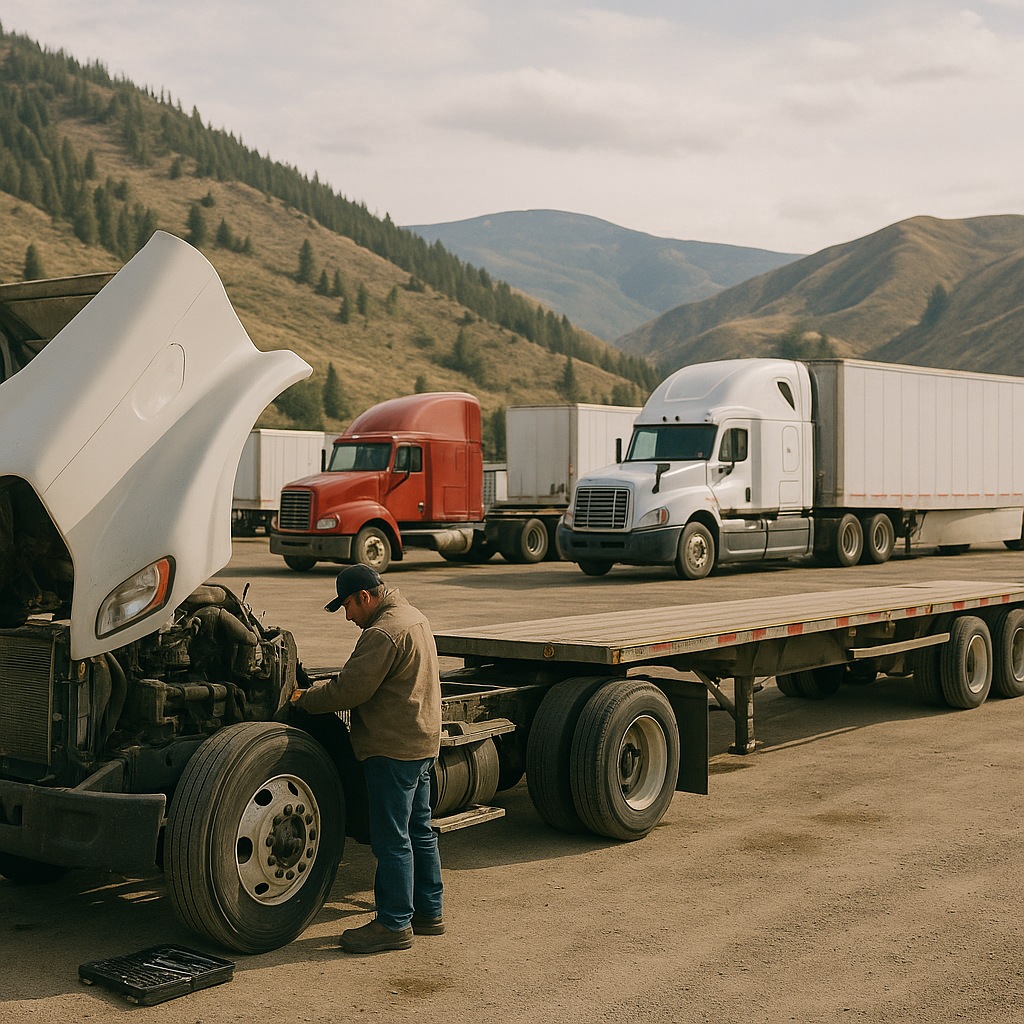

Fleet truck insurance Idaho buyers need isn’t just “commercial auto.” For owner-operators and small fleets, the right setup depends on how you run, what you haul, whether you’re leased on or running your own authority, and whether you’re interstate or intrastate. This guide breaks that down in plain language so you can compare policies without buying the wrong thing.
What Idaho Fleet Truck Insurance Covers#
Fleet truck insurance in Idaho usually means commercial trucking coverage built for a small operation with multiple power units, often a two- to five-truck fleet or an owner-operator adding a second truck. It covers business trucking risks that a personal auto policy was never built to handle, including liability, cargo, equipment damage, and trailer-related exposures.
A commercial trucking insurance policy is insurance designed for business-use trucks hauling freight for pay, with terms based on trucking operations instead of everyday personal driving. A personal auto policy covers normal personal driving and generally doesn’t fit a for-hire trucking operation.
Who this applies to#
This article fits Idaho owner-operators with their own authority, small fleets adding trucks, and operators leased on to another carrier who still need certain coverages in their name. It also fits the common in-between setup: one truck today, second truck soon, and a lot of confusion about when you stop being “just an owner-operator” and start needing fleet-style planning.
If you’re hauling freight for hire, your insurance needs are shaped by carrier type, vehicle weight, cargo, and whether you run interstate or intrastate. That’s why two Idaho operators with similar tractors can need very different policies.
Core coverages for for-hire trucking#
Auto liability pays for bodily injury and property damage you cause to others in a crash. Motor truck cargo covers damage to the freight you’re hauling, subject to the policy terms.
Physical damage covers the truck itself for things like collision and other covered losses. General liability handles certain non-driving business liability exposures tied to for-hire operations.
Non-trucking liability, often called bobtail in everyday conversation, covers non-business use and does not apply while you’re under dispatch hauling a load. Trailer interchange covers a trailer in your care when a signed interchange agreement is in place, while non-owned trailer physical damage is usually the fit when you’re pulling a trailer you don’t own without that signed interchange setup. Reefer breakdown covers certain losses tied to refrigeration unit failure on temperature-controlled loads.
What changes for leased-on vs. own authority#
A leased-on operator runs under another carrier’s authority, while an own-authority carrier operates under its own USDOT and, when required, MC authority. A USDOT number is the identifier used for safety and regulatory tracking, and an MC number is operating authority for certain for-hire interstate carriers.
Practical example: a leased-on dry van owner-operator may rely on the motor carrier’s primary liability while still needing non-trucking liability, physical damage, and possibly occupational or trailer-related coverages depending on the lease. An Idaho carrier with its own authority hauling refrigerated freight may need auto liability with filings, motor truck cargo, physical damage, general liability, and reefer breakdown matched to the load mix and contracts.
Idaho Minimums vs FMCSA Requirements#
Idaho state auto minimums and federal trucking minimums are not the same thing. If you run interstate for-hire trucking, FMCSA rules can override the simple “state minimum” thinking, and your actual requirement depends on your operation type, vehicle weight, cargo, and filings under federal law.
Why state minimums are not the same as trucking requirements#
This is where many small fleets get tripped up. Idaho car insurance rules don’t replace federal trucking requirements for an interstate for-hire carrier, and buying a policy built around the wrong minimum can leave you unable to file authority or satisfy a contract.
Under FMCSA rules and 49 CFR Part 387, for-hire interstate carriers hauling general freight in vehicles over 10,001 lbs must carry at least $750,000 in public liability. Under 10,000 lbs, the federal minimum is $300,000. Auto haulers generally require $1,000,000, and certain hazmat operations require $5,000,000.
How FMCSA rules depend on operation type#
Public liability is the federal term covering bodily injury, property damage, and environmental restoration for certain motor carriers. The rule is never one-size-fits-all.
A small interstate fleet hauling general freight in road tractors over 10,001 lbs falls into a different bucket than a local intrastate operator with lighter vehicles. A private carrier hauling its own goods can fall under a different requirement pattern than a for-hire carrier hauling someone else’s freight for payment.
That distinction matters when you’re setting up authority, filing proof of coverage, or trying to understand why one quote assumes federal filings and another doesn’t. If the policy doesn’t match the actual operation, the premium comparison is meaningless.
Why broker and shipper expectations can exceed minimums#
Even if you meet the legal minimum, a broker or shipper may require more. That’s common in the real world, especially when contracts require higher liability limits, specific cargo terms, or proof of trailer-related protection.
A local Idaho intrastate operation may legally need less than a for-hire interstate carrier, but if a shipper requires higher limits, the “cheaper” minimum-limit policy may not help you book freight. That’s the point where the problem gets expensive: you’ve paid for insurance, but still can’t move the loads you planned to haul. If you’re not sure what coverage fits your operation,
How Fleet Truck Insurance Costs Are Determined in Idaho#
Fleet truck insurance Idaho pricing depends more on operational risk than on a simple truck count. Underwriters look at your drivers, cargo, radius, truck values, loss history, authority status, and where the trucks are based, so two nearly identical fleets can get very different quotes.
The main underwriting drivers#
Your actual premium depends on your operation, cargo, radius, driving history, and other factors. Key drivers usually include motor vehicle records, years of CDL experience, prior claims, type of freight, stated operating radius, garaging location, and the value of each power unit.
A two-truck fleet can also price differently from a one-truck owner-operator because exposure grows as you add units and drivers. If one truck is owner-driven and the second uses a hired driver, underwriting changes fast because the driver pool, scheduling, and payroll mix change.
Why Idaho fleets may see different quotes#
Idaho itself isn’t the whole story. The same tractor parked in Boise and another parked in a smaller market might not price the same, but location is only one piece.
Cargo class can matter even more. Reefer freight brings temperature-sensitive exposure. Flatbed can bring securement and cargo-shift concerns. Auto-haul and hazmat usually bring their own underwriting scrutiny. A carrier with new authority may also be viewed differently than an established operation with clean loss runs.
Here is a simple example: two fleets each run one late-model sleeper and one older day cab. One has clean MVRs and no recent losses, hauling general freight on a moderate radius. The other has a recent backing claim, one speeding violation, and hauls higher-risk loads over a longer radius. The trucks may look similar on paper, but the quotes won’t.
Practical ways small fleets can lower risk#
The best way to control cost is to improve risk quality and buy policy fit, not just hunt for a lower number. Clean driver screening, realistic radius reporting, documented maintenance, and accurate cargo descriptions can all help avoid mispricing and ugly surprises after a claim.
For a small fleet, adding the wrong coverage can waste money, but leaving out a needed filing or trailer protection can cost much more later. That balance matters more than a headline premium.
Coverage Choices That Matter for Small Idaho Fleets#
Small Idaho fleets need coverage that matches the loads, trailers, and business setup they actually use. The most important decisions usually come down to how liability, cargo, truck damage, trailer protection, and reefer exposure fit together on real loads rather than as separate boxes on a quote form.
Cargo and liability combinations#
Motor truck cargo should match the freight you actually haul and the contracts you sign. If you switch between dry van retail freight, food products, and higher-theft loads, a generic cargo setup may not reflect the real exposure.

Liability and cargo also do different jobs. Liability protects against damage or injury you cause to others. Cargo protects the customer’s freight in your care. If your broker packet requires both, having only one doesn’t solve the problem.
Physical damage and trailer protection#
Physical damage protects your truck, not the freight and not the other party’s injuries or property damage. It typically combines collision with comprehensive or fire and theft plus combined additional coverage, rather than standing alone.
This is also where trailer details matter. If your fleet regularly pulls shipper or carrier-owned trailers, ask whether the fit is trailer interchange or non-owned trailer physical damage. The difference often comes down to whether there’s a signed interchange agreement in place. Most non-intermodal owner-operators pulling someone else’s trailer without that agreement are really trying to solve for non-owned trailer physical damage.
When reefer breakdown matters#
Reefer breakdown covers certain cargo losses caused by refrigeration unit failure, subject to policy terms. It matters when your load can spoil because the temperature control system fails, not just because you’re pulling a reefer trailer.
Practical example: an Idaho small fleet with two trucks hauls mixed freight, but one unit also runs refrigerated produce. That truck may need auto liability, cargo, physical damage, non-owned trailer coverage for borrowed trailers, and reefer breakdown stacked correctly. If that truck is leased on and only used under dispatch, non-trucking liability would not replace the carrier-use coverages it needs.
How to Compare Quotes Without Buying the Wrong Policy#
The best quote process starts with a complete, operation-specific submission, not a rushed request for “full coverage.” To compare policies the right way, send accurate truck, driver, cargo, and authority details, then line up limits, deductibles, exclusions, and filings so you’re looking at true apples-to-apples.
What to send when requesting quotes#
A quote package usually needs VINs, unit details, driver lists, garaging locations, years of experience, loss runs, operating radius, cargo type, and whether you’re leased on or running your own authority. If you need federal filings, say that upfront.
Authority status matters more than many buyers expect. An insurer quoting a leased-on setup may structure the account very differently than one quoting an own-authority carrier that needs filings. You can also verify carrier status and basic registration information on SAFER.
How to compare apples to apples#
Don’t compare only the premium. Compare liability limits, cargo terms, deductibles, physical damage deductibles, covered drivers, trailer protection, and whether filings are included where needed.
A quote can look cheaper because it stripped out cargo, raised deductibles, limited drivers, or assumed a different operating radius. That’s why generic commercial auto quotes often miss the mark for for-hire trucking.
Questions to ask before binding#
Ask whether the quote reflects your real load mix, whether it assumes interstate or intrastate operation, whether leased-on or own-authority status was modeled correctly, and whether any exclusions conflict with your contracts. Also ask how trailer use was classified and whether reefer breakdown is needed for temperature-controlled freight.
Good quote prep cuts down on back-and-forth and helps avoid buying a policy that won’t work when a broker asks for a certificate or a claim hits. If you want help sorting out filings, cargo, trailer use, or leased-on versus own-authority details,
Common Idaho Questions Fleet Owners Ask#
A few Idaho questions come up again and again: speed limits, why quotes vary so much, and whether a big-name insurer writes a trucking fleet at all. The short answer is that roadway rules and insurance rules are different issues, and availability or price usually depends more on the trucking risk than on the brand name.
Speed limits and insurance confusion#
“Can semis go 80 in Idaho?” is a traffic-law question, not an insurance requirement question. Speed limits can vary by roadway and vehicle classification, so check current Idaho rules through the Idaho Transportation Department.
Insurance-wise, the main point is simpler: whether you’re allowed to travel at a certain posted speed doesn’t change the need for proper commercial trucking coverage. Safe driving history can affect underwriting, but roadway speed rules and insurance minimums are separate topics.
Why prices vary so much#
A lot of operators assume the state itself is the whole reason a quote is high. In practice, differences usually come from driver records, authority age, cargo type, truck values, loss history, and where and how the units run.
If one Idaho fleet hauls general freight on a tighter radius with clean loss runs and another runs longer lanes with claims and higher-risk cargo, the quotes can be far apart even inside the same state.
Whether major carriers write fleet accounts#
Questions like “Does Geico do fleet insurance?” need a careful answer. Availability varies by business type, underwriting appetite, and whether the carrier or partner market writes for-hire trucking risks like semis and small fleets.
If you’re comparing options, focus less on the logo and more on whether the quote actually fits for-hire trucking, needed filings, cargo, trailer use, and authority structure. For Idaho-specific consumer protection and insurance oversight context, the Idaho Department of Insurance is the state resource to know.
FAQ#
How does commercial fleet insurance work?
Commercial fleet insurance lets one policy structure cover multiple business vehicles, often with shared underwriting across the account instead of treating each truck like a separate personal vehicle. For trucking, that usually means the insurer looks at the whole operation: number of units, driver list, garaging, radius, cargo, claims history, and whether the business is leased on or operating under its own authority.
For a small fleet, that matters because adding a second or third truck changes exposure in ways that go beyond simple vehicle count. The policy still has specific units, drivers, coverages, limits, and deductibles attached to it, but the account is rated as a trucking business, not as ordinary auto insurance.
Can semis go 80 in Idaho?
This is mainly a road-rule question, not an insurance question. Speed limits for semis can depend on the road type and current Idaho traffic rules, so the smart move is to verify current limits with the Idaho Transportation Department or other official Idaho roadway sources before assuming what applies on a given route.
From an insurance standpoint, the posted speed limit doesn’t change whether you need commercial trucking coverage. What does matter is driving behavior over time. Speeding violations, unsafe driving history, and serious losses can affect underwriting and premium, but that’s separate from the legal question of what speed is allowed on a specific highway.
Why is Idaho insurance so expensive?
For trucking, the quote usually reflects risk more than geography alone. A higher premium can come from recent claims, driver MVR issues, long operating radius, cargo type, truck value, new authority status, or a tougher class of business like reefer, hazmat, or auto-haul. Idaho location can play a role, but it’s rarely the only reason.
That’s why two operators in the same city can get very different numbers. One may have clean loss runs, stable freight, and experienced drivers. The other may have newer authority, prior losses, heavier contract requirements, or higher-value equipment. Your actual premium depends on your operation, cargo, radius, driving history, and other factors.
Does Geico do fleet insurance?
Availability varies, and brand-name recognition doesn’t tell you whether a market will write your specific trucking risk. Some major insurance brands participate in commercial vehicle insurance through direct programs, partner agencies, or selected business classes, but that doesn’t mean they write every for-hire trucking account or small semi fleet.
The better question is whether the market you’re considering handles your actual setup: for-hire trucking, interstate or intrastate operation, filings, cargo type, trailer use, and own-authority or leased-on status. If the quote is built like generic commercial auto instead of trucking insurance, it may not solve the problem even if the brand is familiar.
Do leased-on Idaho owner-operators need the same coverage as own-authority fleets?
Not usually. A leased-on owner-operator often relies on the motor carrier’s primary liability while under dispatch, but may still need physical damage, non-trucking liability for non-business use, and sometimes trailer-related protection depending on the lease and equipment arrangement. The exact setup depends on what the motor carrier provides and what the lease requires.
An own-authority fleet usually needs a broader package because it is responsible for its own filings, liability structure, and freight-related exposures. That’s why the first question in any quote process should be how the operation is set up, not just how many trucks are in the fleet.





