
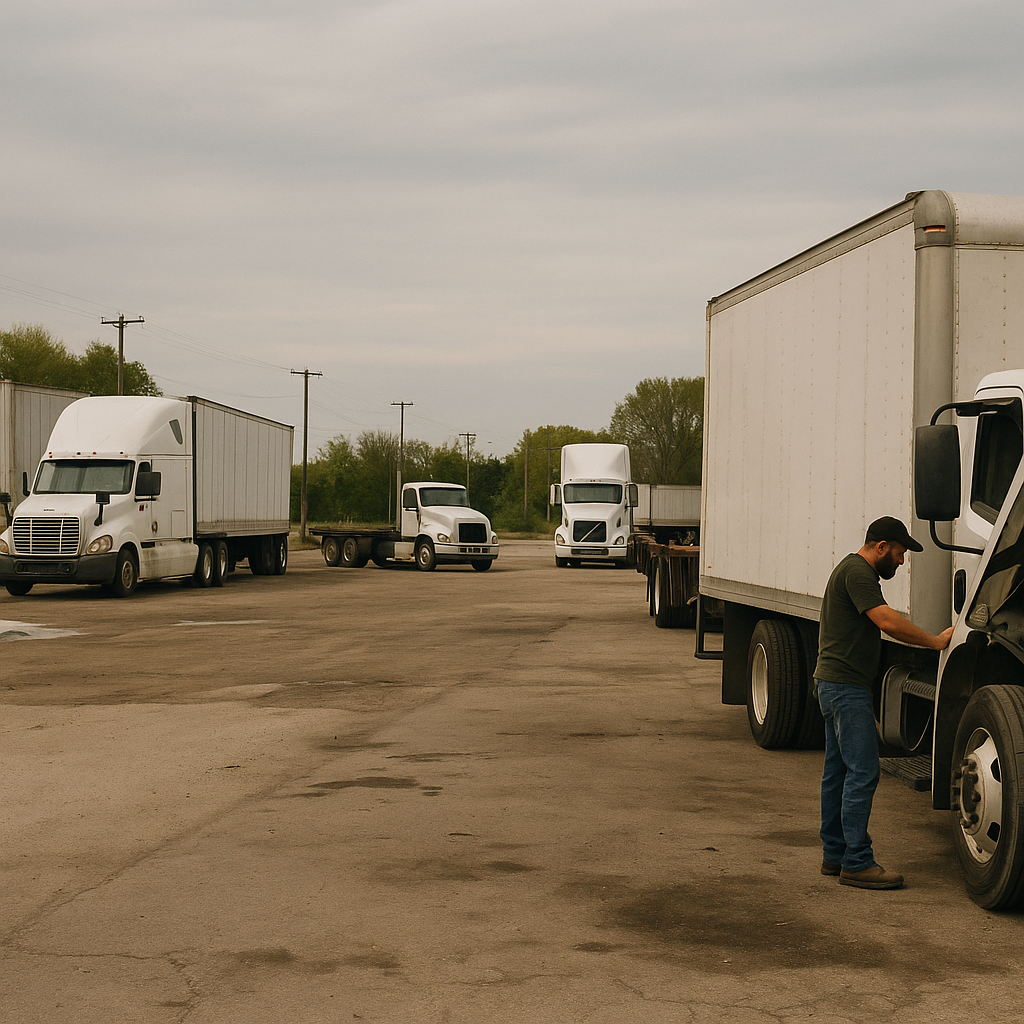

If you’re hauling freight in a cargo van in Illinois, the big mistake is assuming the van gets treated like a personal vehicle. Cargo van truck insurance Illinois decisions usually depend less on the van itself and more on how you use it, who you’re hauling for, what you carry, and whether your work stays in Illinois or crosses state lines.
This guide breaks that out the practical way. You’ll see where personal auto stops working, how Illinois rules differ from FMCSA rules and broker demands, which coverages matter for for-hire work, and what to gather before asking for a quote.
Start With How Your Illinois Cargo Van Actually Operates#
If you use a cargo van to haul property for pay, you may need commercial coverage even if the vehicle looks like a family van from the outside. The insurance decision starts with the work being done: personal use, business use, or for-hire hauling, plus where you travel, what you haul, and who is paying you.
A personal auto policy is insurance built for personal driving, not commercial hauling. Many personal policies restrict or exclude business use, and for-hire hauling is where coverage gaps can get expensive fast.
Personal use, business use, and for-hire hauling#
Personal use means the van is driven for everyday non-business purposes. Business use means the van supports your own business operations, like carrying tools or supplies, while for-hire hauling means you’re transporting someone else’s property for compensation.
That last category is where many Illinois cargo-van operators get tripped up. If you’re running loads for brokers, dispatch services, shippers, or under another carrier’s authority, the insurer will want the real story about the operation. “It’s just a van” doesn’t answer the underwriting question.
Intrastate versus interstate trips#
Intrastate means your operation stays within one state. Interstate means the trip crosses state lines or is part of interstate commerce, which can still matter even when your wheels never leave Illinois because the freight itself is moving in a broader interstate shipment.
A USDOT number is the federal identifier used to track certain commercial carriers and safety records. An MC number is operating authority for certain for-hire interstate operations, and it does not automatically mean every cargo van has the same insurance requirement.
FMCSA registration and operating authority questions depend on the operation’s facts, including interstate activity and carrier role, not just the vehicle type. FMCSA lays out that registration framework at FMCSA.
The operating details that change an insurance decision#
Before you compare policies, pin down these details:
- Are you using the van personally, for your own business, or for-hire?
- Are you hauling under your own authority or someone else’s?
- Do you stay in Illinois or cross state lines?
- What commodities do you carry?
- How far do you run?
- What is the van worth?
- What contract requirements do brokers or shippers impose?
If you can’t answer those clearly, any quote you get is shaky from the start.

Know Which Rules Apply: Illinois, FMCSA, and Customer Contracts#
Illinois cargo-van insurance requirements can come from three different places, and mixing them together causes most of the confusion. You need to separate Illinois vehicle rules, federal FMCSA financial-responsibility rules, and whatever a broker, shipper, or customer contract requires for the loads you want to haul.
Illinois vehicle financial-responsibility rules#
Illinois has its own vehicle financial-responsibility rules, but those state vehicle rules are not the same thing as federal motor-carrier insurance rules. The Illinois Secretary of State and the Illinois Vehicle Code govern state vehicle compliance, while your hauling operation may also trigger separate commercial or federal requirements.
That matters because a state minimum on a vehicle registration question doesn’t tell you what a broker will require, and it doesn’t tell you whether a federal filing applies to your operation. For Illinois vehicle financial-responsibility context, start with the Illinois Secretary of State.
When federal motor-carrier rules may apply#
FMCSA rules are not a blanket rule for every cargo van. Federal financial-responsibility rules apply only within a defined regulatory scope, which is why two vans that look identical can face different requirements based on carrier type, weight, cargo, and interstate activity.
Under 49 CFR Part 387, for-hire interstate carriers hauling general freight in vehicles over 10,001 lbs must carry at least $750,000 in public liability. Under that same federal framework, vehicles under 10,000 lbs can fall into a different threshold, and some operations may not be in that scope at all. Hazmat and certain specialized operations can trigger higher requirements.
An MCS-90 is a federal endorsement tied to certain public-liability filings for motor carriers. It is not a shortcut for deciding what your whole insurance package should be.
Why broker and shipper requirements can exceed legal minimums#
A broker or shipper can require more than the legal minimum before they hand you a load. They may ask for higher liability limits, motor truck cargo coverage, specific certificate wording, additional-insured language, or other contract terms that go beyond what Illinois or FMCSA would require by law.
That is why “legal minimum” and “bookable load” are not the same thing. A policy can be legal for one purpose and still fail a contract review.
If you’re staring at a load requirement sheet and aren’t sure whether your coverage actually matches it,
Do not confuse an MC number with universal insurance requirements#
An MC number does not create one universal answer for cargo-van insurance. Your authority status, USDOT registration, vehicle weight, cargo, and interstate activity all change the analysis.
The safest move is to verify your own registration and public carrier record instead of trusting a forum comment. You can confirm company status, authority, and public insurance-record information through the FMCSA SAFER system.
Build the Right Cargo Van Insurance Package#
A solid cargo van insurance package usually starts with commercial auto liability, then adds cargo, physical damage, and other coverages based on the work you actually do. The main gap to avoid is assuming one policy part covers everything, because liability, freight, and damage to your van are separate problems.
Commercial auto liability for injury and property damage#
Commercial auto liability is coverage for covered bodily injury and property damage you cause with the insured vehicle. It responds to third-party claims tied to the van’s use, but it does not insure the freight inside the van.
This is where many operators mix up auto liability with cargo. If a crash damages someone else’s vehicle or injures another person, that’s an auto-liability issue. If the customer’s freight gets stolen or damaged, that is a separate coverage question.
Motor truck cargo coverage for customers’ freight#
Motor truck cargo coverage is insurance designed for covered loss or damage to a customer’s freight while it is in the carrier’s care, custody, or control. It applies subject to the policy’s limits, deductibles, commodity restrictions, exclusions, and other terms.
Cargo coverage matters because for-hire operators often assume their liability policy protects the load. It doesn’t. The real test is whether the commodity you’re hauling is actually covered, whether theft is included, what documentation is required, and whether any exclusions knock out the claim you thought you had.
Physical damage for the van and permanently attached equipment#
Physical damage covers the insured vehicle itself. Collision covers damage from an impact or upset, while comprehensive covers many non-collision causes like theft, fire, vandalism, or certain weather losses.
Whether you carry physical damage usually depends on the van’s value, your ability to replace it, lender requirements, and how badly downtime would hurt your business. Permanently attached equipment may also need to be scheduled or clearly contemplated by the carrier, depending on what is installed.
General liability for non-driving business risks#
General liability is coverage for certain non-auto third-party claims arising from business operations. It is not a replacement for commercial auto liability, and it does not step in just because a claim happened near the vehicle.
For cargo-van operators, general liability can matter when a customer or facility requires it for non-driving exposures tied to your business relationship. But it should be scoped to the actual work, not added blindly because a checklist on the internet said every trucker needs it.
Optional coverages that depend on the operation#
Some add-ons only make sense for certain operators. Examples include:
- Hired and non-owned auto if business use involves vehicles you do not own
- Trailer-related coverage where trailers are actually part of the operation
- Refrigeration breakdown for temperature-controlled freight
- Non-trucking liability for limited non-business use in the right setup
Non-trucking liability, often called bobtail coverage, applies to certain non-business use only and does not cover paid hauling. That makes it a poor fit for many active for-hire cargo-van operators who are regularly under load or running business miles.
The common gaps are predictable: relying on personal auto, assuming auto liability covers freight, accepting cargo exclusions without checking the commodity list, and overlooking contract wording until a certificate request lands in your inbox.
Understand What Drives Cargo Van Insurance Costs in Illinois#
There is no single posted price that can tell you what cargo van truck insurance Illinois will cost for your business. Premium depends on the actual operation, the people driving, the freight involved, and the coverage structure being requested.
Driver and claims history#
Insurers look closely at driving record, prior claims, years of experience, years in business, and prior insurance history. A clean motor vehicle record helps, but so does a clear and consistent explanation of what the operation actually does.
If your application says one thing and your load confirmations show another, that can create underwriting friction before a claim ever happens.
For-hire status, radius, and interstate exposure#
For-hire hauling usually brings different underwriting questions than simple business use. The farther you run, the more states you touch, and the more often you work in interstate commerce, the more the exposure can change.
That doesn’t mean every interstate cargo van faces the same rule or rate. It means insurers price the real operating profile, not just the body style.
Cargo type, cargo limits, and contract requirements#
Cargo type matters because some freight is viewed as more theft-prone, fragile, temperature-sensitive, or otherwise harder to insure. The limit you request and the wording your customers require can also change the quote, even when a lower legal minimum might exist somewhere else.
A request for higher liability or a specific cargo limit is not just a number on paper. It can shift the whole underwriting review.
Vehicle value, deductibles, and coverage selections#
A newer or higher-value van usually costs more to insure for physical damage than an older van with less value at risk. Deductibles also matter, but choosing them should be a deliberate business decision, not a panic move to make the quote look smaller.
Dropping essential coverage or cutting limits just to force a lower price can create a much larger uninsured loss later.
Fleet size, garaging location, and safety controls#
Garaging location, overnight storage, anti-theft practices, driver screening, and documented safety controls can all affect pricing. For small fleets, the quality of controls often matters as much as the truck count.
Practical ways to reduce avoidable cost drivers include keeping accurate loss runs, using a consistent business description, documenting safety practices, verifying cargo descriptions, and avoiding accidental overlaps or gaps in coverage.
Check Coverage Gaps Before You Haul the Next Load#
Before you accept the next load, review the policy against the actual job, not the sales summary. The declarations page, endorsements, and exclusions control coverage far more than a certificate by itself.
Match the policy business description to the work performed#
Make sure the named insured is correct, the listed drivers are current, the van is scheduled properly, the territory matches where you run, and the policy dates are active. If you changed from local business use to for-hire hauling and never updated the policy, that’s a problem.
Review cargo exclusions and limits by commodity#
Read the commodity list and exclusions before you assume cargo is covered. A certificate can show that motor truck cargo exists, but it does not prove your specific commodity, theft scenario, or limit requirement is covered the way you think.
Confirm who owns the vehicle and who employs the driver#
Ownership and employment details matter. A van titled personally but used by a business, a subcontracted driver, or work under another carrier’s authority can all change how the risk needs to be written.
Check certificate requirements before accepting a contract#
Do not wait until the load is ready to move before checking certificate wording or requested endorsements. Contract-required limits, wording, and evidence of coverage should be reviewed before you commit.
Document accident and cargo-claim responsibilities#
An auto accident claim and a cargo claim are related sometimes, but they are not the same report. For cargo losses, keep the bill of lading, load confirmation, photos, delivery exceptions, seal records if applicable, and written communications with the broker, shipper, or consignee.
Prepare an Accurate Illinois Cargo Van Insurance Quote#
A good quote is really an underwriting review of your operation, not a generic online price check. The more accurately you describe the business, the more useful the quote becomes and the less likely you are to end up with the wrong policy.
Business and authority details#
Gather your legal business name, business address, garaging address, EIN if applicable, and any USDOT or MC information that applies. Be ready to explain whether you run under your own authority, under another carrier’s authority, or through a dispatch or broker arrangement.
A Motor Carrier Management Information System record is part of the federal carrier data environment that supports public and enforcement-facing carrier information. Your public profile can often be checked through SAFER, which is a good way to confirm that your company snapshot reflects the basics accurately.
Driver and vehicle information#
Have the vehicle VIN, year, make, model, and estimated value ready. Also gather driver license details, dates of birth, experience information, and consent for motor vehicle record review if requested.
Hauling territory and cargo details#
State where you travel, how far you typically run, whether you cross state lines, what commodities you haul, and whether you use load boards. If you haul for brokers, do expedited work, use subcontracted drivers, or take temperature-controlled freight, say that plainly.
Current coverage and claims history#
Have prior policy information, current declarations if available, and loss runs ready. Prior insurance continuity matters, and so does being able to explain any past claims accurately.
Questions to ask before choosing a policy#
Ask practical fit questions, not just price questions:
- Which commodities are covered and excluded?
- What deductible applies to cargo?
- How are cargo and auto claims reported?
- How fast can certificates be turned around?
- What territory does the policy contemplate?
- Can the requested contract wording be accommodated?
If you’re not sure how to describe the operation or spot a gap before binding coverage,
Choose Coverage That Matches the Work You Actually Do#
The right sequence is simple: identify the operation, separate legal requirements from contract requirements, choose coverage for the real exposures, and prepare accurate quote details. A cargo van’s size does not decide the insurance by itself. The hauling activity and your role in the load do.
That matters in Illinois because one operator may only need straightforward commercial coverage for local business use, while another may need a much more specific package because they haul for hire, cross state lines, or work under broker contracts.
FAQ#
What kind of insurance do I need for a cargo van?
Start with how the van is used: personal driving, business use, or hauling freight for compensation. If you’re a for-hire operator, commercial auto liability is usually the starting point because it addresses covered third-party injury and property-damage claims arising from use of the van.
From there, many operators also need motor truck cargo for customers’ freight, physical damage for the van itself, and sometimes general liability or contract-specific coverage. The right answer depends on your authority setup, cargo, territory, customer requirements, and whether you’re operating intrastate or interstate.
How much is commercial insurance for a cargo van?
Commercial insurance for a cargo van depends on the operation, not just the vehicle. Insurers usually look at driving record, claims history, years in business, prior insurance, for-hire status, operating radius, garaging location, vehicle value, cargo type, requested limits, and deductibles.
That is why generalized pricing usually misses the mark. One Illinois cargo-van operator hauling local business supplies is a different risk from a for-hire operator crossing state lines with brokered loads. For a meaningful quote, give complete details about how the van is used, what you haul, where you travel, and what your contracts require.
How much is a $1,000,000 liability insurance policy?
A $1,000,000 liability limit by itself does not determine premium. The insurer still prices the full operation, including whether you’re for-hire, what vehicle is insured, who drives it, where it travels, your claims history, and whether the quote also includes cargo or physical-damage coverage.
That means two operators asking for the same limit can get very different quotes. It is better to compare complete proposals with the same business description, territory, and coverage structure than to focus on the liability number alone. The limit matters, but the operating profile is what usually drives the underwriting result.
How much does $100,000 cargo insurance cost?
Motor truck cargo pricing depends on much more than the cargo limit. Insurers usually evaluate the commodities hauled, theft risk, deductible, territory, security practices, loss history, and any exclusions or restrictions in the policy.
That is why asking only for “$100,000 cargo” can be misleading. A policy with that limit may still exclude the freight you actually haul or handle a loss differently than you expect. Before comparing quotes, verify whether your commodities are covered, whether theft is included, what documentation is required, and what deductible applies to a claim.
Can I use personal auto insurance for cargo-van delivery or hauling?
Usually, that is where trouble starts. Personal auto coverage is built for personal driving, and many policies restrict or exclude business use, delivery work, or for-hire hauling. Even if the van looks like a normal passenger vehicle, the insurance decision changes once you start using it commercially.
For Illinois operators hauling property for compensation, relying on a personal policy can create a serious coverage gap. The safest move is to disclose the real use of the van up front and get the operation reviewed as a commercial risk, especially if you work for brokers, carry customer freight, or cross state lines.





