
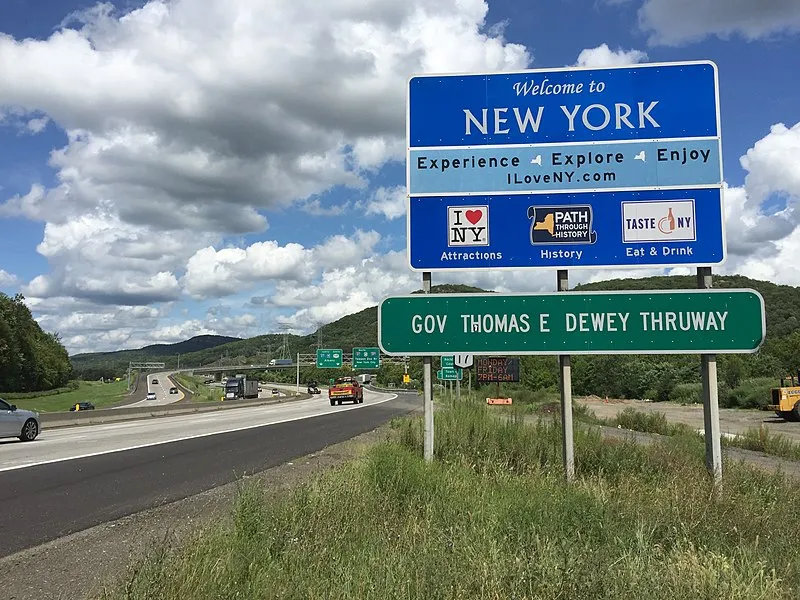

For New York truckers, the biggest regulatory hurdle isn’t just the FMCSA; it is the Department of Taxation and Finance. New York enforces a strict Highway Use Tax (HUT). If your truck is over 18,000 lbs GVW, you must register for a HUT certificate and pay a mileage tax.
Additionally, New York has very strict ID Card requirements. The DMV requires insurance cards with specific 2D barcodes that scan directly into their system. If your agent sends you a generic PDF without the NY barcode, you cannot register your truck.
In New York, the average commercial truck insurance premium typically lands between $14,000 and $28,000 per year. This guide breaks down exactly what you need to pay to keep your plates and HUT certificate active.
Key Takeaways: New York Truck Insurance Costs
- The Price Tag: Expect to pay around $18,500 annually for a Semi-Truck statewide. However, NYC-based trucks often pay $25,000 – $35,000+.
- The “Downstate” Penalty: Garaging a truck in NYC, Yonkers, or Long Island can double your premium compared to Upstate due to theft risk and accident frequency.
- HUT (Highway Use Tax): Required for qualifying trucks operating on New York public highways. Review the official HUT requirements for current weight thresholds, registration, and filing details. While not an insurance filing, it is part of your compliance workflow.
- NY Barcode: You cannot register a vehicle without a barcoded NY Insurance ID Card.
Want the quick version? Watch LogRock’s 60-second New York truck insurance cost overview.

Real Numbers: Estimated Costs by Truck Type
Let’s look at the hard data. The following estimates represent the average annual cost for Auto Liability ($1M Limit) for a driver with a clean record in New York. Note: The ranges below reflect the massive price difference between Upstate (Low End) and NYC (High End).
| Vehicle Type | Limit $300,000 | Limit $750,000 | Limit $1,000,000 (Standard) |
|---|---|---|---|
| Hotshot | $10,500 – $14,000 | $13,500 – $18,000 | $15,500 – $22,000 |
| Box Truck | $9,000 – $12,500 | $12,000 – $16,500 | $14,500 – $20,000 |
| Dump Truck | $12,000 – $18,000 | $16,000 – $22,000 | $18,500 – $28,000 |
| Semi Truck | $13,500 – $18,000 | $17,500 – $24,000 | $21,000 – $30,000 |
| Garbage Hauler | $15,000 – $20,000 | $20,000 – $26,000 | $24,000 – $35,000 |
Pricing estimates are illustrative; confirm current 2026 premiums with live quotes before binding coverage.
Logrock Reality Check: While NY State minimums for registration are surprisingly low (e.g., $10k/$20k for light trucks), DO NOT rely on these. The George Washington Bridge and NY Thruway authority, along with every reputable broker, will demand $1,000,000 Liability. If you hit a luxury car in Manhattan with state minimums, you may be personally exposed for the difference.
Liability Limits: Intrastate vs. Interstate
New York rules change depending on whether you cross state lines. We have broken this down into two tables to make it clear.
Table 1: Intrastate Requirements (NYSDOT)
For trucks that never leave New York (e.g., Albany to Buffalo).
| Vehicle Weight / Type | Minimum Liability Limit | Filing Required? |
|---|---|---|
| Freight 10,001 – 26,000 lbs | $300,000 CSL | Yes (Form E) |
| Freight > 26,001 lbs | $750,000 CSL | Yes (Form E) |
| Household Goods (Movers) | $750,000 + Cargo Ins. | Yes (Form E+H) |
| Passenger (School/Bus) | $1.5M – $5.0M CSL | Yes (Form E) |
| Hazmat | $1,000,000 – $5,000,000 | Yes (Form E/ MCS-90) |
Note: “CSL” means Combined Single Limit. Intrastate carriers must obtain authority from the NYSDOT (Commissioner of Transportation). This is separate from your HUT registration.
Table 2: Interstate Requirements (FMCSA / Federal)
For trucks that cross state lines (e.g., NYC to Jersey City, NJ).
| Vehicle Weight / Type | Minimum Liability Limit | Filing Required? |
|---|---|---|
| Freight < 10,000 lbs | $300,000 CSL | No (Unless Hazmat) |
| Freight > 10,001 lbs | $750,000 CSL | Yes (BMC-91X) |
| Hazmat (Gas/Oil/Explosives) | $1,000,000 – $5,000,000 | Yes (MCS-90) |
| Passenger (16+ seats) | $5,000,000 CSL | Yes (BMC-91X) |
Federal minimums are set by 49 CFR §387.9.
Not sure which liability limit actually protects you? This video breaks down how to choose.
New York Requirements & Critical Filings
To operate legally, your insurance agent must submit specific forms to the NYSDOT and DMV.
- Form E: Mandatory for Intrastate For-Hire carriers. It proves to the NYSDOT that you have liability insurance. This keeps your state operating authority active.
- HUT (Highway Use Tax): Required for qualifying trucks operating on New York public highways. Review the official HUT requirements for current weight thresholds, registration, and filing details. While not an insurance filing, it is part of your compliance workflow.
- Barcoded ID Cards: The NY DMV requires specific 2D Barcoded ID cards for registration. A standard ACORD certificate is not accepted at the DMV window.
- Form H: Mandatory for Household Goods Movers to prove Cargo Insurance coverage.
- NYC CMVT: If you operate primarily in NYC, you may owe the Commercial Motor Vehicle Tax to the city finance department.
Your Questions Answered: “People Also Ask” FAQs
Risk. NYC has some of the highest accident frequencies, insurance fraud rates, and theft rates in the country. Insurers often charge more for trucks garaged in the five boroughs than for trucks garaged in lower-risk upstate or suburban areas. The legal minimums generally apply statewide; the biggest NYC difference is often pricing, driven by garaging and operating exposure.
The Highway Use Tax is a weight-distance tax for qualifying vehicles operating on New York public highways. You generally need a certificate of registration and must file returns on the required schedule. Review the New York Department of Taxation and Finance’s HUT guidance for current thresholds, filing periods, and payment rules.
HUT is a weight-distance tax: the amount depends on the gross weight of the vehicle and the miles driven on New York public highways, rather than a flat fee. Carriers file and pay on the required schedule, and the rate scales with the applicable gross-weight bracket.
HUT registration itself is not automatically suspended by every insurance lapse, but an insurance lapse can affect your operating authority and trigger broader compliance problems. Keeping continuous coverage helps avoid authority, registration, and audit complications.
New York adopts federal safety requirements for many intrastate commercial operations. Whether you need a USDOT number depends on your vehicle, operation, and applicable state and federal rules. For operations meeting the applicable commercial-vehicle threshold, such as vehicles at or above 10,001 pounds in the relevant context, confirm your obligations through the FMCSA and NYSDOT before operating.
Form E is evidence of liability coverage filed for applicable intrastate operating authority. BMC-91X is a federal insurance filing used for certain interstate motor-carrier operations. If you operate both inside and outside New York, your agent should confirm whether both state and federal filings are required for your authority and operation.
Your insurance carrier or agent generates the required New York insurance identification document; it is not the same as a standard ACORD certificate. Ask specifically for the insurance ID card or document accepted for New York vehicle registration before you visit the DMV.
Operating mainly in NYC generally changes price more than the baseline statewide requirements. Form E, HUT, and applicable liability requirements are statewide, but garaging and operating in the five boroughs can materially increase premium because of traffic, theft exposure, and claim frequency.
The Logrock Difference: We Handle the Barcodes
New York is bureaucracy central. If your agent sends you a blurry PDF insurance card without the 2D barcode, you will be turned away at the DMV. At Logrock, we generate the correct Barcoded NY ID Cards instantly. We handle your Form E filing for NYSDOT authority and help you understand how your HUT obligations interact with your insurance. We also help you find carriers willing to write in the tough NYC market.
Conclusion & Get Your New York Quote
New York offers high freight rates to match the high cost of entry. Don’t let a paperwork error at the DMV or a missing HUT certificate stop your cash flow. Ready to get a solid number for your business? Contact Logrock today for a customized, no-obligation quote and keep your wheels turning.
Still weighing your options? Watch how to choose the right truck insurance policy for your business.
If you’re trying to sort out your HUT registration, NYSDOT Form E filing, or need the right registration documents, LogRock can help you review coverage and paperwork based on where you operate—Upstate or Downstate.





