
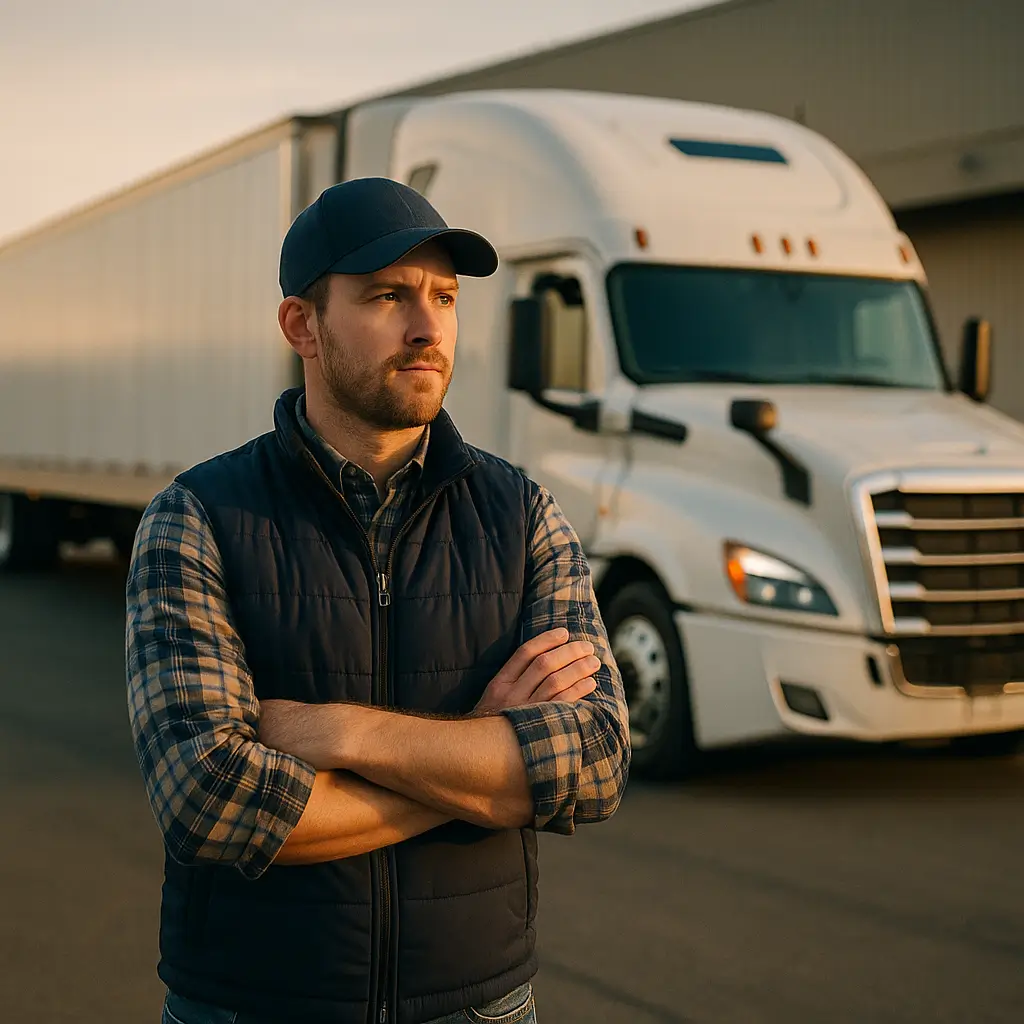

Learn Minnesota commercial auto insurance requirements, 30/60/10 minimums, FMCSA rules, 2026 cost factors, and coverage tips for businesses.
Commercial auto insurance MN minimums are usually described as 30/60/10 liability plus No-Fault/PIP commonly summarized as $40,000 per person, but your contracts—and sometimes federal rules—can require higher limits. If your vehicle is how you make money, a coverage gap can turn one crash into a week of lost jobs and a lawsuit-sized bill.
This guide explains Minnesota requirements, what to buy beyond the minimums, and what drives price in 2026. If you want the definitions first, start with this commercial auto insurance basics guide.
Table of Contents
Reading time: 9 minutes
- Key Takeaways
- Who Needs Commercial Auto Insurance in Minnesota (Not Personal Auto)
- Minnesota Commercial Auto Minimum Requirements (2026): 30/60/10 + PIP
- Federal vs Minnesota Requirements: When FMCSA Rules Override State Minimums
- Build a Commercial Auto Policy That Actually Works: Coverages, Cost Drivers, and a MN Checklist
- Frequently Asked Questions
- Conclusion: Get MN Coverage That Meets Contracts (Not Just Minimums)

Key Takeaways
Minnesota’s commonly cited minimums are 30/60/10 liability plus No-Fault/PIP commonly summarized as $40,000 per person, but many COIs and commercial contracts require $1,000,000 CSL or more.
- MN “minimum” coverage is usually not “enough” once you factor in injuries, vehicle values, and customer contract requirements.
- 30/60/10 is split liability; many businesses choose a CSL (combined single limit) like $1,000,000 CSL because it’s simpler and often required on certificates of insurance (COIs).
- Minnesota is a No-Fault state (PIP matters), and UM/UIM can be a business-saver when the other driver is uninsured or underinsured.
- If you’re for-hire, crossing state lines, or trucking-adjacent, federal FMCSA rules can override MN minimums—and you may actually need trucking-focused coverage rather than a basic commercial auto policy.
Here’s why buying at the state minimum is often the wrong move for a commercial operation:
Who Needs Commercial Auto Insurance in Minnesota (Not Personal Auto)
Commercial auto insurance in Minnesota is typically required by insurers and contracts when a vehicle is used for business operations—and many COIs specify $1,000,000 CSL liability rather than personal-auto limits.
What it is (plain English)
Commercial auto insurance is a vehicle policy designed for work use, often with higher liability options, multiple drivers, business-titled vehicles, and endorsements that match real operations (job-site exposure, delivery, towing, hired vehicles, and more).
Why it’s essential (real-world risk)
Personal auto is priced and written for commuting and errands—not tools, employees, job sites, deliveries, and tight schedules. If a carrier decides your personal policy didn’t match the risk (delivery use, employee driving, business title), you can run into a coverage dispute when you can least afford it.
Who typically needs it in MN
- Vehicles titled to an LLC or corporation (and many sole proprietors, depending on use)
- Any business with employee drivers
- Contractors hauling tools/materials daily (HVAC, electrical, plumbing, landscaping)
- Delivery/service routes (higher mileage + more stops = higher frequency risk)
- For-hire transportation and trucking-adjacent operations
Edge cases that trip up MN business owners
Employees using their own vehicles for errands, client visits, or deliveries is one of the most common gaps. Your general liability policy usually won’t fix auto accident exposure.
If that’s you, review hired & non-owned auto (HNOA) coverage; it’s often one of the most cost-effective ways to close a lawsuit-sized hole.
Minnesota Commercial Auto Minimum Requirements (2026): 30/60/10 + PIP
Minnesota’s commonly cited minimum liability limits are 30/60/10 and the No-Fault structure includes PIP commonly summarized as $40,000 per person, with key requirements found in MN Stat. § 65B.49 and MN Stat. § 65B.44.
This section is the legal “floor.” The smarter question is what limit keeps one crash from turning into a multi-year financial setback.
Minimum liability limits: what “30/60/10” means
Minnesota liability is often expressed as 30/60/10:
- $30,000 bodily injury per person
- $60,000 bodily injury per accident (total)
- $10,000 property damage per accident
Many commercial buyers switch to a CSL (Combined Single Limit), like $1,000,000 CSL, because it’s simpler for COIs and contracts. For the practical difference between split limits and CSL, see liability insurance limits (30/60/10 vs CSL).
Does MN require No-Fault/PIP on commercial auto?
Minnesota is a No-Fault state and, in many cases, Personal Injury Protection (PIP) benefits are part of the required structure; PIP is commonly summarized as $40,000 per person under MN Stat. § 65B.44.
PIP can help pay injury-related costs quickly after a crash, which can reduce downtime and financial stress while fault is still being sorted out.
Quick table: MN minimums vs common real-world requirements
| Coverage item | Minnesota baseline (commonly cited) | What customers/GCs/brokers often require | Who should expect higher limits |
|---|---|---|---|
| Liability | 30/60/10 split | $1,000,000 CSL (very common) | Contractors, delivery fleets, any COI-driven work |
| No-Fault / PIP | Often summarized as $40,000 per person | Must be included where required | Any business with drivers/passengers in MN |
| UM/UIM | Often required/strongly recommended | Sometimes specified | High-mileage operations, metro driving, fleets |
Pro tip: “Minimum” is rarely the “right” number
If you have a financed vehicle, employees, a contract requiring a COI, or meaningful business assets, buying the minimum is usually a false savings. One serious injury claim can exceed $60,000 per accident quickly.
For a quick visual breakdown of how Minnesota insurance costs play out in practice, watch this:
Federal vs Minnesota Requirements: When FMCSA Rules Override State Minimums
For many for-hire interstate motor carriers transporting non-hazardous property, FMCSA financial responsibility rules require at least $750,000 in public liability under 49 CFR Part 387, which can make Minnesota’s 30/60/10 minimum irrelevant for that operation.
What it is (plain English)
FMCSA rules set minimum insurance requirements for certain interstate motor carriers and may require insurance filings depending on your authority and operation. This is the “federal overlay” that can override what you assume you need based on state minimums alone.
Official reference: FMCSA insurance filing requirements.
Why it’s essential (business survival)
If a shipper or broker checks your authority and required filings and you’re short, you don’t just risk penalties—you can lose loads and revenue. And if you’re in a claim while operating outside what your policy was written for, you can end up in a coverage fight that drains cash fast.
Who needs to pay attention
- For-hire operators crossing state lines
- Hotshot-style operations taking paid loads (even “part-time”)
- Anyone whose contracts demand proof of higher limits
- Trucking-adjacent businesses that may actually need trucking-specific coverage
If you’re unsure where you fall, read a plain-language breakdown of FMCSA insurance requirements and filings before you bind coverage.
Pro tip: Don’t let “affordable” become “uninsurable”
The smart play is getting the policy form and limits right first, then shopping price—because “cheap” doesn’t help if it fails a COI review or doesn’t match the operation.
Build a Commercial Auto Policy That Actually Works: Coverages, Cost Drivers, and a MN Checklist
A commercial auto policy that “works” for a Minnesota business usually includes $1,000,000 CSL liability (when COIs require it), required No-Fault/PIP where applicable, and add-ons like physical damage and HNOA to prevent a single claim from stopping operations.
This is where you stop buying “insurance” and start buying uptime—the ability to keep rolling after a claim.
Not sure what limit is right for your operation? This breakdown can help you think it through:
Optional coverages MN businesses should consider (beyond minimums)
- Physical damage (comprehensive + collision): Covers theft, vandalism, weather, animal hits, and at-fault crashes; essential for financed/leased or high-value vehicles.
- Hired & non-owned auto (HNOA): Liability protection when employees drive personal vehicles for work or you rent/borrow vehicles; learn the details in hired & non-owned auto (HNOA) coverage explained.
- Rental reimbursement / towing & labor: Helps keep you working when the unit is down; for many small operators, lost revenue hurts more than the repair bill.
- Umbrella / excess liability: Adds liability limits over auto (and often GL); commonly used to reach $2M–$5M requirements without rebuilding the entire auto policy.
2026 cost drivers in Minnesota (and how to keep premiums sane)
Commercial auto pricing in Minnesota is driven by factors like vehicle use, driver risk, and claims history, as summarized by the Minnesota Department of Commerce: MN Department of Commerce (commercial auto overview).
The big levers insurers rate:
- Driver MVRs (tickets, accidents) and years of experience
- Claims history
- Vehicle type/value (cargo van vs pickup vs box truck)
- Radius, annual mileage, and time of day
- Limits, deductibles, and physical damage choices
- Garaging location (metro vs rural)
- Business type (delivery is priced differently than contractor/service work)
For a deeper breakdown you can use before you request quotes, see what affects commercial auto insurance cost.
Real-world 2026 premium ranges in Minnesota (scenario-based estimates)
These are scenario ranges, not statewide averages, and your results can land outside these ranges depending on drivers, losses, vehicles, and limits.
| MN business scenario | Example setup | Rough annual premium range (estimate) | What usually moves the price most |
|---|---|---|---|
| Solo contractor (1 van/pickup) | $1M CSL, comp/collision, clean MVR | $1,500–$4,000 | Driver record, vehicle value, garaging |
| Small service fleet (3 vehicles) | Mixed drivers, $1M CSL, physical damage | $5,000–$15,000 | Driver mix, mileage/radius, prior claims |
| Local delivery (5 vehicles) | High frequency stops, higher exposure | $12,000–$35,000 | Frequency risk, driver turnover, claims |
| Trucking-adjacent / for-hire | Operation may trigger federal rules | Varies widely | Authority, filings, unit type, contracts |
MN compliance checklist (copy/paste)
- Confirm your policy is written for the real use (delivery, tools, passengers, for-hire, etc.).
- Carry at least MN-required liability and No-Fault/PIP where applicable.
- Match contract/COI requirements first (limits, additional insureds, waivers).
- If crossing state lines/for-hire: confirm FMCSA applicability and any required filings.
- Keep proof of insurance accessible (drivers + office), and update COIs fast.
- Re-shop or remarket after changes: new drivers, new vehicles, new radius, new contracts.
If you’re trying to cut cost without cutting protection, use how to lower commercial auto insurance premiums as your playbook before you ask for quotes.
Frequently Asked Questions
Minnesota’s commonly cited commercial auto minimums are 30/60/10 liability plus No-Fault/PIP commonly summarized as $40,000 per person, but many businesses need $1,000,000 CSL for COIs or higher limits due to FMCSA rules.
Minnesota minimum liability is commonly referenced as 30/60/10: $30,000 bodily injury per person, $60,000 bodily injury per accident, and $10,000 property damage per accident (see MN Stat. § 65B.49). Many businesses carry higher limits—often $1,000,000 CSL—because customer contracts and certificates of insurance (COIs) frequently require it. If you want the practical difference between split limits and CSL (especially when multiple people are injured), read liability insurance limits (30/60/10 vs CSL).
Yes—Minnesota is a No-Fault state and PIP (Personal Injury Protection) is part of the required coverage structure in many situations, with benefits commonly summarized as $40,000 per person under MN Stat. § 65B.44. PIP helps pay injury-related costs quickly after a crash (medical and other benefits), even while fault is being determined. For businesses, faster payments can reduce downtime, limit cash-flow strain, and keep drivers getting treatment without waiting on the other party’s insurer.
Federal requirements can override Minnesota minimums when you operate as a for-hire motor carrier in interstate commerce, and the minimum required limits depend on the type of operation and cargo; for many for-hire interstate carriers hauling non-hazardous property, the federal minimum is $750,000 in public liability (49 CFR Part 387). FMCSA explains insurance filings and requirements here: FMCSA insurance filing requirements. If you’re taking paid loads across state lines—even occasionally—confirm applicability before binding coverage by reviewing FMCSA insurance requirements and filings.
You can lower Minnesota commercial auto premiums without underinsuring by improving controllable underwriting inputs—tight driver selection, documented training, fewer uncontrolled miles, and active coaching if you use telematics—then adjusting deductibles and using an umbrella to reach higher limits efficiently (often $2M–$5M) instead of cutting core liability. Pricing is heavily influenced by driver MVRs, claims history, vehicle type/value, and mileage/radius. For a step-by-step plan, use how to lower commercial auto insurance premiums and pair it with what affects commercial auto insurance cost before you request quotes.
Minnesota generally includes uninsured and underinsured motorist protection as part of the auto insurance structure, and it can matter in commercial settings when your driver is hit by someone with no insurance or too little coverage. For high-mileage businesses, metro routes, and employee drivers, UM/UIM can protect operating cash when the other driver’s limits are not enough. Ask your agent to confirm whether UM/UIM is included on your commercial policy and at what limits.
Possibly. If you regularly use a personal vehicle for deliveries, job-site visits, client appointments, tools, equipment, or business errands, a personal auto policy may not match the exposure. If employees use personal cars for work, hired and non-owned auto coverage can help close the gap that general liability usually will not cover. The safe move is to disclose the exact use to your insurer and get the classification confirmed in writing.
Split limits like 30/60/10 cap each part of a claim separately: $30,000 per injured person, $60,000 total bodily injury per accident, and $10,000 property damage. A $1,000,000 CSL creates one pool of money for the whole accident, which is why contractors, vendors, brokers, and job sites often prefer it on a COI. For many Minnesota businesses doing contract-driven work, CSL is the more practical business limit even when the legal minimum is lower.
A COI summarizes your insurance coverage, including carrier, policy number, effective dates, and limits, and it is commonly requested by customers, general contractors, property managers, municipalities, and larger clients before work starts. The COI does not change what your policy covers, but it proves whether your limits match the contract. Many COI requests require $1,000,000 CSL, so a policy written only at Minnesota minimums can still fail a job-site requirement.
Yes, but it usually costs more and the carrier options may be narrower. Minnesota commercial auto underwriters look closely at driver MVRs, recent accidents, violations, years of experience, and claim history. A single at-fault accident or serious moving violation can raise the premium, while multiple issues can push an account into a non-standard market. Be upfront when requesting quotes, because misrepresenting driver history can create a coverage dispute when a claim happens.
Conclusion: Get MN Coverage That Meets Contracts (Not Just Minimums)
Minnesota minimums—commonly cited as 30/60/10 liability plus No-Fault/PIP commonly summarized as $40,000 per person—are a starting line, not a finish line. The real goal is protecting cash flow and staying eligible for work by meeting COI requirements and avoiding coverage gaps.
If you’re trucking-adjacent, don’t force-fit a basic policy; depending on authority, cargo, and radius, you may need trucking-focused coverage. Use business insurance coverages overview (bundle strategy) to see how auto fits with GL/umbrella/workers’ comp, and review commercial truck insurance basics if your operation looks more like hauling than service work.
Key Takeaways:
- Match the policy to the real use (delivery, employees, tools, for-hire), not what you wish the use was.
- Expect $1,000,000 CSL to be the practical standard for many COIs, even if MN minimums are lower.
- If interstate/for-hire applies, confirm FMCSA requirements and filings before binding coverage.
If you want help aligning limits to contracts and keeping premiums under control, compare quotes after you’ve nailed down your drivers, vehicles, radius, and required limits.
If you operate in Minnesota and want to make sure your commercial auto policy matches your real contracts, vehicles, and drivers — not just the state minimum — LogRock can help you work through it. Talk to our team to identify gaps, align your limits to what your COIs actually require, and get a quote that fits your operation.
Speak with LogRock and Request a Quote




