
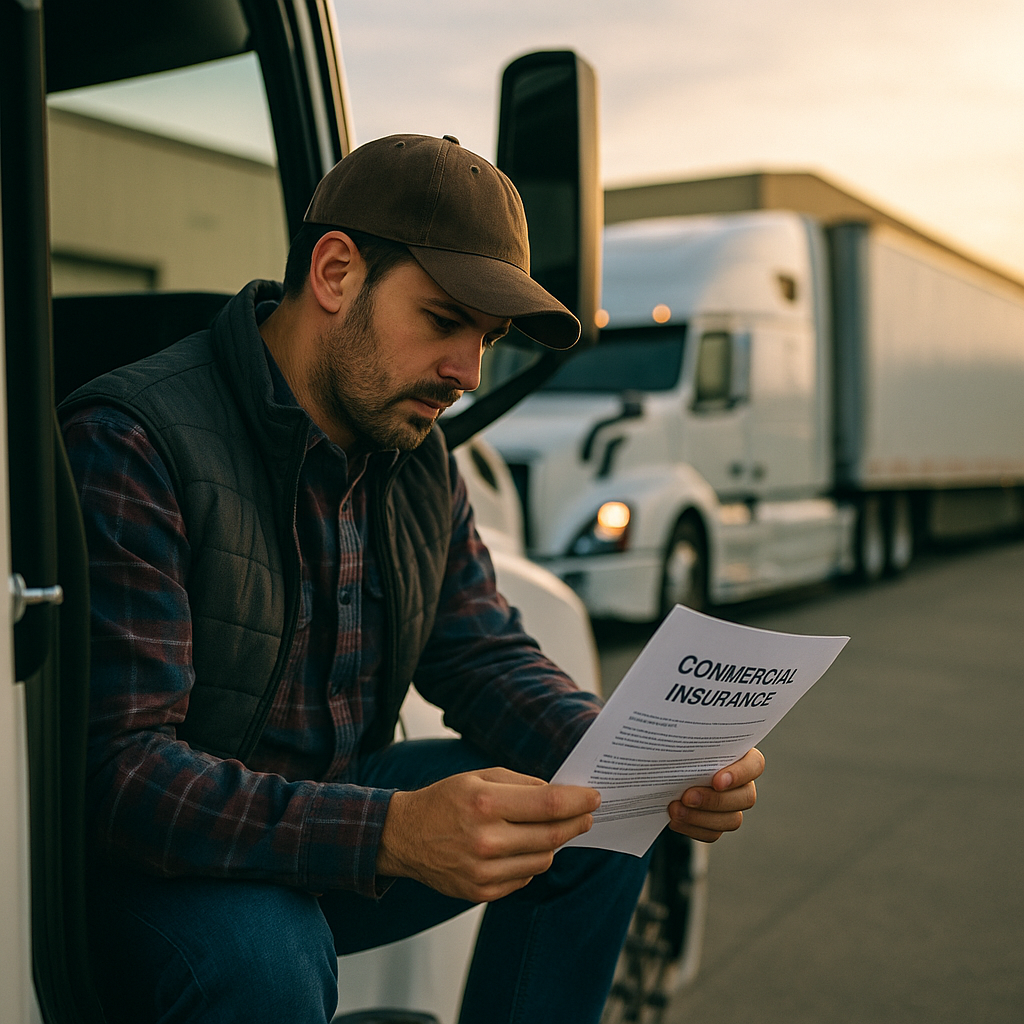
Commercial insurance information for 2026: coverages, costs, claims, and commercial truck insurance tips. Build the right policy stack—get the checklist.

Commercial insurance information matters most when something goes wrong: a claim, a contract requirement you missed, or an ugly “we don’t cover that” surprise. If you’re running a small business (or a one-truck operation), one uncovered gap can turn a good month into a problem month.
This guide stays practical: what commercial insurance is, the core coverage types most businesses stack together, how underwriting and claims work, and what drives pricing in 2026. If you want a quick foundation first, bookmark commercial insurance basics for small operators (editorial note: confirm URL before publish).
Table of Contents
Reading time: 9 minutes
- Commercial insurance information in 2026: what it is (and what it isn’t)
- Types of commercial insurance coverage (10 common policies)
- How commercial insurance works (quotes, underwriting, and claims)
- Commercial insurance cost drivers in 2026 (and how to keep it affordable)
- Build your policy stack: a 12-point checklist
- Frequently Asked Questions
- Conclusion: turn information into a policy that won’t surprise you
Commercial insurance information in 2026: what it is (and what it isn’t)
Commercial insurance is coverage written for business operations, and it’s commonly organized into property (things you own) and casualty/liability (harm you cause or are alleged to have caused) lines in state insurance guidance.Source
In plain English, commercial insurance protects your customers, your contracts, your employees, your vehicles, your equipment, and your income. It’s rarely “one policy.” It’s a policy stack that matches your exposures.
Commercial insurance vs. personal insurance (why personal policies fail at claim time)
Personal insurance is priced and written for personal use; commercial insurance assumes business mileage, business visitors, business contracts, and higher-dollar disputes.
- Higher damages: Business claims often involve bigger medical bills, bigger property damage, and higher defense costs.
- Contract requirements: COIs, additional insured wording, and required limits are where costs (and claim issues) sneak in.
- More parties: Landlords, brokers, GCs, shippers, vendors, and subs can all end up on the same claim.
Real-world examples (plain English)
- A customer trips in your shop → general liability often responds.
- A fire wipes out inventory/tools → commercial property responds (if the cause of loss is covered).
- Your employee gets hurt lifting freight → workers’ comp responds (when required by state law).
- Your driver hits another vehicle during a delivery → commercial auto or commercial truck insurance responds based on the vehicle and operation.
Types of commercial insurance coverage (10 common policies)
Types of commercial insurance coverage usually include liability, property, income protection, and specialized lines, and many small businesses carry more than one policy because no single form covers every exposure.
For a deeper dive on the most common liability line, see commercial general liability insurance explained (editorial note: confirm URL before publish).
Coverage comparison table (save this)
| Coverage | What it protects | Common buyers | “Gotcha” to watch |
|---|---|---|---|
| Commercial General Liability (CGL) | Third-party bodily injury, property damage, advertising injury | Almost everyone | Doesn’t cover professional mistakes (E&O) or employee injuries |
| Commercial Property | Building/contents/tools at a location | Retail, offices, shops | Flood/earthquake typically separate |
| Business Interruption (Business Income) | Lost income + extra expense after a covered loss | Property owners, storefronts | Waiting period + documentation burden |
| Commercial Auto | Liability/physical damage for business vehicles | Any business with vehicles | Personal auto may restrict business use |
| Workers’ Compensation | Employee injury/illness | Anyone with employees | State rules vary; penalties can be serious |
| Professional Liability (E&O) | Claims alleging your advice/service caused financial harm | Consultants, IT, agencies | Often claims-made; retro date matters |
| Cyber Liability | Breach response + cyber liability | Any business handling customer data | Controls (MFA/backups) may be required |
| EPLI | Employment-related claims | Growing teams | HR practices can affect underwriting |
| Umbrella/Excess | Extra liability limits above primary policies | Contract-driven businesses | Must match underlying requirements |
| Inland Marine (Tools/Equipment) | Tools/equipment in transit or at job sites | Contractors, installers | Scheduling and valuation must be accurate |
Plain-English definitions for the big lines
- CGL: “Someone says you harmed them” (injury/property damage).
- Property: “Your stuff got damaged” (building, contents, inventory).
- Auto: “A vehicle caused a loss” (liability + physical damage).
- Workers’ comp: “An employee got hurt” (state-regulated benefits).
- E&O: “A professional mistake cost someone money” (bad advice, missed deadline, negligent design).
- Cyber: “A data/system incident happened” (breach response, ransomware, certain liabilities).
Commercial truck insurance, trucking insurance, and semi truck insurance (transportation operators)
Commercial truck insurance is a transportation-focused package that commonly includes auto liability and physical damage, and it may also include cargo, general liability, non-trucking liability, trailer interchange, and filings depending on your operation.
If you operate for-hire, the underwriting details matter a lot: radius, commodity, driver experience, garaging, contracts/COIs, and whether you’re power-only or hauling your own trailer. That’s why “semi truck insurance” pricing can swing hard at renewal even when nothing feels different.
Hotshot insurance (light-duty hauling is still commercial risk)
Hotshot insurance is commercial coverage for light-duty, for-hire hauling, and it still needs correct vehicle use, driver scheduling, and cargo requirements to avoid coverage gaps.
If hotshot is your lane, read hotshot insurance explained (editorial note: confirm URL before publish).
How commercial insurance works (quotes, underwriting, and claims)
Commercial insurance works through a quote → underwriting → bind process, and the policy’s declarations, endorsements, exclusions, and conditions control what gets paid when a claim happens.
The quote → underwriting → bind workflow
What it is: You apply, the carrier underwrites, you accept terms, and the policy is issued.
What you’ll be asked for:
- Named insured: Legal entity name and ownership (LLC vs DBA mismatches cause claim headaches).
- Operations: What you do, where you do it, and how often (classification matters).
- Payroll/revenue: Drives premium for GL, workers’ comp, and some professional lines.
- Vehicles/drivers: Units, VINs, drivers, miles/radius, garaging (for auto/truck).
- Prior losses: Loss runs and any open claims.
- Contracts/COIs: Limits and required endorsements (additional insured, waiver of subrogation, etc.).
Policy structure (the parts that matter when there’s a claim)
If you only read one page, read the Declarations. If you only read one more thing, read the endorsements, because that’s where contracts “rewrite” your policy.
- Declarations page: Limits, deductibles, named insured, locations.
- Forms + endorsements: The actual coverage language.
- Exclusions: What’s carved out.
- Conditions: What you must do (timely notice, cooperation, no voluntary payments).
- Definitions: How the policy defines key words (definitions change outcomes).
Claims workflow (and why claims get delayed/denied)
Most commercial claims follow the same steps: notice of loss, adjuster assignment, documentation, coverage review (sometimes with a reservation of rights), payment/repair/settlement, and sometimes subrogation.
For a deeper breakdown and a documentation checklist, use step-by-step insurance claims process (editorial note: confirm URL before publish).

Seven common reasons claims get delayed or denied:
- Late reporting: You waited weeks or months to report.
- Wrong named insured: Entity/DBA mismatch or the wrong entity on the policy.
- Operation not disclosed: The description/class code doesn’t match what you actually do.
- Excluded cause of loss: Common in property and cyber.
- Missing proof of value/ownership: Tools, equipment, inventory without receipts/photos.
- Condition problems: Voluntary payments or failure to mitigate damages.
- Limits/sublimits too low: You hit a cap you didn’t know existed.
Mini glossary (terms you’ll actually see on quotes)
Definitions can vary by form, but NAIC’s consumer glossary is a solid baseline for plain-English meanings.Source
- Premium: What you pay for coverage.
- Deductible: What you pay out of pocket per claim (or per occurrence).
- Limit: The most the insurer pays.
- Aggregate: The most the insurer pays over the policy term (often annual).
- Endorsement: A change to the policy (this is where contracts bite).
- Exclusion: A coverage carve-out.
Commercial insurance cost drivers in 2026 (and how to keep it affordable)
Commercial insurance pricing is driven by underwriting inputs like classification, payroll/revenue, claims history, limits, deductibles, and documented safety controls—not by a single “average cost” number.
For tactical levers that lower premium without creating coverage gaps, see how to reduce commercial insurance costs (editorial note: confirm URL before publish).
What moves premium the most
- Industry/classification: Often the biggest driver for GL and workers’ comp.
- Payroll and revenue: Many lines rate directly on these figures.
- Territory and location: Theft, weather, and litigation environment matter.
- Prior claims: Frequency + severity drive renewals.
- Limits and deductibles: Higher limits and lower deductibles usually cost more.
- Fleet/driver profile: Experience, MVRs, radius, usage (auto/truck).
- Safety and cyber controls: Training, RTW programs, telematics, MFA, backups.
Workers’ comp reality check (why payroll accuracy matters)
Workers’ comp premium is commonly calculated as (payroll ÷ 100) × class rate, then adjusted by experience modification and carrier credits/debits, so misclassified work or messy payroll records can distort price fast.
BLS publishes industry injury and illness data through its Injuries, Illnesses, and Fatalities (IIF) program, which helps explain why claim frequency and severity differ by job type.Source
2026 underwriting trend: verify controls, don’t just talk about them
Carriers are getting stricter about proof, especially in cyber and commercial auto.
- Cyber: MFA, backups, admin controls, and incident response planning are commonly asked for; NAIC’s consumer overview is a good baseline.Source
- Auto/fleet: Driver onboarding, MVR monitoring, maintenance logs, telematics, and written safety policies.
- Premises/property: Cameras, alarms, sprinklers, housekeeping, and verified upgrades.
Emerging risks to bring up before renewal
- Cyber: Not just for large companies—small operators get hit too.
- Supply chain: Pushes stronger business income planning and vendor review.
- AI-related exposures: Often land in E&O + cyber + privacy + IP conversations.
- Climate-driven losses: Can tighten property terms in certain territories.
Build your policy stack: a 12-point checklist you can run in 15 minutes
A 12-point commercial insurance checklist helps you confirm named insured, limits, deductibles, scheduled equipment, and contract-required endorsements before you bind or renew coverage.
If you’re in transportation, pair this with a dedicated commercial truck insurance guide (editorial note: confirm URL before publish).
- List exposures: customers, jobsites, storefront/office, equipment, vehicles, data, employees.
- List “deal drivers”: landlord, lender, broker/shipper, GC—who requires COIs?
- Confirm your named insured matches your legal entity (LLC vs DBA matters).
- Map exposures to lines: CGL, property, BI, auto, WC, E&O, cyber, umbrella, inland marine.
- Set limits based on worst-case loss + contracts (not minimums).
- Choose deductibles based on cash flow (what can you pay tomorrow?).
- Schedule tools/equipment accurately (photos + receipts reduce claim friction).
- For vehicles: keep driver list, garaging, radius, and use accurate (no “close enough”).
- Document safety controls (training, inspections, incident reporting).
- Document cyber controls (MFA, backups, access controls, vendor management).
- Don’t accept endorsements you don’t need (they cost money and can add obligations).
- Re-shop and re-underwrite at renewal and whenever operations change.
If you use personal vehicles for work (or have hired/non-owned exposure), start with a clean explanation here: commercial auto insurance overview (editorial note: confirm URL before publish).
Frequently Asked Questions
Commercial insurance is coverage written for business operations, typically built as a stack of policies (like general liability, property, and commercial auto) because one policy can’t cover every exposure. A common real-world baseline for many small businesses is CGL plus property (if you have tools, inventory, or a location) and auto (if vehicles are used for work). Contracts often require specific limits and endorsements on a COI, so the “right” program is the one that matches your operations and satisfies those requirements. If you’re starting from scratch, review commercial insurance basics for small operators.
The most common types of commercial insurance are CGL, commercial property, business income (interruption), commercial auto, workers’ compensation, professional liability (E&O), cyber, EPLI, umbrella/excess, and inland marine for tools and mobile equipment. Many businesses don’t need all 10, but most need more than one because exposures stack up (customers + vehicles + employees + contracts). Transportation operators often add trucking-specific coverages like cargo, non-trucking liability, and trailer interchange based on contracts and operations. For deeper liability context, see commercial general liability insurance explained.
Often, yes—because many personal auto policies restrict business use, delivery use, or regular work mileage, which can create coverage disputes when there’s a claim. If you’re using a personal vehicle for sales calls, hauling tools, deliveries, or jobsite travel, you should review whether you need a commercial auto policy, a business auto endorsement, and/or hired and non-owned auto liability depending on how vehicles are used. The key is matching the declared use to reality, since “wrong use” is a common underwriting and claims problem. Start here: commercial auto insurance overview.
Commercial general liability (CGL) typically covers third-party bodily injury, third-party property damage, and certain personal/advertising injury claims (like libel or slander) arising from your business operations. Many CGL policies are commonly issued with limits like $1,000,000 per occurrence and $2,000,000 aggregate because those limits are frequently required in leases and vendor contracts, but your contract requirements can be higher. CGL usually does not cover employee injuries (workers’ comp), professional mistakes (E&O), or damage to your own property. Learn the details here: commercial general liability insurance explained.
Conclusion: turn information into a policy that won’t surprise you
Commercial insurance works best when it’s treated like a system: exposures → contracts → policy stack → proof (COIs) → renewal updates. That’s how you avoid the classic “I thought that was covered” moment.
Key Takeaways:
- Commercial insurance is a stack, not one policy: Match lines to real exposures (people, property, vehicles, data, contracts).
- Underwriting details drive price: Class codes, payroll/revenue, driver/radius, claims history, limits, and deductibles matter more than “shopping.”
- Claims issues are predictable: Late notice, wrong named insured, and undisclosed operations are avoidable with a simple checklist.
If you’re transportation-focused, keep going with trucking insurance checklist and hotshot insurance explained (editorial note: confirm URLs before publish).





