
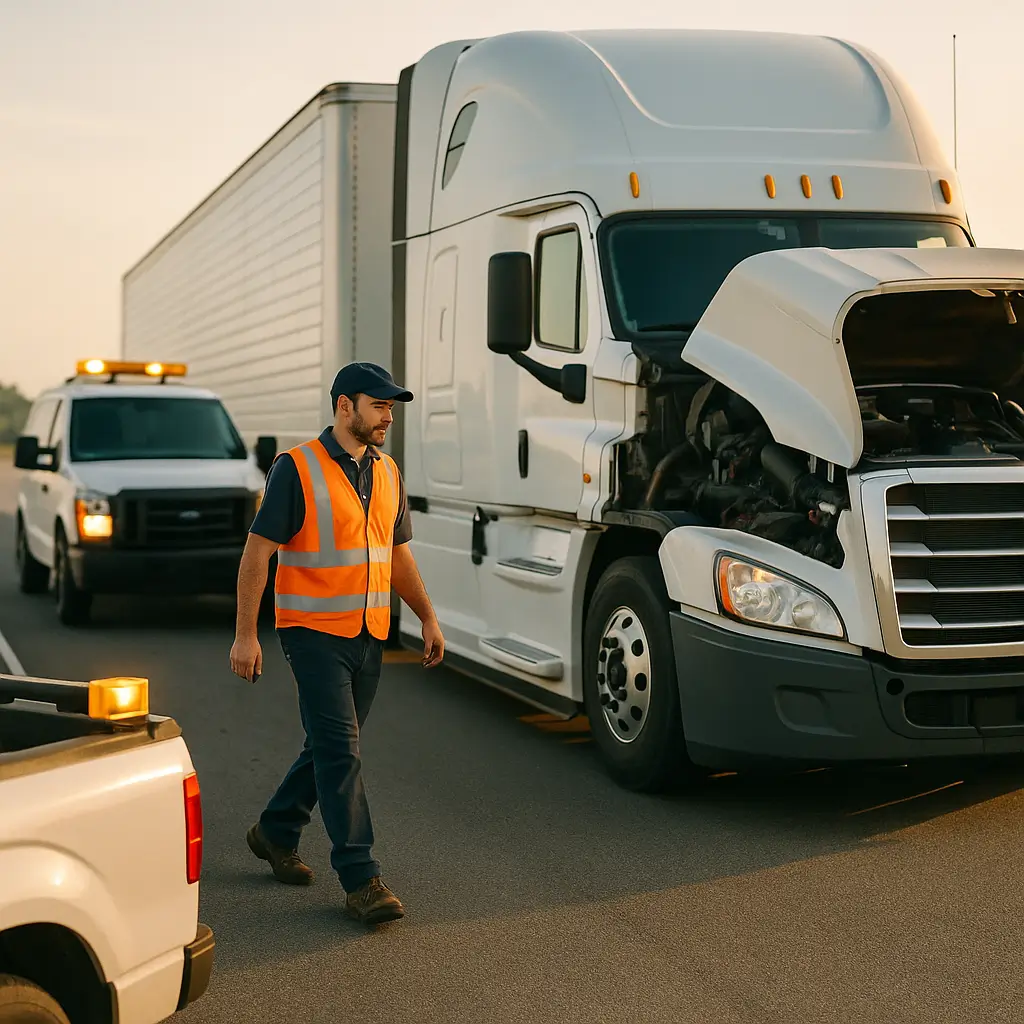

See what commercial truck roadside service covers, 2026 costs, towing, tires, fuel, mobile mechanics, and plan fees.
Commercial truck roadside service is a dispatch-and-vendor network that sends towing, tire help, fuel delivery, or a mobile mechanic to get you moving again—usually with mileage caps, dollar limits, and after-hours rules. In 2026, many basic plans run $0–$500 per year, but a single heavy-duty tow over the cap can cost more than a year of membership.
If you want the clean line between “roadside” and “insurance,” start with Semi truck insurance coverage basics so you don’t assume roadside is “included” when it’s not.
Table of Contents
Reading time: 9 minutes
- Key Takeaways
- What Is Commercial Truck Roadside Service (and What It Isn’t)
- What Commercial Truck Roadside Assistance Covers (9 Core Services)
- Membership vs Pay‑As‑You‑Go vs Insurance Add‑On (Which Model Fits?)
- Commercial Truck Roadside Service Cost in 2026 (Ranges + ROI + Choosing Checklist)
- Frequently Asked Questions
- Conclusion: Pick a Plan That Matches Your Lanes (Not Just the Price)

Key Takeaways
Commercial truck roadside service is a paid dispatch program (not “free repairs”) where towing caps, exclusions, and after-hours fees determine your real out-of-pocket cost.
- Roadside service is a dispatch + network + rules, not a blank check; the fine print is caps, exclusions, and billing.
- Towing limits are the make-or-break detail: one heavy-duty tow can exceed a full year of membership.
- Membership vs pay-as-you-go is a cash-flow decision: predictable budgeting often wins for OTR owner-operators.
- Insurance add-ons exist, but vary by state and carrier: compare limits, exclusions, and how claims/records are handled.
What Is Commercial Truck Roadside Service (and What It Isn’t)
Commercial truck roadside service is a program that dispatches help—tow, tire service, fuel delivery, lockout help, winching, or a mobile mechanic—using a vendor network with preset benefit limits and billing rules.
What it is (plain English)
Think of it as a “breakdown response system” you run through one phone number or app instead of hunting for providers while you’re parked on the shoulder.
What it isn’t
- It isn’t commercial truck insurance: liability, physical damage, cargo, and related coverages are separate from roadside dispatch; use Commercial truck insurance explained to avoid assuming an endorsement covers what it doesn’t.
- It isn’t unlimited towing: most plans apply a per-event mileage cap or a dollar cap, and you pay the overage.
- It isn’t maintenance: roadside is the parachute after something goes wrong, not the pre-trip that prevents it.
Who usually needs it
- Owner-operators (OTR or regional): one surprise invoice can crush weekly cash flow.
- Hotshot operators: a one-truck operation has no redundancy when you’re down.
- Small fleets: consolidated billing and fewer “random vendor” surprises make planning easier.
What Commercial Truck Roadside Assistance Covers (9 Core Services)
Most commercial truck roadside assistance plans cover nine core dispatch services—towing, mobile mechanic, tire service, fuel delivery, jump starts, lockouts, winching, minor parts delivery, and trip interruption support—while still charging for parts, overages, or recovery work.
What it covers (typical services)
| Service | What’s usually included | Common “you still pay” items |
|---|---|---|
| Heavy-duty towing | Dispatch + tow to a shop/safer location; sometimes a mile cap | Hook-up, mileage over cap, after-hours, recovery vs tow |
| Mobile mechanic / road repair | Dispatch; sometimes discounted labor | Labor time, diagnostics, parts, shop supplies |
| Tire service | Service call; mount/dismount; sometimes labor coverage | The tire (often), disposal fees, remote-area charges |
| Fuel delivery | Delivery service | The fuel + sometimes a delivery minimum |
| Jump start / battery help | Jump start | Battery replacement, electrical diagnostics |
| Lockout service | Help accessing cab | Key replacement, special lock systems |
| Winching / ditch pull-out | Winch assistance up to a cap | Recovery charges if “accident recovery” or severe conditions |
| Minor parts delivery | Delivery/logistics | The parts and sometimes the delivery fee |
| Trip interruption support | Sometimes hotel/meals (limited) | Anything beyond caps; often excluded entirely |
Pro tip (to reduce calls): Your cheapest roadside plan is fewer roadside events, and that starts with maintenance discipline—use Preventive maintenance checklist for trucks to cut avoidable failures that turn into towing and tire calls. For scheduling discipline across the year, pair it with the Annual Truck Maintenance Calendar for Owner-Operators.
One way to reduce roadside calls is tightening your maintenance and tire spend. This video covers tools that help:
Why it’s essential (the business case)
A breakdown rarely stops at the invoice because downtime creates a chain reaction: missed appointments, reschedules, detention headaches, and higher claim risk on sensitive freight.
Common exclusions and surprise charges (read this twice)
Most “cheap” plans become expensive through add-on billing categories that aren’t obvious on the brochure.
- After-hours / weekend rates
- Remote-area surcharges
- Accident recovery vs mechanical breakdown (often billed differently)
- Trailer coverage gaps (some plans cover power unit only)
- Hazmat/oversize restrictions (varies—get it in writing)
- Mileage overages beyond tow caps
How response time really works (real-world)
Roadside response time has two clocks: dispatch time (how fast they answer and assign) and provider arrival time (how far the vendor is, plus weather and local availability).
You can speed things up by providing a GPS pin, mile marker, nearest exit, unit details, trailer attached (yes/no), and tire size/position if it’s a tire event.
Membership vs Pay‑As‑You‑Go vs Insurance Add‑On (Which Model Fits?)
Commercial truck roadside service is commonly sold in three models—membership programs, pay-as-you-go dispatch, and insurance roadside endorsements—each with different pricing, caps, and administrative tradeoffs.
What it is (three common models)
| Model | Best for | Pros | Cons | Typical pricing structure |
|---|---|---|---|---|
| Membership program | OTR/regional owner-ops; predictable budgeting | One number/app; plan benefits; easier cash-flow planning | Caps and exclusions; overages can sting | Annual fee + covered benefits + overages |
| Pay-as-you-go dispatch | Local ops; low event frequency; spare equipment available | No annual fee; pay only when needed | Highest variance; remote calls can be brutal | Per-event service call + tow/miles + labor + parts |
| Insurance roadside endorsement | Drivers who want one policy/bill | Can bundle; policy-defined limits | Varies by state/carrier; limits may be low | Added premium + per-event limits (varies) |
Why it matters (don’t mix up “roadside” with “insurance”)
Roadside is an operational service to get you moving, while insurance is financial risk transfer for covered losses and legal liability.
To see exactly what your auto liability insurance covers — and what it doesn’t — this breakdown helps clarify the line between your insurance policy and your roadside plan:
Insurers sometimes offer roadside as an endorsement, but the limits and exclusions vary by carrier and state. Roadside is still separate from federally required financial responsibility; for regulatory baseline, review FMCSA insurance filing requirements before you assume a roadside add-on satisfies any insurance obligation.
To get terminology straight before you compare options, read Trucking insurance basics (coverages & endorsements).
Who should choose what (quick direction)
If you want to see how roadside plans compare with standalone breakdown coverage for owner-operator trucks, review that context before you commit to a model.
- If you run corridors + rural stretches: a membership program usually wins because you can’t control where breakdowns happen.
- If you’re truly local with backup equipment: pay-as-you-go may pencil better.
- If you want one bill: compare an insurance add-on, but verify towing caps, overage rules, and exclusions in writing.
For pricing specifics on the membership model, see commercial truck roadside assistance membership costs and plan structures. If you want to compare specific providers across these models, see best commercial roadside assistance picks and 2026 costs.
Commercial Truck Roadside Service Cost in 2026 (Ranges + ROI + Choosing Checklist)
In 2026, many basic commercial truck roadside memberships cost about $0–$500 per year, while pay-as-you-go service calls often start around $100–$400+ before towing miles, labor time, after-hours premiums, or recovery charges.
Typical 2026 cost ranges (what’s realistic)
| Cost item | Typical range (2026) | What drives the number |
|---|---|---|
| Membership fee | $0–$500/year (basic plans) | Vehicle class, tow cap, included services, network strength |
| Service call fee (pay-as-you-go) | $100–$400+ | Time of day, location, vendor availability |
| Heavy-duty tow (event cost) | High variance | Hook-up, mileage, winch/recovery, after-hours, terrain |
| Tire callout labor | $150–$500+ | Tire size, axle position, location, after-hours |
| Fuel delivery service | $75–$250+ (fuel extra) | Distance, minimums, time of day |
Why cost is a CPM decision (not a “membership” decision)
Roadside spend shows up as repair/maintenance cost plus downtime, and both hit your cost-per-mile when you miss revenue hours.
Before you run the ROI math on a roadside plan, it helps to see the full cost picture. This video walks through how repair and downtime costs hit your per-mile margins:
ATRI’s Operational Costs of Trucking report is a solid public reference for how repair/maintenance fits into overall operating cost categories.
If you want a practical way to run the numbers, compare roadside and downtime against your full operating picture using your owner-operator expenses and cost-per-mile.
3 quick ROI scenarios (conservative on purpose)
- One tow exceeds a year of membership: If a plan costs $300/year, avoiding one after-hours callout or one tow overage can pay for the membership by itself.
- Tire event: labor vs tire cost: Even if the program doesn’t pay for the tire, covering dispatch or labor can still prevent a painful bill in a remote area.
- Downtime cost (opportunity cost): An 8-hour day lost isn’t just time—it’s earning power, plus reschedules and deadhead repositioning; BLS wage data is a reasonable baseline reference for time value: BLS Occupational Outlook: Heavy and Tractor-Trailer Truck Drivers.
Provider comparison checklist (what to verify in writing)
- Tow cap: miles or dollars, and is it per event or per year?
- Overage billing: how it’s calculated (per mile, zone, hourly, etc.).
- Trailer coverage: power unit only or tractor + trailer?
- Tire program: labor covered, preferred network, call limits?
- Mobile mechanic: do they dispatch diesel techs, or just tow?
- Dispatch method: phone + app, GPS pin drop, ETA tracking?
- Billing: consolidated invoicing (fleet) vs driver pay-and-reimburse.
- Exclusions: accident recovery, off-road, extreme weather, hazmat/oversize restrictions.
Tech & app dispatch (small detail, big impact)
GPS pin drops and ETA tracking reduce “where exactly are you?” delays, which matters when every hour threatens an appointment window.
Breakdown playbook (while you wait)
- Get as far off the travel lane as conditions allow; hazards on. Having the right emergency kit for truckers in your cab shortens the gap between breakdown and stabilization.
- Set triangles per your operation and road conditions.
- Message dispatch/customer early with an updated ETA.
- Give roadside: GPS pin + mile marker + nearest exit + unit details + trailer attached (yes/no) + tire size/position if it’s rubber.
- Save invoices, tow miles, timestamps, and photos when safe.
If you’re sorting out whether a roadside membership, pay-as-you-go plan, or an insurance add-on fits your operation — or if you want to confirm there are no gaps between your roadside coverage and your commercial truck insurance — LogRock can help you look at the full picture. Talk to our team to ask questions, compare options, and request a quote matched to your lanes and truck class.
Speak with LogRock and request a quoteFrequently Asked Questions
Commercial truck roadside assistance eligibility, towing caps, and “what you still pay” charges vary by provider, so the fastest way to avoid surprises is to confirm limits and exclusions in writing before you rely on a plan.
Commercial truck roadside assistance typically covers dispatch for heavy-duty towing, mobile mechanic help, tire service, fuel delivery, jump starts, lockouts, and winching, with benefits capped by miles, dollars, or call limits.
Most programs still charge for parts, tires, towing mileage over the cap, and after-hours or remote-area fees, so the “covered” part is often dispatch and a defined allowance. Before you buy, ask whether the plan covers the tractor only or the tractor plus trailer, and how it treats “recovery” (ditch pull-out) versus a standard tow to a shop.
Roadside assistance is often worth it when one after-hours tow, tire callout, or remote-area dispatch could exceed the annual membership cost, because it converts unpredictable breakdown invoices into a more predictable budget line.
For OTR and regional owner-operators, the real win is reducing downtime chaos: one missed appointment can trigger reschedules, deadhead repositioning, and lost revenue hours. For truly local operations with backup equipment and low breakdown frequency, pay-as-you-go can be cheaper—just make sure you’ve priced realistic service call fees and towing overages for your area.
Most basic commercial roadside plans cover the power unit only, and trailer coverage is either excluded or sold as an add-on. Before enrolling, ask the provider directly whether the plan covers a tractor-trailer combination, what happens if the trailer requires a separate tow, and whether dolly service or fifth-wheel issues are included. If you regularly pull a trailer, a plan that excludes it can leave you paying a second tow invoice at a breakdown that generates only one incident. See tractor-trailer roadside assistance for plan options that cover both units.
Roadside assistance is an operational dispatch service — it sends help to get you moving and bills through a membership or per-event structure. On-hook towing insurance is a liability coverage that protects vehicles in your possession while being towed, typically required for tow operators rather than owner-operators seeking help. If you’re a trucker needing breakdown dispatch, roadside assistance is what you want. If you’re asking whether your insurer will pay for a tow after a covered physical damage event, that depends on your policy’s physical damage or motor truck cargo terms — not a roadside membership.
Many consumer roadside plans exclude commercial use and higher-GVWR vehicles, and their towing limits are often designed for passenger vehicles rather than tractors, straight trucks, or hotshot rigs with trailers.
Even when a consumer plan will dispatch, it may cap towing at a short distance and still leave you paying most of the heavy-duty invoice. If you run CDL work, verify eligibility, commercial-use rules, and tow capacity in writing, including whether a trailer is covered and whether “recovery” is excluded or billed separately.
Most U.S.-based commercial roadside programs cover the contiguous 48 states and may extend to Canada, but cross-border coverage is not universal — many plans exclude Mexico entirely, and those that cover Canada often apply the same tow caps and overage rules as domestic calls. If you run cross-border lanes, ask the provider explicitly whether the plan covers the specific countries you operate in, whether the vendor network exists in those areas, and whether billing works the same way. A gap in coverage in a remote area of Mexico or northern Canada can leave you paying a full-rate private tow with no dispatch support, which is often the most expensive scenario possible.
Commercial truck roadside memberships commonly cost about $0–$500 per year for basic coverage in 2026, but your total cost depends on tow mile caps, call limits, truck class, and what the plan does with tires and after-hours billing.
To keep the plan “affordable,” you should also reduce the behaviors and operating conditions that increase breakdown frequency and total risk; that same risk pattern shows up in underwriting too, so What affects truck insurance cost is a useful parallel read. Always ask for sample billing scenarios that show hook-up, mileage, labor, and after-hours pricing.
Calling for a roadside dispatch does not itself generate a CSA violation or appear on your insurance record. CSA scores are driven by roadside inspections, citations, and accidents reported through FMCSA’s Safety Measurement System — not breakdown service calls. However, the underlying reason for the breakdown could matter: a mechanical failure that results in an out-of-service order during an inspection, or an accident that requires roadside and generates a police report, can affect both. Keep invoices and timestamps from your roadside calls — they can be useful documentation if an insurer or underwriter questions a claim.
If a breakdown event results in an out-of-service order or an inspection entry you want to challenge, here’s how to use FMCSA’s DataQ system to address it:
Response time has two parts: how fast dispatch answers and assigns, and how far the nearest vendor is from your location. You control the first part by calling immediately rather than waiting, providing a GPS pin or what3words location, a mile marker and nearest exit, your unit details, whether a trailer is attached, and the specific problem, such as a flat tire with axle and position. The more complete your first call, the fewer callbacks to clarify and the faster the vendor can stage the right equipment. Plans with GPS-integrated apps let you drop a pin rather than describe your location, which is worth evaluating when comparing providers.
Start by calling dispatch again to confirm the assignment is active and get a revised ETA — sometimes a vendor is reassigned without notification. If the delay threatens an appointment or safety, ask dispatch to escalate to a closer vendor or authorize you to source one locally and submit for reimbursement. Keep a record of every call: timestamps, names, and what you were told. If you hire a private vendor, get a written invoice with itemized charges before the work starts — most plans that allow out-of-network service will reimburse up to a cap, but reimbursement claims require documentation. If the provider fails to arrive entirely, file a formal complaint with the roadside provider and document it in writing; repeated vendor failures in a region can affect your coverage renewal negotiation.
It depends on the plan and the lease terms. Some membership programs require you to be the registered owner or operator of the vehicle. Others will cover any truck you’re operating under your motor carrier authority at the time of the breakdown. Lease agreements sometimes include roadside coverage through the lessor — check your contract before buying a separate plan so you’re not paying twice or discovering a gap when you need it. If the truck is rented from a fleet and the lessor provides roadside, confirm the dispatch number and benefit limits before departure. If your lease situation also raises questions about insurance obligations and operating authority, owner-operator lease-on vs own authority insurance covers how coverage responsibilities are split.
It depends on how the plan defines eligibility. Some membership programs require you to be listed as the owner or operator of the vehicle; others cover any CDL driver operating under your motor carrier authority at the time of the event. If you’re leased on to a carrier, the carrier’s plan may already cover you — ask for the dispatch number and plan terms before departure so you’re not paying for a membership you don’t need or relying on coverage that won’t respond. If the carrier’s plan has weak towing limits or excludes your lanes, a supplemental individual plan can fill the gap. For operators who are weighing lease-on vs. running their own authority, those structural decisions also affect how insurance — not just roadside — is handled; see owner-operator lease-on vs own authority insurance for the full picture.
Roadside dispatch and an insurance claim are separate transactions. Calling for a tow does not automatically trigger a claim — only a claim filed through your insurer creates an insurance record entry. That said, if the breakdown was caused by an accident and you involve roadside and your insurer, both events may be documented independently. Keep the roadside invoice and timestamps as documentation, since some insurers may ask for a timeline when processing a physical damage or cargo claim tied to the same event. If you’re unsure whether to file a claim, speak with your insurer first — filing unnecessarily can affect your rate at renewal.
Yes, some commercial roadside programs offer plans for Class 3–5 vehicles, pickup-and-gooseneck setups, and non-CDL operations, while others are structured specifically for Class 7–8 tractors. The key distinction is how the plan defines an eligible vehicle: if it requires a CDL to operate or sets a minimum GVWR, non-CDL hotshots may be excluded from certain tow or tire coverage tiers. When shopping plans, confirm whether your truck class, trailer weight, and registration type qualify — and whether coverage extends to the trailer and any load-bearing equipment attached.
Most commercial roadside membership programs offer fleet accounts that consolidate billing and give each driver a single dispatch number or app login, rather than requiring per-driver enrollment. The practical advantages are fewer “which number do I call?” situations during a breakdown and easier end-of-month reconciliation. When comparing plans for a fleet, ask whether coverage is per-truck or per-driver, how benefit resets work (per event, per year per unit), and whether the plan supports consolidated invoicing or requires each driver to pay and submit for reimbursement. For fleets with multiple states in their lane mix, confirm that the network reaches the corridors you actually run.
No — commercial roadside assistance covers the vehicle dispatch and defined labor services, not the freight on board. If your cargo is damaged, delayed, or spoiled while the truck is broken down, that’s a motor truck cargo insurance matter, not a roadside claim. This gap matters especially for refrigerated loads, time-sensitive shipments, or high-value freight: the roadside plan gets the truck moving, but it does not compensate for load loss, temperature excursions, or missed delivery penalties. Review your cargo coverage limits and any shipper or broker contract requirements separately before assuming roadside handles the freight side of a breakdown.
Electric and alternative-fuel commercial trucks (CNG, LNG, hydrogen) have different breakdown profiles than diesel — a dead battery or fuel system issue requires specialized equipment that most traditional roadside vendors don’t carry. As of 2026, most mainstream commercial roadside programs do not have dedicated EV-specific service tiers for Class 7–8 trucks, though some vendors in major corridors are beginning to offer mobile charging units or hydrogen support. If you operate electric or alternative-fuel equipment, ask providers directly whether their vendor network can service your truck’s powertrain, what happens if the nearest specialized vendor is hours away, and whether a standard tow to a charging facility is covered under the same terms as a diesel tow to a repair shop. The gap between dispatch availability and EV-capable vendors is the main risk to confirm in writing before you rely on any plan.
Conclusion: Pick a Plan That Matches Your Lanes (Not Just the Price)
A commercial truck roadside plan only “works” when its tow cap, overage billing method, and exclusions match your lanes, truck class, and appointment pressure.
Rule of thumb: if one tow would wreck your week, buy the plan with the strongest towing terms for where you run—and confirm those terms in writing before you rely on them.
Key Takeaways:
- Choose based on tow cap + overage rules, not just the annual fee.
- Budget roadside as a cost-per-mile and downtime decision, not a “nice-to-have.”
- Verify trailer coverage, after-hours charges, and “recovery vs tow” definitions in writing.
If you’re running high-volume states, these guides are good follow-up reads: Texas commercial truck insurance guide and Florida commercial truck insurance guide.
If you’re evaluating roadside plans, want to confirm there are no gaps between your roadside service and your commercial truck insurance, or simply want a quote matched to your truck class and lanes — LogRock can help you work through the full picture. Talk to our team to ask questions, compare your options, and get a quote.
Speak with LogRock and request a quote




