
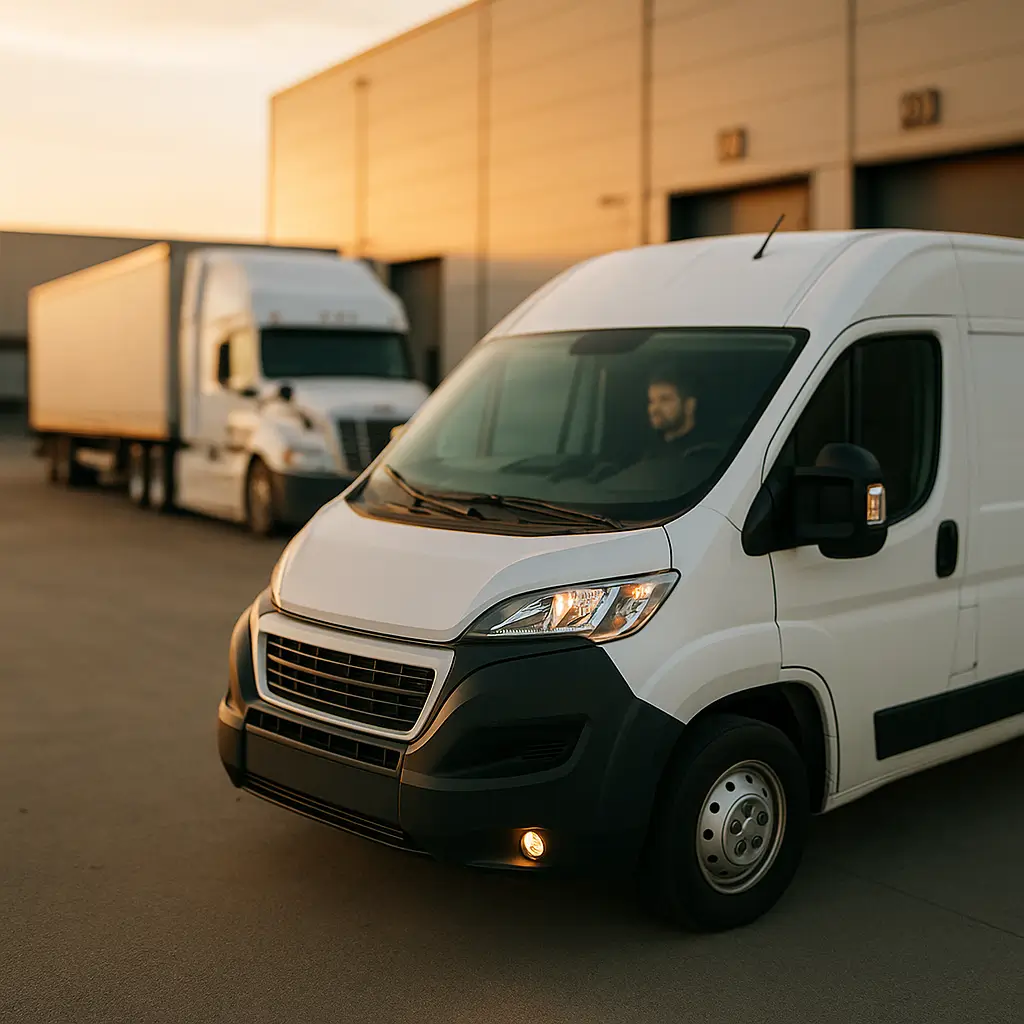

Learn 5 essential courier van insurance coverages, 2026 costs from $2K–$9K, and key US vs. UK terms to meet delivery contract requirements.
Courier van insurance is commercial coverage for delivery-for-pay vans, and it’s built for high mileage, frequent stops, and contract-driven insurance limits that personal auto policies typically don’t cover.
If you’ve been pricing this like a normal policy, start by comparing it to a true commercial baseline for vans and then layer in courier-specific needs; here’s the on-site guide to cargo van insurance.
Courier van insurance is commercial auto coverage for vans delivering packages or goods for pay. It typically includes liability (damage/injuries you cause), can include physical damage (your van), and often adds cargo/goods-in-transit and general liability for delivery-site incidents. It’s designed for high-mileage, multi-stop delivery work—not personal driving.
Table of Contents
Reading time: 8 minutes
- Key Takeaways
- What Is Courier Van Insurance (and Why Personal Auto Usually Isn’t Enough)
- Courier Van Insurance Coverage Checklist (5 Core Coverages)
- Requirements: US vs UK (So You Buy the Right Policy)
- How Much Does Courier Van Insurance Cost in 2026? (Plus How to Pay Less Without Getting Burned)
- Frequently Asked Questions
- Conclusion: Match Your Coverage to Your Contract (Then Shop Prices)

Key Takeaways
Courier van insurance for delivery-for-pay commonly requires commercial-rated liability plus contract-driven add-ons, and many 2026 policies price in the $2,000–$9,000/year range depending on limits, radius, drivers, and loss history.
- Personal auto usually won’t cut it: Misclassification is a common reason claims get denied when the vehicle is used for delivery-for-pay.
- Most couriers need layers: Liability + physical damage + cargo/goods-in-transit + general liability are the most common “contract-safe” building blocks.
- Cheapest isn’t best: The lowest premium often means missing a required coverage, an excluded loss, or limits too low to keep the contract.
- Shop apples-to-apples: Compare quotes only after matching limits, deductibles, drivers, and cargo responsibility.
What Is Courier Van Insurance (and Why Personal Auto Usually Isn’t Enough)
Courier van insurance is commercial truck insurance for vans used to deliver goods for compensation, and it’s rated for high-mileage, multi-stop operations that insurers treat differently than commuting or personal use.
What it is (plain English)
Courier work includes last-mile routes, same-day delivery, medical runs, and contract parcel delivery where you’re paid to transport someone else’s property. Even if you’re not in a semi, you’re still operating a business vehicle with business exposure.
If you’re moving from gig driving into true for-hire contracts, a quick overview of how commercial policies are structured helps; start with commercial truck insurance requirements.
Why it’s essential (business risk + contract reality)
Courier operations change the risk profile in ways underwriters care about, and those same differences are why shippers and platforms ask for a COI (Certificate of Insurance).
- Frequency risk: More starts/stops, more backing, more parking-lot incidents.
- Theft exposure: Doors open often, packages are visible, and “quick drop-offs” create opportunity.
- Contract requirements: Many clients require specific limits and COI wording (additional insured, waiver of subrogation, primary & noncontributory, and cargo requirements).
Who typically needs it
- Owner-operators with one van doing delivery-for-pay
- Small fleets running 1–5 vans doing last-mile delivery routes
- Drivers transitioning from personal use into for-hire delivery contracts
UK terms you’ll see online (and the US equivalents)
Courier insurance search results often mix UK and US language, and the terms aren’t 1:1—so translate before you buy.
- Hire & Reward (UK): For-hire / delivery-for-pay classification (US wording varies by carrier)
- Goods in Transit (UK): Cargo coverage / motor truck cargo (US)
- Public liability (UK): General liability (US)
Courier Van Insurance Coverage Checklist (5 Core Coverages)
The most common courier van insurance package includes five core coverages—liability, physical damage, cargo/goods-in-transit, general liability, and UM/UIM/Med Pay—because courier losses typically involve crashes, theft, delivery-site incidents, and injury downtime.
Not sure how auto liability and general liability work together? This breakdown explains both coverages and when each one applies:
| Coverage | What it covers | Who usually requires it | Typical note |
|---|---|---|---|
| Commercial auto liability | Injuries/property damage you cause | State + contracts/platforms | Often the first thing a client asks to see |
| Physical damage (comp/collision) | Your van (theft, crash, weather) | Lenders/leases; smart cash-flow planning | Deductible choice matters |
| Cargo / Goods in Transit | Packages while in your care | Contracts/clients | Exclusions matter (unattended vehicle, high-value items) |
| General liability | Non-auto claims at delivery sites | Warehouses/clients | Covers “oops” moments carrying packages inside |
| UM/UIM + Med Pay (where available) | Injuries when the other driver is uninsured/underinsured | Optional but valuable | More road time = higher odds of needing it |
1) Commercial auto liability (often required)
Commercial auto liability pays for bodily injury and property damage to others when you’re at fault, and it’s the backbone coverage in most courier contracts and COI checks.
If you want a deeper breakdown of limits, exclusions, and why “state minimum” often fails contract requirements, read commercial auto liability insurance explained.
Pro tip: Liability doesn’t pay for your van or your packages—those exposures are handled by physical damage and cargo/GIT.
2) Physical damage (comprehensive + collision)
Physical damage coverage typically combines comprehensive and collision to cover your van for crashes, theft, vandalism, and many weather losses, and it’s commonly required if the van is financed or leased.
Pro tip: Choose a deductible that matches your real emergency fund. A higher deductible can lower premium, but it increases the cash hit on day one of a claim.
3) Cargo coverage (US) / Goods in Transit (UK)
Cargo/Goods-in-Transit coverage protects packages while they’re in your “care, custody, and control,” which is the legal exposure many courier contracts push onto the driver or carrier.
Common denial triggers include unattended vehicle theft, high-value items not scheduled or excluded, and losses caused by improper securing. If you want the US-specific version of how cargo claims get adjusted, see cargo insurance for cargo vans.
4) General liability (GL) / Public liability (UK)
General liability (GL) covers third-party claims that aren’t caused by an auto accident, like damaging property while carrying a package inside or causing a slip-and-fall hazard at a delivery site.
For limits, costs, and COI language around GL coverage, see general liability for trucking businesses.
This is the coverage that often satisfies “public liability” language in contracts and warehouse requirements.
5) Uninsured/underinsured motorist + medical payments (where available)
UM/UIM and Medical Payments (Med Pay) can help cover injuries and medical costs when the other driver has no insurance or not enough, and availability and rules vary by state.
If you’re on the road all day, the probability of being hit by someone else goes up—so this is often a smart “stay working” coverage for owner-operators.
For state-by-state rules and 2026 cost context, see UM/UIM coverage for truck drivers.
Requirements: US vs UK (So You Buy the Right Policy)
Courier van insurance requirements are driven by state commercial auto rules, contract COI language, and sometimes FMCSA federal triggers when you operate as a regulated interstate motor carrier.
US: platform + state + (sometimes) federal triggers
In the US, your real-world “requirements” usually come from three places:
- State rules: Commercial auto requirements vary by state, and state minimum limits often don’t meet contract standards; use the NAIC state insurance departments directory to confirm your state regulator.
- Your contract/platform: Limits, COI wording, additional insured, waiver of subrogation, and cargo requirements are common.
- Federal rules (when applicable): FMCSA filings/registration can be triggered by interstate operations and specific business models.
FMCSA references (official):
For the practical “paper trail” side—especially if you’re crossing state lines or scaling into regulated operations—review DOT compliance and insurance records.
Pro tip (contract survival): Ask for COI requirements in writing and confirm: limits, additional insured, waiver of subrogation, primary & noncontributory wording, and cargo limits/exclusions.
UK: common terms you’ll see in quotes
UK courier quotes often bundle terms like Hire & Reward, Goods in Transit, and Public Liability, and those terms don’t automatically match how US carriers rate courier risk.
Bottom line: Don’t buy based on UK wording if you operate in the US—the biggest risk isn’t overpaying, it’s buying the wrong use classification and finding out after a loss.
How Much Does Courier Van Insurance Cost in 2026? (Plus How to Pay Less Without Getting Burned)
Courier van insurance cost in 2026 commonly falls in the $2,000–$9,000 per year range for many setups, but new ventures, dense metro routes, higher limits, and prior claims can push pricing higher.
For a full picture of what courier van business costs look like in 2026 — including insurance — this breakdown covers the numbers:
Typical 2026 cost ranges (why the spread is so wide)
Price usually moves with the risk factors underwriters can measure, especially driving history, operating radius, garaging location, theft frequency, limits, and whether you’ve had a recent lapse.
- Higher limits: More severity exposure (bigger losses), especially when contracts require higher liability limits.
- Urban density: More claims frequency and more theft opportunity.
- Prior losses or lapses: Fewer carrier options and higher pricing for multiple terms.
- Multiple drivers: Especially when drivers are inexperienced or have adverse MVRs.
| Scenario | What usually drives price | “Best lever” to improve it |
|---|---|---|
| New courier, dense metro routes | No commercial history + high frequency/theft risk | Tighten radius/operations; raise deductible only if cash exists |
| Experienced driver, stable routes | Predictable exposure and better underwriting profile | Shop multiple markets at renewal with identical limits |
| Higher limits + cargo responsibility | Severity exposure + cargo claim potential | Document procedures, secure parking, and cargo controls |
Monthly vs annual payments (why monthly feels expensive)
Commercial policies often require a down payment and then installments that may include billing or finance fees, which is why “monthly” can feel steep even when the annual premium is reasonable.
If cash flow is tight, budget the down payment like fuel and maintenance; a missed payment can create a lapse, and lapses can raise rates and reduce carrier options for years.
How to reduce courier van insurance premiums (without getting underinsured)
Affordable pricing usually comes from reducing frequency risk, reducing theft risk, and proving consistent operations—not from stripping coverages your contract expects.
A practical starting point is affordable trucking insurance savings playbook, and these tactics translate well to couriers:
- Pick deductibles strategically: Don’t choose a $2,500 deductible if you don’t have $2,500 available.
- Use dashcams/telematics: Helps defend claims and can improve underwriting results with some carriers.
- Control drivers: Run MVR checks, list every driver, and enforce incident reporting.
- Reduce theft exposure: Secure parking, lockboxes, and a “no unattended with visible packages” rule.
- Shop correctly: Compare quotes with the same limits, deductibles, drivers, and cargo terms.
Here’s a deeper look at the factors underwriters use to price policies like yours — and where the real pricing levers are:
Common courier insurance mistakes that can void a claim
Courier claim problems are often caused by classification and paperwork mistakes, not the accident itself.
- Misclassifying use: Saying “personal use” when it’s delivery-for-pay.
- Skipping cargo/GIT: Even though the contract makes you responsible for packages.
- Underbuying liability: Losing contracts because your COI doesn’t meet requirements.
- Letting the policy lapse: Often raises premium and reduces market options.
- Not listing drivers: Allowing unauthorized drivers can trigger coverage disputes.
For deeper underwriting context, see the courier van insurance cost in 2026 guide and these common insurance mistakes that increase costs.
Frequently Asked Questions
In most cases, no. Personal auto policies typically exclude delivery-for-pay use, which means a claim that occurs during a paid delivery run can be denied outright. If you use a van for gig delivery or contract routes, you need coverage rated for commercial or for-hire use — even if the vehicle itself is the same. Misclassifying use is one of the most common reasons courier claims get disputed.
Courier van insurance is commercial auto insurance rated for vans used to deliver goods for pay, and it typically includes liability plus optional physical damage, cargo/goods-in-transit, and general liability based on contract requirements.
This coverage is priced and underwritten differently than personal auto because courier work usually means higher mileage, frequent stops, more backing/parking exposure, and higher theft frequency. If a policy is written for personal use (or the wrong business class), insurers can dispute claims when the loss happens during delivery-for-pay operations.
Courier van insurance cost in 2026 commonly ranges from $2,000 to $9,000 per year for many owner-operators, with higher premiums possible for new ventures, dense metro routes, higher liability limits, prior claims, or any recent coverage lapse.
Pricing is usually driven by driver history (MVR), garaging ZIP code, operating radius, delivery type (general parcels vs high-value/medical), deductibles, and how many drivers are listed. To compare fairly, keep limits and coverages identical across quotes so you’re measuring price, not missing protection.
If your contract makes you responsible for packages while they’re in your care, custody, and control, you should carry goods-in-transit (UK) or cargo coverage (US) with limits that match the contract and realistic load values.
Cargo/GIT is where exclusions often decide the claim, including unattended vehicle theft, high-value items, temperature-sensitive goods, and improper securing. For a US-focused explanation of cargo terms and common denial points, review the cargo insurance for cargo vans guide and confirm your courier agreement’s required limits in writing.
Hire & Reward cover is a UK term meaning the vehicle is used to carry goods for payment, and in the US this is handled as a commercial delivery/for-hire use classification (carrier wording varies).
The practical rule is disclosure: if you’re delivering for compensation, your policy must be rated for that exposure so the insurer can price the risk correctly and avoid claim disputes. If you’re operating in the US, buy US-appropriate commercial coverage and make sure the COI matches your contract language (limits, additional insured, and any cargo requirements).
It depends on the contract, but common requirements include a minimum of $1,000,000 combined single limit (CSL) for commercial auto liability, a $1,000,000 general liability limit, and cargo limits matched to your average load value. Many warehouse and platform clients also require additional insured status, waiver of subrogation, and primary & noncontributory wording. Ask your client for the COI requirements in writing before you bind coverage.
Only drivers listed on the policy are covered by default. If an unlisted driver operates the van — even occasionally — a claim during that trip may be disputed or denied. List every driver who uses the vehicle, run MVR checks before adding them, and notify your insurer immediately if a driver changes. Most policies price additional drivers based on their MVR.
It depends on which coverages you carry and your policy’s exclusions. Physical damage (comprehensive) may cover the van itself if it was damaged in the break-in. Cargo/goods-in-transit coverage may cover stolen packages — but watch for the unattended vehicle exclusion, which some policies apply when the van is left alone with visible cargo. To reduce exposure, use lockboxes, avoid leaving packages visible, and confirm how your cargo policy handles theft from an unattended vehicle.
FMCSA requirements are triggered by specific operating conditions — mainly interstate commerce and certain carrier registration thresholds — not simply by doing courier work. Many local or metro courier operations using vans under 10,001 lbs GVWR may not require FMCSA registration, but they still need commercially rated auto coverage to meet state requirements and client COI demands. If you cross state lines, carry regulated cargo, or operate as a registered for-hire carrier, FMCSA insurance filing requirements can apply.
Yes, but expect fewer carrier options and higher premiums. Most standard markets want a clean or near-clean MVR for the past 3–5 years. If your record includes at-fault accidents, DUIs, or serious violations, you may need a non-standard or surplus-lines market, which typically costs more. Be upfront with your agent so they can approach the right carriers; misrepresenting your MVR can create claim problems later.
Conclusion: Match Your Coverage to Your Contract (Then Shop Prices)
If you’re ready to build a coverage package that matches your courier contracts — or just want to see where your current policy has gaps — LogRock can help. Share your route type, cargo, and required limits, and our team will walk you through your options and put together a quote on an apples-to-apples basis.
Speak with LogRock and request a quote
If you’re ready to build a coverage package that matches your courier contracts — or just want to see where your current policy has gaps — LogRock can help. Share your route type, cargo, and required limits, and our team will walk you through your options and put together a quote on an apples-to-apples basis.
Speak with LogRock and request a quoteCourier van insurance isn’t about buying “more coverage.” It’s about buying the right layers so one loss doesn’t wipe out months of profit—or cost you the contract.
Start by getting your client/platform requirements in writing, build the package (liability + physical damage + cargo/GIT + GL as needed), then shop quotes with the same limits and deductibles.
Key Takeaways:
- Build coverage around your COI requirements, not guesses or UK terminology.
- Expect many 2026 courier van policies to land in the $2,000–$9,000/year range, with big swings based on risk factors.
- Compare quotes only after matching limits, deductibles, drivers, and cargo terms.
If you share your route type (local/metro/regional), what you haul (general parcels/medical/high-value), and required limits, you can quote courier van insurance on an apples-to-apples basis.





