
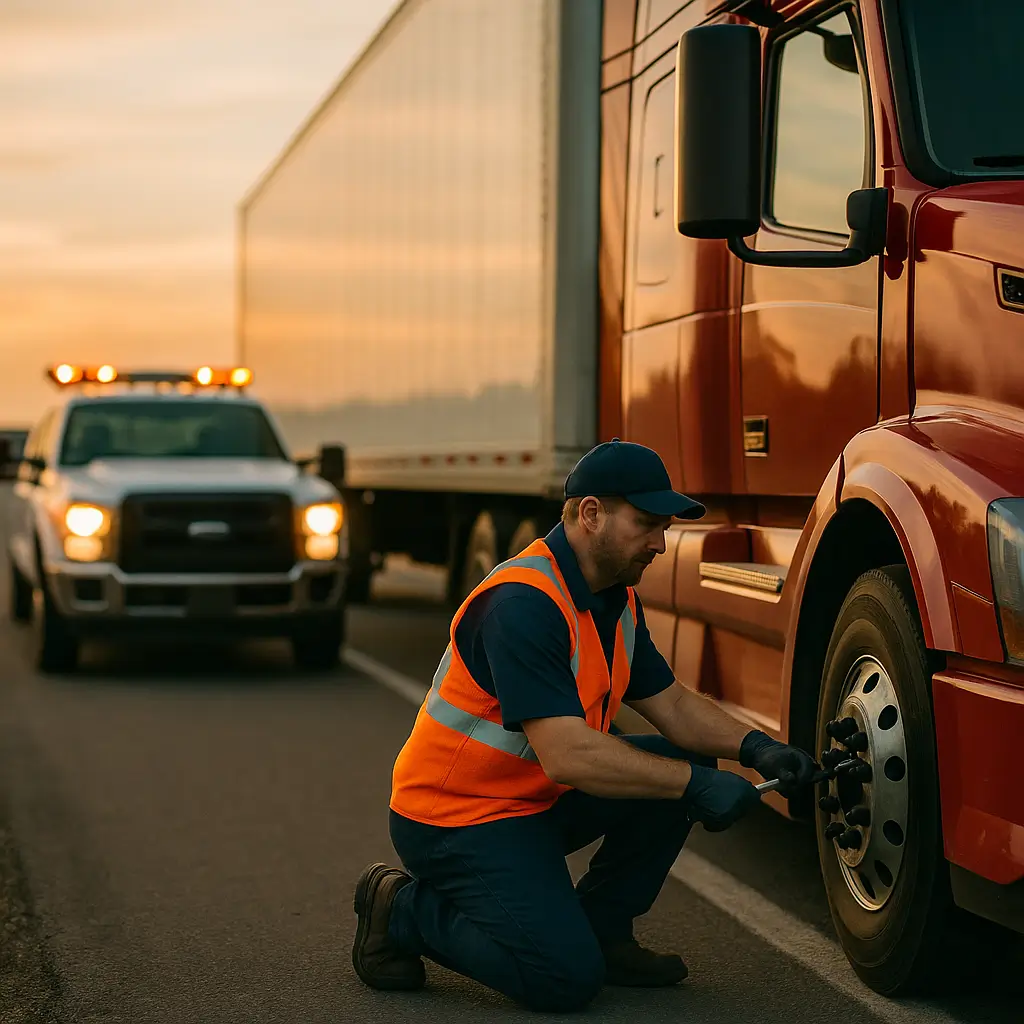

See 2026 tractor trailer roadside assistance costs, common services, towing limits, trailer rules, per-call pricing, annual plans, and ROI tips.
Tractor trailer roadside assistance isn’t just a “nice to have”—one breakdown can erase a week’s profit if towing, recovery, and downtime stack up fast. Most operators pay $300–$900 per truck per year for a membership-style plan (based on 2026 provider rate surveys; your cost will vary by tow-mile limits, trailer coverage, and number of units), while pay-per-call commonly runs $25–$350+ for small issues and $1,000–$5,000+ when heavy towing or recovery is involved.
Before you buy a plan (or assume your policy covers it), make sure you understand where roadside ends and insurance begins—especially if you’re trying to keep your commercial truck insurance costs under control. If you need the bigger coverage picture first, start with commercial truck insurance basics.
Table of Contents
Reading time: 8 minutes
- Key Takeaways
- What Tractor Trailer Roadside Assistance Is (and What It Isn’t)
- The 7 Must-Have Services in Tractor Trailer Roadside Assistance (Plus Common Limits)
- 2026 Pricing: Membership vs Insurance Add-On vs Pay-Per-Call (With ROI Math)
- How to Choose the Right Plan (Owner-Op Checklist) + Mobile Mechanic vs Towing
- Frequently Asked Questions
- Conclusion: Buy Coverage That Matches Your Trailer, Lanes, and Limits

Key Takeaways
The biggest roadside-assistance “gotchas” come from trailer towing rules, tow-mile/cost caps, and whether a provider treats the tractor and trailer as one event or two separate tows.
- Trailer rules matter: Confirm the plan tows the tractor + attached trailer together, not as two billed events.
- Pricing is about limits, not slogans: Low annual fees often mean low tow miles and tight labor caps, which can hurt when you’re 60+ miles from a heavy-duty shop.
- Mobile mechanic vs towing is a business decision: The cheapest option is often the one that prevents a second bill (failed roadside repair + tow).
- Roadside isn’t trucking insurance: It complements a semi truck insurance program; it doesn’t replace required liability filings.
What Tractor Trailer Roadside Assistance Is (and What It Isn’t)
Tractor trailer roadside assistance is a dispatch service and vendor network that sends help for common breakdown events like tire service, jump-starts, fuel/DEF delivery, lockouts, minor repairs, and towing/recovery when the unit can’t roll.
What it is (plain English)
You’re paying for speed, coordination, and negotiated service access when you’re stuck on the shoulder or at a shipper. The best plans also make billing predictable (or at least capped) when a situation gets messy.
Why it’s essential (business risk)
Roadside service is less about convenience and more about controlling the costs you don’t see on the invoice:
- Downtime: lost revenue, missed reloads, layovers, and weekend “dead time.”
- Unplanned repair costs: after-hours labor, travel fees, and “remote location” surcharges.
- Safety risk: shoulder exposure at night, weather, and traffic.
- Load risk: appointment failures, reefer temperature issues, and claims friction.
This 60-second breakdown covers why the wrong coverage decisions can cost owner-operators more than they expect:
What it isn’t
Roadside assistance is not a substitute for required insurance or financial responsibility, and FMCSA filing requirements are separate from roadside service programs. FMCSA outlines insurance filing requirements here: FMCSA insurance filing requirements.
It also isn’t the same as “towing only.” Many programs advertise towing but cap or exclude the services that actually get you rolling again.
Roadside assistance vs insurance add-on (endorsement)
Roadside is usually purchased either as an insurance add-on/endorsement attached to your policy or as a standalone membership with its own contract and limits.
- Insurance add-on: convenient billing, but sometimes lower tow miles and strict labor caps.
- Standalone membership: separate contract, often more detailed heavy-duty terms, sometimes better for OTR lanes.
If you’re deciding between the two, review how endorsements work inside policies: truck insurance add-ons (including roadside).
The 7 Must-Have Services in Tractor Trailer Roadside Assistance (Plus Common Limits)
Roadside packages vary so much that two plans with the same “features list” can differ by hundreds or thousands of dollars in what you’ll pay out-of-pocket because of tow limits, labor caps, recovery rules, and trailer language.
Here’s what to verify before you buy.
| Service | Usually Included? | Typical Limits to Watch | Common Exclusions/Surprises |
|---|---|---|---|
| 1) Towing & recovery | Yes | Tow miles/time, max payout, “nearest shop only” | Recovery/winch often capped or excluded |
| 2) Tire service (tractor + trailer) | Sometimes | Service call vs labor cap | Tire cost usually extra; mount/balance billed |
| 3) Fuel/DEF delivery | Yes | Dispatch fee vs fuel cost | Minimum gallons; after-hours markup |
| 4) Battery/jump | Yes | Jump only vs diagnostic | Alternator/starter issues not “covered” |
| 5) Lockout | Sometimes | Basic entry only | Key cutting/programming excluded |
| 6) Minor roadside repair / mobile mechanic dispatch | Sometimes | Labor cap, callout fee | Parts always extra; vague “repair” language |
| 7) Trip interruption (if offered) | Rare | Daily caps, qualifying events | Paperwork-heavy; exclusions common |
1) Towing & recovery (tractor + trailer rules matter)
Towing and recovery can run $1,000–$5,000+ when a heavy wrecker, winching, or a loaded trailer is involved (rates vary significantly by region, load, terrain, and time of day — your specific quote will differ), so your tow-mile and payout caps matter more than the annual membership price.
Read towing language like a contract, not an ad. If you want a deeper breakdown of caps and exclusions, review towing coverage explained for semi trucks.
2) Does it cover the tractor and trailer together?
Many roadside plans either cover the power unit only or treat the tractor and trailer as two separate tows, which can mean two dispatches, two caps, and two bills.
Confirm these three items in writing:
- Is the attached trailer included (not just the tractor)?
- Is it one tow event or two separate tows?
- Is it covered loaded and empty, and how do they define “attached”?
3) Tire service (don’t assume trailer tires are included)
Some plans cover the service call but not the tire, and others treat steer tires differently than drives or trailer tires.
If you run odd sizes or wide-base singles, ask about vendor availability in your lanes. “Covered” doesn’t help if nobody can source the rubber.
2026 Pricing: Membership vs Insurance Add-On vs Pay-Per-Call (With ROI Math)
Most operators see roadside membership pricing around $300–$900 per truck per year, but the real cost difference comes from tow miles/caps, labor limits, and whether the trailer is included.
If you want to understand how roadside stacks with broader breakdown coverage options, LogRock covers five scenarios with 2026 cost ranges.
Why breakdowns cost more than the invoice
Your real cost is usually: service bill + downtime + missed appointment risk. ATRI’s Analysis of the Operational Costs of Trucking — updated annually — consistently shows repair, maintenance, and downtime as significant line items in total per-mile operating cost.
Typical annual cost ranges (what operators actually see)
| Plan Type | Typical Annual Cost (Per Truck) | Tow/Labor Limits | Trailer Included? | Best For |
|---|---|---|---|---|
| Membership roadside | ~$300–$900/yr | Varies widely | Sometimes | Owner-ops who want predictable spend |
| Insurance add-on/endorsement | Often lower than membership (varies) | Often tighter caps | Sometimes excluded | One-bill simplicity + basic help |
| Pay-per-call | $0/yr | You pay full rate | Yes, if you pay | Low-incident operations or “rare breakdown” setups |
Pricing swings for the same reason your semi truck insurance and trucking insurance premiums swing: equipment, operating radius, claims history, and risk profile. For the quick version of those variables, see what affects truck insurance cost.
Per-incident cost breakdown (the missing piece)
Use these ranges for quick planning and ROI math (your location and after-hours timing can push costs higher):
| Event Type | Typical Per-Call Range | What Drives Cost Up Fast |
|---|---|---|
| Jump-start | $25–$150 | After-hours, remote location, diagnostics |
| Fuel/DEF delivery | $50–$250 + fuel | Minimum gallons, after-hours, rural lanes |
| Lockout | $75–$250 | Key cutting/programming (often excluded) |
| Tire service (labor only) | $150–$500 | Night callouts, tire size availability, trailer tires |
| Short tow | $300–$900 | Heavy wrecker, loaded trailer, clearance constraints |
| Long tow/recovery | $1,000–$5,000+ | Winching, rollover, remote recovery, multiple units |
Quick ROI rule of thumb (simple, usable)
Annual membership ROI ≈ (expected calls/year × average out-of-pocket per call) − annual membership cost
If you expect 2–3 incidents per year, a $500–$800 plan can pay for itself quickly—especially when it includes the trailer under one tow event.
Two real-world-style scenarios (how the math plays out)
Case Study A — Membership paid off (multiple calls):
An OTR owner-operator running Midwest → Northeast has 3 events in a year: one jump, one trailer tire call at night, and one tow to the nearest heavy-duty shop. Pay-per-call could land around $1,200–$2,500+ depending on after-hours and tow distance. A mid-tier membership with decent tow miles and clear trailer terms kept the out-of-pocket lower and more predictable.
Case Study B — Pay-per-call was fine (rare event):
A regional day-cab operation with strong maintenance discipline has one fuel delivery in two years. In that model, annual fees can exceed the single event cost, so a maintenance reserve plus pay-per-call can be rational.
If you’re doing the ROI math on a membership plan, this short clip on protecting your per-mile margin is worth 60 seconds:
How to Choose the Right Plan (Owner-Op Checklist) + Mobile Mechanic vs Towing
The best roadside plan is the one that matches your operation—OTR vs regional, power-only vs trailer ownership, reefer vs dry van, and the tow/recovery reality in the lanes you actually run.
Choose based on how you run
- OTR vs regional/local: remote lanes increase tow and recovery risk.
- Power-only vs you own the trailer: trailer coverage matters more when it’s yours.
- Reefer vs dry van: temp-sensitive freight makes downtime expensive fast.
- Hotshot vs semi: equipment and towing rules differ, and assumptions get costly.
10 questions to ask before you buy (copy/paste this)
- Does it cover tractor + attached trailer as one tow event?
- Tow limits: miles, hours, dollar cap—which one applies first?
- Do they tow to the nearest qualified shop only, or your preferred shop?
- What is the labor cap, and what counts as labor vs a service call fee?
- Is it direct-bill (they pay the vendor) or reimbursement (you pay first)?
- Are there after-hours/holiday surcharges?
- Are winching/recovery events covered or excluded?
- Tire coverage: service only, or discounts on the tire itself?
- Are trailer tires explicitly included?
- Are there cancellation fees or multi-vehicle requirements?
Mobile mechanic vs towing: when each is worth it
Mobile repair wins when it’s minor (air leaks, hoses, clamps, sensors, lights), you’re in a high-traffic corridor, and a tech can realistically fix it in one visit.
Towing is smarter for safety-critical failures (wheel-end, steering, major coolant loss), repeated no-starts with an unknown cause, or anything likely to become “pay twice” (failed road fix + tow).
Labor rates vary by market, and roadside rates are often higher than shop wage numbers due to travel, overhead, and after-hours factors (BLS diesel tech information: BLS diesel service technician and mechanic data).
Pro tip: reduce calls with maintenance discipline
Preventing one after-hours tire or no-start call can cover a big chunk of an annual membership fee. If you want a practical routine you can run between loads, use a preventive maintenance program for semi trucks.
Frequently Asked Questions
Roadside assistance sometimes covers the tractor and attached trailer together, but only if the contract explicitly includes both units as one tow/recovery event. Many plans cover the power unit only, or they’ll cover both but treat them as two separate tows, which can mean two dispatches and two caps. Ask for the exact trailer language in writing, confirm whether coverage applies loaded vs empty, and verify the tow destination rule (nearest qualified shop vs your preferred shop). If your freight is time-sensitive, “nearest shop only” can add downtime even when the tow is paid.
It depends entirely on the plan’s contract language. Some plans cover a loaded trailer the same as an empty one; others restrict coverage or increase fees when cargo is on board because recovery risk is higher. Reefer operators have an additional concern: if the tractor is towed but the loaded trailer is left on a shoulder, temperature-sensitive freight may be at risk. Before you sign, confirm whether “loaded” vs. “empty” changes your coverage terms, and whether the plan addresses what happens to an attached trailer that can’t move with the tractor.
Commercial truck roadside assistance typically costs $300–$900 per truck per year for a membership plan, with price driven by tow miles, labor caps, after-hours rules, and whether the trailer is included. Insurance endorsements can be cheaper upfront, but they often come with tighter limits that increase out-of-pocket on a real tow. A simple ROI check is: (expected calls/year × average per-call cost) − annual fee; if you expect 2–3 calls/year, membership often wins, especially when towing and trailer terms are strong.
If your tow-mile limit runs out before you reach a qualified shop, you typically pay out-of-pocket for the remaining distance at the provider’s per-mile rate — which can add up quickly in rural areas. Some plans cap the total payout in dollars rather than miles, which can be equally limiting on a long haul. Before you buy, ask specifically: “What do I pay if the shop is 80 miles from the breakdown?” A plan with a 50-mile tow limit may still leave you with a $300–$500 gap fee. Knowing the per-mile overage rate in advance is part of the real cost comparison. See breakdown coverage for broader protection options.
Tractor trailer roadside assistance usually includes a mix of towing, tire service, jump-start, fuel/DEF delivery, lockout, and limited mobile repair dispatch, but the “included” list matters less than the limits. The terms that decide your bill are tow-mile or dollar caps, labor caps, after-hours surcharges, recovery/winch exclusions, and whether trailer tires and the attached trailer are covered. Always confirm whether the plan direct-bills the vendor or reimburses you after you pay, because reimbursement models can strain cash flow.
Response time is one of the most underrated variables in a roadside plan — and one of the hardest to find in the brochure. Response windows for heavy-duty service typically range from 1–4 hours for common events (tire, jump, fuel) in a corridor area, and can stretch to 6+ hours for heavy recovery in rural or remote lanes. Plans with larger vendor networks generally respond faster, but “network size” is rarely defined in the contract. Ask providers specifically about average response times in the corridors you actually run — not a national average — and look for any SLA (service level agreement) language in the contract.
Roadside assistance can be cheaper as an insurance add-on, but the tradeoff is often tighter tow and labor caps and weaker trailer coverage, which can cost more during a $1,000–$5,000+ tow/recovery event. Whether it “affects claims” depends on how the endorsement is administered; some work like a service benefit, while others feel closer to a claim or reimbursement process. If you’re building a complete protection stack (liability + physical damage + non-trucking + roadside), start with an owner-operator insurance guide so your roadside choice fits the rest of your trucking insurance setup.
Generally yes — roadside assistance premiums or membership fees are commonly treated as an ordinary and necessary business expense for owner-operators. Keep your receipts and membership documentation. This can apply whether you pay for a standalone membership or a roadside endorsement added to your trucking insurance policy. As with all business deductions, consult a tax professional familiar with trucking to confirm how this applies to your specific setup and entity type.
Conclusion: Buy Coverage That Matches Your Trailer, Lanes, and Limits
The best tractor trailer roadside assistance plan isn’t the cheapest—it’s the one that matches how you run: tractor + trailer terms, realistic tow miles and labor caps, and a cost structure that fits your incident frequency.
Key Takeaways:
- Confirm in writing whether towing applies to the tractor + attached trailer as one event.
- Pick limits based on your lanes: tow miles, recovery/winch rules, and labor caps decide the real bill.
- Use ROI math: a $500–$800 plan can pay off quickly if you expect 2–3 calls/year.
If you’re running hotshot and assuming semi-style towing rules, that assumption can get expensive; see the hotshot insurance guide. If your bigger goal is lowering total cost per mile, pair roadside with smarter coverage choices: how to save on trucking insurance (affordable trucking insurance tips).
If you’re ready to compare specific providers, LogRock has ranked the best semi truck roadside assistance options with 2026 costs and trailer coverage notes.
If you’re comparing roadside plans and want to make sure your coverage actually fits how you run — tractor and trailer together, OTR or regional, reefer or dry van — LogRock can help you review your options, ask the right questions, and get quotes matched to your operation.





