
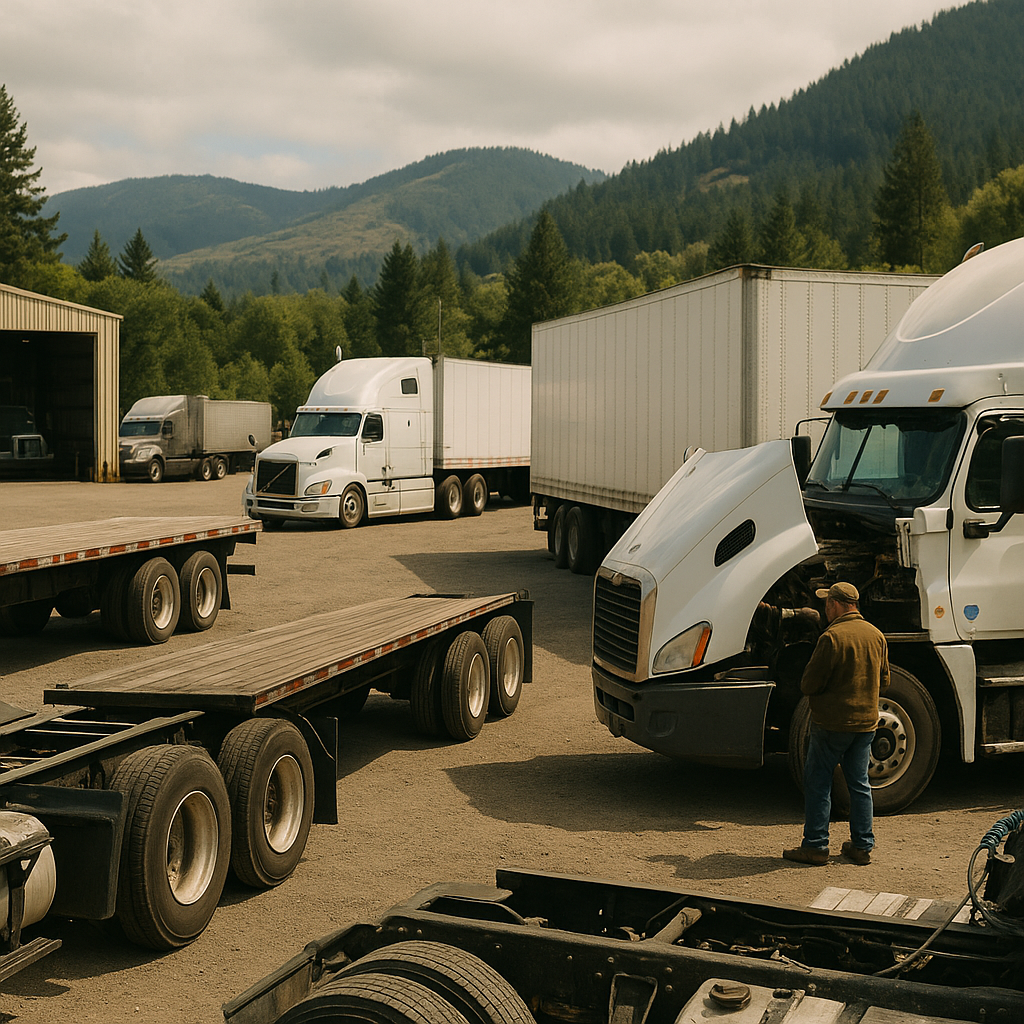

Tow truck commercial insurance Oregon operators buy has to match real towing work, not just the fact that the vehicle is a truck. A tow business can create risk on the road, while a customer vehicle is hooked up, and while that vehicle sits in your lot. If you run a wrecker, rollback, or small towing fleet, the right policy depends on what you actually do every day.
A lot of Oregon operators get tripped up in the same place: they assume state minimums, personal auto coverage, and federal trucking rules all mean the same thing. They don’t. This guide breaks down what tow truck insurance usually covers, how Oregon and FMCSA rules can overlap, what drives cost, and how to build the right policy without buying blind.
What Commercial Tow Truck Insurance Covers#
Tow truck commercial insurance is business insurance built for vehicles used to tow, recover, transport, and sometimes store other people’s vehicles. It usually starts with liability for your truck, then adds tow-specific protection like on-hook, garagekeepers, physical damage, and general liability depending on how your operation works.
Core liability coverages#
Commercial auto liability is the part of a policy that covers injuries or property damage you cause to others while operating the truck in business use. For a tow operator, that is the foundation, because the truck is working every day in traffic, at breakdown scenes, and on customer calls.
Tow operators usually need more than a basic understanding of commercial auto insurance, because towing adds exposures beyond ordinary hauling. A standard business auto setup may not fully address what happens when a customer’s vehicle is attached to your truck, parked in your lot, or damaged during handling.
General liability is coverage for third-party bodily injury or property damage that happens off the truck’s driving exposure, like a slip-and-fall at your office or yard. If your towing business has customer contact, a lot, or regular service calls, general liability for trucking may help fill a different part of the risk picture than auto liability does.
Tow-specific exposures#
On-hook liability is coverage designed for damage to a customer’s vehicle while it is attached to or being towed by your truck. This matters because towing creates a very specific exposure once someone else’s car is on your hook, wheel-lift, or rollback.
Garagekeepers liability is coverage for customer vehicles kept in your care, custody, or control at a covered premises, such as a storage lot or yard. If you impound, hold, or store vehicles overnight, that exposure is different from active towing.
Physical damage is coverage for damage to your own tow truck from collision, fire, theft, vandalism, or some weather events, depending on the policy terms. It protects your equipment, not the customer’s vehicle.
NAIC consumer guidance is useful here because it separates plain-language coverage concepts that people often mix together, especially liability versus damage to property in your care (NAIC).
What the policy does not replace#
Tow truck insurance doesn’t mean one policy covers every scenario automatically. Cargo-style thinking can cause problems here, because customer vehicles in a tow setup are not the same as general freight on a trailer.
Coverage needs also change fast based on whether you handle roadside assistance, accident recovery, repossession work, or storage. A one-truck owner-operator doing local breakdown calls has a different exposure mix than a small fleet doing recovery, impounds, and lot storage.

Oregon Requirements vs Federal Trucking Rules#
Oregon and federal trucking rules can both matter, but they do different jobs. Oregon can affect vehicle registration, proof of insurance, and operating compliance inside the state, while FMCSA rules apply when your operation falls under federal motor carrier requirements, especially in interstate activity or certain for-hire setups.
What Oregon regulates#
Oregon can regulate how your commercial vehicle is registered and what documentation you need to operate legally in the state. For tow operators, that can affect what proof of insurance or business compliance documents you need to keep current through the Oregon DMV and related state processes (Oregon DMV).
That doesn’t mean Oregon’s baseline expectations are enough for every towing business. Personal auto minimums are not the same thing as commercial towing coverage, and they definitely don’t tell you what a lender, contract, yard owner, or federal filing may require.
When FMCSA rules apply#
FMCSA is the Federal Motor Carrier Safety Administration, the federal agency that oversees many interstate commercial motor carrier rules. If your tow operation crosses state lines, works under a motor carrier setup, or otherwise falls into federal jurisdiction, you may also need to deal with federal authority, filings, and financial responsibility rules.
USDOT number means a federal identifier used to track safety and compliance for commercial carriers subject to those rules. MC number means operating authority for certain for-hire interstate carriers. You can verify carrier status through SAFER, which is FMCSA’s public lookup system.
Under FMCSA rules and 49 CFR Part 387, federal minimum financial responsibility depends on the type of carrier, vehicle weight, and what is being hauled or transported. For example, for-hire interstate carriers hauling general freight in vehicles over 10,001 pounds must carry at least $750,000 in public liability under 49 CFR Part 387, but that is not a universal rule for every tow truck or every Oregon operator (eCFR).
Why tow trucks are not all treated the same#
Tow trucks are not all treated the same because operation type matters. A local Oregon tow business working intrastate calls can face a different compliance path than a carrier handling interstate recoveries or operating under broader motor carrier authority.
That difference is where many operators make expensive mistakes. If you’re unsure whether your setup needs state-only compliance or a broader federal review,
How Tow Truck Coverage Changes by Operation Type#
The right tow truck policy depends on the actual work your truck performs, not just the truck class or your business name. Light-duty roadside towing, rollback transport, repo work, and storage yard operations create different claim patterns, so the insurance mix often changes with the job.
Light-duty towing#
Light-duty towing usually centers on roadside assistance, breakdown towing, lockout support, jump starts, and short local runs. That often means frequent dispatches, dense traffic exposure, and repeated handling of customer vehicles in everyday conditions.
For this kind of operation, auto liability and on-hook are usually core concerns. If you rarely store vehicles and mostly complete quick handoffs, your lot exposure may be smaller than your road exposure.
Rollback and flatbed towing#
Rollback and flatbed towing can reduce some hook-related issues, but it still involves loading, securing, and transporting customer vehicles. The loss scenario shifts toward loading damage, tie-down issues, and accidents while carrying a vehicle on the bed.
That can make the details of on-hook, physical damage, and related endorsements more important than they first appear. A truck with higher equipment value may also push the need for stronger protection on the truck itself.
Recovery and repossession work#
Recovery work and repossession tend to bring more severe and less predictable losses than ordinary roadside towing. Accident scenes, winching, off-road recovery, disputed vehicle possession, and after-hours work can all change how an underwriter looks at the risk.
If this is part of your business, make sure the policy actually contemplates it. An owner-operator who occasionally does recovery has a different profile from a small fleet built around that work every week.
Storage yard operations#
Storage yard exposure starts once customer vehicles are parked, moved, keyed in, or held on your property. Handling keys, controlling lot access, and moving vehicles around the premises all increase the importance of care-custody-control questions.
Garagekeepers becomes much more relevant here, and limits that seemed fine for a simple towing operation may not look adequate once multiple customer vehicles can be on the lot at the same time. That is one reason a one-truck operator and a three-truck small fleet can need very different coverage structures even if both say they are "just towing."
How Much Tow Truck Insurance Costs in Oregon#
Tow truck insurance in Oregon does not have one standard price because underwriters rate the whole operation, not just the truck. Cost usually changes with truck value, towing radius, driver history, claims experience, garaging location, the type of towing you do, and the limits and endorsements you choose.
Main pricing drivers#
The biggest pricing drivers are usually the truck itself and the work attached to it. A newer rollback with expensive equipment, wider operating radius, and more physical damage exposure will usually rate differently than an older local wrecker doing short runs.
Underwriters also look hard at driver records, years in business, prior losses, where the truck is garaged, and whether you operate as an owner-operator or small fleet. If customer vehicles are regularly towed, recovered, stored, or moved around a lot, that can also change the premium picture.
Why quotes vary between operators#
This is why two Oregon tow operators can ask for "the same" coverage and get very different quotes. One may have clean driving history, local service, no storage, and a lower-value truck. The other may run wider radius work, handle recoveries, have prior claims, and store several customer vehicles overnight.
The same issue applies to higher liability limits. A $1,000,000 liability setup does not come with one fixed market price because carriers rate the underlying risk profile, not just the number printed on the declarations page.
How to estimate a quote accurately#
The fastest way to get a useful quote is to describe the operation exactly as it runs. Tell the carrier whether you do roadside assistance, collision recovery, repossession, impounds, storage, dealer transport, or a mix.
Be clear about radius, truck type, where the truck is parked, who drives it, and whether customer vehicles are ever stored. Bad or incomplete information can make a policy look cheaper than it really is, then create problems when the application gets corrected or a claim happens.
If you’re trying to sort out why one quote looks much lower than another, the answer is often missing coverage rather than better pricing. That’s a good point to stop and
How to Choose the Right Coverage Mix#
The best way to choose tow truck insurance is to build it in layers based on what the operation actually does. Start with required liability, then add the protections tied to towing, storage, truck value, and customer interaction so you don’t pay for the wrong thing or miss the part that matters most.
Start with required liability#
Begin with commercial auto liability because that is the base policy for a tow truck in business use. Then confirm whether your operation has any Oregon-specific documentation needs, contract requirements, lender requirements, or federal filings that affect the limit or proof of insurance you need.
If you cross state lines or operate under a for-hire motor carrier setup, verify whether FMCSA rules apply in addition to Oregon requirements. Don’t assume a personal policy or a generic business auto quote solves a towing exposure.
Add tow-specific protection#
Once liability is set, add on-hook if you tow customer vehicles. Add garagekeepers if you store or keep those vehicles at your location. Add physical damage coverage if you need protection for your own truck and equipment.
Then look at general liability if customers come to your yard, you have a business location, or contracts require it. This step matters because towing losses often happen in places that don’t fit neatly into one coverage bucket.
Close common gaps#
A common gap is assuming one coverage follows the vehicle through every stage of the job. It doesn’t. Garagekeepers generally addresses vehicles at the premises in your care, while on-hook is built for damage during active towing. Neither one is a substitute for liability on your own truck.
Another common gap is thinking customer vehicles count like ordinary cargo. Tow operations need policy terms that specifically fit towing and storage, not broad assumptions.
For an owner-operator, a simple decision path works well: confirm liability, then ask whether you tow customer vehicles, store them, and need protection on the truck itself. For a small fleet, add a second review around driver scheduling, yard exposure, multiple units, and whether all trucks perform the same type of work.
How to Get a Tow Truck Quote in Oregon#
Getting a tow truck quote goes faster when you hand the carrier a complete, accurate picture of the operation up front. The key details are the truck, the drivers, the business entity, where the truck is kept, the towing radius, and exactly what kind of work you do.
What information carriers ask for#
Most carriers will ask for the VIN, year, make, model, and value of the truck. They’ll also want the garaging address, business name, entity type, driver license details, prior insurance history, loss history, and a description of operations.
Be ready to explain whether you do light-duty towing, rollback transport, recovery, repossession, roadside service, impounds, or storage. If more than one driver uses the truck, disclose that early.
How to compare quotes correctly#
Compare quotes by reading the coverage terms, not just the coverage labels. Two proposals may both say liability, on-hook, or garagekeepers, but the deductibles, exclusions, sublimits, and endorsements can be very different.
That matters a lot in towing. A quote that looks lean and simple may only look that way because it leaves out part of the work you actually do.
What to review before binding#
Before binding, review exclusions, deductibles, covered vehicle descriptions, driver schedules, and endorsements. Confirm that the policy matches your real operation today, not what the business looked like six months ago.
If you added storage, started taking recovery calls, changed your operating radius, or put on another driver, update the insurance before a claim forces the issue. Busy owner-operators and small fleets do better with a checklist than with memory.
Common Gaps and Mistakes to Avoid#
Most tow truck insurance mistakes come from using the wrong policy type or leaving out the coverage tied to real towing work. The biggest problems are personal auto confusion, missing tow-specific protection, and underestimating storage or recovery exposure.
Personal auto confusion#
Personal auto insurance is built for personal driving, not commercial towing. If the truck is used in business, hauling calls, or customer service work, personal coverage is not a substitute for a tow truck policy.
A related mistake is misunderstanding bobtail insurance. Bobtail or non-trucking liability applies to certain non-business use situations, not paid towing operations.
Missing tow-specific coverages#
Some policies look affordable because they only address the truck on the road. If you tow customer vehicles, keep them overnight, or move them around your yard, missing on-hook or garagekeepers can leave a major hole.
That hole usually doesn’t show up until a customer’s vehicle is damaged and everyone assumes the policy should respond. That’s the worst time to learn the form doesn’t match the work.
Underinsuring storage or recovery work#
Storage and recovery work can change the severity of a loss fast. One damaged vehicle in a lot is one thing. Multiple customer vehicles, key control issues, theft allegations, or difficult recoveries can be a different level of exposure altogether.
Review coverage before renewal and any time the business changes. A tow operation can outgrow last year’s insurance faster than most operators think.
FAQs#
How much is commercial insurance on a tow truck?#
Tow truck insurance cost in Oregon depends on the type of towing you do, the truck’s value, where it is garaged, your driving record, prior claims, towing radius, and the coverages and limits you choose. A local light-duty operator may rate very differently than a recovery-focused business with storage exposure. The best way to price it accurately is to give complete details about the truck, drivers, radius, and whether you tow, recover, repo, or store customer vehicles.
What kind of insurance does a tow truck company need?#
Most tow truck companies should start by evaluating commercial auto liability, then add tow-specific coverages based on the job. Common needs include on-hook liability for customer vehicles while being towed, garagekeepers liability for vehicles stored on your premises, physical damage for your own truck, and general liability for non-driving business exposures. The right mix depends on whether you do roadside towing, rollback transport, recovery, repossession, storage, or some combination of those services.
How much does a $1,000,000 liability insurance policy cost?#
There is no universal price for a $1,000,000 liability policy because the limit is only one part of the rating. Insurers also look at the type of tow work, truck value, garaging location, radius, driver history, claims history, years in business, and whether the operation includes storage or recovery. In practice, two Oregon operators can carry the same liability limit and still get very different quotes. Compare the full coverage structure, not just the limit amount, before making a decision.
What are the requirements for commercial auto insurance in Oregon?#
Oregon requirements depend on how the tow truck is used, how it is registered, and whether the business is operating only intrastate or also under federal motor carrier rules. State requirements and documentation can run through the Oregon DMV, while federal financial responsibility can apply under FMCSA rules and 49 CFR Part 387 when the operation falls into that scope. The safest approach is to verify both Oregon and federal obligations instead of assuming personal auto minimums or a generic business auto policy are enough.





