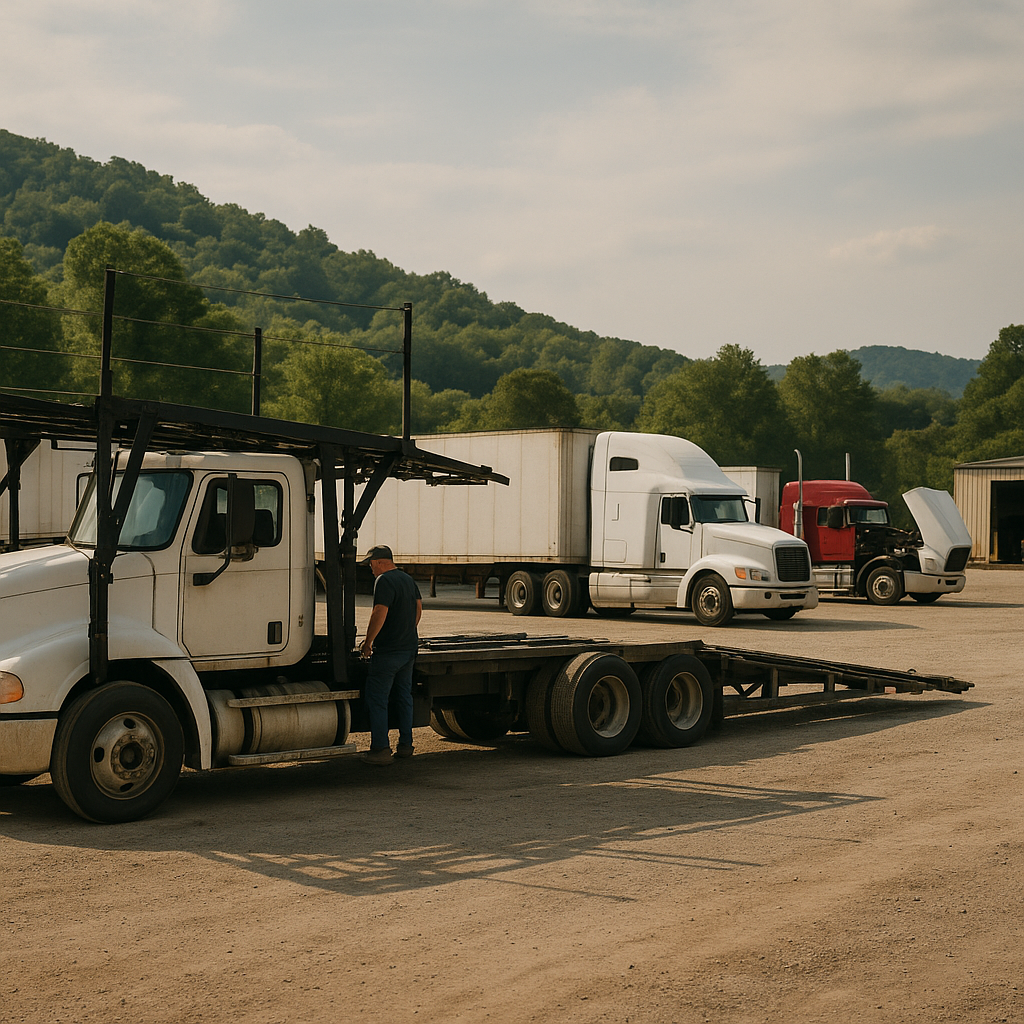
If you’re shopping for car hauler trucking insurance in Virginia, the biggest mistake is treating the truck, trailer, and loaded vehicles like one thing. They aren’t. A Virginia car hauler usually needs a mix of commercial coverages, and the right setup depends on whether you haul intrastate or interstate, what trailer you run, and whose vehicles you’re transporting.
What car hauler trucking insurance covers in Virginia#
Car hauler trucking insurance in Virginia is commercial insurance built for a business that transports vehicles for pay. It can protect the truck, the trailer, your legal liability on the road, and in some cases the vehicles you’re hauling, but those are separate policy parts and not one blanket coverage.
A car hauler trucking insurance policy is commercial coverage for a vehicle-transport business. It isn’t personal auto insurance, and it isn’t the same as a generic business owners policy you might see for an office or retail shop.
Truck, trailer, and load: what each policy part protects#
Your truck or tractor is one exposure. Your trailer is another. The cars you’re hauling are a third.
That’s where many first-time auto carriers get tripped up. Physical damage can insure your truck and sometimes your owned trailer. Motor truck cargo can address the vehicles you’re transporting. Auto liability handles damage or injury you cause to others while operating the unit, not damage to the cars on your trailer.
Where auto carrier exposure differs from general trucking#
A car hauler has a different risk profile than a dry van hauling boxed freight. You’re hauling visible, high-value units, often loading and unloading more carefully, and claims can involve tie-down issues, loading damage, or questions about when the vehicle was damaged.
That matters because underwriters usually want a clear picture of your trailer type, the value of the vehicles you haul, your radius, and your experience hauling cars specifically.
What a Virginia car hauler usually needs first#
Most Virginia owner-operators start with auto liability, then look at physical damage for the truck, cargo for the hauled vehicles, and any trailer-related coverage that fits how the trailer is owned or used. Coverage needs change based on carrier type, trailer setup, and whether the operation is interstate or intrastate.
If you only remember one thing, remember this: the truck being insured does not automatically mean the trailer is protected, and the trailer being protected does not automatically mean the hauled vehicles are covered.
Virginia rules vs FMCSA requirements#
Virginia rules and FMCSA rules are not the same thing, and a car hauler may have to deal with both. Virginia handles state registration and vehicle compliance, while FMCSA financial responsibility rules apply when your operation falls under federal motor carrier requirements.
A USDOT number is the federal identifier used for certain commercial carriers, and an MC number is operating authority for for-hire interstate carriers. You can confirm a carrier’s status through SAFER, the FMCSA’s public carrier lookup system.
What Virginia sets versus what federal trucking rules set#
Virginia can govern state-level registration and commercial vehicle requirements through the Virginia Department of Motor Vehicles. But state minimums do not erase federal insurance rules when your operation is subject to them.
For federal liability requirements, the controlling rule is 49 CFR Part 387. Under 49 CFR Part 387, for-hire interstate carriers hauling property in vehicles over 10,001 pounds often fall under federal public liability rules, but the minimum depends on the operation.
When interstate hauling changes the insurance picture#
If you haul vehicles across state lines for hire, FMCSA rules usually matter. That’s where drivers hear shorthand like “truckers need this minimum” and get burned, because the actual requirement depends on carrier type, weight, cargo, and operating scope.
For example, under 49 CFR Part 387, for-hire interstate carriers hauling property in vehicles over 10,001 pounds generally need at least $750,000 in public liability. But auto haulers are commonly written with $1,000,000 in auto liability because auto carriers fall into a different exposure category than ordinary general freight. Hazmat can be much higher. Under 10,000 pounds can scope differently.
Why state minimums and federal minimums are not the same thing#
Your state minimum isn’t your federal minimum. Trailer insurance also isn’t the same thing as the liability coverage required to operate a trucking business.
That distinction matters in the real world. A Virginia plate, a registered trailer, or proof that your truck is insured does not by itself prove that your operation meets FMCSA financial responsibility rules. And buying only the bare minimum policy structure can leave a car hauler exposed on the trailer or the loaded vehicles.
If you’re not sure which rules apply to your operation,
How much car hauler insurance costs in Virginia#
Car hauler insurance costs in Virginia vary based on the operation, not a single market price. Your actual premium depends on your truck and trailer setup, the value of what you haul, your radius, your driving history, your experience, and the limits and deductibles you choose.
A deductible is the amount you pay out of pocket on a covered claim before the insurer pays the rest. Higher deductibles can change pricing, but they also change what a claim feels like when money has to come out of your pocket fast.
Main factors that move the price up or down#
Underwriters usually look hard at:
- Driver history
- Years in business and hauling experience
- Interstate vs intrastate operation
- Radius of operation
- Garaging location
- Truck value
- Trailer type and value
- Loss history
- The value and type of vehicles hauled
A one-ton hotshot setup pulling a car hauler trailer doesn’t get looked at the same way as a heavy auto carrier with a different trailer configuration and a broader operating radius.
Why one-truck owner-operators get different quotes than small fleets#
A one-truck owner-operator often gets priced more directly on that one driver’s record, one unit’s value, and one operating pattern. A small fleet can spread risk across several units and drivers, but it can also bring more complexity, more certificates, and more exposure.
Neither setup is automatically cheaper. It’s just different underwriting.
What underwriters look at for auto carrier risk#
Car hauling is specialized. Underwriters want to know whether you haul dealer vehicles, auction units, private-party moves, salvage, or mixed work. They may also ask how vehicles are loaded, where they’re parked, and whether your business regularly handles higher-value units.
The cleaner and more accurate your submission is, the more useful your quote will be.
Coverage breakdown: what to buy and what each part does#
A Virginia car hauler usually needs several separate coverages working together. Auto liability covers what you do to others on the road, physical damage covers your insured truck and possibly your owned trailer, cargo addresses the vehicles you’re hauling, and trailer-related coverages depend on who owns the trailer and whether there’s a signed interchange agreement.
The NAIC is a good plain-language reference for insurance basics, but trucking still needs operation-specific scoping because not every policy part means what drivers think it means.
Auto liability for bodily injury and property damage#
Auto liability pays for injury or property damage you cause to others while operating the covered commercial vehicle. It does not pay for damage to your own truck, and it does not replace cargo coverage for the vehicles you’re hauling.
This is the policy part tied most directly to FMCSA financial responsibility rules. For a Virginia car hauler running interstate for hire, this is usually the coverage that gets the most compliance attention.
Physical damage for the truck and trailer#
Physical damage is coverage for your insured truck and trailer against losses like collision or other covered causes. In trucking, collision usually pairs with comprehensive or fire and theft with combined additional coverage, not as a standalone piece.
This is where drivers often assume too much. If your trailer is owned and scheduled, it may be included here. If it isn’t scheduled correctly, or if it’s borrowed, leased, or otherwise not covered the way you think, a claim can turn into a bad surprise.
Cargo coverage for hauled vehicles#
Motor truck cargo is insurance for the property you’re transporting for others. For a car hauler, that usually means the vehicles on your trailer.
Cargo is the coverage that answers the question, “What if one of the vehicles I’m hauling gets damaged?” But policy wording matters. Limits, exclusions, and claim scenarios can differ based on loading, theft, overturn, or other loss causes. Cargo is not the same as physical damage on your truck or trailer.
General liability, trailer interchange, and non-owned trailer physical damage#
General liability covers certain non-driving business exposures, like a third-party injury claim that doesn’t come from operating the truck on the road. For-hire trucking businesses often carry it because shippers, brokers, or contracts may ask for it.
Trailer interchange covers physical damage to a trailer in your care under a signed interchange agreement. Non-owned trailer physical damage covers a trailer you don’t own when there is no signed interchange agreement. That’s an everyday distinction many non-intermodal owner-operators miss.
If you borrow or pull someone else’s trailer, “trailer insurance” isn’t specific enough. You need the right kind of trailer-related coverage for that exact setup.
Does a car hauler trailer need insurance?#
A car hauler trailer may need its own scheduled coverage or related trailer protection, depending on who owns it, how it’s attached, and how the policy is written. The key point is that liability for operating the unit, physical damage to the trailer itself, and damage to the vehicles on the trailer are three different insurance questions.
When drivers ask this, they usually mean one of three things: “Is the trailer legal without separate insurance?” “Is my trailer protected if it’s damaged?” or “Are the cars on it covered?” Those are not the same answer.
When the trailer is covered by the truck policy#
If you own the trailer and it’s properly scheduled, it may be covered under physical damage on the commercial auto policy. In some setups, attached-trailer liability may be contemplated as part of the insured unit’s operation.
But don’t assume. A trailer omitted from the policy details can leave you with no physical damage protection on the trailer itself.
When separate trailer coverage may be relevant#
If the trailer is borrowed, leased, or not owned by your business, separate trailer-related coverage may matter. That’s where non-owned trailer physical damage or trailer interchange can come into play, depending on whether a signed interchange agreement exists.
And none of that replaces cargo. The trailer can be insured while the loaded cars are not.
What Virginia buyers usually mean when they ask this question#
Most Virginia buyers are trying to avoid paying for the wrong thing. Fair concern. Just don’t solve it by skipping a needed coverage part because someone online said the truck policy “covers the trailer.”
The right answer depends on ownership, attachment, use, and policy structure.
Virginia car hauler insurance checklist before you buy#
Before you buy car hauler trucking insurance in Virginia, gather the operation details that actually drive the quote. A clean submission helps you avoid bad assumptions, wasted back-and-forth, and policies that look cheaper only because they leave out equipment or exposures you actually have.
A garaging location is the main place the truck is kept when not in use. Insurers ask because location affects theft, weather, and other risk factors.
What to gather for a fast quote#
Have these ready:
- Truck VIN and unit details
- Trailer VIN, type, and value
- Current or planned operating radius
- Intrastate or interstate scope
- USDOT and MC information, if applicable
- Driver history and experience
- Garaging location
- Types of vehicles hauled
- Any prior loss history
If you’re setting up authority, timing matters because filings and proof-of-insurance questions can slow you down if details are incomplete.
Questions to ask before binding coverage#
Ask direct questions:
- Is the trailer itself covered, and how?
- Are the hauled vehicles covered under cargo?
- What limits and deductibles apply to each part?
- Is this written for my actual hauling type?
- If I borrow or swap trailers, what changes?
- What documents can I get quickly if a shipper asks?
These questions help you compare policies on substance, not just price.
Common gaps to avoid on a first policy#
The big ones are simple:
- Assuming cargo also covers the trailer
- Assuming trailer coverage also covers the loaded vehicles
- Assuming state registration means federal compliance
- Assuming any trucking policy fits auto hauling
For a time-pressed owner-operator, that’s where expert review earns its keep.
How to get a quote for a Virginia car hauler#
A fast, accurate quote starts with the right operation details and ends with a side-by-side review of what each policy actually covers. For a Virginia car hauler, the goal isn’t just getting a number back quickly. It’s making sure the truck, trailer, liability, and hauled-vehicle exposure are all scoped correctly.
A certificate of insurance is the document that shows proof of coverage to a shipper, broker, or other third party. Fast help matters when you need proof quickly or need to understand whether a filing question is state-related or FMCSA-related.
What a fast, accurate quote process looks like#
Usually it goes like this: intake, operation review, underwriter questions, quote options, then a coverage comparison. The more accurate your unit, trailer, driver, and cargo details are upfront, the smoother that process goes.
How to compare policies without comparing apples to oranges#
Compare like for like. Match liability limits, deductibles, covered equipment, and cargo structure before deciding one quote is better than another.
A lower number isn’t automatically better if it leaves out the trailer, changes deductibles sharply, or narrows the hauled-vehicle protection you expected.
When to ask for help with certificates or filing questions#
If you’re unsure whether your operation needs a filing, whether your MC setup is complete, or what proof a shipper wants to see, ask before binding. That’s especially true if you’re switching from general freight or starting authority with a car hauler operation.
FAQ#
How much is insurance on a car hauler trailer?
There isn’t one standard price for a car hauler trailer because the cost depends on what coverage you’re actually talking about. An owned trailer scheduled for physical damage is different from a borrowed trailer needing non-owned trailer physical damage, and both are different from cargo covering the vehicles loaded on the trailer. The useful comparison is coverage scope: who owns the trailer, whether it’s listed on the policy, how it’s used, and what value needs protection. Your actual premium depends on your trailer type, value, operating radius, claims history, and the rest of the operation.
Does a car hauler need insurance?
Yes, a car hauler business needs commercial insurance, but the exact mix depends on how it operates. If you haul vehicles for hire, you may need auto liability that fits your operating scope and, if interstate, complies with applicable FMCSA rules. Beyond that, many car haulers also need physical damage for the truck, cargo for the vehicles being transported, and possibly general liability or trailer-related coverage. The key is not buying a generic trucking policy and assuming it fits auto hauling. Requirements vary by carrier type, vehicle weight, cargo, and whether you operate interstate or intrastate.
How much is insurance for a hauling business?
Insurance for a hauling business varies based on the operation, not a flat monthly number. Carriers and underwriters look at the truck and trailer values, the type and value of cargo, driver history, years of experience, garaging location, operating radius, loss history, and whether the business runs one truck or a small fleet. For a car hauler, the type of vehicles transported and the trailer setup matter a lot. Two businesses can both say they “haul cars” and still get very different quotes because one is local, experienced, and narrowly scoped while the other is broader, newer, or higher risk.
Does Virginia require trailer insurance?
Virginia doesn’t make this as simple as “every trailer needs its own insurance policy.” What matters is the trailer’s ownership, how it’s used, how the unit is registered, and how the policy is structured. Separate from that, a trucking business may still need liability coverage to operate legally, especially if federal rules apply. So the better question is whether the trailer itself is physically protected and whether your operation’s liability and cargo exposures are covered correctly. Don’t assume that because the truck is insured, the trailer is automatically protected in every loss scenario.
Is cargo coverage the same as coverage for my truck and trailer?
No. Cargo coverage is for the vehicles or other property you’re hauling for someone else, while physical damage is for your insured truck and trailer. Auto liability is another separate part, covering injury or property damage you cause to others while operating the commercial vehicle. That’s why car haulers can have a policy that protects the truck but not the hauled cars, or protects the hauled cars but not a borrowed trailer. If you’re reviewing quotes, make each policy part stand on its own so you can see exactly what is and isn’t covered.