
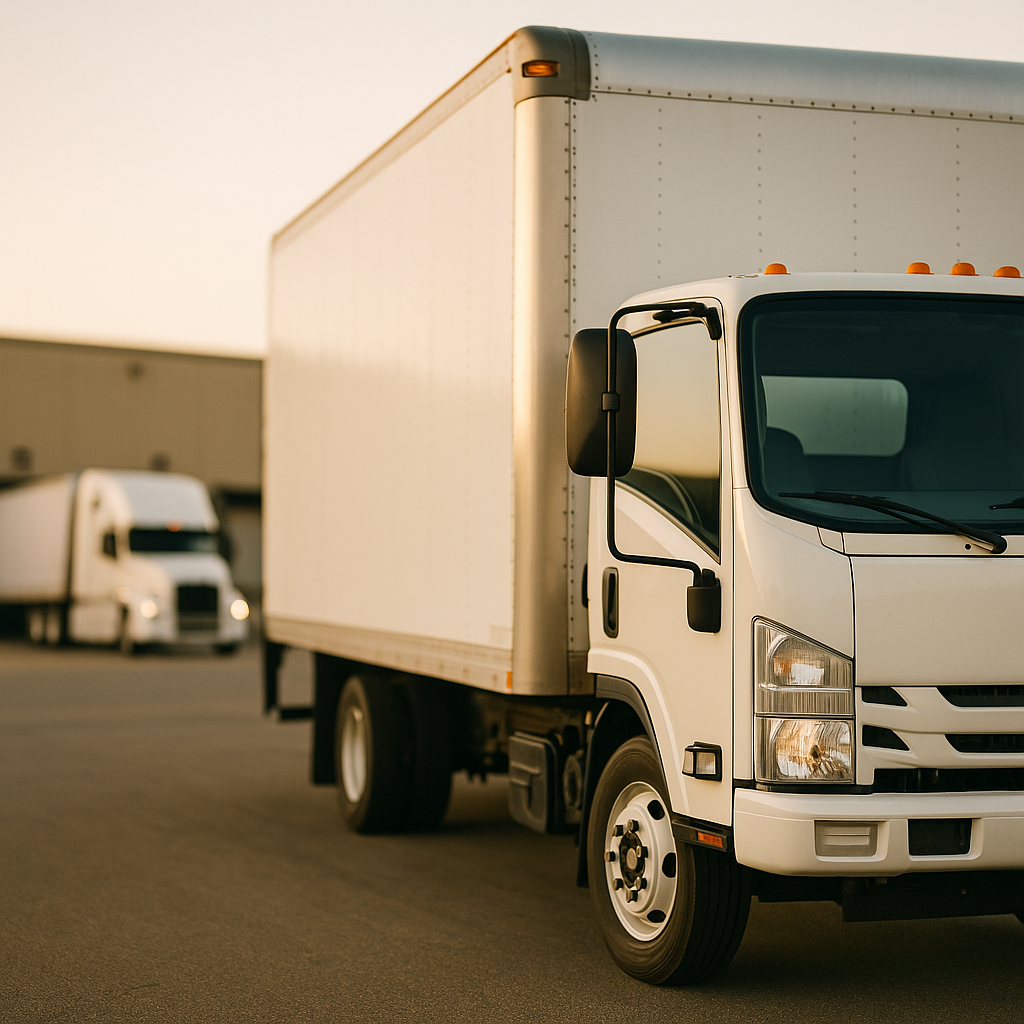
2026 box truck insurance rates run $250–$950/mo typical, $1,600+ high-risk. See costs by coverage, state, and size—then cut premiums fast.

Box truck insurance rates in 2026 typically run $250–$950 per month for established operators with clean records, while new ventures and higher-risk routes often land $650–$1,600+ per month. Those ranges change fast based on your garaging ZIP, operating radius, cargo type/value, and whether you need a full package (liability + cargo + physical damage) versus liability-only.
If your bill jumps $300–$800 a month, that’s real money—fuel, tires, maintenance, or your own paycheck. For more benchmarking (including sample quote ranges by risk tier), use this deeper reference on Box Truck Insurance Price in 2026.
Key Takeaways:
- Typical box truck insurance rates in 2026: about $250–$950/month for established operators; $650–$1,600+/month for higher-risk profiles.
- Your operation matters more than truck length: radius, garaging ZIP, cargo type/value, and new venture status often move rates more than “26-foot vs 20-foot.”
- Coverage package drives price: liability-only vs full package can be a 2–4x difference.
- You can cut costs 10–25%: tighten radius, fix classifications, adjust deductibles, improve safety documentation, and shop the right carriers.
Table of Contents
Reading time: 9 minutes
- 2026 box truck insurance rates (monthly & annual benchmarks)
- Rates by coverage type: what you’re actually paying for
- What is the cost for a 26-foot box truck? (Plus size, use case, and state)
- How to lower box truck insurance costs (step-by-step) + rate calculator + quote checklist
- Next step: get a real rate for your box truck
- Frequently Asked Questions
- Conclusion: budget your rate, then lower it the right way
2026 box truck insurance rates (monthly & annual benchmarks)
In 2026, box truck insurance rates for established for-hire operators commonly range from $250–$950 per month ($3,000–$11,400 per year), while higher-risk profiles often price at $650–$1,600+ per month. Box truck coverage is a slice of commercial truck insurance—and it’s priced like a business risk, not personal auto.
If you’re newer to trucking policy structure, start with this primer on commercial truck insurance basics.
Typical monthly ranges (by risk tier)
These are planning ranges, not guaranteed quotes, and they assume a for-hire box truck, clean MVR, reasonable radius, accurate cargo description, and continuous coverage.
| Risk tier | Typical monthly rate | Typical annual rate | Who this usually fits |
|---|---|---|---|
| Lower-risk | $250–$500 | $3,000–$6,000 | Established operator, local/suburban routes, light-to-moderate cargo risk |
| Typical | $500–$950 | $6,000–$11,400 | Most for-hire operators with standard coverages and clean history |
| Higher-risk | $650–$1,600+ | $7,800–$19,200+ | New venture, dense urban lanes, higher-value cargo, violations/claims, tough ZIPs |
What these numbers include (and don’t)
When people say “box truck insurance rates,” they may be comparing different coverage stacks.
- Liability-only: Cheapest on paper; often not enough for broker/shipper contracts.
- Full package: More realistic—liability + cargo + physical damage (comp/collision) + common add-ons.
- Limits and deductibles: Moving from $750k to $1M liability, changing cargo limits, or adjusting deductibles can swing the premium.
This is why comparing your premium to someone else’s without matching operations is like comparing cost-per-mile without matching lanes.
Rates by coverage type: what you’re actually paying for
Box truck premiums are built from coverage lines—primary liability (often $750,000–$1,000,000 limits), cargo (commonly $100,000), and physical damage—each priced separately and then packaged into one policy. Underwriters don’t just price “a box truck”; they price the probability and severity of a claim based on your operation and your coverage stack.
A clean compliance/safety profile can also affect eligibility and pricing; for how underwriting ties safety history to cost, review DOT record and trucking insurance.
Primary liability (the big rate driver)
Primary liability pays for injuries and property damage you cause to others, and it’s the foundation of most commercial truck insurance programs.
- Why it matters: Many brokers/shippers require $1,000,000 even when legal minimums differ by operation.
- Regulatory context: FMCSA insurance and filing requirements vary by carrier type and commodity; see FMCSA insurance filing requirements.
Cargo insurance (usually required for for-hire work)
Cargo insurance covers damage to the freight you’re hauling, and most broker/shipper agreements require it for for-hire work.
- Common limit: $100,000 is a frequent requirement, but certain freight needs more.
- Underwriting reality: “General freight” vs “household goods” vs “electronics” can change carrier appetite and pricing quickly.
Physical damage (comprehensive + collision)
Physical damage pays to repair or replace your truck after collision, theft, vandalism, or certain weather events, and most lenders require it if the unit is financed.
- Fast lever you control: Deductibles often change monthly cost immediately (as long as the deductible is realistic for your cash flow).
- Truck value matters: Higher stated/actual cash value (ACV) usually means higher physical damage premium.
Common add-ons that change the monthly price
- General liability: Non-auto business liability (slip-and-fall at docks, etc.).
- Non-trucking liability / bobtail: Coverage when not under dispatch (details vary by policy and lease setup).
- Trailer interchange: Needed if you pull non-owned trailers under interchange agreements.
- Occupational accident: Often used by owner-operators for injury/disability-style protection.
What is the cost for a 26-foot box truck? (Plus size, use case, and state)
A typical for-hire 26-foot box truck in 2026 often insures for about $550–$1,100 per month with $1M liability, cargo, and physical damage, while new ventures and urban moving/expedite risks can exceed $1,500 per month. A 26-footer is a common step-up because it opens bigger contracts, but it can also trigger higher limits and more exposure.
To see the full list of rating variables underwriters actually score, read what affects the cost of truck insurance.
Quick answer: 26-foot box truck insurance cost
With a typical for-hire setup (often $1M liability + cargo + physical damage), a 26-foot box truck commonly lands around $550–$1,100/month for established operators. New ventures or high-risk urban operations can push $1,500+/month.
Why 26-foot trucks often price higher
Insurance doesn’t price the length alone; it prices what the length usually signals about claim severity and operating conditions.
- Higher severity potential: Higher GVWR and bigger loss potential in crashes.
- More exposure: More miles, more stops, tighter delivery schedules.
- Contract pressure: 26-foot operations often come with higher required limits and cargo requirements.
Size + operation table (planning ranges)
Assumptions: clean MVR, continuous coverage, for-hire; “full package” pricing varies heavily by truck value and cargo.
| Truck size / use case | Typical monthly range | Notes |
|---|---|---|
| 12–16 ft local delivery | $250–$700 | Often lower mileage and lower severity; still depends on ZIP + cargo |
| 20–24 ft mixed local/regional | $400–$950 | Common “middle” range; classification and radius drive it |
| 26 ft for-hire (standard freight) | $550–$1,100 | Often priced higher due to exposure + limits requested |
| 26 ft moving/urban/new venture | $1,200–$2,600+ | Higher theft/claim frequency + claim severity patterns |
Rates by state: sample quote ranges (use for budgeting)
These are sample ranges to show how location can swing rates; they are not official state averages.

Assumptions for the ranges below: For-hire box truck, $1M liability, cargo included, 50–200 mile radius, clean MVR, no recent at-fault losses, and continuous coverage (no lapse/re-entry).
| State | Established (sample monthly) | New venture / high-risk (sample monthly) |
|---|---|---|
| CA | $700–$1,400 | $1,600–$2,800+ |
| FL | $600–$1,250 | $1,400–$2,600+ |
| NY/NJ metro | $750–$1,600 | $1,800–$3,200+ |
| TX | $500–$1,050 | $1,200–$2,200+ |
| IL | $550–$1,150 | $1,300–$2,400+ |
| GA | $500–$1,050 | $1,200–$2,200+ |
| PA | $450–$950 | $1,100–$2,000+ |
| OH | $400–$900 | $1,000–$1,900+ |
Why the spread happens: Repair costs, medical costs, litigation environment, theft rates, weather losses, and congestion can all shift pricing. Your garaging ZIP and lanes can matter as much as the state line.
How to lower box truck insurance costs (step-by-step) + rate calculator + quote checklist
Most box truck operators can reduce premiums by 10–25% by tightening radius, correcting classifications, adjusting deductibles (for example $1,000 → $2,500), improving safety documentation, and shopping multiple carrier markets. If you’re hunting affordable trucking insurance, the trick isn’t “minimum coverage”—it’s buying the right coverage and presenting your risk like a pro.
This deeper guide on how to save on truck insurance pairs well with the checklist below.
Step-by-step: how to lower box truck insurance costs quickly
- Shop the right way (market coverage, not just price): Get more than 2–3 quotes; carrier appetite varies by cargo, radius, and new venture status.
- Tighten your radius if you can (even temporarily): A true 0–100 mile radius is priced differently than “regional/anywhere.”
- Increase deductibles strategically: If you can afford it, raising comp/collision deductibles can reduce premium; don’t do it if one claim will crush cash flow.
- Fix your classifications: Wrong cargo description or use (for-hire vs private) leads to re-rating, cancellations, or audit surprises.
- Add safety proof underwriters respect: Dash cams, telematics, documented maintenance, and driver training logs turn “we’re safe” into something rateable.
- Avoid lapses: A lapse can put you into a re-entry bucket, which often costs more than the “savings” from skipping a payment.
DIY rate calculator (fast planning estimate)
Use this to estimate where you’ll land (low / typical / high-risk) by scoring your profile and matching the tier.
| Variable | Low risk (0) | Medium (1) | High (2) |
|---|---|---|---|
| Authority | Established | — | New venture |
| Operating area | Rural/suburban | Mixed | Dense urban/metro |
| Radius | Local | Regional | Multi-state / variable |
| Cargo | Low/moderate | Mixed | High-value/special handling |
| Garaging ZIP theft exposure | Low | Medium | High |
| Driver history | Clean | Minor issues | Violations/claims/lapse |
Score guide:
- 0–3 points: often lands in the $250–$700/mo band (depends on coverages)
- 4–7 points: often lands $500–$1,100/mo
- 8–12 points: often lands $1,200–$2,600+/mo
This doesn’t replace a quote, but it stops you from planning your business on fantasy numbers.
60-second quote checklist (what to gather before you call)
Having this ready usually means faster quotes and fewer re-quotes later.
- VIN, year/make/model, GVWR, truck value (ACV), lienholder (if any)
- Garaging address (real overnight ZIP)
- DOT/MC, authority type, years in business
- Driver list + DOB + license states + experience
- Prior insurance info + loss runs (if you have them)
- Operating radius + top lanes (where you really run)
- Cargo type, max cargo value, typical customers
- Requested limits (liability, cargo) + deductibles
Verification tip: You can verify authority/snapshot details through the FMCSA SAFER System.
Next step: get a real rate for your box truck
A real box truck insurance quote is based on your garaging ZIP, lanes, cargo, loss history, and requested limits—not statewide averages or someone else’s premium. Benchmarks are useful for budgeting, but your real premium comes down to your operation: radius, lanes, cargo, garaging ZIP, loss history, and whether you’re a new venture.
Related reading (next best steps)
- Box Truck Insurance Quote (2026) for a faster, cleaner quoting process
- Florida truck insurance cost guide if your location is pushing you into the high-risk tier
If you’re ready to shop, get multiple quotes with the same limits and the same operation details—then compare coverage, not just price. For carrier “appetite” and how to compare options, use Best Box Truck Insurance (2026).
Frequently Asked Questions
These FAQs summarize 2026 box truck insurance rate ranges ($250–$950/month typical) and the underwriting factors that most often change quotes.
Most established box truck operators pay $250–$950 per month, and higher-risk profiles commonly price at $650–$1,600+ per month. Your final number depends on your liability limit (many contracts require $1,000,000), whether you’re adding cargo (often $100,000) and physical damage, and where the truck is garaged. New venture authority, dense metro routes, higher-value freight, violations/claims, or a lapse in coverage can all push quotes into the higher tier. For more sample ranges by risk band, see Box Truck Insurance Price in 2026.
The biggest drivers of box truck insurance pricing are new venture status, driver MVR and claims history, operating radius and metro exposure, cargo type/value, and the garaging ZIP (theft frequency and loss history). Secondary drivers include the truck’s value (affecting physical damage), deductible levels, and how accurately your classifications match what you really do (for-hire vs private, household goods vs general freight). If you want the broader rating-factor breakdown underwriters use across trucking, review what affects the cost of truck insurance.
A typical for-hire 26-foot box truck often costs $550–$1,100 per month for established operators with clean records and a standard full package (commonly $1M liability + cargo + physical damage). New ventures, moving/expedite work, dense urban lanes, and higher theft exposure can push pricing to $1,500+ per month, and in some cases higher depending on limits, cargo, and location. The 26-footer itself isn’t the only factor—your use case is the multiplier, especially when contracts require higher limits or stricter cargo terms.
New ventures usually pay more because insurers have limited operating history to underwrite and fewer carriers will write brand-new authority, which reduces competition and increases premiums. Many new venture box truck quotes land in the $650–$1,600+ per month range depending on radius, garaging ZIP, and cargo, especially when you need $1M liability and cargo. To reduce the hit, keep your radius conservative, be precise about cargo and lanes, avoid any lapse, and document safety (dash cams/telematics, maintenance logs). Your safety history and compliance profile can also matter; see DOT record and trucking insurance.
There isn’t one universal “best” carrier because box truck insurance rates depend on carrier appetite for your cargo, radius, garaging location, and new venture status. The practical way to find the best rate is to compare multiple markets using the same limits (often $1M liability) and the same operation details, then review exclusions, deductibles, and required filings—not just premium. If you want a quick way to compare options by operation type, use Best Box Truck Insurance (2026). When you’re ready to price your exact setup, start with Box Truck Insurance Quote (2026).
Conclusion: budget your rate, then lower it the right way
If you’re budgeting for 2026, most established for-hire box trucks land between $250–$950 per month, but new venture or metro/high-value profiles often run $650–$1,600+ per month. The fastest way to control cost is to match your coverages to your contracts, present accurate classifications, and shop multiple carrier markets.
Key Takeaways:
- Budget first: Use monthly/annual bands and state/location swings to avoid underpricing your overhead.
- Package drives price: Liability-only vs a full package can be a 2–4x difference.
- Lower premiums the smart way: Tighten radius, fix classifications, raise deductibles only if you can fund them, and document safety.
When you want a real number, bring the 60-second checklist and request quotes with the same limits so you can compare apples to apples.





