
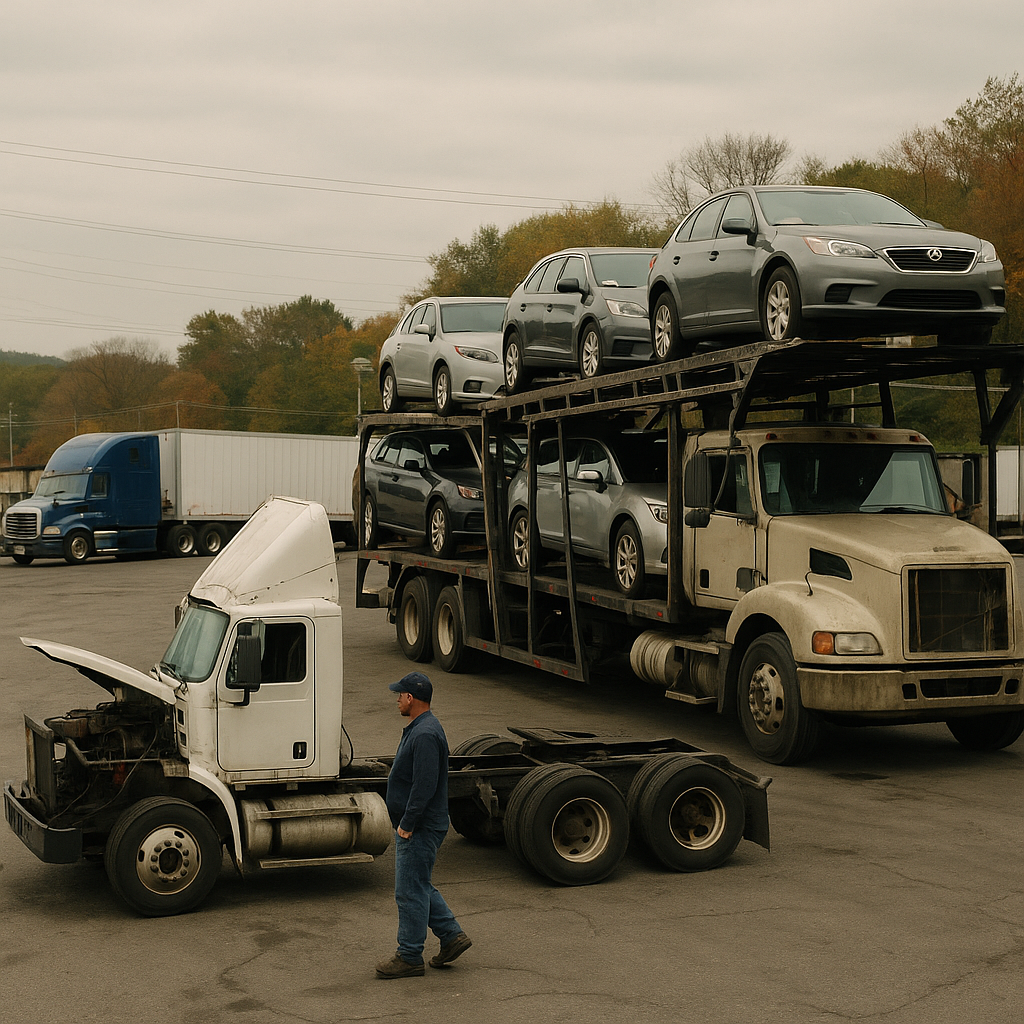

If you’re hauling cars in New Jersey, "commercial auto" and "trucking insurance" aren’t the same thing. A car carrier trucking insurance setup usually combines liability, cargo, physical damage, and sometimes trailer-related coverage based on how you run, what authority you have, and whether you cross state lines.
A lot of New Jersey auto haulers get tripped up by shorthand. State minimums, FMCSA filings, cargo limits, and trailer use don’t all live in the same bucket. This guide breaks down what matters, what’s required, and where car carriers most often leave a gap.
What Car Carrier Insurance Means in New Jersey#
Car carrier trucking insurance in New Jersey usually means more than a basic commercial auto policy. Most auto haulers need coverage built around for-hire trucking risk, cargo exposure, and federal or state compliance, not just a policy that insures a business vehicle. The right structure depends on your authority, operating radius, trailer setup, and whether you haul interstate or intrastate.
Commercial auto vs. trucking insurance#
Commercial auto insurance is insurance for vehicles used in business. Commercial trucking insurance is the policy structure built for trucking operations, where liability, cargo, filings, and truck-specific coverages have to match how the carrier actually runs.
That difference matters for car haulers. If you’re transporting other people’s vehicles for pay, the exposure isn’t just "my truck is on the road." It’s also damage to customer vehicles, loading and unloading issues, trailer use, and whether your insurer classifies the operation correctly.
A policy can look fine on the declarations page and still be wrong for the job. That’s where owner-operators get burned: the truck is insured, but the hauling operation isn’t matched cleanly.
How auto haulers are classified#
Auto haulers are usually classified by whether they’re for-hire, meaning they transport property for someone else in exchange for payment, or private. They may also be classified by interstate versus intrastate operation, unit size, cargo type, and whether they operate under their own authority.
That classification drives more than price. It affects liability minimums, whether federal filings apply, and how underwriters look at the operation.
For a New Jersey car carrier, "I only move cars" doesn’t simplify things. In many cases it makes cargo and trailer details more important, because you’re often hauling high-value vehicles with concentrated exposure on one load.
Why policy structure matters#
Policy structure matters because a car carrier doesn’t just need a number on a certificate. It needs liability set up for the right operation, cargo that matches vehicle values, and truck and trailer coverage that reflects how the equipment is used.
This is where quotes can look similar but not actually match. One policy may account for cargo exposure, trailer use, and filings, while another may only solve part of the problem. If you’re not sure what fits your operation,

New Jersey and FMCSA Requirements Carriers Need to Know#
New Jersey car carriers may have to meet both state and federal rules. If you operate interstate for-hire, FMCSA registration, authority, and federal financial responsibility rules can apply on top of New Jersey requirements. Liability requirements are not the same thing as cargo or physical damage, which are often operational or contract-driven instead of federally mandated.
State minimums vs. federal filing requirements#
Auto liability pays for bodily injury and property damage you cause to others in a crash. For interstate for-hire carriers, federal minimum financial responsibility rules sit under 49 CFR Part 387, and they vary by carrier type, weight, and commodity.
For-hire interstate carriers hauling general freight in vehicles over 10,001 pounds must carry at least $750,000 in public liability under 49 CFR Part 387. Auto haulers are commonly written at higher liability limits, and operators often see $1 million in practice, but that doesn’t mean every truck has the same legal minimum.
This is where drivers mix up state minimums and federal minimums. Run interstate freight and the federal rule may control your filing requirement even if New Jersey’s vehicle insurance minimums are lower. A good starting point is understanding the difference between auto liability coverage and broader trucking insurance requirements.
USDOT and MC authority basics#
A USDOT number is the identifier FMCSA uses to track safety and operating information. An MC number, often called operating authority, is the federal authority many for-hire interstate carriers need to transport regulated property for compensation.
If you’re a New Jersey car hauler moving vehicles across state lines under your own authority, FMCSA may require that authority and the related insurance filing before you can operate legally. FMCSA is the primary source for registration and authority rules at fmcsa.dot.gov.
An MCS-90 is an endorsement tied to federally required public liability filings for certain motor carriers. It’s part of the compliance picture for interstate for-hire operations, but it isn’t a substitute for building the rest of the policy correctly.
When filings apply to auto haulers#
Filings usually matter when the operation triggers a compliance requirement, especially for interstate for-hire authority. That’s separate from coverages like cargo and physical damage, which may be chosen based on business need, lender terms, or broker and shipper expectations.
For a car carrier, that’s a key distinction. Federal rules focus heavily on liability responsibility. They do not mean FMCSA is choosing your cargo limit for the value of the vehicles you’re hauling, and they do not automatically protect your truck or trailer from physical loss.
Core Coverages for Car Carrier Trucking Operations#
A New Jersey auto hauler usually needs a coverage package, not one standalone policy. The core pieces are auto liability for crash responsibility, cargo for customer vehicles in transit, physical damage for your truck, and trailer-related coverage depending on ownership and use. Optional add-ons can help, but the basics need to match the actual operation first.
Auto liability#
Auto liability is the foundation because it addresses injury or property damage you cause to others while operating the truck. If you’re for-hire and interstate, this is also the coverage that ties most directly to federal financial responsibility rules and filings.
For car carriers, liability limits aren’t just a box to check. Auto haulers operate large units, often in dense traffic, tight delivery points, and multi-vehicle loading situations. That’s one reason the policy has to reflect the true class of business rather than a generic commercial auto description.
Motor truck cargo#
Motor truck cargo covers damage to property you’re hauling for others, subject to the policy’s terms, exclusions, and limits. For auto haulers, that means the customer vehicles on your trailer are often the heart of the risk.
Because the cargo itself may be high value, a low or mismatched cargo limit can leave a serious gap. It also matters how the policy handles loading, unloading, theft, and claims involving more than one vehicle on the same trailer. If you want a deeper breakdown of motor truck cargo insurance, it’s worth reviewing before comparing quotes.
Physical damage and trailer coverage#
Physical damage covers direct loss to your truck from collision and other covered causes like theft, fire, or weather, depending on the coverage form. For trucking, that usually means collision plus comprehensive or fire and theft with combined additional coverage, not collision by itself.
Car haulers often have expensive tractors and specialized trailers. If either one is financed, leased, or simply critical to staying on the road, the structure of physical damage coverage matters just as much as the deductible.
Trailer coverage needs special attention. If you own the trailer, physical damage may need to include it specifically. If you pull someone else’s trailer under a signed interchange agreement, trailer interchange coverage may apply. If there is no signed interchange agreement and the exposure is to a non-owned trailer, operators often need non-owned trailer physical damage instead.
Optional protections that may fit#
Optional protections depend on how the car carrier operates. Some owner-operators ask about non-trucking liability, also called bobtail in everyday conversation, which covers non-business use only and never applies while you’re under dispatch hauling for pay.
Other add-ons can include general liability for non-driving business exposures. Reefer breakdown exists in trucking, but it’s usually irrelevant to a standard auto hauler operation.
The point isn’t to stack every possible coverage. It’s to make sure the standard truck insurance pieces are in place first, then add only what fits the way you actually work.
What Carriers in New Jersey Usually Pay and Why#
New Jersey car carrier insurance pricing depends on the operation, not a universal rate card. Underwriters look at the truck, trailer, authority, radius, cargo values, driving history, and claims profile to decide how risky the account is. Two carriers with the same truck can price very differently if one hauls high-value vehicles interstate and the other runs a tighter, lower-exposure setup.
Primary cost drivers#
Driving records matter because losses usually follow behavior over time. Authority age matters too, since a new venture with fresh authority is often harder for underwriters to predict than an established carrier with clean history.
Vehicle values also move the number. A financed tractor, a specialized car-hauler trailer, and concentrated cargo exposure create a different risk picture than a simpler local operation.
Deductibles, policy limits, garaging, and prior claims also feed the price. NAIC offers consumer-friendly background on how deductibles and policy structure affect insurance costs at naic.org.
How cargo type and radius affect price#
Radius is simply how far from your base you typically operate. Longer radius usually means more time on the road, more jurisdictions, and more chances for losses.
Cargo type is a big lever for auto transport. When you’re hauling customer vehicles, underwriters don’t just see "freight." They see the value of what’s on the trailer, how many units can be affected by one event, and whether loading and unloading create extra claims potential.
If you’re trying to understand the moving pieces behind pricing, these are the same kinds of commercial truck insurance cost factors that carriers compare across quotes.
Why renewals can change#
Renewal increases can happen even when nothing obvious changed on your side. Carriers may reprice an entire class of business, tighten underwriting for new authorities, or react to broader loss trends in trucking.
Your own account can also change. A claim, a violation, a driver change, a wider operating radius, or higher-value loads can all alter how the insurer views the risk. That’s why a renewal that feels "the same as last year" can still come back with a different premium.
Common Coverage Gaps for Auto Haulers#
Most auto hauler coverage gaps come from mismatch, not from one missing checkbox. The policy may insure a truck, but not the real cargo values, trailer exposure, or authority setup behind the operation. That’s how a quote can look cheaper up front and still leave a New Jersey car carrier exposed where the loss actually happens.
Cargo value gaps#
A cargo limit has to make sense for the vehicles you actually transport. If your typical load value has drifted up over time, an old cargo limit may no longer reflect the real exposure.
This gets worse with multi-vehicle loads. One incident can affect several units at once, so "some cargo coverage" isn’t enough if the limit is far below what you normally have on the trailer.
Trailer exposure gaps#
Trailer issues get missed all the time. Owner-operators may assume the trailer is automatically covered, or they may buy the wrong trailer-related coverage for the way they use borrowed or non-owned equipment.
That also happens with non-business-use coverage. A lot of drivers say "bobtail" when they really mean non-trucking liability, which only applies during non-business use and never during paid hauling. If you need the clean distinction, review how bobtail and non-trucking liability actually work.
Authority and filing mistakes#
Filings have to match the operation. If you’re interstate for-hire, authority status and insurance filings need to line up with how you’re running now, not how you planned to run six months ago.
A technically cheap quote can become expensive fast if it doesn’t match your business class, your filings, or your real cargo exposure. That’s the point where comparing price alone stops being useful. If a quote feels low but the details are fuzzy,
How to Get the Right Quote for a New Jersey Car Carrier#
The best car carrier quote is the one that matches your operation cleanly. To get there, gather your authority, vehicle, driver, cargo, and radius details before you shop. Then compare quotes line by line for coverage structure and filings, not just premium.
What information to gather first#
Start with the basics: legal business name, garaging address, VINs, unit values, trailer details, and driver information. Then get specific about whether you have a USDOT number, whether you need or already hold MC authority, and whether the operation is interstate or intrastate.
You’ll also want your radius, typical lanes, vehicle types hauled, estimated cargo values, loss history, and any lender or contract requirements. For a car carrier, "what do you haul?" should include more than "cars." It should reflect whether you’re moving standard used vehicles, dealer units, specialty vehicles, or higher-value loads.
How to compare quotes without missing coverage#
Compare liability limits, cargo limits, deductibles, covered equipment, and whether the quote addresses trailer use correctly. Ask whether the insurer classified the operation as an auto hauler and whether any exclusions could matter during loading, unloading, or multi-vehicle transport.
Also ask what filings are included if you operate under authority. A quote can be fast and still miss a structural issue that causes trouble later.
When to talk to an agent#
Talk to an agent when your operation has any moving parts that don’t fit a simple box: new authority, interstate work, multiple trailers, unusual vehicle values, or uncertainty around filings. Car carrier risk is specific enough that a generic business auto quote often doesn’t answer the real question.
Before you bind, verify your operating status and authority details through SAFER and make sure the policy matches what that status requires.
FAQ#
How much does $100,000 cargo insurance cost?
The cost of a $100,000 cargo limit isn’t fixed because cargo insurance is priced around the operation, not just the limit. For a New Jersey car carrier, insurers usually look at what kinds of vehicles you haul, total load values, operating radius, theft exposure, claims history, and deductibles. They may also care about whether the operation is new authority or established. Two haulers can carry the same nominal limit and get very different pricing because the real loss potential is different. The only reliable number comes from a quote built around your actual lanes, equipment, and cargo mix.
How much does commercial insurance cost in NJ?
Commercial insurance in New Jersey doesn’t have one standard price for trucking operations. Your actual premium depends on your operation, cargo, radius, driving history, authority status, vehicle and trailer values, claims record, and the coverages and limits you choose. A local business auto account and an interstate car carrier can both be in New Jersey and still price nothing alike. That’s why broad online averages usually don’t help much. For auto haulers, the important question isn’t just "what does it cost in NJ?" but "what does it cost for this exact trucking setup?"
Do car transporters have insurance?
Yes, car transporters typically carry insurance, but the mix depends on how they operate. Most for-hire auto haulers need commercial liability coverage for road exposure, and many also carry cargo coverage for the vehicles they’re transporting. They may also need physical damage on the truck and trailer-related coverage depending on ownership and equipment use. If they run interstate under their own authority, federal filings may be part of the setup too. The key point is that "insured" can mean very different things, so customers and carriers both need to look at the actual policy structure, not just a certificate.
How much does a $1,000,000 liability insurance policy cost?
A $1,000,000 liability policy doesn’t come with one universal price. Insurers rate it based on the truck class, business type, authority, operating radius, driver history, loss history, garaging, and whether the operation is intrastate or interstate. For a New Jersey car carrier, the hauling class and exposure tied to auto transport can matter as much as the limit itself. One operator with clean history and a tight radius may price much differently than a new interstate authority hauling higher-value vehicles. The practical way to compare is to hold the coverage structure constant and see how each quote treats the same operation.





