
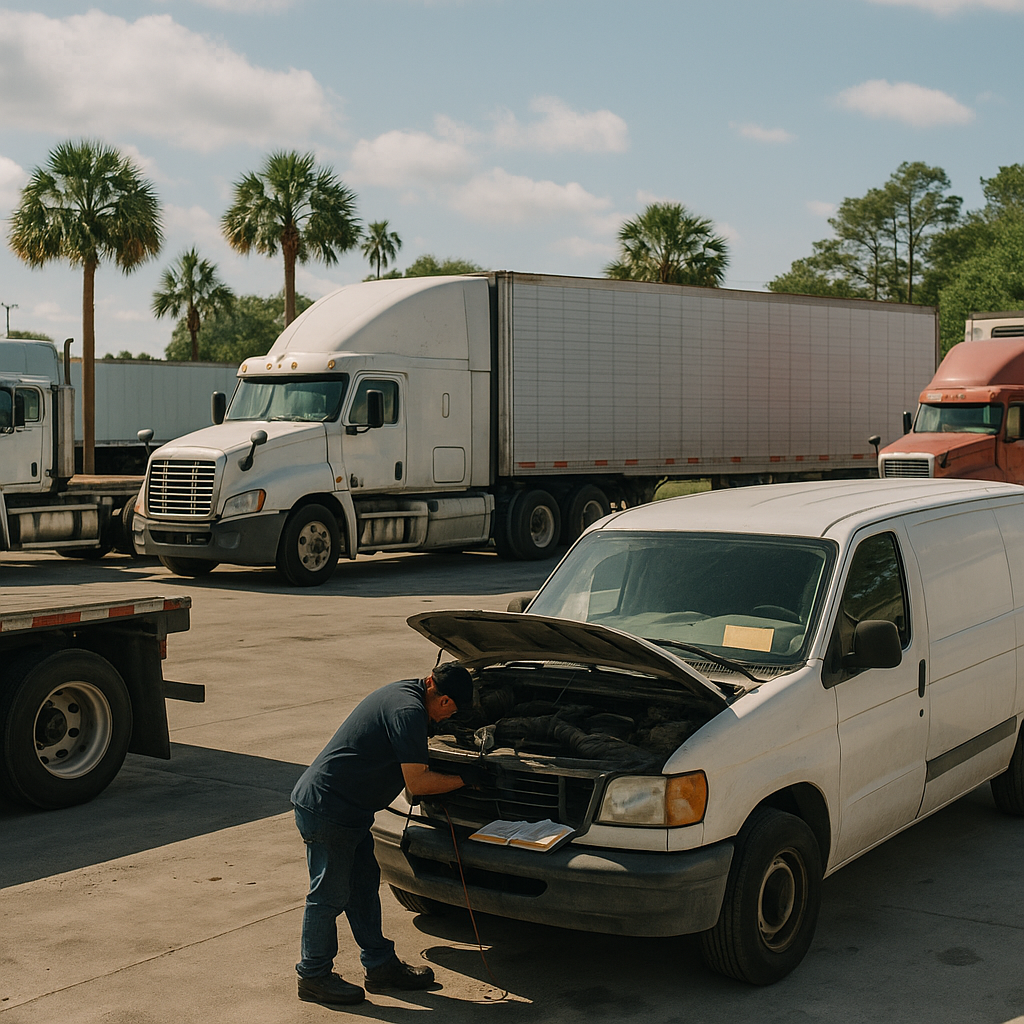

If you’re shopping for cargo van truck insurance Florida, the biggest mistake is starting with a generic price instead of your actual operation. A Florida cargo van delivering your own products, hauling customer freight for pay, or crossing state lines can trigger very different insurance, contract, and compliance questions.
Start With the Work Your Cargo Van Actually Does#
The right Florida cargo van insurance starts with what the van actually does all day: whose goods are in it, whether you’re hauling for pay, where you drive, and how often you use it for business. That use-based decision path matters more than the words “cargo van” on the registration.
A lot of confusion starts when people assume every delivery van fits the same box. It doesn’t. A florist delivering its own arrangements, a contractor moving tools between jobs, and an owner-operator hauling freight for a customer are all using similar vehicles in very different ways.
Own-product delivery versus for-hire hauling#
If you deliver your own goods, your insurance review is different from a for-hire hauling operation carrying someone else’s property for pay. For-hire hauling can create separate authority, contract, filing, and cargo coverage issues that don’t always apply to a business moving its own inventory.
For-hire means you’re paid to transport property for someone else. That matters because commercial auto liability is coverage for third-party bodily injury or property damage claims caused by a covered vehicle, while motor truck cargo insurance is coverage designed for covered loss or damage to customer freight in your care.
If you own the goods in the van, that property may not fit the same way customer freight would. If you haul for customers, the load itself usually needs its own review instead of assuming auto coverage protects it.
Local delivery, intrastate routes, and interstate trips#
Local Florida delivery does not automatically mean the same rules apply as interstate trucking, and crossing state lines can change the compliance review. The details matter: who hires you, where the freight moves, and whether the trip is part of interstate commerce.
Intrastate means you operate only within one state. Interstate means transportation crosses state lines or is part of a shipment moving across state lines, even if your part of the trip stays in Florida.
That’s why two vans with the same body style can have different insurance needs. One may only need a business-use commercial auto setup, while another may need a deeper review of federal status, customer contracts, and cargo limits.
Why a personal auto policy may not match business use#
A personal auto policy is not built for regular delivery work, for-hire hauling, or customer-property exposure just because the vehicle is van-sized. If the van is used for business every day, the policy form and underwriting need to match that use.
Personal auto coverage often isn’t designed around commercial mileage, multiple drivers, delivery schedules, business equipment, or hauling someone else’s goods. Even when a claim sounds vehicle-related, the real coverage question is whether the policy was written for the risk you actually have.
That mismatch is where operators get burned. The van looks ordinary, but the work isn’t.

Separate Florida Rules From FMCSA Requirements#
Florida vehicle rules, customer contracts, and FMCSA requirements are three separate issues, and you shouldn’t treat them as interchangeable. A Florida cargo van can be legal to register in the state and still have separate contract or federal insurance questions depending on how it operates.
Florida registration and financial-responsibility considerations#
Florida registration and financial-responsibility rules should be reviewed separately from federal motor-carrier authority questions. State-level vehicle requirements don’t automatically answer whether a business needs federal filings, cargo coverage, or authority-related review.
The Florida Department of Highway Safety and Motor Vehicles handles state vehicle and registration information, and the Florida Department of Financial Services is another useful state resource when you’re sorting out insurance-related issues. The key point is simple: state registration is one question, but your insurance structure may involve more than state minimum thinking.
This is where people mix up personal auto rules, business-use vehicle requirements, and motor-carrier compliance. Those are not the same conversation.
When federal motor carrier rules may enter the picture#
Federal motor-carrier requirements may apply when the operation is for-hire, interstate, and otherwise subject to FMCSA regulation, but not every Florida cargo van business fits that profile. You need to scope the operation before assuming any federal insurance minimum or filing applies.
Under 49 CFR Part 387, federal financial responsibility depends on the carrier’s operation, vehicle, and cargo. For example, for-hire interstate carriers hauling general freight in vehicles over 10,001 pounds must carry at least $750,000 in public liability. That does not mean every cargo van business needs the same limit.
Vehicle size, commodity, for-hire status, and interstate versus intrastate use all matter. Hazmat and certain other operations can trigger different requirements than ordinary local delivery.
USDOT numbers, MC authority, and insurance filings#
A USDOT number, MC number, and insurance filing are not universal for every Florida cargo van operator. Some businesses need one, some need more than one, and some may not need the same federal setup at all.
A USDOT number is a federal identifier used to track certain commercial motor carriers and safety records. An MC number is operating authority used for certain for-hire interstate operations.
Instead of relying on driver forums or what a shipper “always asks for,” verify the status. The FMCSA and the SAFER system let operators check carrier identification and authority-related records directly.
Why vehicle size, cargo, and operation details matter#
The same cargo van can fall into very different insurance and compliance buckets depending on weight, cargo, route, and business model. That’s why generic advice fails so often.
A van carrying a company’s own parts around Orlando is different from a van under contract to haul customer parcels into Georgia. One might mainly need properly structured commercial insurance. The other might also need authority and filing review.
When you’re not sure, slow down and separate the questions: state registration, federal status, and customer contract demands.
Choose the Coverage That Protects the Van, the Load, and the Business#
Florida cargo van insurance usually involves more than one coverage type because the van, the freight, and the business each create different risks. The most common mistake is assuming one policy covers everything, when liability, cargo, vehicle damage, and non-driving claims are often handled separately.
Commercial auto liability#
Commercial auto liability pays covered third-party injury or property damage claims caused by a covered vehicle, up to the policy limit. It protects against damage you cause to others, not damage to your own van or the freight inside it.
This is the core business vehicle coverage most operators think of first. But it only answers one part of the exposure. If your van causes a crash, liability may respond to the other party’s damages subject to the policy terms. It doesn’t mean the cargo or your van is insured too.
Motor truck cargo coverage#
Motor truck cargo coverage protects covered customer freight against covered loss or damage while you’re transporting it. It is separate from auto liability, and auto liability does not insure the load itself.
This matters for Florida cargo vans doing courier, parcel, delivery, or light freight work for others. Cargo forms can vary a lot. Some commodities are restricted. Some theft scenarios have conditions. Some classes of property may be excluded or sublimited.
If the van carries customer-owned goods, don’t assume “insured vehicle” means “insured freight.”
Physical damage coverage for the cargo van#
Physical damage coverage protects the insured van itself against covered damage, usually through collision and comprehensive causes of loss. Collision covers damage from impact or upset, while comprehensive commonly covers things like theft, fire, vandalism, and weather.
Physical damage is about the vehicle you own, finance, or lease. If the van is stolen, hit, or damaged in a storm, this is the part of the insurance program that may matter most to keeping the business moving.
Deductibles, stated value issues, lender requirements, and the van’s actual use all affect how this coverage should be reviewed.
General liability for non-driving business risks#
General liability covers certain third-party bodily injury, property damage, and personal or advertising injury claims that don’t necessarily come from driving the van. It’s the business-premises and operations side, not the vehicle side.
A general liability policy is business liability coverage for non-auto claims, such as a slip-and-fall at your shop or certain damage tied to operations away from driving. Some customer contracts ask for it even when the real day-to-day exposure is mostly auto-based.
For owner-operators and small fleets, whether general liability makes sense depends heavily on contracts and how the business operates.
Hired and non-owned auto exposure#
If the business rents vans, borrows vehicles, or has employees using personal vehicles for business errands, hired and non-owned auto exposure needs its own review. Standard vehicle scheduling may not automatically solve that problem.
Hired and non-owned auto liability is coverage for certain liability claims involving rented, borrowed, or employee-owned vehicles used in the business. It’s especially relevant when operations scale fast, a replacement van is rented temporarily, or staff occasionally make deliveries in their own cars.
Tools, inventory, parcels, refrigerated goods, and customer-owned property should also be checked against policy forms, exclusions, and limits. Similar names on a declarations page do not guarantee the same protection.
Match Cargo Coverage to What You Haul and What Your Contracts Require#
Cargo coverage should match the highest value of freight in the van, the kind of property being hauled, and what your contracts require. A basic cargo limit can look fine until one larger load, one theft condition, or one shipper requirement exposes the gap.
Customer freight, business inventory, tools, and parcels#
Customer freight, your own inventory, tools, and parcels may not be treated the same way under one policy form. You need to know exactly what property you’re asking the insurer to cover.
Customer freight is usually the main focus of motor truck cargo coverage. Your own stock, contractor tools, or mixed-use loads may need separate review. That’s especially true if the van sometimes shifts between delivery work, service calls, and hauling property that belongs to the business.
How to choose a cargo limit#
Choose a cargo limit based on the highest value in the van at one time, not the average day. If one bad loss can exceed the limit, the paper limit wasn’t enough.
That number should also be checked against shipper, broker, or customer contracts. Some contracts ask for a minimum cargo limit that has little to do with your most common load. Others require certain theft controls or certificates before they’ll release work.
Deductibles, exclusions, and valuation methods#
Cargo protection depends on more than the limit because deductibles, exclusions, and valuation language decide how a claim is actually handled. Two $100,000 cargo policies can perform very differently.
Review commodity restrictions, unattended vehicle conditions, theft safeguards, territorial limits, and any refrigeration-related need. Also check how the policy values damaged property. Replacement cost, actual cash value, and contract-driven assumptions are not interchangeable.
Certificates of insurance and shipper requirements#
A certificate of insurance shows evidence of coverage, but it does not replace the policy or the contract. If a shipper requires something specific, the certificate alone won’t change the policy language.
A certificate of insurance is a document showing basic proof of coverage in force on the date issued. It is useful, but it is not the full contract and does not rewrite exclusions, conditions, or valuation terms.
When one missed detail can cost a load or a claim, it’s smart to organize cargo type, maximum load value, contract requirements, and delivery territory before asking for a review. If you’re not sure how those pieces fit,
What Drives Florida Cargo Van Insurance Costs#
Florida cargo van insurance costs are individually underwritten, so there is no reliable one-price answer for every operator. The premium depends on the operation, the van, the drivers, the cargo, and the coverage structure being requested.
Vehicle value, age, and safety equipment#
The van itself affects pricing because insurers look at value, repair cost, theft exposure, and safety features. A newer financed van with physical damage coverage is a different insurance risk than an older van carrying liability only.
Vehicle modifications, anti-theft devices, storage setup, and replacement cost all affect the property side of the account. The more value tied up in the van, the more important accurate physical damage underwriting becomes.
Delivery radius, annual mileage, and garaging location#
Where the van runs, how far it travels, and where it is kept overnight are major rating inputs. A local daytime route can underwrite differently from a multi-county operation with heavy annual mileage or regular interstate trips.
Florida garaging location matters too. Insurers look at traffic density, theft patterns, storm exposure, and claims trends by area. Mileage and route radius also help show how much road exposure the business creates.
Driver history, business experience, and listed drivers#
Drivers are one of the biggest pricing variables because the insurer is evaluating who is behind the wheel and how stable the operation is. Clean records and consistent business details usually present differently than undisclosed or frequently changing drivers.
Commercial experience, prior coverage, loss history, and whether all regular drivers are listed can all affect underwriting. Omitting temporary drivers or part-time operators often creates quote quality problems later.
Cargo type, coverage limits, deductibles, and claims history#
Adding cargo or physical damage changes the insurance decision because the insurer is now taking on more property exposure, not just liability exposure. Higher limits, broader terms, and lower deductibles usually mean a broader transfer of risk.
That doesn’t mean the answer is to strip coverage down. Better cost control usually comes from cleaner submissions, accurate business descriptions, safer operations, and comparing equivalent terms instead of chasing a headline number.
Prepare for a Clean Quote Comparison#
A clean quote comparison starts before you request pricing. If the business description, cargo details, drivers, or route pattern are incomplete, you can end up comparing quotes that look similar on the first page but cover different risks.
Information to gather before requesting quotes#
The best quote process starts with complete operating details, not vague estimates. The more accurately you describe the van and the work, the more usable the quotes will be.
Gather the VIN, vehicle value, garaging address, business description, cargo types, maximum cargo value, route radius, annual mileage, driver details, loss history, contracts, and authority information if it applies. If you rent, borrow, or substitute vehicles, include that too.
How to compare policy terms instead of just limits#
Compare the same coverage structure across quotes or the numbers won’t mean much. A higher limit doesn’t automatically mean better protection if exclusions or scheduling details don’t match.
The NAIC recommends comparing policy terms, limits, deductibles, and exclusions rather than relying only on price or summary documents. That matters here. Named insured, scheduled vehicles, drivers, cargo limit, deductibles, and endorsements all need to line up before you decide which quote is stronger.
| Quote item | Why it matters | What to confirm |
|---|---|---|
| Named insured | Must match the operating business | Correct entity and DBA |
| Vehicle schedule | Confirms the van is actually listed | VIN, year, make, use |
| Driver list | Unlisted drivers can create problems | All regular and temp drivers |
| Liability coverage | Covers third-party auto claims | Limit and use classification |
| Cargo coverage | Protects covered customer freight | Limit, commodity, exclusions |
| Physical damage | Protects the insured van | Deductible and valuation |
Questions to ask about exclusions and endorsements#
Ask how your actual loss scenarios would be handled, because similarly named coverages can work very differently. That’s the fastest way to expose gaps before a claim does it for you.
Ask what happens if the van is stolen overnight, if a temporary driver is involved in a crash, if a rented van substitutes for your scheduled unit, or if a customer load is damaged while unattended. Those are real-world tests, not abstract policy questions.
Common quote mistakes cargo-van operators can avoid#
Most quote problems come from describing the operation too loosely or leaving out details that underwriters care about. That can lead to avoidable mismatches between the quote and the real exposure.
Common mistakes include describing for-hire work as ordinary business use, omitting temporary drivers, failing to disclose rentals or borrowed vehicles, and relying on a certificate instead of reviewing the policy. If your operation changes during the year, renewal is the time to clean that up.
Florida Cargo Van Insurance Checklist Before You Buy#
Before you buy Florida cargo van insurance, confirm the operation, territory, cargo, drivers, and contract demands separately. The right setup comes from matching coverage to the real work, not from assuming every cargo van needs the same policy package.
Confirm the business-use description#
The business description on the application should match what the van really does every week. If the operation is for-hire, delivery-only, service-related, or mixed-use, that needs to be stated clearly.
Make sure the named insured is correct, the vehicle use is accurate, and the route pattern is honestly described. Small wording differences here can affect the entire quote.
Verify Florida, federal, and contract obligations separately#
State rules, FMCSA status, and customer contract requirements should be checked one by one instead of blended together. That keeps you from solving the wrong problem.
Review Florida registration and financial-responsibility issues, then verify any federal status through FMCSA and SAFER if your operation may be for-hire or interstate. After that, review what shippers or customers actually require on certificates, limits, or endorsements.
Check vehicle, driver, cargo, and rental exposures#
Your checklist should include the van, every driver, the property in the van, and any substitute vehicle arrangements. Gaps often show up in the details people assume are “temporary.”
Check maximum cargo values, commodity type, listed drivers, driver changes, physical damage needs, and any rented or borrowed vehicle use. Those details shape both eligibility and coverage design.
Review proof of insurance and renewal changes#
Proof of insurance is only useful if it reflects the current operation. Renewal is the time to update the file before a new load, new driver, or new route creates a mismatch.
Florida owner-operators and small fleets should request a full coverage review with complete operating details so commercial auto, cargo, and vehicle protection can be evaluated together. If you’d like help sorting that out,
FAQ#
What insurance do you need for a cargo van?
What you need depends on how the cargo van is used. If it’s used for business, commercial auto liability is usually the starting point because it covers certain third-party injury or property damage claims caused by a covered vehicle. If you haul customer freight, you may also need motor truck cargo insurance because liability coverage does not insure the load itself.
Many operators also review physical damage coverage for the van, plus general liability for some non-driving business risks. If the business rents vans, borrows vehicles, or has employees using personal vehicles for work, hired and non-owned auto liability may matter too. Exact requirements depend on use, contracts, cargo, location, and operating authority.
How much does $100,000 cargo insurance cost?
A $100,000 cargo limit does not come with one standard price. The premium depends on what you haul, the highest value in the van at one time, theft exposure, delivery territory, claims history, deductible, vehicle security, and the policy’s exclusions and conditions.
Two operators asking for the same limit can price very differently if one hauls low-theft goods on local daytime routes and the other carries higher-risk cargo with overnight stops. The limit number alone is not enough to predict pricing. Your actual premium depends on your operation, cargo, radius, driving history, and other factors.
How much cargo insurance do I need for a trucking company?
Start with the highest value of customer freight you might carry at one time, not your average load. If one full loss could exceed the cargo limit, the limit may be too low for the operation. After that, compare your number against shipper, broker, or customer contract requirements.
You also need to check what the policy actually covers. Commodity restrictions, theft conditions, unattended vehicle rules, territorial limits, and valuation language all matter. A stated cargo limit is only one part of the answer. The right amount depends on load value, contract demands, and how the policy treats the freight you haul.
How much is a $1,000,000 liability insurance policy?
A $1,000,000 commercial auto liability policy does not have a universal price. The premium depends on the business risk being insured, including the vehicle, drivers, garaging location, route radius, annual mileage, claims history, cargo type, and whether physical damage or cargo coverage is also being added.
For some operations, that limit may be chosen because of a customer contract, business preference, or broader risk review. For others, the required minimum may scope differently depending on carrier type, weight, cargo, and whether the operation is interstate or intrastate. The only useful price comparison is one built on matching exposure details across quotes.
Does a personal auto policy cover a cargo van used for delivery?
Sometimes people assume a cargo van can stay on a personal policy because it looks like an ordinary van, but business use changes the insurance question fast. Regular delivery work, for-hire hauling, customer-property exposure, and commercial mileage are not automatically what a personal auto policy is designed for.
If the van is used for business, the safer move is to review the actual operation and confirm the policy form matches that use. That includes checking who owns the business, who drives the van, what cargo is carried, and whether the work is own-product delivery or for-hire hauling. Don’t assume the vehicle type alone answers the coverage question.





