
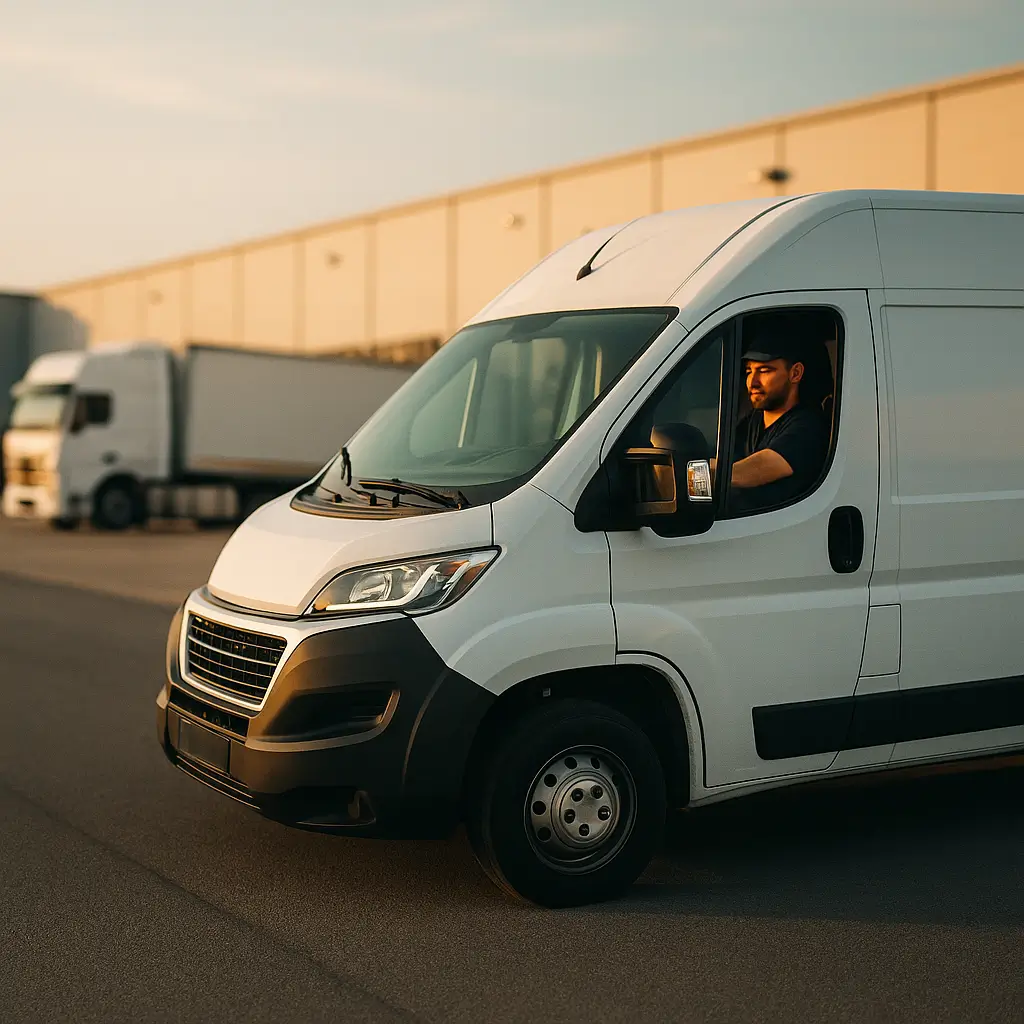

Commercial van insurance in 2026 generally costs about $120 to $800+ per month per van, depending on use. Costs by use:
| Use | Monthly | Annual |
|---|---|---|
| Service/contractor van | $120-$450 | $1,440-$5,400 |
| Local delivery/courier | $250-$800+ | $3,000-$9,600+ |
| For-hire cargo/expedite | $300-$1,200+ | $3,600-$14,400+ |
Commercial van insurance in 2026 typically costs about $120 to $800+ per month per van, based on use type (service vs delivery), garaging ZIP, driver records, annual mileage/radius, liability limits (often $1,000,000 for contracts), and whether you add comprehensive/collision. The #1 reason claims get messy is simple: the policy was written like a personal vehicle even though the van is being used like a business asset (tools, deliveries, employees, job sites).
This guide gives you van-specific cost benchmarks, a coverage checklist, and the “contract reality” requirements that show up on COIs. For broader price comparisons across commercial vehicles, see Logrock’s guide to cheapest commercial auto insurance (2026).
Key Takeaways: Essential Commercial Van Insurance
- Correct classification matters more than “cheap.” A service van rated like a delivery van (or vice versa) can spike premium or create claim friction.
- Liability is the base; physical damage protects uptime. If you can’t replace the van quickly, comp/collision is usually a cash-flow decision.
- Tools/cargo usually aren’t covered by auto physical damage. Many businesses need an add-on (often inland marine / tools coverage) to avoid theft losses.
- Your contracts set the real requirements. Many vendors, GCs, and brokers want $1,000,000 liability and specific COI wording—state minimums often won’t cut it.
Table of Contents
Reading time: ~10 minutes
- Who Needs Commercial Van Insurance (and When Personal Auto Isn’t Enough)
- How Much Does Commercial Van Insurance Cost in 2026?
- What Does Commercial Van Insurance Cover?
- Commercial Van Insurance Requirements (State + Contract Reality)
- What Affects Commercial Van Insurance Rates? (Van-Specific Factors)
- How to Get Cheap Commercial Van Insurance (Without Cutting the Wrong Corners)
- Can You Insure Multiple Vans Under One Policy?
- Real-World Examples: Picking the Right Coverage by Use Type
- Frequently Asked Questions
- Why Logrock (and Any Good Agent) Will Ask “Annoying” Questions
- Conclusion & Get a Van Policy That Won’t Fail You on Claim Day

Who Needs Commercial Van Insurance (and When Personal Auto Isn’t Enough)
Commercial van insurance is designed for business use exposures like employee drivers, high annual mileage, frequent stops, and job-site/loading risk—factors that can materially change underwriting and claim handling compared to a personal auto policy.
Personal auto is built for commuting and errands. Commercial coverage is built for the reality that your van is a revenue tool: tight schedules, loading/unloading, tools or inventory inside, and higher time-on-road.
1) Common business uses that trigger commercial coverage
If the van supports revenue, insurers usually want it on a commercial auto policy (or a properly endorsed business-use policy, depending on the carrier and operation).
- Trades: HVAC, plumbing, electrical, general contractors (tools + job sites)
- Delivery/courier: local routes, medical delivery, last-mile, multi-stop routes
- Cargo van owner-operators:
- Any business with employees driving: your risk changes when someone else has the keys
2) Quick self-check: do you need it?
If you answer “yes” to any of these, you should treat the van as commercial for quoting and coverage decisions.
- The van is titled to your business (LLC/corp) or primarily used for work
- You carry tools, equipment, or inventory
- You deliver goods (especially for pay)
- You have employees/contractors driving it
- Your customer/GC/broker requires a COI (often with $1,000,000 liability)
How Much Does Commercial Van Insurance Cost in 2026?
Commercial van insurance commonly costs $120 to $800+ per month per van in 2026, with the biggest price drivers being use type, garaging ZIP, driver MVRs, mileage/radius, liability limits (often $1,000,000), and whether comprehensive/collision is included.
For a video walkthrough of what these numbers look like in practice, watch LogRock’s breakdown of cargo van business startup costs:
If you’re budgeting, split the decision into two buckets: (1) liability-only pricing to meet a contract, and (2) liability plus comp/collision to protect the van and keep you working if it’s stolen or totaled.
Typical cost ranges (benchmarks you can budget with)
These are planning ranges, not a quote — for a deeper breakdown of , your ZIP code and driver history can move the number fast.
| Van Use Type (Most Common Classes) | Typical Monthly Range (Per Van) | Typical Annual Range | Notes |
|---|---|---|---|
| Service/contractor van (tools, local radius) | $120–$450 | $1,440–$5,400 | Often lower than delivery if mileage is moderate and stops are limited |
| Local delivery/courier (higher mileage, more stops) | $250–$800+ | $3,000–$9,600+ | Stop-and-go + backing/parking exposure increases frequency claims |
| For-hire cargo van / expedite | $300–$1,200+ | $3,600–$14,400+ | Contracts may require higher limits and cargo-related add-ons |
| Passenger/livery (if applicable) | Varies widely | Varies widely | Often requires a specialty/livery form—don’t assume standard commercial auto applies |
What you’ll need to get an accurate quote (fast)
Having the right info upfront helps avoid re-quotes and “surprise” reclassification after underwriting reviews your application.
- Vehicle details: VIN(s), year/make/model, and any upfit details (shelves, racks, liftgates)
- Garaging ZIP: where the van sleeps at night
- Driver list: DOBs and license numbers (MVRs get pulled)
- Operations: annual mileage + typical radius (local vs multi-state)
- Use type: service vs delivery vs for-hire cargo
- Limits: requested liability limits (many contracts want $1,000,000)
- History: prior insurance and loss runs (if you have them)
What Does Commercial Van Insurance Cover?
Commercial van insurance can include liability, physical damage (comprehensive and collision), medical-related coverages (Med Pay/PIP), and UM/UIM, while tools, equipment, and cargo usually require separate coverage forms with their own limits and theft conditions.
The common surprise is thinking “the van policy covers everything inside the van.” In many cases, it doesn’t—at least not the way owners assume.
1) Liability (the coverage you can’t skip)
Liability coverage pays for injuries and property damage you cause to others, and it’s the foundation of almost every contract requirement and compliance check.
- Business reality: Many vendors and GCs require $1,000,000 auto liability on the COI, even if your state minimum is lower.
- Shopping tip: Compare quotes with the same limit; $300,000 vs $1,000,000 isn’t a fair price comparison.
2) Comprehensive + collision (protects the van itself)
Comprehensive generally covers theft, vandalism, hail, glass, and animal strikes, while collision covers crash damage to your van (subject to deductible).
- Who usually needs it: anyone who can’t replace the van quickly, and anyone with a lender/lease (they often require it).
- Deductibles: raising deductibles can lower premium, but only if your cash reserves can handle the deductible without derailing payroll or rent.
3) Medical payments / PIP and UM/UIM (state-dependent)
Med Pay/PIP can help with injuries to occupants, and UM/UIM helps protect you if the at-fault driver has no insurance or low limits, with availability and structure varying by state.
If your vans spend all day in dense traffic, can be one of the most practical coverages you buy—because “not at fault” doesn’t pay bills by itself.
4) Tools, equipment, and cargo (usually not covered the way you think)
Tools, equipment, and cargo are often insured under separate forms (commonly inland marine/tools coverage or motor truck cargo, depending on what you carry and who owns it) rather than under auto physical damage.
- Why it matters: tool theft can be a five-figure loss and can shut down a crew for days.
- What to ask: “Is property inside the van covered, under what form, what are the sublimits, and what are the theft requirements?”
Commercial Van Insurance Requirements (State + Contract Reality)
Commercial van insurance requirements usually start with your state’s minimum liability rules for registration/operation, but many business contracts require $1,000,000 auto liability and specific COI wording that goes beyond state minimums.
Most owners ask, “What’s the state requirement?” The more useful question is, “What will my customer or broker reject if it’s missing from the COI?”
1) State requirements (baseline)
States require some level of liability insurance to legally operate and register vehicles; the is a useful starting point before confirming your exact rule with your state DMV or insurance department.
Practical note: Minimum limits vary by state and can change; confirm with your state DMV/insurance department or your agent for your exact requirement.
2) Contract requirements (what actually wins and keeps work)
Service vendors, GCs, and brokered freight commonly require these items before you start work or pick up a load.
- $1,000,000 auto liability (often shown as CSL)
- COI: certificate of insurance
- Sometimes required endorsements/wording:waiver of subrogation
Once you know what your COI needs to say, here’s how to actually send one to a customer or broker:
If you show up with the wrong limits or missing wording, you can lose the job before the first invoice goes out.
3) Why rates vary so much by ZIP and state
Commercial van insurance rates often vary more by garaging ZIP than “state average” because insurers price local crash frequency, theft trends, litigation environment, medical costs, and repair costs.
- High traffic density: more exposure per mile
- Theft/vandalism: cargo vans are common targets in many metros
- Repair inflation: parts and labor costs are a huge driver
- Weather: hail/flood exposure can push comprehensive losses
What Affects Commercial Van Insurance Rates? (Van-Specific Factors)
Commercial van insurance rates are primarily driven by driver MVRs, use classification (service vs delivery vs for-hire), garaging ZIP, mileage/radius, vehicle value/repairability, theft exposure, and selected limits/deductibles.
If you’re looking for affordable trucking insurance for a van operation, the goal isn’t “find a loophole.” It’s “make your risk predictable” so underwriters can price it competitively.
1) Driver factors
Insurers price commercial auto heavily off driver history, including violations, at-fault accidents, years licensed, and experience in similar work.
- Small fleet reality: one risky driver can raise the whole policy, especially with 1–5 vans.
- Action you can take: run MVRs before handing someone keys; don’t wait for renewal to learn what’s on their record.
2) Use type and routing
Service vans, delivery/courier, and for-hire cargo vans are commonly priced differently because the claim frequency and exposure patterns are different.
- Delivery/courier: more stops, more backing, more parking-lot exposure
- Service calls: fewer stops, often more predictable routing
- For-hire: contract compliance and cargo-related exposures can add requirements
3) Vehicle and parking
Newer vans and upfitted vans can cost more to repair, and parking conditions (street vs locked yard) can change theft and vandalism exposure.
- Theft risk: loaded vans left overnight can attract break-ins and tool theft.
- Loss prevention: gated parking, cameras, and unloading high-value tools can pay back in fewer claims and better renewal outcomes.
How to Get Cheap Commercial Van Insurance (Without Cutting the Wrong Corners)
Cheap commercial van insurance is only “cheap” if it still pays claims correctly and meets contract requirements like $1,000,000 liability and COI wording, because a denied claim or rejected COI is often more expensive than the premium you saved.
Here’s the playbook that actually holds up in the real world.
1) Shop quotes—but keep them comparable
- Use the same liability limits across carriers
- Use the same comp/collision deductibles
- Use the same driver list
- Describe the same use type/class code (service vs delivery vs for-hire)
If one quote is half the price, ask: “What classification did you rate me as?” “Cheap” is often misclassification or missing coverage.
2) Control losses like a business owner
Underwriters reward predictable operations, especially on renewals when loss history starts to matter more than vehicle value.
- Driver policies: written rules for speeding, phone use, backing, and seatbelts
- Dash cams:dash cam discounts
- Telematics: only worth it if you’ll manage behavior, not just install the device
- Parking controls: lighting, cameras, locked gates, and “no loaded vans overnight” rules where possible
Quick refresher: Watch Cargo Van Startup: 3 Key Costs to Master for a short breakdown of the cost levers to watch.
3) Choose deductibles based on cash flow
If raising deductibles saves $40/month but puts you one claim away from missing payroll, that’s not savings—it’s a cash-flow trap.
4) Bundle only when it reduces gaps
Bundling can help, but the bigger win is closing coverage gaps between auto, tools/equipment, and general liability so your biggest loss isn’t sitting uninsured.
Can You Insure Multiple Vans Under One Policy?
Most insurers can schedule on one commercial auto policy, and some carriers offer fleet-style rating as you grow. See LogRock’s guide to a for how that structure works when driver controls and loss history are strong.
For growing businesses, one policy is usually cleaner for billing, limits, and COIs.
1) How multi-van policies typically work
A multi-van commercial auto policy lists multiple vehicles (and usually drivers) under one set of coverages and limits.
- Operational benefit: consistent limits and easier COI issuance for customers
- Pricing reality: as you add vans, your premium becomes more about driver quality and loss history than the value of any one van
2) When separate policies can make sense
- Different operations: service vans and delivery vans may need different rating and underwriting appetite
- Different locations: different metros can have very different loss environments
- Contract-specific limits: one segment might need higher limits or endorsements
Real-World Examples: Picking the Right Coverage by Use Type
Real-world commercial van insurance programs typically differ by operation type—service vans prioritize tools/theft and employee driving controls, while delivery and for-hire operations prioritize frequency-claim prevention and contract-ready limits like $1,000,000 liability.
Here’s what “right coverage” looks like in business terms, not theory.
1) HVAC contractor (tools + employee driver)
A service van loaded with tools and equipment is commonly exposed to tool theft and employee-driven at-fault losses on the way to job sites.
- Priority #1: liability limits that match your commercial contracts (often $1,000,000)
- Priority #2: comp/collision if you can’t replace the van quickly
- Priority #3: tools/equipment coverage (don’t assume it’s included in auto)
- Also consider:general contractor insurance
2) Local delivery/courier (high mileage, tight routes)
High-mileage delivery operations often generate frequent small claims (backing, parking-lot contact, mirrors) that can drive renewal increases.
- Priority #1: higher liability limits due to time-on-road exposure
- Priority #2: UM/UIM because uninsured drivers are common in many markets
- Priority #3: downtime planning (rental reimbursement or cash reserves)
- Operational lever: dash cams and coaching tied to real driving events
3) Cargo van owner-operator (for-hire loads)
For-hire cargo van operations often rise or fall on contract compliance, because brokers can reject a COI that doesn’t match the rate confirmation.
- Priority #1: contract-required liability limits (commonly $1,000,000)
- Priority #2: cargo coverage if required (watch unattended vehicle and theft conditions)
- Priority #3:sprinter van insurance requirements
Frequently Asked Questions
Commercial van insurance commonly costs $120 to $800+ per month per van in 2026, depending on use (service vs delivery), garaging ZIP, driver MVRs, mileage/radius, liability limits (often $1,000,000 for contracts), and whether comprehensive/collision is included.
The fastest way to narrow the number is to quote multiple carriers using the same limits, deductibles, drivers, and class code. If one quote is dramatically lower, confirm the operation was rated correctly (delivery vs service misclassification is a common cause of “too good to be true” pricing).
Commercial van insurance can include liability (injury/property damage you cause), plus optional comprehensive and collision for theft and crash damage to the van, and often UM/UIM and Med Pay/PIP depending on the state and carrier.
Tools, equipment, and cargo are commonly not covered the way owners expect under auto physical damage, so contractors and delivery operators often need a separate tools/inland marine form or cargo coverage. For broader pricing context, see cheapest commercial auto insurance (2026).
You typically need commercial van insurance when a van is used primarily for business (service calls, deliveries, transporting tools or inventory), titled to a business, driven by employees, or tied to contracts that require a COI with limits like $1,000,000 liability.
Even if you’re a one-van operator, frequent stops, high annual mileage, and delivery exposure are the kinds of factors that often push a risk out of “personal use” underwriting. The practical test is simple: if the van is how you get paid, insure it like the business asset it is.
You can lower commercial van insurance costs by quoting comparable policies (same limits/deductibles/class code), improving driver controls (MVR screening, training, dash cams/telematics), and reducing theft exposure with secure parking and tool controls.
Avoid “savings” that come from missing coverage or wrong classification, because that’s when claims get delayed or denied. If you want a broader framework for keeping premiums affordable while staying properly insured, review Logrock’s guide to affordable trucking insurance and apply the same risk-control mindset to your vans.
Yes, most insurers can write a single commercial auto policy covering multiple scheduled vans, and it’s common for 2–20 van operations because it simplifies billing, keeps limits consistent, and makes COIs easier to issue.
As you scale, pricing often becomes more tied to driver quality and loss history than to any single vehicle. If your fleet has very different operations (service + delivery + for-hire) or very different territories, separate policies can sometimes be cleaner from an underwriting and volatility standpoint.
Usually no—standard commercial auto physical damage primarily covers the van itself, while tools and equipment inside the vehicle often require separate coverage such as an inland marine/tools form or a tools endorsement with its own limits and theft conditions.
If your van is essentially your shop, ask your agent to confirm (in writing) what property-in-vehicle coverage exists, any sublimits, and any conditions like forced-entry requirements, unattended vehicle rules, or overnight parking restrictions. This is one of the most common “I thought I was covered” gaps for contractors.
Yes. Most insurers look at how the van is used, not only how often. Even occasional business use—weekend side jobs, part-time deliveries, or hauling tools for paid work—can create a coverage gap on a personal auto policy. If you use the van for pay or regularly carry business tools/goods, quote it as commercial rather than risking a denied claim. For more context on the personal-vs-commercial line, see commercial auto insurance definition.
Misclassification can create two problems: an underpriced policy that gets corrected at audit or renewal, or a claim dispute if the carrier determines the van was being used differently than described on the application. Be specific about mileage, number of stops, routing, and whether you deliver for pay so the price and coverage match reality.
In many cases, yes. Hired and non-owned auto coverage can extend liability protection when an employee uses a personal vehicle for business errands or when your business rents a vehicle. If your team sometimes uses personal cars for supply runs, deliveries, or job-site errands, ask your agent whether HNOA should sit alongside your commercial van policy.
Usually not automatically. Most commercial auto policies list specific drivers, and an unlisted or unapproved driver behind the wheel at the time of a loss can complicate or delay a claim. If you use rotating staff, seasonal help, or subcontractors, ask whether each driver must be added individually or whether a broader driver endorsement is available.
Not always. Towing can introduce separate liability and physical damage questions depending on the trailer’s ownership, weight, and business use. If your van pulls an equipment trailer or cargo trailer, confirm whether the trailer must be scheduled separately or endorsed onto the policy before you rely on coverage.
Why Logrock (and Any Good Agent) Will Ask “Annoying” Questions
Commercial van insurance underwriting commonly depends on measurable variables—garaging ZIP, driver MVRs, annual mileage/radius, and use classification—and changing just one of those can materially change premium and eligibility.
A good agent asks about mileage, radius, drivers, parking, and what you haul because those details decide:
- Whether your policy is rated correctly (and stays correct after underwriting review)
- Whether your claim gets paid cleanly without classification disputes
- Whether your COI passes contract review without delays
If you’ve dealt with compliance checklists or contract onboarding, you already know how it goes: details aren’t busywork—they’re how you keep revenue moving.
Conclusion: Get a Commercial Van Policy That Won’t Fail You on Claim Day
Commercial van insurance is a cash-flow protection tool. The right policy matches your real use type, meets your contract requirements, and closes the obvious gaps (physical damage, tools/cargo, and driver exposure).
Key Takeaways:
- Budget range: plan on $120 to $800+ per month per van, with delivery and for-hire use commonly pricing higher than service.
- Contracts beat minimums: many customers and brokers require $1,000,000 liability and specific COI wording.
- Don’t insure “stuff in the van” by accident: tools/equipment often need separate coverage.
If you’re trying to figure out the right liability limits, close the tools/cargo gap, or make sure your COI will actually pass a contract review, LogRock can help you review your van operation and match coverage to how the vehicle is really used. Talk to our team to ask questions, identify possible gaps, and request a quote based on your business.
Speak with LogRock and request a van insurance quote




