
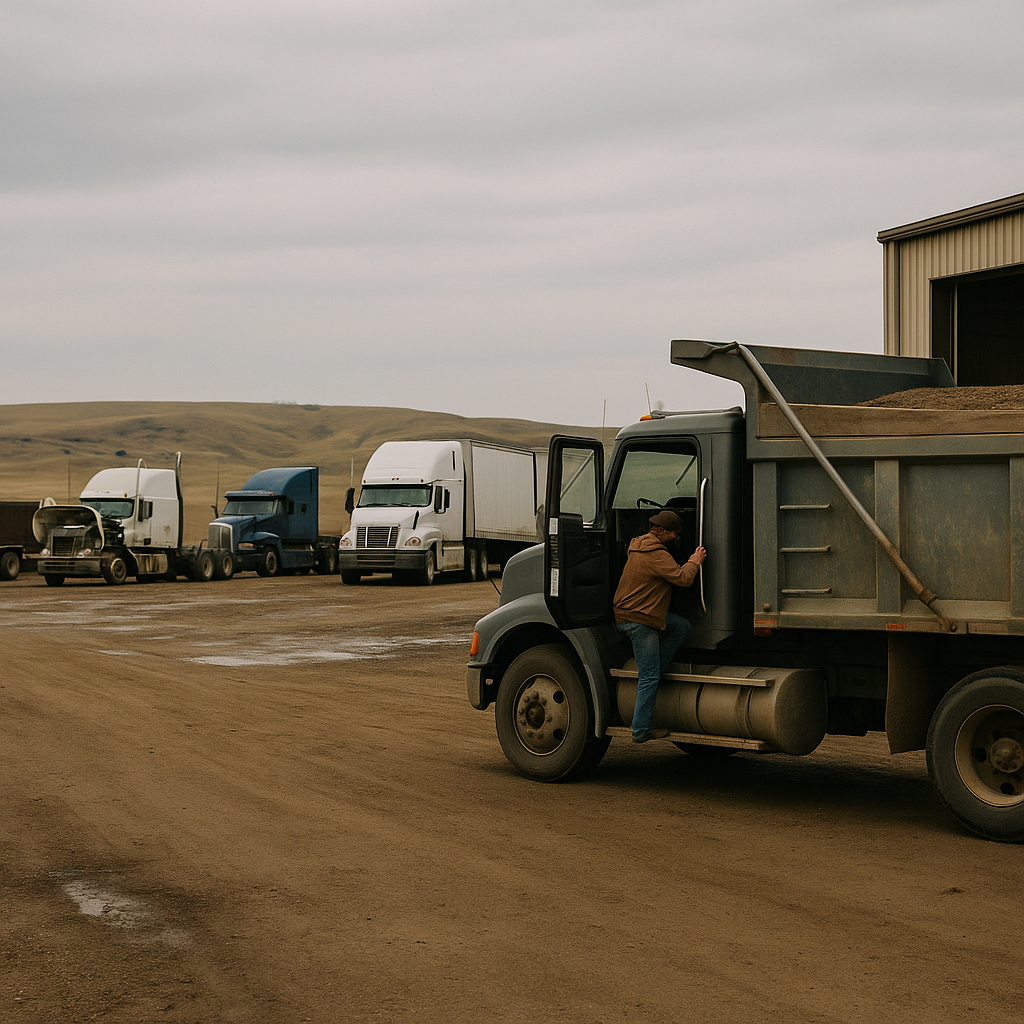
If you run a dump truck in North Dakota, you need commercial trucking insurance built for hauling dirt, gravel, aggregate, debris, and similar loads. The right setup depends on how you operate, what you haul, your truck weight, and whether you stay in North Dakota or cross state lines.
A lot of operators get tripped up by bad shortcuts. Personal auto isn’t the same as a commercial auto policy, and a state minimum isn’t automatically your FMCSA minimum. This guide sorts out the coverages, compliance basics, cost drivers, and quote comparisons that matter for dump truck truck insurance North Dakota.
What dump truck insurance is and who needs it#
Dump truck insurance is commercial coverage designed for trucks used to haul materials for business, not personal driving. If you’re hauling soil, gravel, rock, demolition debris, or similar loads for pay, you usually need commercial coverage that matches that work and the risks around it.
A commercial auto policy is insurance written for business vehicle use, including liability from operating a work truck. A dump truck used on jobsites, haul roads, pits, and public roads has exposures that a personal auto policy usually wasn’t built to cover.
How dump truck insurance differs from personal auto#
Personal auto policies usually cover private driving, not business hauling with a heavy commercial truck. If a claim happens while you’re using the truck for commercial work, the carrier may deny it because the truck was being used outside the policy’s intended purpose.
That matters even for a simple local setup. A North Dakota owner-operator hauling gravel from a pit to a nearby jobsite may never leave the state, but the truck is still being used for business hauling. That calls for commercial liability, and often physical damage too.
Owner-operators vs small fleets#
Both single-truck owner-operators and 2-5 truck fleets need coverage matched to the actual operation. The questions are practical: who owns the truck, who drives it, what materials it carries, where it runs, and what kind of jobsites it enters.
A one-truck operator may need a straightforward liability and physical damage package. A small fleet may need tighter certificate handling, driver scheduling controls, and more attention to how each truck is garaged and used.
When contracts require extra coverage#
Legal minimums aren’t always the whole story. A certificate of insurance is a document that shows your active coverage and limits to a customer, contractor, lender, or other third party.
General contractors, lenders, aggregate yards, and shippers may ask for higher limits, proof of physical damage, or additional coverages before they let you work. That’s where operators get burned by buying the cheapest-looking quote first, then learning it doesn’t satisfy the contract after the job is ready to start.
If you’re staring at a contract requirement and aren’t sure whether your policy actually fits, [](https://www.logrock.com/?utm_source=BLOG&utm_campaign=dump-truck-truck-insurance-North-Dakota).
Core coverages for a dump truck in North Dakota#
Most dump truck operators should start with auto liability, then evaluate physical damage, cargo-related protection, and any jobsite-driven coverages. The exact mix depends on whether you haul for hire, what materials you carry, and whether your work creates off-truck liability around yards or jobsites.
Auto liability#
Auto liability pays for bodily injury or property damage you cause to others with the truck. For most dump truck operations, it’s the foundation of the policy because a loaded truck can cause severe damage in a crash.
Think about a dump truck backing into a loader, clipping a parked vehicle, or causing a multi-vehicle wreck at an intersection. Liability is what responds to third-party injury and property damage claims, subject to the policy terms and limits.
This is also where operators confuse state minimums with trucking requirements. Your required limit can change based on whether you’re for-hire or private, your weight, your cargo, and whether you operate interstate or intrastate.
Physical damage#
Physical damage protects the truck itself against covered losses. In trucking, that usually includes collision and comprehensive coverage, or fire and theft with combined additional coverage depending on the policy structure.
Collision helps when your truck hits another vehicle or object. Comprehensive generally covers things like hail, theft, vandalism, or some non-collision losses. In North Dakota, hail and weather exposures make this especially worth thinking through.
A practical example: your dump truck slides on ice and damages the cab and box, or a hailstorm batters the hood and roof while the truck is parked. Without physical damage, those repair bills come back to you, and downtime can hurt as much as the repair itself.
Cargo and hauled-material exposures#
Motor truck cargo covers covered property you’re hauling for others if it’s damaged or lost in transit. For dump trucks, this gets trickier than it does for boxed freight because not every hauled material fits the same cargo profile.
Some materials may have limited cargo value, while others create bigger exposure from spill cleanup, contamination, or third-party damage. A load of aggregate spilled into traffic can create more than one problem at once: roadway cleanup, another driver’s damage claim, and possible disputes over the material itself.
That doesn’t mean every dump truck needs the same cargo setup. It means you should describe the hauled material accurately during underwriting, which is the insurer’s process for evaluating your risk before offering terms.
General liability and jobsite add-ons#
General liability covers certain business-related injury or property damage claims that don’t come from operating the truck on the road. For dump truck operators, that can matter around yards, loading areas, and jobsites.
Example: a visitor slips in your yard, or your off-truck business activity damages someone’s property. That’s a different exposure from a highway accident.
Some operations also need extra endorsements or certificates because of where they unload, who they work for, or what contract language says. The key is not assuming every quote includes dump-truck-specific use just because it says “commercial truck.”

North Dakota and FMCSA requirements that can affect your policy#
Requirements for a dump truck can change based on whether you run only in North Dakota or operate across state lines. Federal rules can apply when the operation falls under FMCSA jurisdiction, while some local hauling setups are shaped more by state rules and contract requirements.
Interstate vs intrastate operation#
Interstate means your operation crosses state lines or is part of interstate commerce. Intrastate means the operation stays within one state.
That difference matters a lot. A dump truck hauling aggregate only between North Dakota pits and local construction sites may face a different compliance path than a truck hauling materials into Minnesota or picking up loads tied to interstate commerce.
For federal basics, the FMCSA is the main reference point. If your operation falls under federal jurisdiction, your insurance, filings, and authority setup may need to align with that status.
Weight and carrier type#
Under 49 CFR Part 387, for-hire interstate carriers hauling general freight in vehicles over 10,001 lbs must carry at least $750,000 in public liability. Carriers under 10,000 lbs are scoped differently, auto haulers have a different minimum, and hazmat can require much higher limits.
That’s why “all truckers need $750K” is wrong. The right question is whether you’re for-hire or private, what the truck weighs, what commodity you haul, and whether the operation is interstate.
A USDOT number is an identifier used by regulators to track safety and operating status. An MC number is operating authority used for certain for-hire interstate operations.
Certificates, filings, and proof of coverage#
Not every dump truck needs the same federal filing profile. But many operators still need proof of coverage fast, either for a regulator, a shipper, a pit, a general contractor, or a lender.
If you’re checking whether a carrier is active and how it’s registered, you can verify status through SAFER. That’s useful when you’re setting up a new operation, confirming authority status, or double-checking records before a contract starts.
State rules vs federal rules#
North Dakota state requirements and federal trucking requirements are not interchangeable. A truck can be legal under one framework and still be missing something required under the other.
A practical example: a local aggregate hauler working entirely inside North Dakota may not have the same FMCSA filing setup as a for-hire carrier crossing state lines. But that same local hauler may still need commercial liability, certificates, and contract-specific limits to stay operational.
What affects dump truck insurance cost#
Dump truck insurance cost is driven by risk, not just the size of the truck. The biggest pricing factors usually include truck value, repair cost, driver history, radius, annual mileage, materials hauled, jobsite exposure, prior claims, and the limits and deductibles you choose.
Truck value and repair cost#
A newer dump truck with a higher stated value usually costs more to insure for physical damage than an older unit with less value. A deductible is the amount you pay out of pocket before covered physical damage insurance starts paying on a claim.
Repair cost matters too. Some trucks are expensive to fix because of body configuration, parts cost, specialty equipment, or local labor availability. Even two trucks with similar age can underwrite differently if one is a tandem axle working daily and the other is an older single-axle used seasonally.
Driving record and operating radius#
A clean MVR and stable operating history usually help. A wider radius, more annual miles, multiple drivers, or recent losses usually add risk.
For example, a dump truck making short local runs around one North Dakota county may rate differently than a truck spending long days on mixed routes between pits, highway jobs, and multiple towns. Same truck class, different exposure.
Cargo, materials, and jobsites#
What you haul changes the risk story. Rock, sand, dirt, debris, or specialty material can each create different spill, cleanup, damage, and claims patterns.
Jobsites matter too. Tight backing, rough terrain, loader contact, rollover exposure, and public-road transitions all affect how an insurer looks at the operation. A sidewall scrape at a narrow site entrance isn’t the same risk as straightforward road-only hauling.
Coverage limits, deductibles, and endorsements#
Higher liability limits and lower deductibles usually increase premium. On the other hand, trimming too far can leave gaps that look cheap on paper and expensive after a claim.
Business structure and prior insurance continuity can also matter. If there was a lapse, a new venture, or a recent change in operations, the quote may come back differently than it would for a similar truck with clean continuous coverage.
When a quote looks surprisingly low, that’s usually the time to slow down and compare what’s actually included instead of rushing to bind it. If you want help pressure-testing the details, [](https://www.logrock.com/?utm_source=BLOG&utm_campaign=dump-truck-truck-insurance-North-Dakota).
How to compare quotes without buying the wrong coverage#
The best way to compare dump truck insurance quotes is to match each quote to the real operation, not just the premium. Two quotes can look close on price and still be very different on dump-truck use, exclusions, certificates, deductibles, and how a claim would actually be handled.
Match the quote to the operation#
Tell the broker or carrier exactly what the truck does. Local dirt work, aggregate hauling, debris removal, seasonal work, subcontracting, and occasional out-of-state trips can all affect how the risk is classified.
If the quote was built assuming one narrow use, but your truck does three kinds of hauling in real life, the cheapest option may be the one most likely to cause trouble later.
Check exclusions and class restrictions#
An exclusion is a policy provision that says a certain loss, use, or situation isn’t covered. This matters because some policies or markets may be picky about dump truck classes, jobsite use, or the exact kind of hauled material.
If the truck sometimes hauls outside a narrow local scope, say that upfront. It’s better to hear “this market won’t write that class” before a claim than after one.
Confirm filings and certificates#
Fast certificate support matters when a general contractor or shipper wants proof now, not next week. Filing support matters too if your operation needs it.
Ask practical questions: Can they issue certificates quickly? Do they understand the difference between local intrastate hauling and a for-hire interstate setup? Can they explain what filings apply and why?
Compare deductibles and limits#
Don’t just compare total premium. Compare liability limits, physical damage deductibles, any cargo terms, and how the policy would respond to a rollover, side-swipe, spill, or backing loss.
Ways dump truck operators may reduce insurance cost#
The most reliable way to reduce dump truck insurance cost is to reduce avoidable risk. That means cleaner records, better documentation, and smarter coverage choices, not blindly chasing the lowest quote.
Improve the risk profile#
Keep MVRs clean, maintain accurate garaging information, and document maintenance. Garaging matters because where the truck is kept can affect theft, weather, and claim exposure.
Safety tech can help support the story too. Dash cams, telematics, and documented inspection habits won’t erase every risk, but they can make underwriting easier.
Choose coverage intentionally#
You can sometimes lower cost by choosing deductibles that fit your cash flow and trimming extras you don’t need. But don’t strip out core protection just to make the premium look better.
A truck that’s financed usually needs physical damage anyway. A truck working active jobsites may need more than bare-minimum thinking.
Keep records clean and current#
Update the insurer when the garaging address changes, when the radius changes, or when the truck starts hauling different material. Bad or stale information can lead to bad quotes and harder claims.
Review coverage before renewal#
Review the policy before renewal if the truck aged another year, routes changed, or the operation expanded. A seasonal dirt-work setup today can become a broader hauling business next year, and the policy should keep up.
Is North Dakota a no pay no play state?#
No-pay-no-play is a legal rule, not a coverage type. In plain language, some states limit what an uninsured driver can recover after a crash, especially for certain non-economic damages, but that doesn’t replace the need for proper commercial insurance.
What the rule means#
No-pay-no-play refers to laws that can restrict recovery for drivers who were uninsured at the time of an accident. It’s about claim recovery rights, not about satisfying trucking insurance requirements.
How it can affect uninsured drivers after a crash#
If a state applies some version of this rule, an uninsured driver may face limits on what they can collect even if another party caused the crash. That’s a legal issue that should be checked against current state guidance, not something to guess about from a forum post.
For North Dakota-specific guidance, check the North Dakota Department of Insurance.
Why this matters for commercial operators#
Commercial operators still need proper liability and other coverage because no-pay-no-play doesn’t protect your truck, pay your lender, or handle third-party claims you cause. If your dump truck is damaged in a crash, having the right policy matters regardless of the other driver’s insurance situation.
When to request a quote#
The best time to request a dump truck insurance quote is before the truck starts hauling, before a contract demands proof, or before a change in operations creates a coverage mismatch. Quote timing matters because filings, certificates, and underwriting details can take longer when something is unclear.
New authority or new truck#
If you’re adding a truck, starting a business, or changing from personal use to commercial hauling, get the quote early. Have VINs, driver information, garaging details, cargo descriptions, and operating radius ready.
Renewal after a route change#
If the truck used to stay local but now crosses state lines, or if you shifted from dirt work into broader hauling, review the policy before renewal. Interstate versus intrastate details can change the insurance setup.
Before adding a second truck#
Adding another truck changes more than vehicle count. It can change driver assignments, scheduling, limits, and certificate needs.
Before signing a contract#
A quote conversation works best when you already know whether the truck hauls only in North Dakota or crosses state lines, and what proof the customer wants. Compare the coverage, not just the premium.
FAQ#
How much does it cost to insure a dump truck?
Dump truck insurance cost depends on the operation more than the truck alone. The main drivers are truck value, repair cost, driver history, garaging, operating radius, annual mileage, claim history, materials hauled, and the liability limits and deductibles you choose. Interstate versus intrastate operation can also change the picture. A newer tandem axle hauling rock every day may underwrite very differently than an older single-axle truck used seasonally for local dirt work. Your actual premium depends on your operation, cargo, radius, driving history, and other factors.
What kind of insurance do I need for a dump truck?
Most dump truck operators should start with auto liability because it covers bodily injury and property damage you cause to others with the truck. From there, many also need physical damage to protect the truck itself, especially if it’s financed or would be expensive to repair. Motor truck cargo may matter depending on what you haul and how that hauled material is treated under the policy. General liability can also matter for off-truck exposures around jobsites or yards. Requirements vary by carrier type, vehicle weight, cargo, and whether you operate interstate or intrastate.
Is North Dakota a no pay no play state?
No-pay-no-play is a legal concept that can limit what an uninsured driver is allowed to recover after a crash in some states. It’s not an insurance policy by itself, and it doesn’t satisfy commercial trucking requirements. For a dump truck operator, the practical point is simple: even if another driver causes a crash, you still need your own proper coverage to protect the truck, satisfy contracts or lenders, and handle your own claim exposure. Because legal recovery rules can change, it’s smart to confirm current North Dakota guidance with the state Department of Insurance instead of relying on rumor.
Who has the cheapest commercial truck insurance?
There isn’t one carrier that’s cheapest for every dump truck operation. The lowest quote depends on the truck, the driver, the hauling class, operating radius, prior losses, garaging, and the exact coverage structure. Two policies can have similar prices but very different exclusions, deductibles, filing support, and certificate turnaround. That’s why the right comparison isn’t just who quoted the lowest premium. It’s whether the policy actually fits your operation and whether the insurer or broker understands dump truck risk. If you’re not sure what coverage fits your operation, LogRock can help you scope it.
Do all dump trucks need FMCSA insurance filings?
No. FMCSA filings depend on the operation, not just the fact that the vehicle is a dump truck. The key questions are whether you’re operating for-hire or private, whether the truck is involved in interstate commerce, the vehicle weight, and what commodity is hauled. A local North Dakota dump truck staying intrastate may have a different compliance path than a for-hire interstate carrier. But even when federal filings aren’t required, you may still need commercial liability, proof of coverage, and certificates for customers, lenders, pits, or contractors. Always match the filing question to the actual operation.





