
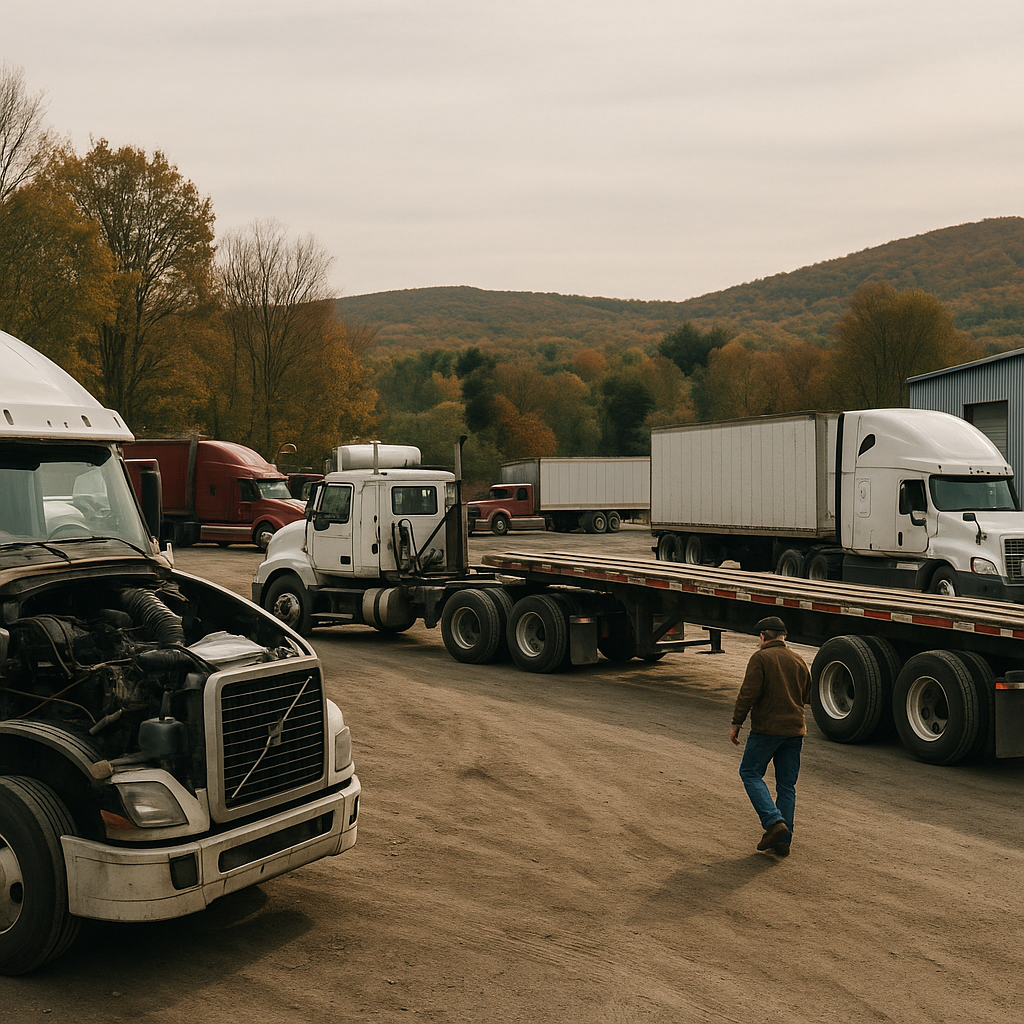
Flatbed truck insurance Massachusetts operators buy should match the way they actually haul, not a generic box-checking list. If you run steel, lumber, machinery, or palletized freight on an open deck, your truck, trailer, cargo, and authority setup all change what coverage makes sense.
A lot of owners get tripped up in the same places. They mix up Massachusetts state minimums with FMCSA rules, assume a personal auto policy helps on a working truck, or bind a policy that still doesn’t satisfy the filing or proof needed to start hauling.
What Flatbed Truck Insurance Covers#
Flatbed truck insurance is commercial insurance built for a working flatbed operation, including the truck, liability from hauling, and the cargo exposure that comes with an open trailer deck. In Massachusetts, the right setup usually combines auto liability with cargo, physical damage, and trailer-related coverage based on how you run.
A flatbed truck insurance policy is commercial coverage for a truck used to haul freight on a flatbed, along with the risks tied to that work.
Core coverages for a flatbed operation#
The base policy usually starts with auto liability, which pays for bodily injury or property damage you cause to others in a covered crash. If you’re for-hire, this is the coverage most closely tied to authority and regulatory requirements.
Then there’s motor truck cargo, which covers freight you haul for others, subject to the policy’s terms and exclusions. For a flatbed operator, that matters because exposed cargo can shift, get wet, or get damaged during loading, transit, or unloading in ways enclosed van freight doesn’t.
Physical damage covers your truck for collision and other direct damage losses like fire, theft, or certain weather events. On a newer tractor hauling heavy machinery or bundled lumber, this often matters just as much as liability because one bad loss can sideline the truck that produces your income.
What changes when you haul cargo on an exposed deck#
A flatbed load creates different risk than dry van freight because the cargo sits out in the open and has to be secured correctly. Steel, lumber, pallets of block, and construction equipment don’t just have different values. They also have different tie-down needs, shifting risk, theft exposure, and claim severity if something breaks loose or arrives damaged.
The NAIC has plain-language insurance guidance that helps explain how exclusions, deductibles, and policy terms can change what a policy really pays after a loss. That’s especially important for flatbed work, where the cargo itself can be rugged but still easily damaged by improper securement, water intrusion, or impact.
If you’re not sure whether your cargo setup matches the policy you’re buying,
When truck and trailer coverage need to be separate#
A trailer interchange policy covers a trailer in your care when you use it under a written interchange agreement. A non-owned trailer physical damage policy covers certain trailer damage exposures when the trailer isn’t yours, usually without relying on an interchange agreement.
That distinction matters because many Massachusetts flatbed operators don’t own every trailer they pull. One driver may own the tractor but lease the trailer. Another may borrow a flatbed for a week. Another may swap equipment under a contract. In each case, the trailer exposure can sit outside the tractor’s basic coverage unless it’s specifically addressed.
Other common coverages include general liability for non-driving business exposures and non-trucking liability, sometimes called bobtail, for non-business use when you’re not under dispatch. Those cover different situations than auto liability, so they aren’t interchangeable.
Who Needs It in Massachusetts#
Massachusetts flatbed operators need different insurance setups depending on whether they haul for-hire or private, stay intrastate or cross state lines, and what they haul. A one-truck owner-operator and a small fleet often need the same core policy types, but not always the same limits, filings, or paperwork flow.
A for-hire carrier hauls property for someone else for payment. A private carrier hauls its own goods as part of its own business.
For-hire vs private carriage#
If you haul steel for a shipper and get paid to move that freight, you’re usually in a for-hire setup. If you own a construction company and use your flatbed to move your own materials and equipment, that’s a private carriage setup instead.
That difference affects insurance expectations right away. For-hire carriers usually face more scrutiny around authority, cargo, and proof of coverage, while private carriers may not need the same exact structure but still need commercial trucking coverage for the truck and operation.
Interstate vs intrastate operations#
Interstate commerce means your operation crosses state lines or is part of a shipment moving across state lines. Intrastate commerce stays within one state and isn’t part of a broader interstate move.
A Massachusetts operator who only runs local building materials inside the state may face a different compliance picture than a flatbed owner-operator hauling machinery into Connecticut, Rhode Island, or New York. Weight, cargo, and whether you need operating authority can change what insurance is required and what brokers or shippers expect to see before they load you.
Owner-operators vs small fleets#
A one-truck business and a three-truck fleet may carry the same basic coverages: liability, cargo, physical damage, and trailer-related protection. The difference is often in the details: driver schedules, deductibles, loss control, certificate requests, and how quickly the business can document a claim or add equipment.
When flatbed tow trucks fit differently#
Some flatbed tow-truck businesses fit into a different insurance lane because towing and recovery create a different exposure than hauling general freight. If the truck is used mainly for vehicle recovery, roadside service, or repo-style work, the coverage structure and carrier appetite may differ from a standard freight-hauling flatbed.

Massachusetts Requirements and FMCSA Rules#
Massachusetts flatbed operators should not assume the state’s minimum vehicle insurance rules are the same as federal trucking rules. If you operate for-hire in interstate commerce, FMCSA requirements can control your liability minimums and filings, and those depend on carrier type, vehicle weight, and cargo.
A USDOT number is the identifier used to track a carrier’s safety and regulatory record. An MC number is operating authority used for certain for-hire interstate carriers.
State minimums versus federal trucking requirements#
This is where a lot of owner-operators get bad advice. Your Massachusetts auto registration and state-required insurance can be one issue. Your federal trucking requirement can be another.
Under 49 CFR Part 387, for-hire interstate carriers hauling general freight in vehicles over 10,001 pounds must carry at least $750,000 in public liability. Carriers under 10,000 pounds can fall under a lower federal minimum, auto haulers have a higher minimum, and certain hazmat operations require much more. That’s why “all truckers need $750K” is wrong.
The FMCSA ties those financial responsibility rules to the operation itself, not just the state where the truck is garaged. So a Massachusetts flatbed running interstate general freight may be governed by federal rules even if the truck rarely leaves New England.
When a filing or proof of coverage is required#
An MCS-90 is an endorsement tied to federally required public liability for certain motor carriers. It supports the policy’s proof of financial responsibility for regulated operations.
A common real-world problem looks like this: a new flatbed owner-operator buys a policy on Friday, books a Monday load, then learns the authority can’t go active because the required insurance filing hasn’t posted yet. The truck is insured, but the operation still can’t legally dispatch under that authority until the filing and status line up.
You can check carrier registration context and status through SAFER, which is often the fastest way to verify whether the USDOT and authority details are lining up the way you think they are.
Why the right authority matters before you dispatch#
A Massachusetts RMV registration card doesn’t prove you meet federal for-hire requirements. A certificate of insurance doesn’t always mean the filing the authority needs has been accepted. And a shipper asking for a certificate may still want cargo limits, trailer coverage details, or additional insured language beyond the legal minimum.
That gap is where expensive mistakes happen. A driver may think, “I’ve got insurance, so I’m good,” then lose a week because the coverage doesn’t match the authority, cargo class, or dispatch plan.
What Affects Flatbed Insurance Cost#
Flatbed truck insurance cost in Massachusetts depends on the truck, trailer, cargo, route pattern, driving history, and how the business is set up. There isn’t one useful flat rate because a local private flatbed hauling owned equipment is a very different risk from a for-hire interstate operator hauling steel coils several states away.
Truck, trailer, and cargo risk drivers#
The garaging location is where the truck is principally kept when not in use. Insurers also rate for vehicle value, repair cost, theft exposure, and whether the trailer is owned, leased, or borrowed.
A newer tractor with high physical damage values usually costs more to insure than an older paid-off unit with limited comp and collision exposure. The same goes for trailers. If you’re insuring a newer aluminum flatbed with specialized equipment, that can change the conversation even before cargo enters the picture.
Cargo matters a lot. Steel coils, structural steel, and machinery can drive higher concern because losses can be severe if the load shifts or breaks free. Lumber may have different weather and securement concerns. Palletized materials can create their own damage patterns if wrapping fails, forks punch through freight, or load edges collapse in transit.
How routes, radius, and operation type affect pricing#
Operating radius is the normal distance your truck travels from its base of operation. Local Massachusetts work usually prices differently than multistate hauling because miles, traffic patterns, road exposure, and claim handling complexity all change.
A truck running Boston-area deliveries and returning to the same yard at night is not rated the same as a flatbed doing longer runs through the Northeast corridor. For-hire business also tends to be reviewed differently than private business because the cargo mix, scheduling pressure, and customer requirements can vary more.
Why claims history and driving record matter#
Past losses don’t just affect premium. They affect whether an insurer sees the account as stable, marginal, or outside appetite. Repeated backing claims, load securement losses, or out-of-service issues can make a policy harder to place or narrow the options available.
Driver records matter the same way. One experienced owner with a clean history and a narrow cargo profile presents differently than a small fleet with several newer drivers and mixed freight.
Common savings levers without buying the wrong coverage#
The safest way to control cost is to reduce avoidable risk, not strip out protection you actually need. Better maintenance records, clean MVRs, safer parking, anti-theft measures, and deductibles you can truly afford all help make the account cleaner.
Matching limits and coverages to the operation also matters. If you never use non-owned trailers, don’t buy coverage built for that exposure. If you regularly pull someone else’s flatbed, don’t skip it and hope the tractor policy somehow picks it up. That kind of “savings” usually turns into a denied claim.
What Flatbed Insurance Usually Does Not Cover#
Flatbed truck insurance does not cover every loss just because the truck is insured. Common gaps include personal auto policies, cargo outside the policy’s terms, excluded operations, and trailers or equipment that aren’t properly scheduled or endorsed.
An exclusion is a policy term that says a specific type of loss, use, or property is not covered.
Common exclusions and coverage gaps#
Cargo coverage may exclude certain commodities, cap payment for specific types of property, or deny losses tied to improper securement or unattended theft situations. Physical damage on the tractor doesn’t automatically cover every trailer attached to it. General liability doesn’t replace auto liability. Non-trucking liability doesn’t cover business hauling.
Personal auto misconceptions#
This one burns new owner-operators all the time. A personal auto policy is built for personal driving, not a commercial flatbed operation. If you use a working truck to haul freight for money, the insurer can treat that as outside the policy’s intended use.
A practical example: someone buys a truck, tags it, and assumes the same insurance approach they used on a pickup will work until business picks up. Then there’s a crash on the way to a paid load or while returning from a delivery, and the policy doesn’t respond the way they expected.
Cargo handling mistakes and unsecured load issues#
With flatbeds, coverage questions often come down to what happened before the loss. Was the load properly secured? Who loaded it? Was a tarp used where required? Did weather contribute? Was the damage caused during transit, at a job site, or while lifting the freight off the trailer?
Those facts matter because flatbed claims are heavily documentation-driven.
Why separate policies matter for leased or non-owned equipment#
If you pull a trailer you don’t own, coverage may depend on whether it’s scheduled, covered as non-owned equipment, or subject to a written interchange agreement. That’s why leased and borrowed trailer setups should be reviewed up front instead of after a loss.
How to Get the Right Quote#
The right flatbed truck insurance quote in Massachusetts starts with accurate operating details, not just the truck VIN. The more clearly you describe your cargo, routes, trailer setup, and authority status, the easier it is to compare policies without missing a coverage gap that only shows up after a claim or during authority activation.
A VIN is the vehicle identification number used to identify the truck or trailer being insured.
What information to gather before requesting quotes#
Have the basics ready before you ask for terms:
- Truck and trailer VINs
- Garaging address
- Driver license details and driving records
- Cargo types you actually haul
- Estimated annual miles
- Usual operating radius
- USDOT or MC information, if applicable
- Whether you are for-hire or private
- Whether the trailer is owned, leased, or non-owned
If you say “general freight” but actually haul steel, lumber, and equipment on an open deck, that mismatch can create problems later.
Questions to ask a broker about flatbed risks#
Ask direct questions. Does the quote include cargo? What about physical damage? Is there coverage for a borrowed trailer? If you’re applying for authority, will the broker help confirm the filing side of the policy is set up correctly?
Those questions matter because a policy can look complete on the declarations page and still miss a core flatbed exposure. If you want help sorting that out before you bind,
How to compare quotes without missing a coverage gap#
Compare more than the premium. Look at limits, deductibles, listed vehicles, named insured details, covered territory, cargo terms, trailer treatment, and any filing support. Two quotes can look close in price but be very different in what they actually protect.
Why working with trucking specialists helps#
A trucking-focused broker can spot the gaps generic commercial auto quoting often misses. That’s especially useful for Massachusetts flatbed operators who need to line up the policy with authority, cargo type, and trailer use instead of buying broad-sounding coverage that doesn’t match the real job.
Savings, Claims, and Practical Operating Tips#
The best savings moves for a flatbed operator usually come from cleaner risk, better documentation, and regular policy reviews, not from cutting core coverage. Good records can also make a major difference after a cargo or collision claim, when the carrier wants to know exactly what was hauled, how it was secured, and what equipment was involved.
How to lower risk without cutting needed coverage#
Safer parking, strong maintenance logs, driver screening, and realistic deductibles all help. So does staying disciplined about the cargo you describe to the insurer. If your operation changes, your policy should change with it.
Documentation that helps during claims#
Keep photos of the truck and trailer, pre-trip inspection notes, bills of lading, securement details, and load-condition photos when practical. On flatbed freight, that evidence can matter a lot if the dispute involves weather, shifting cargo, or tie-down failure.
When a small fleet should review limits again#
Review coverage whenever you add a truck, add a trailer, hire a driver, change your haul radius, or start carrying different freight. Small fleets often outgrow their original setup before they realize it.
Conclusion: Match Coverage to the Way You Haul#
Flatbed truck insurance in Massachusetts works best when it follows the real operation: who you’re hauling for, where you run, what the trailer setup looks like, and what cargo sits on that deck. That’s more useful than chasing a generic “best” or “cheap” policy label.
The biggest takeaways are simple. State minimums are not the same as FMCSA requirements. Cargo, trailer ownership, and authority details all matter. If your routes, freight, or equipment change, review the policy before the next load does it for you.
FAQ#
How much is flatbed insurance?
Flatbed insurance cost varies too much by operation to reduce to one useful number. The main drivers are truck value, trailer setup, cargo type, driving record, claims history, operating radius, garaging location, and whether the business is for-hire or private. A Massachusetts operator hauling local building materials may price very differently from an interstate flatbed hauling steel or machinery. The better way to think about cost is whether the quote matches the risk. A low premium doesn’t help if it leaves out cargo, trailer damage, or the filing support needed for your authority.
Can you get insurance on a flatbed trailer?
Yes. A flatbed trailer can often be insured, but the right coverage depends on whether you own it, lease it, borrow it, or operate it under a written interchange agreement. If the trailer is yours, it may be scheduled for physical damage. If it’s not yours, you may need non-owned trailer physical damage or trailer interchange coverage, depending on the arrangement. This is where many operators assume the tractor’s policy automatically covers the trailer. Sometimes it doesn’t, or it covers only part of the exposure, so ownership and contract details matter.
Does Progressive insure flatbed trucks?
Insurer appetite changes over time, so the better question is whether a given insurer currently wants your kind of flatbed risk and whether the policy fits your operation. Flatbed work is not one uniform class. Hauling lumber, steel, machinery, or construction materials can be viewed differently, and interstate for-hire authority can add filing needs that matter just as much as price. Instead of focusing on one carrier name, compare whether the quote addresses liability, cargo, physical damage, trailer exposure, and any authority-related requirements your operation has.
How much does commercial hauling insurance cost?
Commercial hauling insurance cost depends on the business model behind the truck. A single-truck owner-operator with clean history, stable lanes, and a narrow cargo profile may look very different from a small fleet with mixed drivers, broader territory, and heavier or higher-severity freight. Insurers usually look at vehicle type, annual mileage, route radius, cargo, garaging, loss history, and requested limits. If the hauling is for-hire and interstate, authority and filing needs can also affect the placement. The most accurate comparison comes from reviewing the full operation, not just the truck itself.





