
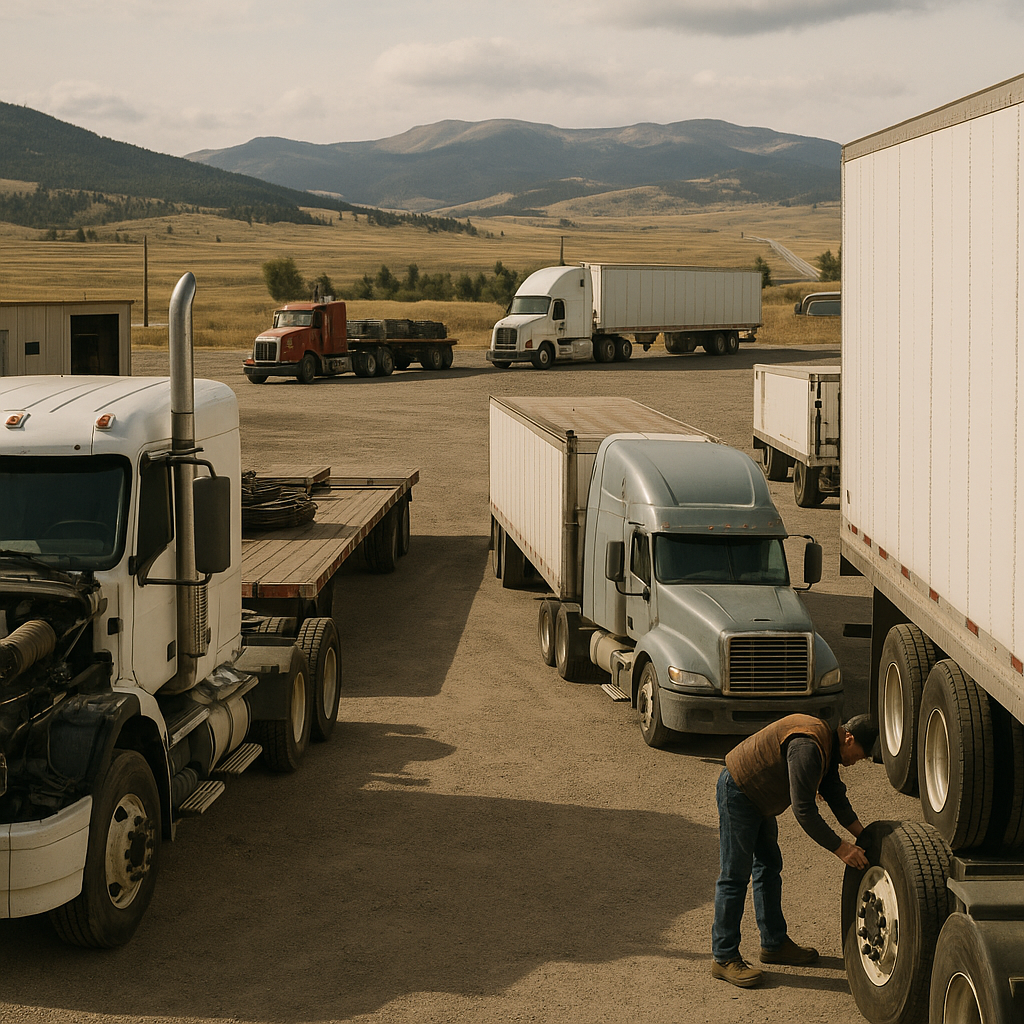

Montana fleet truck insurance protects trucks used for business, not personal driving. If you run one truck with a commercial setup or a small fleet of 2–5 trucks, the right policy depends on what you haul, where you run, how your trucks are titled and scheduled, and whether you operate intrastate or interstate.
This guide keeps it practical. It separates Montana rules from FMCSA rules, explains the main trucking coverages in plain English, and shows how to read quotes without getting fooled by stripped-down pricing.
Montana fleet truck insurance basics#
Montana fleet truck insurance is commercial insurance built for trucks used in business, usually under one policy structure or a coordinated set of coverages for one operation. For most Montana owner-operators and small fleets, it means matching liability, truck, cargo, and trailer protection to the way the business actually runs.
What commercial fleet insurance means#
Commercial fleet insurance is business auto coverage for multiple vehicles used in a company operation. In trucking, that can mean a true 2–5 truck fleet, or a single-truck operation with commercial insurance built around scheduled business-use vehicles and trucking-specific coverages.
This is not the same thing as a personal auto policy. Personal auto insurance is built for private passenger use, while trucking coverage has to account for business use, heavier vehicles, cargo exposure, authority, and compliance rules. The NAIC gives plain-language background on how commercial auto coverage differs from personal auto terminology.
Who needs fleet coverage in Montana#
Montana operators need commercial trucking coverage when trucks are used to haul freight, run under a motor carrier, or support a business operation. A motor carrier is a business that transports property or passengers for compensation or as part of its business.
If you’re a for-hire carrier, a leased-on owner-operator, or a small fleet with a few power units, the policy has to match your carrier type, vehicle weight, cargo, and operating scope. That’s where many bad quotes start: the coverage gets priced for a different operation than the one you actually run.
How fleet policies differ from personal auto#
Fleet truck insurance is built around risk that personal auto policies were never meant to handle. A trucking policy may include liability, cargo, physical damage, trailer-related coverage, and filings tied to authority or state requirements.
The point of this article isn’t to throw generic insurance language at you. It’s to help you figure out what coverage fits your Montana operation, what may be required, and how to compare quotes on equal terms.
Montana rules: state minimums, FMCSA, and no-fault basics#
Montana trucking insurance rules depend first on whether you operate only inside Montana or cross state lines. State minimums and federal FMCSA requirements are not the same thing, and most confusion starts when drivers assume one liability number covers every trucking operation.
State minimums versus federal requirements#
FMCSA is the Federal Motor Carrier Safety Administration, the agency that oversees many interstate motor carrier rules. Under FMCSA financial responsibility rules and 49 CFR Part 387, for-hire interstate carriers hauling general freight in vehicles over 10,001 lbs must carry at least $750,000 in public liability, while other operations can fall under different minimums based on weight, cargo, and carrier type.
That’s why “all truckers need $750K” is wrong. Under 10,000 lbs can fall under a different threshold, auto haulers can require more, and certain hazmat operations can require much more. Requirements vary by carrier type, vehicle weight, cargo, and whether you operate interstate or intrastate.
Intrastate and interstate operations#
Intrastate means you operate only within one state. Interstate means you cross state lines or haul freight tied to interstate commerce, even if a given trip stays within Montana.
If you run intrastate only, Montana state rules may control more of the liability discussion. If you run interstate for-hire freight, FMCSA requirements come into play and can override what drivers think of as the “state minimum.” The safe move is to confirm your actual requirement based on authority type, weight class, and operating scope before you bind coverage.
Why no-fault matters less than trucking scope#
Montana is not generally treated as a no-fault auto insurance state in the way drivers use that term for passenger cars. For trucking, though, that question usually matters less than your liability limit, your filings, and whether your operation is intrastate or interstate.
A filing is proof sent by an insurer to show you carry the insurance required for a regulated operation. If your trucking setup triggers federal or state filing requirements, that matters a lot more than passenger-auto terms like no-fault.
A lot of fleets get in trouble here by buying to the wrong rule, then finding out during authority setup, a contract review, or a roadside issue that their policy doesn’t match their actual operation. If you’re not sure what fits,
Coverage choices for Montana fleets#
Most Montana fleets need auto liability as the core coverage, then add operational coverages based on cargo, truck value, trailer use, and whether the truck is under dispatch. The right package depends on what the truck does day to day, not on a generic “full coverage” label.
Required liability and filings#
Auto liability is coverage for bodily injury and property damage you cause to others in a crash. For regulated trucking operations, it’s the core compliance coverage and the one most often tied to state or federal filings.
If you’re a for-hire carrier, this is usually the first thing that has to be right. A certificate of insurance is a summary document showing coverage is in force, but it is not the policy itself and it does not replace required filings.
Cargo and business protection#
Motor truck cargo insurance protects freight you’re hauling if covered cargo is damaged or lost from a covered cause. If you haul for shippers or brokers, this is often expected contractually even when it’s not the same thing as your core liability requirement.
General liability covers certain non-driving business exposures, like some third-party injury or property damage claims not caused by the truck on the road. For trucking, its value depends on how your operation interacts with customers, job sites, and contracts.
Physical damage, bobtail, trailer, and reefer options#
Physical damage covers damage to your truck itself. In trucking, that usually means collision for crash damage and comprehensive or fire-and-theft type coverage for non-collision losses. Collision should not be treated as a standalone fix; it typically pairs with comprehensive-style protection.
Non-trucking liability, often called bobtail by drivers, covers certain non-business use of the truck when it is not under dispatch. It does not cover paid hauling. That’s one of the most common misunderstandings in trucking insurance.
Trailer interchange covers a trailer in your care when you have a signed interchange agreement. Non-owned trailer physical damage is usually the better fit when you use a trailer you don’t own without that signed interchange setup.
Reefer breakdown covers certain loss tied to refrigeration unit failure on temperature-controlled loads. Not every fleet needs it, but if you run refrigerated freight, skipping it can leave a big hole.
LogRock specializes in trucking insurance for owner-operators and small fleets. LogRock writes auto liability, motor truck cargo, general liability, physical damage, non-trucking liability/bobtail, trailer interchange, non-owned trailer physical damage, and reefer/refrigeration breakdown. It does not write intermodal, household goods movers, last-mile/final-mile as a primary class, driveaway, or NTL bundled with cargo, GL, trailer interchange, or non-owned trailer physical damage.
What changes the cost of fleet truck insurance in Montana#
Montana fleet truck insurance cost depends on the operation behind the quote. Carrier type, truck weight, cargo, route radius, claims history, and whether you run one truck or several all shape the premium, so cost comparisons only make sense when the coverage setup is actually comparable.
Carrier type, weight, and cargo#
A for-hire interstate carrier hauling general freight is rated differently from a local intrastate business-use truck. Heavier units, specialized equipment, higher-hazard cargo, and stricter filing needs can all change how an underwriter prices the risk.
Underwriting is the process an insurer uses to evaluate the risk of your operation and decide how to price and structure coverage. If two quotes have different cargo assumptions or different operating classifications, they are not really competing quotes.
Driving records and loss history#
Clean MVRs, fewer losses, and stable operations usually help. Prior claims, major violations, or a pattern of preventable accidents can narrow your options or change the terms, even if the truck and route look the same on paper.

For small fleets, driver quality matters fast because one problem account can affect the whole policy. For single-truck owner-operators, your own record often carries even more weight.
Radius, route, and operating scope#
Where you run matters. Local hauling, regional lanes, and long-haul interstate routes create different exposure, and route density or weather conditions can matter too.
Montana operators sometimes assume lower traffic automatically means simple insurance. But once your operation includes interstate exposure, time-sensitive freight, mountain weather, or wider radius, the risk picture changes.
How fleet size affects pricing and structure#
One truck and a 2–5 truck fleet can look similar from the outside, but the policy structure can be different. Small fleets may have more moving parts: multiple drivers, multiple units, changing schedules, and more certificate requests.
That doesn’t mean bigger always costs less or more per truck in a predictable way. Your actual premium depends on your operation, cargo, radius, driving history, and other factors. The only useful comparison is same limits, same deductibles, same cargo type, same territory, and same operating scope.
How to compare quotes without getting misled#
The best way to compare Montana fleet truck insurance quotes is to make sure each quote matches the same real-world operation. A cheap-looking quote can turn expensive fast if it leaves out filings, strips key coverages, or classifies your business differently than you actually run.
Match the quote to the actual operation#
Start with the basics: who is insured, what trucks are scheduled, what cargo is hauled, whether the operation is for-hire or private, and whether it runs intrastate or interstate. If any of that is off, the quote may not be usable when you need it.
Ask whether the policy reflects your actual authority and route profile. If you have a USDOT or MC setup, you can also verify public operating details and safety status through SAFER.
Check limits, deductibles, and exclusions#
A quote with lower limits or missing cargo may look better until a shipper rejects it or a loss exposes the gap. Check liability limits, cargo limits, deductibles, covered vehicles, trailer language, and whether non-trucking or reefer protection is included when needed.
Exclusions matter too. A policy can be technically in force and still not fit the way the truck is being used.
Look for filings, support, and turnaround time#
Fast service is part of the product in trucking. If you need a certificate, a filing update, or a change on a truck, delays can hold up a load or a contract.
That’s why quote-reading isn’t just about premium. It’s also about whether the broker understands trucking operations and can help keep paperwork moving when your business changes.
Ways Montana fleets can reduce risk and stay insurable#
Fleets stay insurable by making the operation easier to understand and easier to trust. Underwriters look for clean records, disciplined maintenance, stable drivers, and paperwork that matches the way the business actually runs.
Safety habits that help underwriting#
Screen drivers carefully and keep records current. A driving record review helps catch issues before they turn into a policy problem, and consistent safety habits can matter more than promises on an application.
Prompt claim reporting helps too. When a loss happens, delays and incomplete facts usually make everything harder.
Paperwork and maintenance discipline#
Keep maintenance logs, inspection routines, and unit schedules organized. Maintenance is the routine work that keeps the truck safe and roadworthy, and poor maintenance history can raise concerns fast.
Make sure filings, garaging, driver lists, and vehicle details are current. Sloppy paperwork is one of the easiest ways to create avoidable quote friction or renewal trouble.
When to review coverage after a change#
Review your policy any time the operation changes in a real way. That includes adding trucks, changing cargo, hiring drivers, expanding your radius, crossing into interstate work, or shifting authority structure.
A policy that fit six months ago may not fit now. Catching that early is usually easier than fixing it after a certificate request, audit question, or claim.
Get the right Montana fleet quote for your operation#
The right Montana fleet truck insurance quote should match what your trucks actually do, not what a generic form guessed they do. For most owner-operators and small fleets, that means building coverage around authority, cargo, truck setup, trailer use, and whether you run intrastate or interstate.
LogRock specializes in trucking insurance for owner-operators and small fleets. It’s a strong fit for common trucking operations that need practical help with liability, cargo, physical damage, trailer-related coverage, bobtail/NTL, and reefer protection.
If your operation falls into a niche class outside scope, it’s better to know that up front than waste time on a quote that won’t bind. If you’re trying to sort out what your Montana operation really needs,
FAQ#
What is commercial fleet insurance?
Commercial fleet insurance is business auto coverage for multiple vehicles used in one company operation. In trucking, that usually means one policy structure or a coordinated package covering the fleet’s liability, trucks, cargo, and related exposures based on how the business actually runs.
For a Montana trucking business, “fleet” does not only mean a giant carrier. It can apply to a small 2–5 truck operation, and some single-truck operators still need a commercial policy built around business use, filings, and trucking-specific coverage rather than personal auto language.
Is Montana a no-fault insurance state?
No. Montana is not generally treated as a no-fault insurance state in the way that term is used for passenger auto systems. But for commercial trucking, that usually isn’t the main question anyway.
What matters more is whether your operation is intrastate or interstate, whether you’re for-hire, what your truck weight is, what you haul, and whether you need state or federal filings. Trucking insurance compliance is driven more by liability requirements and operating scope than by passenger-car insurance labels.
What is the average cost of trucking insurance?
There is no single useful average for every Montana trucking operation. Cost varies depending on your operation, cargo, radius, driving history, equipment, claims record, and whether you run one truck or a small fleet.
A one-truck owner-operator hauling general freight on a limited radius may rate very differently from a 5-truck fleet running multiple drivers, wider lanes, and more demanding shipper requirements. The best way to judge cost is to compare quotes only after the limits, deductibles, cargo type, and operating scope match.
Which auto insurance company is the best in Montana?
There isn’t one universal “best” company for every trucking operation in Montana. The best fit depends on your authority, cargo, route profile, truck type, service needs, and which insurers have an underwriting appetite for your class of business.
For trucking, the better question is whether the coverage matches your real operation and whether the broker can help with filings, certificates, changes, and quote accuracy. A strong option for one fleet can be a poor fit for another if the operation details are different.
Do Montana fleets need the same insurance if they stay in-state?
Not always. A fleet that operates only within Montana may be dealing mostly with state-level rules, while a for-hire interstate carrier can trigger FMCSA financial responsibility requirements under 49 CFR Part 387.
That’s why one statewide shortcut usually fails. Requirements vary by carrier type, vehicle weight, cargo, and whether you operate interstate or intrastate. Before you assume your setup is covered, confirm the rule that actually applies to your authority and the freight you haul.





