
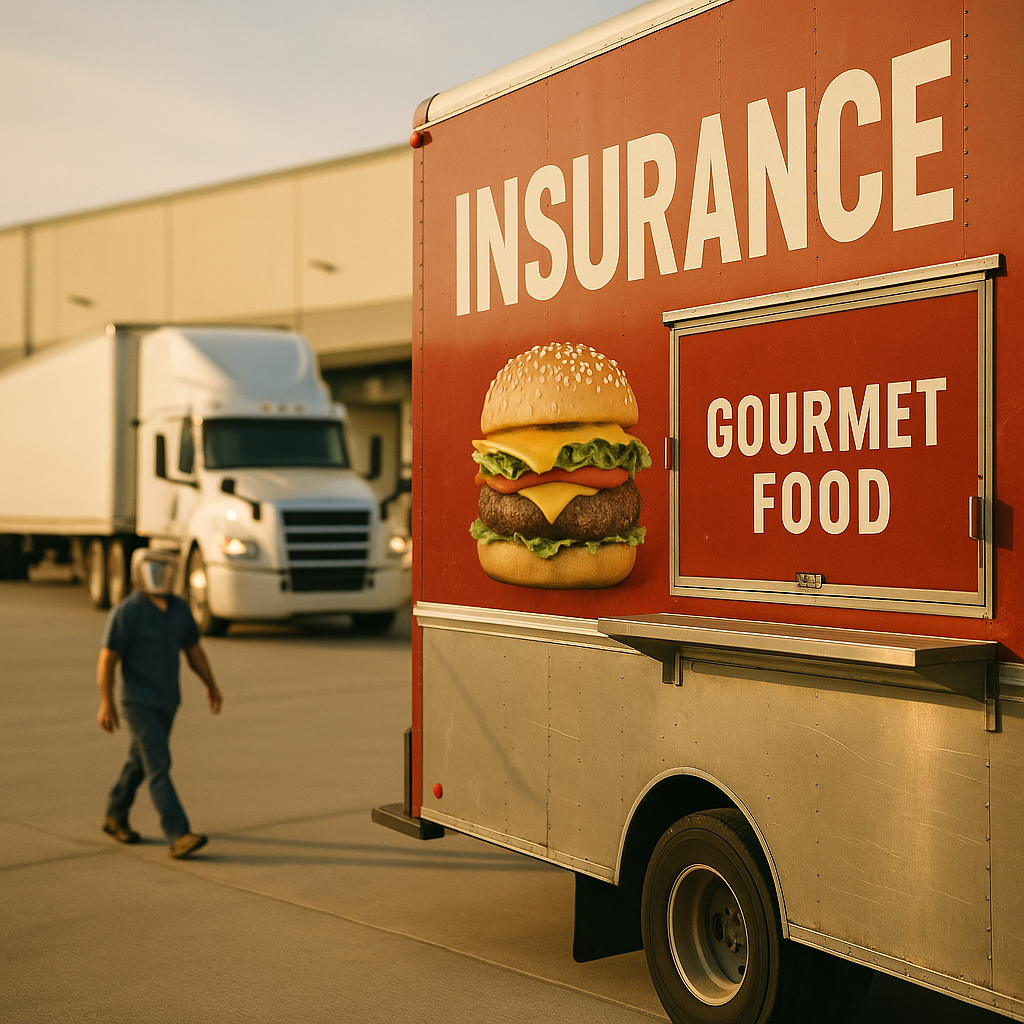

Food concession insurance: 7 coverages, COI wording, and 2026 cost ranges—plus commercial truck insurance notes for trailer haulers. Compare quotes.
Food concession insurance is usually a bundle of coverages—general liability with product/completed operations, equipment coverage for mobile gear, and often workers’ comp and commercial auto—built to satisfy venue COI requirements like $1M per occurrence / $2M aggregate and additional insured wording. If you sell at fairs, festivals, pop-ups, or from a trailer, this checklist helps you buy the right policy, get the COI accepted, and budget realistic 2026 costs.
If you’ve ever gotten the email that says, “Vendor check-in is Friday—send your COI,” you already know the scramble. Start with the foundation coverage most venues require: General liability insurance for vendors.
Table of Contents
Reading time: 8 minutes
- What is food concession insurance (and who needs it)?
- The 7 coverages food concession insurance typically includes
- Event paperwork: additional insured, waiver, and primary wording
- Certificates of insurance (COIs): what venues usually require
- Food concession insurance cost in 2026 (what to budget)
- State & local requirements vs. venue contracts (plus one-day reality)
- Claims scenarios + “fast quote” checklist
- Frequently asked questions

What Is Food Concession Insurance (and Who Needs It)?
Food concession insurance is a business insurance package that typically starts with general liability (often written at $1,000,000 per occurrence / $2,000,000 aggregate for venue contracts) and then adds protections for food-related claims, equipment, employees, and vehicles based on how you operate.
What it is (plain English)
It’s not “one magic policy.” It’s usually a combination of:
- Liability coverage for customer injuries and property damage
- Protection for food-related allegations (often under product/completed operations)
- Coverage for equipment, employees, and vehicles—based on your setup (tent, booth, trailer, kiosk)
If you want a tighter definition of what vendors typically need (and what venues usually ask for), use this primer: Food vendor liability insurance basics.
Why it’s essential (not just “because the venue says so”)
High-traffic events create predictable claims: slip-and-falls, burns, smoke/grease damage, and foodborne illness allegations (even when fault is disputed).
Most small-business risk stacks start with general liability, property, and workers’ comp; the U.S. Small Business Administration describes business insurance as a standard part of launching and operating a business (source: U.S. SBA – Get business insurance).
Who needs it (exactly)
- Weekend festival and fair vendors
- Concessionaires in arenas/stadiums
- Pop-up tent vendors (even “just one weekend”)
- Concession trailer operators (especially if towing and storing equipment)
- Anyone selling higher-risk items (deep-fried foods, poultry, dairy, seafood) or using propane/open flame
The 7 Coverages Food Concession Insurance Typically Includes
Food concession insurance typically includes general liability with product/completed operations, plus equipment coverage for mobile gear, and many vendors also need workers’ compensation and commercial auto when towing trailers or making deliveries.
Coverage cheat sheet (what it protects + who asks for it)
| General Liability (GL) | Customer injuries, property damage | Venues, cities, promoters | Often $1M / $2M |
| Product/Completed Ops | Alleged food illness, allergen claims | Venues/promoters | Commonly included with GL |
| Property (at a location) | Equipment at a fixed site | Optional | Based on values |
| Inland Marine / Equipment | Gear that moves (events) | Smart vendors (risk-driven) | Based on trailer contents |
| Commercial Auto | Towing, deliveries, business use | Contracts + reality | State minimums → higher |
| Workers’ Comp | Employee injuries | States + venues | Statutory |
| Liquor Liability | Alcohol-related claims | Venues/permits | Often higher limits |
1) General liability (GL) + product/completed operations
General liability is the “admission ticket” for most events because it responds to third-party bodily injury and property damage claims.
- Typical claim: customer slip-and-fall at your booth
- Typical claim: you damage the venue’s floor, wall, or electrical
Food-related allegations are commonly handled under product/completed operations, but you still need to confirm it’s included for your operation.
2) Product liability (foodborne illness + allergen allegations)
Product liability is the part of liability coverage that can apply when someone alleges food poisoning, cross-contamination, or an undeclared allergen exposure.
Policy language and exclusions matter; use this explainer to sanity-check what you’re buying: Product liability insurance (foodborne illness).
3) Property coverage (equipment at a fixed location)
Property coverage is designed to insure equipment at a scheduled location, which matters if you store gear at a commissary, warehouse, or consistent business address.
- Refrigerators/freezers
- POS systems
- Signage and prep equipment
Two knobs that change claims outcomes fast: replacement cost vs. actual cash value and the deductible.
4) Inland marine / equipment coverage (gear that moves)
Inland marine (often called “equipment coverage”) is commonly used to insure mobile gear during load-in/load-out, transit, and temporary storage.
Real-world loss time is predictable: set-up day, tear-down day, and overnight in a trailer or box truck.
5) Workers’ compensation (if you have employees)
Workers’ compensation is the coverage that pays for employee work injuries (medical care and wage benefits) and is required by many states once you have employees.
Behind the line is high-frequency injury territory: cuts, burns, slips, and repetitive-motion injuries.
6) Liquor liability (only if you sell/serve alcohol)
Liquor liability is a separate coverage for alcohol-related claims, because general liability typically excludes or limits liquor exposures beyond incidental situations.
If you serve beer, wine, cocktails, or boozy frozen drinks, expect the venue (and sometimes the permit) to ask for this explicitly.
7) Commercial auto — and where trucking insurance enters the picture
Commercial auto is usually needed when a vehicle is used for business purposes like towing a concession trailer, hauling equipment, or making catering deliveries.
Start here if towing/delivery is part of your operation: Commercial auto insurance for business use.
Important crossover: If you’re running a one-ton pickup with a big trailer, a medium-duty truck, or anything that starts to look like a “hotshot” or semi-style hauling setup, ask whether you’re drifting into commercial truck insurance/trucking insurance classification. The goal isn’t buying extra—it’s avoiding a claim issue because the vehicle use, radius, or unit type was rated incorrectly.
Event Paperwork: Additional Insured, Waiver of Subrogation, and Primary Wording
Vendor packets commonly require additional insured status plus endorsements like primary and noncontributory and a waiver of subrogation, and a COI that doesn’t match the exact wording can get you rejected even if you “have insurance.”
Additional insured: what it does (and doesn’t)
What it does: It extends protection under your policy to the venue/promoter for claims arising out of your operations.
What it doesn’t do: It doesn’t automatically cover the venue for unrelated negligence, and it doesn’t replace the need for proper limits and included coverages.
If you want the plain-English version (and why a COI alone may not be enough), read: Additional insured endorsement explained.
Primary & noncontributory (why they care)
Primary and noncontributory wording means your policy responds first without the venue’s policy sharing the loss, and many carriers require a specific endorsement—not just a note typed on the certificate.
Waiver of subrogation (plain English)
A waiver of subrogation means your insurer agrees not to pursue recovery against the venue in certain scenarios, and it can cost extra or be unavailable depending on the policy form.
Copy/paste sample insurance request language (not legal advice)
Use this as a starting point when you ask what the venue wants:
Sample request:
“Please issue a COI showing General Liability with product/completed operations, limits of $____ per occurrence / $____ aggregate, effective dates including setup and teardown. Certificate Holder: _____. Additional Insured: _____ (venue/promoter/municipality). Include primary & noncontributory wording and waiver of subrogation where required per vendor packet.”
Certificates of Insurance (COIs): What Venues Usually Require
A certificate of insurance (COI) is typically issued on an ACORD 25 form and serves as proof your policy exists, but venues use it as a gatekeeper for load-in and they often require endorsements beyond what a COI alone shows.
To avoid rework, build your process around a checklist and keep venue details in one place. Start with: Certificate of insurance (COI) guide.
Typical COI requirements checklist
- Event name + physical address: and sometimes the city/agency’s legal name
- Dates: include setup and teardown (claims happen during load-in)
- Limits: commonly $1M/$2M, but always verify the vendor packet
- Additional insured entities: often multiple parties
- Primary/noncontributory + waiver: if required
- Description of operations: what you sell, cooking method, propane, etc.
How to avoid COI delays (real-world workflow)
- Ask for the vendor packet’s insurance page (don’t guess).
- Get the exact spelling of Certificate Holder and Additional Insured.
- Request early if endorsements are required; those aren’t always instant.
Food Concession Insurance Cost in 2026 (What to Budget)
Food concession insurance cost in 2026 commonly ranges from $25–$100+ per day for some short-term general liability options to roughly $80–$300+ per month for annual packages, with higher pricing for alcohol, higher limits, more endorsements, and higher-risk cooking.
Typical 2026 price ranges (market ranges, not promises)
- One-day / weekend event GL: often $25–$100+ per day (varies by limits, attendance, cooking, and alcohol)
- Annual vendor packages: commonly $80–$300+ per month depending on limits, endorsements, equipment, and auto
- Liquor liability: can increase cost substantially based on sales and venue requirements
- Workers’ comp: driven heavily by payroll, duties, and state rules
Payroll-driven pricing is one reason staffing decisions affect total insurance cost; wage and role data is tracked by federal labor statistics (source: U.S. BLS – Food Service Managers).
Top cost drivers (what moves your premium fast)
- Higher limits (and umbrellas), especially for high-attendance events
- Endorsements: additional insured, primary/noncontributory, waiver of subrogation
- Menu risk: poultry, seafood, dairy, and tight temperature-control foods
- Cooking method: deep frying, open flame, propane
- Event count and revenue (more events = more exposure)
- Claims history and years in business
Pro tip: annual packaging is often cheaper if you do a season
If you’re doing multiple events per year, stacking one-day policies can cost more than an annual setup that’s built for COIs and repeat events.
A common structure is a: Business owners policy (BOP) (often general liability + property), then you add vendor-specific pieces like equipment coverage, workers’ comp, and commercial auto.
State & Local Requirements vs. Venue Contracts (Plus One-Day Coverage Reality)
Health department permits and food safety rules are regulatory requirements, while insurance limits and COI wording are usually contractual requirements set by venues, promoters, municipalities, and landlords.
Permitting is not insurance
Temporary food establishment rules, inspections, commissary requirements, and permit fees don’t replace insurance, and insurance doesn’t replace permitting.
One-day / event food vendor insurance: when it works (and when it doesn’t)
One-day coverage can be a good fit when you only do a few events per year and your vendor packet doesn’t demand complex endorsements.
Good fit:
- You do 1–3 events per year
- No alcohol
- Simple setup and modest limits
- You only need coverage for a specific date and location
Common limitations to understand before you buy:
- Some policies exclude certain cooking methods or high-risk items
- Transit/storage of equipment may not be covered the way you expect
- Venue endorsements (AI/primary/waiver) may cost extra or take longer than “instant” ads suggest
For the short-term route, start here: Event insurance (one-day / short-term).
Loss prevention that reduces claims (and helps underwriting)
The FDA Food Code (2022) is widely used as a model code for food safety practices, and insurers and venues often like to see controls that reduce predictable losses (source: FDA Food Code (2022)).
- Temperature logs (hot hold / cold hold)
- Allergen signage and separate utensils where needed
- Handwashing station compliance
- Spill control: mats, cones, and fast cleanup
- Fire safety: extinguishers, hood/suppression where applicable, propane procedures
Claims Scenarios + “Fast Quote” Checklist (So You Don’t Buy the Wrong Thing)
Most concession claims fall into a few repeat categories—slip-and-fall, burns, foodborne illness allegations, theft of equipment, and employee injuries—and whether coverage applies depends on the policy form, endorsements, and exclusions in force on the loss date.
Claims scenarios (what would—and wouldn’t—be covered)
- Customer slips on spilled drink in front of your booth: usually general liability, assuming the claim isn’t excluded.
- Customer alleges food poisoning from undercooked chicken: often product/completed operations; documentation can help defense.
- Trailer break-in the night before the event: may fall under equipment/inland marine or property, depending on how gear is scheduled and stored.
- Employee burns their arm on the fryer: workers’ comp (if required/held and properly classified).
- Grease/fire damages the venue’s property: general liability property damage, subject to exclusions and facts.
Reality check: Coverage always depends on the actual policy language. Don’t rely on assumptions or a COI summary alone.
Fast quote checklist (what you’ll be asked)
- Business name/entity + years in operation
- Menu + cooking methods (deep fry, open flame, propane)
- Estimated gross receipts (annual or per event)
- Number of events per year + typical attendance sizes
- Requested limits + venue endorsement requirements
- Employee count + payroll (if any)
- Vehicle/trailer details if towing/delivering
- Prior claims (even small ones)
Frequently Asked Questions
Most food concession operators need general liability (commonly required at $1M per occurrence / $2M aggregate) that includes product/completed operations for food-related allegations, plus equipment coverage for mobile gear.
If you have employees, many states require workers’ compensation, and if you tow a trailer or deliver catering you’ll often need commercial auto. A practical starting point is General liability insurance for vendors, then match endorsements (additional insured, primary/noncontributory, waiver) to the vendor packet.
Food concession insurance cost in 2026 is often $25–$100+ per day for some short-term general liability options and roughly $80–$300+ per month for many annual vendor packages, depending on limits and add-ons.
Pricing moves fastest with higher limits/umbrellas, alcohol service, higher-risk cooking (deep frying/open flame/propane), more events and higher revenue, and endorsement requirements like additional insured, primary/noncontributory, and waiver of subrogation.
Many venues require concession vendors to add the venue/promoter/municipality as an additional insured, and they often pair that with primary and noncontributory wording on the liability policy.
Depending on the carrier, this may require a formal endorsement (not just wording typed into the COI), so request it early to avoid last-minute rejection. For a plain-English breakdown, see Additional insured endorsement explained.
Yes, many carriers offer one-day or event vendor policies, but you should confirm the policy includes product/completed operations and that the effective dates include setup and teardown.
If the venue requires additional insured, primary/noncontributory, or waiver of subrogation, those endorsements can add cost and time, so don’t wait until the day before check-in. Start here and compare against the vendor packet: Event insurance (one-day / short-term).
Conclusion: Food Concession Insurance Is a COI-Ready Checklist
Food concession insurance is simplest when you treat it like a checklist: start with GL + product/completed operations, then add equipment coverage, workers’ comp (if needed), and auto coverage if you tow or deliver.
Most “last-minute” problems come from COI wording and missing endorsements—not from the base policy.
Key Takeaways:
- Match the vendor packet: limits, dates (setup/teardown), and endorsement wording are what get COIs rejected.
- Protect mobile gear: consider inland marine/equipment coverage if your setup moves event to event.
- Get vehicle use right: towing and delivery often require commercial auto, and bigger hauling setups may trigger trucking-style classification.
Related reading: Certificate of insurance (COI) guide, Event insurance (one-day / short-term), and Commercial auto insurance for business use.





