
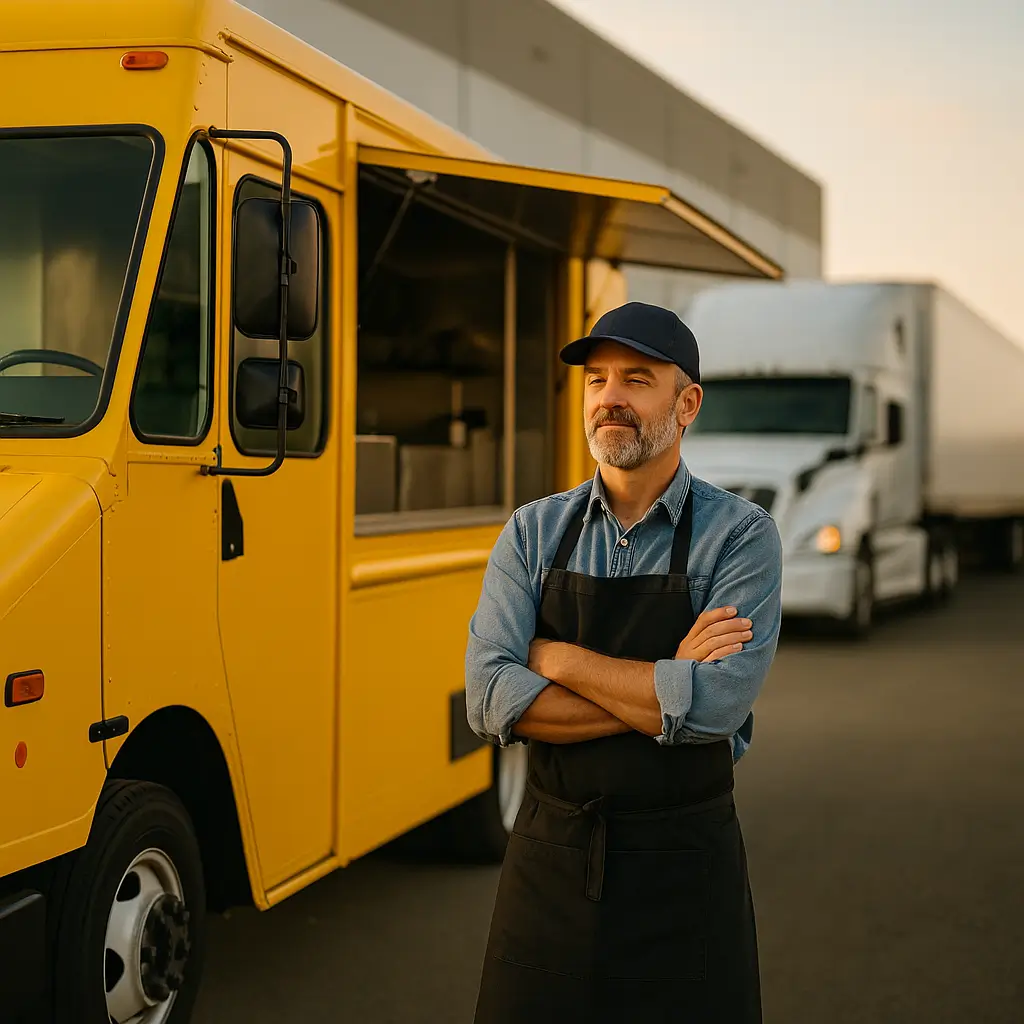
2026 food truck insurance Florida costs can run $2K–$8K/yr. See 6 must-have coverages, COI checklist, and savings tips—get quotes fast.

Food truck insurance Florida typically costs $2,000–$8,000 per year in 2026 for many single-truck operators, with pricing driven mostly by commercial auto, truck value/build-out, cooking risk, and where you park overnight. If you need a quick rule of thumb: plan for general liability + product liability, commercial auto, and some form of equipment protection, then build the COI process so you can book events without scrambling.
In Florida, you don’t lose money one bite at a time—you lose it in one bad incident: a fender-bender driving to an event, a customer slip near your service window, or a kitchen fire that parks your only unit for weeks. If you’re still on a personal auto policy, start by understanding what commercial auto insurance is built to cover for business-use vehicles.
Table of Contents
Reading time: 8 minutes
- Key Takeaways
- How Much Does Food Truck Insurance Cost in Florida (2026)?
- 6 Coverages Florida Food Trucks Usually Need (and what each one does)
- Florida Requirements vs City/Event Rules: COIs, Limits, and Permit Coordination
- How to Get Affordable Food Truck Insurance in Florida (without buying junk coverage)
- Frequently Asked Questions
- Conclusion
Key Takeaways
Most Florida food truck insurance programs combine commercial auto and general liability as the core, and many operators land in a $2,000–$8,000/year total range depending on use, limits, and loss history.
- Most Florida food truck operators land in a broad $2,000–$8,000/year range depending on commercial auto, cooking risk, and where/how you operate.
- Events and cities usually care less about “Florida minimums” and more about your COI wording, limits, and Additional Insured endorsements.
- Your biggest cost lever is typically commercial auto + physical damage, followed by general liability/product liability.
- You can often lower premiums without weakening protection by tightening your radius, improving theft controls, and choosing deductibles intentionally.
How Much Does Food Truck Insurance Cost in Florida (2026)?
Food truck insurance cost in Florida commonly falls between $2,000 and $8,000 per year (2026) for a single truck, but your final premium depends on commercial auto rating, truck value, cooking hazards (propane/deep fryer/open flame), garaging ZIP, and claims history.
Below is a practical cost table to sanity-check quotes; these are typical ranges (not guarantees) and can swing based on experience, radius, and how often you work large events. For external benchmarking by policy type, see Insureon’s food truck insurance cost breakdown.
| Coverage type | Typical Florida cost range (annual) | Common limit/structure | Best for |
|---|---|---|---|
| General liability (+ product liability) | $500–$2,500 | Often $1M per occurrence / $2M aggregate (commonly requested) | Events, breweries, catering clients |
| Commercial auto liability | $2,000–$6,000+ | Liability + optional medical payments | Driving to/from events, operating on public roads |
| Physical damage (comp/collision) | $500–$3,500+ | Deductible-based; tied to truck value | Financed trucks, protecting the build-out |
| Equipment & tools (inland marine) | $250–$1,500 | Scheduled equipment; off-truck coverage | Generators, POS, removable gear |
| Workers’ comp | Varies widely | Payroll/class-code driven | Any employee exposure (burns, cuts, slips) |
| Umbrella/excess liability | $300–$1,500 | Extra limits over GL/auto | Larger festivals, municipal contracts |
For a quick breakdown of what Florida insurance costs look like for commercial vehicles in 2026, watch this:
Why Florida pricing varies (more than people expect)
- Garaging + theft exposure: Overnight parking and theft controls (fenced lot, cameras, immobilizer) can change how carriers view the risk.
- Storm season reality: Cheap coverage can still leave you exposed on downtime, storage, and equipment values after a storm.
- Venue-driven limits: Some of your cost isn’t “Florida” at all—it’s the limits and endorsements required by the places that pay you.
For a deeper look at underwriting inputs that move your premium up or down, see what affects insurance cost.
6 Coverages Florida Food Trucks Usually Need (and what each one does)
Florida food truck insurance is usually built from six practical coverage blocks—general liability, product liability, commercial auto, physical damage, equipment/tools, and business interruption—because a mobile kitchen is both a vehicle and a public-facing food business.
Think of this as your “keep the business alive” stack: you don’t need every add-on, but you do need the right policies with the right definitions for a mobile operation.
Not sure how auto liability and general liability fit together? This short explainer breaks down the difference:
1) General liability (slip-and-fall + property damage)
General liability insurance pays for third-party bodily injury and property damage claims, like a customer slipping near your window or damage to a venue’s property.
Most events, breweries, and corporate catering clients won’t let you operate without it, and it’s also the coverage that prevents one claim from turning into a personal financial mess. For the plain-English breakdown, read general liability insurance.
Pro tip: Many venues request $1M per occurrence / $2M aggregate, but always verify each event packet.
2) Product liability (foodborne illness + allergen claims)
Product liability coverage protects you if a claim alleges your food caused harm, including foodborne illness, contamination, or allergen-related injuries.
One allegation can trigger medical bills and legal defense costs, especially after a high-volume festival weekend. Product liability is often included with GL for food vendors, but confirm it on the declarations page. For a combined look at limits and costs, see food truck liability insurance and food vendor liability insurance.
3) Commercial auto (the truck is a vehicle and a business)
Commercial auto liability covers at-fault accidents and related injuries/property damage when your food truck is used for business on public roads.
Personal auto policies commonly exclude business use or misclassify the risk, which is how “I thought I was covered” becomes a claim denial fight. This is why food truck operators should start with a policy designed for business-use vehicles, like Florida commercial auto insurance.
If you also operate other rigs (box truck deliveries, a trailer setup, or you’re expanding), the structure overlaps with commercial truck programs: vehicle use, radius, and claims history drive the price.
4) Physical damage (comprehensive & collision) + build-out value
Physical damage coverage (comprehensive and collision) pays to repair or replace your truck after a covered loss like a crash, theft, vandalism, or hail.
If the truck is financed, lenders typically require physical damage coverage as a loan condition; review your loan agreement or confirm with your lender before binding. Even if it’s paid off, it protects the asset that produces your income.
- Settlement tip: Keep photos and receipts for your build-out so your value isn’t “guessed” during a claim.
- Deductibles: A higher deductible can lower premium, but only choose a number you can pay quickly.
5) Equipment & tools (the stuff that walks away)
Equipment and tools coverage is often written as inland marine or scheduled equipment, and it covers removable items like generators, POS systems, and small appliances (including off-truck use in many forms).
Theft doesn’t just cost you equipment—it can wipe out a weekend’s revenue if you can’t operate. For a deeper dive, see Inland marine / equipment & tools coverage.
6) Business interruption (income protection after a covered loss)
Business interruption coverage helps replace lost income and cover ongoing expenses when a covered claim forces a temporary shutdown.

Single-truck operators have zero redundancy, so downtime is often the biggest “silent loss” after a fire or major claim. Ask your agent how business income is calculated (and whether extra expense is included).
Florida Requirements vs City/Event Rules: COIs, Limits, and Permit Coordination
Florida food truck insurance “requirements” are most often set by cities, venues, and event organizers through COI limits and contract wording rather than a single statewide minimum that applies to every booking. Review our food truck insurance requirements guide before your next permit application.
Here’s the practical reality: you rarely get stopped by “statewide minimums”; you get stopped by a permit office or venue manager asking for a COI with exact language by a deadline.
The state vs local split (what to verify)
- State-level food service oversight: Florida’s DBPR (Hotels & Restaurants) is a key hub for licensing and inspection guidance for many food service operations. Confirm your lane here: https://www.myfloridalicense.com/DBPR/hotels-restaurants/
- Local rules: Cities and counties control vending permissions, zoning, fire rules, and special event requirements—including insurance limits and COI wording.
COI checklist (what cities/venues commonly ask for)
A complete certificate request usually includes the certificate holder details, the right limits, and any additional insured wording required by the contract. If you need a refresher on how certificates work, start with certificate of insurance (COI).
- General liability limit: Often $1M per occurrence (verify per event)
- Certificate holder: Name/address exactly as provided (small typos can cause rejection)
- Additional Insured: Endorsement naming the venue/city/county (not just a note on the COI)
- Event details: Date(s) and location address
- Contract wording: Sometimes “primary and non-contributory” is required—ask your agent to confirm the endorsement is on the policy before the event, not during a claim.
- Commercial auto proof: Often requested if you drive/park on-site
Before you accept a venue’s required limits at face value, it’s worth asking whether those limits are enough for your operation:
City mini-profiles: the safe way to research requirements quickly
City and festival insurance requirements change often, so use a repeatable method instead of relying on forum posts.
- Search: “[City] special event vendor packet insurance” or “[City] food truck permit insurance requirements”
- Look for a PDF from Parks & Rec, Special Events, Fire Marshal, or Risk Management
- Confirm: limits, additional insured language, and submission deadline
- Send your agent/broker the exact wording needed (copy/paste reduces rework)
Use the method for Miami, Tampa, Orlando, and Jacksonville, and don’t ignore smaller municipalities where paperwork can still be strict.
How to Get Affordable Food Truck Insurance in Florida (without buying junk coverage)
Affordable food truck insurance in Florida usually comes from controlling the biggest rating variables—auto radius, garaging/theft controls, claims history, and documented safety practices—not from stripping coverage until the policy can’t respond to real claims.
The goal is “apples-to-apples” quoting and fewer surprises when a venue asks for a COI on a deadline.
Do these before you shop (it changes your quote quality)
- Tighten your operating radius: Local-only vs statewide travel can materially change auto pricing.
- Improve overnight storage: Fenced lot, cameras, immobilizer, and/or GPS are all worth mentioning to underwriting.
- Stay current on fire controls: Keep suppression system inspections and extinguisher logs organized.
- Add dash cams: They help in disputed accidents and can reduce “word vs word” claims.
- Avoid lapses: Coverage gaps often trigger surcharges or fewer market options.
Bundled vs itemized: which is better?
- Bundled (sometimes): Fewer gaps, easier COI management, and less admin friction.
- Itemized (often): Commercial auto might price best with one carrier while GL prices best with another, and splitting can save real money.
If you want a clean method for comparing limits, deductibles, and exclusions across carriers, use how to compare insurance quotes.
Real-world Florida scenarios (quick matching)
- Festivals + breweries every weekend: GL/product liability and fast COIs matter most; umbrella can come up for larger events.
- Corporate catering: Higher limits and specific contract language are common; turnaround time matters. For one-time events, see catering insurance for one day for short-term coverage considerations.
- Coastal counties + storm season: Storage, documentation, and downtime planning become as important as premium. Use hurricane preparedness for small businesses to pressure-test your plan.
Frequently Asked Questions
Food truck insurance in Florida often totals $2,000–$8,000 per year (2026) for a single truck, with commercial auto liability and physical damage usually being the largest premium drivers. Pricing moves up or down based on garaging ZIP, driving radius, claims history, truck value/build-out, and cooking hazards like propane, deep fryers, and open flame. If you work frequent festivals, expect more COI activity and sometimes higher requested limits (which can increase premium). For public benchmarks by policy type, Insureon publishes typical food truck cost ranges.
Food truck insurance “required” in Florida is typically set by venues, cities, and event contracts, not by one universal statewide policy list, and many bookings require general liability with $1M per occurrence plus a COI showing an Additional Insured. You also need appropriate auto coverage to legally operate the vehicle, and many event sites ask for proof of commercial auto on the COI. The fastest way to avoid permit delays is to get the venue’s exact COI wording (certificate holder + additional insured language) and send it to your agent, then confirm your coverage on the declarations page.
Florida workers’ compensation requirements depend on your business type and employee/payroll setup; see Florida Statute Chapter 440 for the statutory framework and verify rules using the Florida CFO workers’ comp employer resources at https://www.myfloridacfo.com/division/wc/employer/. Even when a small operator isn’t strictly required to carry a policy, venues and catering contracts may still demand proof of workers’ comp before allowing you on-site. Practically, workers’ comp helps cover medical costs and wage benefits from common food truck injuries like burns, cuts, and slips. For a plain-English overview, see workers’ compensation insurance.
Personal auto insurance is typically not appropriate for a food truck because the vehicle is used for business, and many personal policies exclude commercial use or won’t properly rate a vehicle that operates as a mobile kitchen. If you have an accident driving to an event, a business-use exclusion can turn into a denied claim or a coverage dispute when you can least afford downtime. A commercial policy is designed to match business use, business miles, and the higher liability exposure tied to public events and frequent stops. Start by reviewing commercial auto insurance so your vehicle coverage aligns with how you actually operate.
Commercial auto covers accidents while your truck is being driven on public roads, while general liability addresses operational exposure while you’re parked and serving—such as customer slips near the service window or property damage at a venue. The two policies work together, which is why event operators often need both shown on a COI. Confirm with your agent where the auto policy ends and GL begins, because details vary by carrier.
General liability covers third-party bodily injury and property damage around your operation—for example, a customer trip near the service window or damage to a venue’s surface from a generator. Product liability addresses allegations that your food caused harm, such as foodborne illness, allergen reactions, or contamination. Many food vendor policies include both, but confirm on the declarations page that product liability is explicitly included.
Most COIs can be issued the same day once your agent has the certificate holder name and address, event date and location, and any additional insured wording from the venue contract. The bottleneck is usually incomplete paperwork, not the carrier. Keep a past event template as a starting point, then update the certificate holder and event details.
Business interruption generally responds when a covered direct physical loss to your truck or equipment forces a temporary shutdown. Storm damage that physically affects your truck may trigger coverage, but voluntary event cancellations or government-ordered evacuations are commonly excluded unless a specific civil-authority extension applies. Florida operators should ask about named-storm and flood exclusions, the period of restoration, and whether extra expense or replacement-unit costs are included.
Yes. Fleet or multi-unit policies can cover operators with more than one truck. Rating is typically per unit, but a combined program may simplify COI management and administration, and sometimes improve pricing compared with separate policies. Ask your agent to quote both individual and combined structures, then compare the real premium and coverage terms before deciding.
Conclusion: Build coverage that keeps you booking Florida events
Florida food truck insurance isn’t about buying the cheapest policy—it’s about staying operational when something goes sideways. Start with the core stack (GL/product + commercial auto + physical damage + equipment), add workers’ comp if you have employees or contract requirements, and tighten your COI process so you can say “yes” to bookings fast.
Key Takeaways:
- Budget realistically: Many operators land in the $2,000–$8,000/year range, with auto and truck value driving most of the spread.
- Win bookings with paperwork: COIs often need $1M GL limits and an Additional Insured endorsement that matches the venue’s wording.
- Save without gutting coverage: Tight radius, theft controls, clean documentation, and apples-to-apples quoting usually beat “minimum coverage” strategies.
If you’re shopping now, start with a food truck insurance quote and compare matching limits, deductibles, and endorsements before choosing a policy.
If you’re running a food truck in Florida and want to make sure your coverage stack holds up at events—from COI wording to the right limits—LogRock can help review your operation, identify gaps, and compare options across carriers. Talk to our team, ask questions, and get a quote built for how you actually work.
Speak with LogRock and request a food truck insurance quote.





