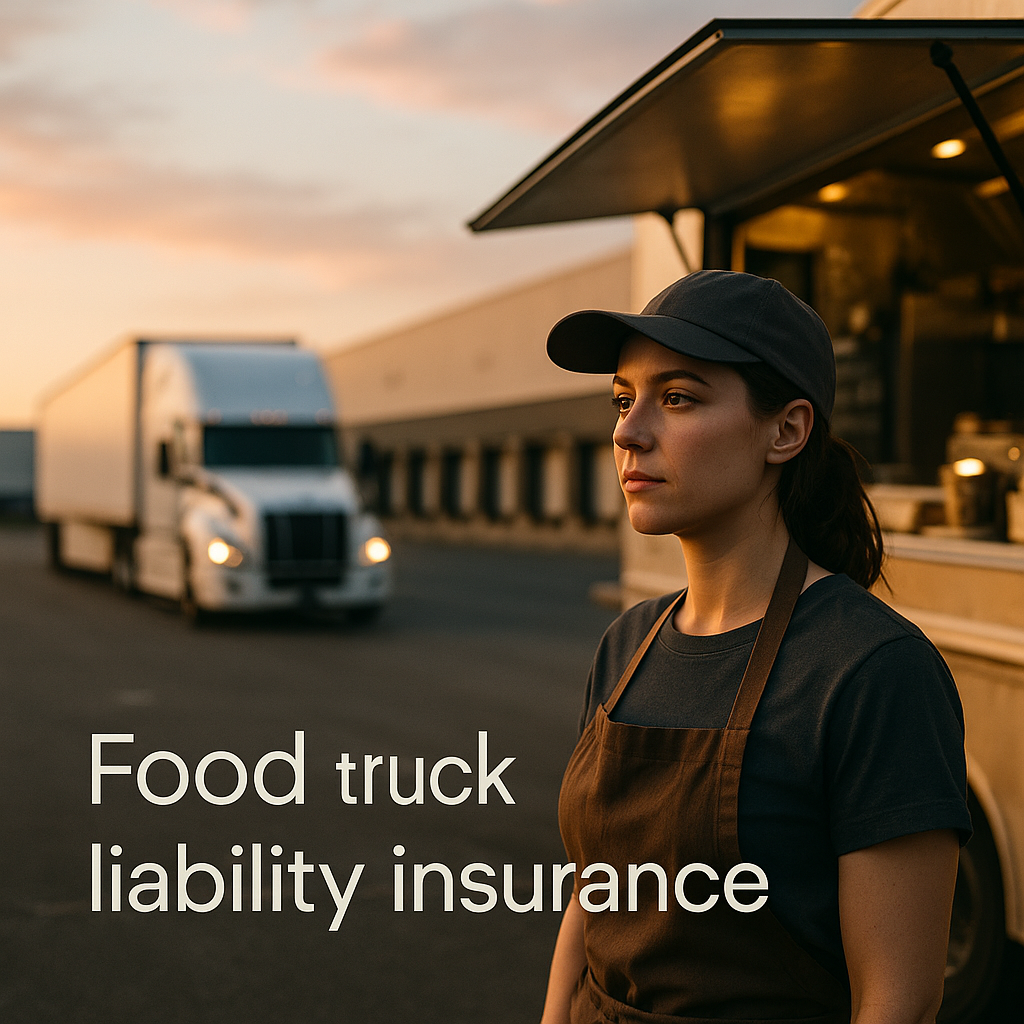
Food truck liability insurance: 6 coverages, 2026 cost ranges, and COI wording (additional insured) so events don’t cancel you—in any state. Get quote-ready fast.
Food truck liability insurance usually means general liability (often including product/completed-ops), commercial auto if the truck drives on public roads, and workers’ comp if you have employees—plus COIs that match event contracts. If you want the fastest “quote-ready” baseline, start with $1M/$2M general liability, verify products-completed operations, and plan for a COI with additional insured wording.
This guide turns the coverage jargon into a simple checklist you can hand to an agent—starting with the general liability insurance for vendors foundation most events look for first.
Table of Contents
Reading time: 11 minutes
Key takeaways for food truck liability insurance (save these before you request quotes)
Most U.S. events and venues commonly require $1,000,000 per occurrence / $2,000,000 aggregate general liability limits from food vendors, and they can reject you if your COI wording doesn’t match the contract.
- “Insured” isn’t the same as “approved”: a COI with the correct certificate holder and additional insured wording is what keeps bookings from getting cancelled.
- Product liability is the landmine: confirm products-completed operations is included and ask about foodborne illness/allergen exclusions.
- Commercial auto is separate from GL: personal auto often won’t respond when the vehicle is used for business.
- Costs vary because your risk varies: revenue, events vs. a weekly route, employees, cooking method (fryer/open flame), and driving radius all change pricing.
What food truck liability insurance covers (and what it doesn’t)
Food truck liability insurance is primarily third-party protection for bodily injury and property damage claims made by customers, venues, landlords, or bystanders, and it typically excludes damage to your own equipment unless you add property coverage.
What it is (plain English)
Think: “They say you hurt them or damaged their property.” That includes the classic slip-and-fall in the line, a burn from a hot tray, or a claim that your setup damaged a venue’s floor.
If you want a plain-language overview of common coverage terms, the NAIC consumer insurance education hub is a solid starting point: https://content.naic.org/consumer.
Why it’s essential (cash-flow reality)
One claim can trigger attorney demand letters, medical bills, and weeks of admin work. Even when you did nothing wrong, you still lose time, bookings, and momentum.
Who typically needs it most
- New trucks: trying to get approved for markets, festivals, and commissaries.
- Catering-focused operators: dealing with venue contracts and strict vendor requirements.
- Commissary-based trucks: working under landlord/commissary insurance rules.
A common misunderstanding (and how to avoid it)
Liability insurance usually does not replace your stolen generator, broken fridge, or damaged POS tablets. That’s typically handled by property/equipment coverage (often bundled inside a BOP).
Food truck vs. commercial truck insurance (when you also haul or tow)
Commercial truck insurance is generally designed for hauling operations and heavier auto exposures, while food truck liability insurance focuses on customer, venue, and product exposures from serving the public.
- Food truck liability: line exposures, customer injury, property damage, product claims.
- Commercial trucking policies: often built for for-hire hauling, larger vehicles, and specific auto risk profiles.
If you serve and haul for hire (or run a hybrid setup with a trailer or towing), don’t guess—structure it correctly. Internal overview: commercial truck insurance basics.
The 6 core coverages most food trucks need (checklist + what’s “required”)
The U.S. SBA explains that some insurance is required by state law (such as workers’ comp rules), while many requirements come from contracts with venues, cities, landlords, and event organizers.
Reference: https://www.sba.gov/business-guide/launch-your-business/get-business-insurance.
Coverage checklist (quote-ready)
| Coverage | What it protects | Commonly required by | Typical limit starting points* |
|---|---|---|---|
| General Liability (GL) | Slip-and-fall, burns, third-party property damage | Events, landlords, commissaries, permits | $1M per occurrence / $2M aggregate |
| Product Liability (often inside GL) | Foodborne illness, allergen allegations, “your food harmed me” | Events, corporate catering | Usually matches GL limits |
| Commercial Auto | Crashes while driving to/from events, commissary, catering | Law + contracts | State minimums to higher contractual limits |
| Workers’ Comp | Employee injuries (cuts, burns, slips) | State law (varies), contracts | Statutory |
| Liquor Liability | Alcohol-related claims (if serving) | Venues/events, liquor licensing | Commonly $1M |
| Property/Equipment (often in a BOP) | Your gear, tools, sometimes spoilage | Lenders/leases, survival need | Based on equipment value |
*Limits vary by contract, venue, and risk profile; treat these as starting questions, not guarantees.
1) General liability (GL)
General liability insurance pays for covered third-party bodily injury and property damage claims (and legal defense) that arise from your day-to-day operations serving the public.
- Why it matters: It’s the first policy most venues and event organizers look for.
- Ask about: “Damage to premises rented to you” and “Medical payments” sublimits, because those come up in vendor disputes.
2) Product liability (often included—don’t assume)
Product liability coverage for food vendors is commonly handled under the GL policy’s products-completed operations coverage, but it must be confirmed on the actual policy form.
- Why it matters: One alleged foodborne illness can involve multiple claimants and large medical bills.
- Ask directly: “Is products-completed operations included?” and “Any foodborne illness, allergen, or communicable disease exclusions?”
Internal deep dive: product liability insurance for food businesses.
3) Commercial auto (if the truck moves on public roads)
Commercial auto insurance covers liability for at-fault accidents involving a business vehicle, and it can also include physical damage coverage for the vehicle itself.
- Why it matters: Personal auto commonly excludes business use, and one accident can turn into a six-figure problem fast.
- Don’t miss: If employees run errands in personal cars, ask about hired/non-owned auto coverage.
Internal reference: commercial auto insurance for business vehicles.
4) Workers’ compensation (when you have employees)
Workers’ compensation insurance pays for covered medical care and wage replacement when an employee is injured on the job, and requirements are set at the state level.
Food service injuries are common: knife cuts, fryer burns, slips near the truck, and lifting injuries. If you hire seasonally for festivals, don’t wait until the week before the event—many venues want proof upfront.
Example of state guidance (California): https://www.dir.ca.gov/dwc/employers.html.
Internal overview: workers’ compensation insurance overview.
5) Liquor liability (only if you serve/offer alcohol)
Liquor liability insurance covers alcohol-related claims tied to the sale or service of alcohol, and many GL policies exclude these claims beyond limited “incidental” scenarios.
- Who needs it: beer/wine/cocktail service, or any contract that specifically requires liquor liability.
- Contract tip: For corporate catering where alcohol is present, clarify who is “furnishing” alcohol in the agreement.
6) Property/equipment coverage (often bundled, but business-critical)
Property/equipment coverage insures your tools and gear—like grills, refrigeration, smallwares, and POS equipment—and it may include business interruption depending on the form.
- Fast win: Build an equipment list (brand/model/value) so you don’t underinsure.
- Where it’s commonly packaged: inside a BOP.
Internal explainer: business owner’s policy (BOP) for small businesses.
Food truck liability insurance limits + the COI playbook (the part that keeps you booked)
A Certificate of Insurance (COI) is a one-page proof-of-coverage document that shows your policy dates, limits, and certificate holder, and many events require it to be issued with specific additional insured language.
Typical limits vs. “big event” limits
Liability limits are the maximum amount a policy will pay for covered claims, and vendor contracts commonly start at $1M/$2M before jumping to $2M–$5M+ for large festivals, stadiums, corporate campuses, and city-sponsored events.
- If you see: “$2M per occurrence” or “$5M combined single limit,” you may need an umbrella/excess policy and specific underlying limits.
- When it comes up: high foot traffic, tight spaces, open-flame cooking, alcohol service, or higher-revenue events.
Broader context on liability and claims costs: https://www.iii.org/.
COI workflow (timing, wording, and how not to get cancelled)
COI rejections often happen because the legal business name is wrong, the policy dates don’t cover the event date, limits don’t match the contract, or the additional insured requirement isn’t backed by an endorsement.
Internal walkthrough: certificate of insurance (COI) explained.
- Small recurring markets: request COIs 1–3 business days ahead.
- Large festivals / corporate / city events: request COIs 3–7+ business days ahead (endorsements can take time).
Copy/paste COI request email template
Subject: COI Request for [Event Name] on [Date]

Hi [Agent/Carrier/COI Department],
Please issue a Certificate of Insurance for [Your Legal Business Name] for the event below:

- Event: [Event Name]
- Date(s): [Event Date Range]
- Location: [Address]
- Required GL limits: [$1M/$2M or as required]
- Certificate Holder: [Legal Name + Address]
- Additional Insured wording (from contract):
  “[Paste exact wording here]”
- Send COI to: [Email]

Thank you,
[Name] / [Phone]
Food truck liability insurance costs in 2026 (monthly + annual ranges)
Food truck liability insurance pricing in 2026 is driven by measurable underwriting inputs—like revenue, payroll, claims history, cooking method (open flame/fryer), and driving radius—so identical limits and identical descriptions are required for apples-to-apples quotes.
2026 cost ranges (real-world estimating bands)
| Coverage | Typical monthly range (est.) | Typical annual range (est.) | What pushes it higher |
|---|---|---|---|
| GL (incl. product in many cases) | $30–$150 | $360–$1,800 | High revenue, high-traffic events, claims |
| BOP (GL + property) | $60–$250 | $720–$3,000 | Equipment value, endorsements |
| Commercial auto | $120–$450+ | $1,440–$5,400+ | Vehicle value, radius/miles, drivers, loss history |
| Workers’ comp | Varies | Varies | Payroll, class codes, claims, state rules |
| Liquor liability | $25–$150 | $300–$1,800 | Type of service, venues/contracts |
| Umbrella/excess | $30–$200+ | $360–$2,400+ | Required limits, underlying policies, risk profile |
Bundle math: when a BOP is smarter (and when it’s not)
A Business Owner’s Policy (BOP) commonly bundles GL + property and can be cost-effective when you have meaningful equipment value and want fewer renewal gaps.
- Bundling often helps when: you have $10,000–$75,000+ in equipment, you need both liability and property anyway, and you want one renewal date.
- Standalone policies can be better when: you need lots of festival endorsements, you serve alcohol frequently, or you operate multiple units.
Internal explainer: business owner’s policy (BOP) for small businesses.
How to lower costs without creating gaps
Lower premiums usually come from lower risk and clean underwriting info—not from stripping coverages that your contracts (and real-world exposures) require.
- Slip-and-fall control: use slip-resistant mats and simple line control (cones/signage) at every stop.
- Allergen process: label common allergens, train staff, and document procedures.
- Incident discipline: document incidents immediately (photos + witness info) even if “nothing happened.”
- No lapses: avoid coverage lapses before festival season—lapses can increase pricing and create contract problems.
If you also operate other commercial vehicles (delivery box truck, towing setup, etc.), quote those exposures correctly too so you don’t overpay or get denied at claim time. If higher event limits are the issue, an umbrella can help; internal overview: umbrella insurance to increase liability limits.
Next steps: get quote-ready and stop losing bookings over paperwork
A quote-ready food truck insurance request includes your limits, events schedule, vehicle usage, payroll, and exact COI wording requirements so the policy you buy is the policy that actually gets you approved.
Quote-ready checklist (do this today)
- List your top 5 venues: capture their limits and any special wording (additional insured, waiver of subrogation, primary/noncontributory).
- Confirm products coverage: verify products-completed operations is included and ask about foodborne illness/allergen exclusions.
- Quote the vehicle correctly: if the truck moves, price commercial auto (not personal auto).
- Verify workers’ comp rules: requirements vary by state, and some events ask for proof even for short-term staff.
Related reading (build your coverage stack)
Frequently Asked Questions
Most food trucks need general liability (often including products-completed operations), commercial auto if the truck is driven on public roads, and workers’ compensation if they have employees (requirements vary by state). Many events also require a Certificate of Insurance (COI) with specific certificate holder details and additional insured wording that matches the contract. If you serve alcohol, liquor liability may be required, and large festivals or corporate events may require $2M–$5M+ limits, which often means adding an umbrella policy.
Food truck insurance cost depends mainly on revenue, event types (festivals vs. a weekly route), employees and payroll, claims history, cooking method (open flame/fryer), and driving radius. As 2026 estimating bands, general liability often runs about $30–$150 per month, a BOP about $60–$250 per month, and commercial auto about $120–$450+ per month. To compare quotes correctly, keep the same limits, the same business description, and the same event schedule across every carrier, then confirm products-completed operations and COI endorsement requirements.
General liability is sometimes required by local permits, but it’s very often required to do business by event organizers, landlords, and commissaries, and contract limits can exceed legal minimums. The SBA notes that insurance requirements vary by state and by contract, which is why a truck can be “legal” but still get rejected by a venue for missing limits or endorsements. If you do events, plan for at least $1M per occurrence / $2M aggregate as a common starting point, then confirm the venue’s exact COI and additional insured wording.
Product liability is often included inside a general liability policy under products-completed operations, but you should confirm it on the policy because exclusions can apply to foodborne illness, allergens, or communicable disease scenarios. Food trucks have higher product exposure because a single alleged contamination or mis-labeled allergen can involve multiple claimants and significant medical costs. The safest approach is to ask the agent to confirm products-completed operations is included at the same limit as your GL and to disclose any food-related exclusions in writing. Internal deep dive: product liability insurance for food businesses.
Conclusion: Buy the right food truck liability insurance—and make the COI match the contract
The coverage list is the easy part; the hard part is getting limits, endorsements, and COIs aligned with how you actually operate and what venues require. If you set up a quote-ready checklist and request COIs early, you’ll avoid last-minute cancellations and ugly coverage surprises.
Key Takeaways:
- Start with $1M/$2M GL, confirm products-completed operations, then price commercial auto if the truck moves.
- Request COIs early and copy/paste the venue’s exact additional insured wording.
- Compare quotes only when limits, descriptions, and schedules match—cheap gaps cost more later.
If you want help getting quote-ready (limits, endorsements, and COI workflow), use the button above and build your requirements list before your next big event.