Hot shot car hauling insurance for owner-operators: 6 coverages, 2026 cost ranges, FMCSA filings (MCS-90/BMC-91) and broker limits. Get covered right.
Hot shot car hauling insurance owner operator coverage usually comes down to a simple stack: primary liability, motor truck cargo (autos), physical damage (truck and often trailer), general liability, plus add-ons like trailer interchange and occupational accident when your operation requires them. Match your limits to your maximum vehicle value on the deck and your broker’s written COI requirements—because a cheap policy with the wrong limits or exclusions can turn into an expensive denial.
👉 Ready to save on your hot shot truck insurance?
Watch the video below for a quick overview of hot shot insurance rules, how much it costs, and practical ways to save. Or give us a call: (704) 290-3630
Car hauling pays—until one strap slips, hail lights up an open deck, or a broker rejects your COI because the cargo limit doesn’t match the load. If you want the broader foundation first, start with Hot shot insurance basics for owner-operators, then come back here for the car-hauler-specific setup.
Table of Contents
Reading time: 8 minutes
- Introduction: Read This Before You Quote
- Hot Shot Car Hauling vs. General Hot Shot: What Changes for Insurance
- The 6 Core Coverages Hot Shot Car-Hauling Owner-Operators Need (Plus Add-Ons)
- MCS-90, BMC-91, BMC-34: What Hot Shot Car Haulers Actually Need
- 2026 Hot Shot Car Hauling Insurance Cost (and Why It’s Been Moving Since 2024)
- Frequently Asked Questions
- Conclusion: Match Coverage to Cargo (and Broker Requirements)
Introduction (Read This Before You Quote)
Hot shot car hauling insurance is easiest to buy when you already know your maximum cargo exposure (max cars × realistic value) and your equipment replacement cost (truck and trailer stated values).
This guide lays out a practical “coverage stack” for hot shot auto haulers—what to buy, what brokers commonly request, and how to set limits without paying for coverage you don’t need.
Featured-snippet answer (what insurance you need): Most hot shot car-hauling owner-operators need primary liability, motor truck cargo (autos), physical damage (truck and often trailer), general liability, trailer interchange (if pulling non-owned trailers), and occupational accident (often for 1099/leased-on setups). Your limits should match your maximum vehicle value on the deck and your broker’s written requirements.
Key takeaways (fast)
- Car hauling gets rated differently than general freight because cargo values and claim severity are higher.
- Your “must-have” stack is usually liability + auto cargo + physical damage + general liability, then add endorsements based on authority status and dispatch.
- Cargo limit math matters: set limits to your maximum exposure (not the average load).
- Denials are the expensive outcome: securement-related exclusions and misclassified use (bobtail/NTL) are common traps.
Hot Shot Car Hauling vs. General Hot Shot: What Changes for Insurance
Hot shot car hauling typically involves higher cargo values per trip than general freight, which increases claim severity and tightens broker COI requirements.
What it is (plain English)
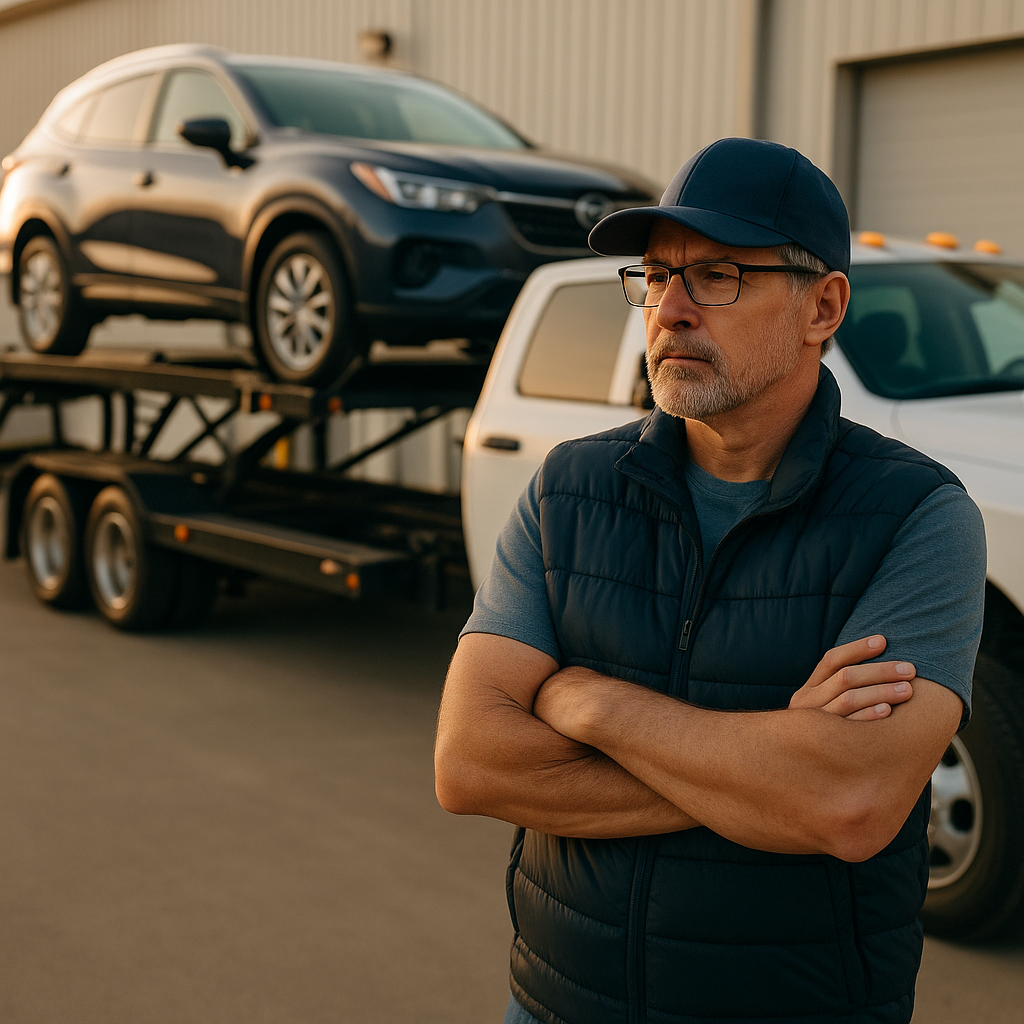
Hot shot car hauling usually means a dually (often Class 3–5) pulling a gooseneck or wedge trailer—commonly 1–5 vehicles, open deck or enclosed—running auctions, dealer transfers, or private moves.
If you want a quick “how the pieces fit” overview (liability vs cargo vs physical damage), read Commercial truck insurance explained (101).
Why it’s essential (business reality)
With cars, cargo value stacks fast—one incident can damage multiple units on the same load.
- Load/unload losses: scrapes, ramps, low-clearance mistakes.
- Securement losses: strap/chain failures, anchor-point issues, winch problems.
- Weather losses: hail is a real exposure for open-deck haulers.
- Theft/vandalism: especially when parking is limited and unsecured.
Who needs a car-hauling-specific setup?
- Owner-operators hauling cars under their own DOT/MC.
- Leased-on drivers moving cars with a dispatch arrangement.
- Anyone booking through brokers that require COI language like additional insured, waiver of subrogation, or primary & noncontributory.
Pro tip: underwriter questions to have ready
- Max vehicles and max total value you’ll haul.
- Open vs enclosed trailer.
- Typical lanes (states) and garaging ZIP.
- Authority status: new authority vs established, and whether you’ve had any insurance lapses.
- Equipment details: truck/trailer year, VINs, and stated values.
The 6 Core Coverages Hot Shot Car-Hauling Owner-Operators Need (Plus Car-Hauler Add-Ons)
Most hot shot car-hauling owner-operators build insurance around six core coverages—liability, cargo, physical damage (truck and trailer), general liability, and occupational accident—then add endorsements based on how they dispatch and whose trailers they pull.
1) Primary Liability (Auto Liability)
Primary auto liability pays for bodily injury and property damage you cause while operating the vehicle, and brokers commonly expect a $1,000,000 limit even when legal minimums differ by operation.
- What it is: The backbone coverage for at-fault injury/property damage claims.
- Why it matters: It’s the limit brokers check first on your COI.
- Who needs it: For-hire operations under their own authority; leased-on drivers may have it provided by the motor carrier (verify in writing).
2) Motor Truck Cargo (Car Hauler Cargo)
Motor truck cargo insurance covers damage to the vehicles you’re hauling, and car hauling increases cargo-loss severity because a single event can affect multiple units.
- What it is: Cargo coverage tailored to the commodity (autos).
- Why it matters: Cargo is where car hauling separates from general freight.
- Who needs it: Anyone moving customer vehicles, auction cars, dealer transfers, or brokered loads.
Car-hauler reality check: Review exclusions closely (securement, wear/tear, mechanical breakdown, “mysterious disappearance,” high-end/exotics unless endorsed).
3) Physical Damage (Truck) — Comp & Collision
Physical damage (comprehensive and collision) covers your truck if it’s wrecked, stolen, or hail-damaged, and lenders typically require it when the truck is financed.
- What it is: Comp/collision on the power unit.
- Why it matters: One total loss can shut the business down.
- Who needs it: Most owner-operators, especially with payments or limited cash reserves.
4) Physical Damage (Trailer) — Often Separate
Trailer physical damage insures your gooseneck/wedge/enclosed trailer value, and it’s often written separately from the truck’s physical damage.
- What it is: Comp/collision coverage on the trailer.
- Why it matters: Car-hauler trailers are expensive and take constant wear (ramps, deck components, tie-down points).
- Who needs it: Anyone who owns or finances the trailer.
5) General Liability (GL)
General liability covers many non-auto claims (like certain premises/property claims), and it’s commonly required by brokers and shipper contracts even when it isn’t legally mandated.
- What it is: “Non-auto” business liability.
- Why it matters: Contract requirement for many shippers/brokers.
- Who needs it: Most for-hire operations interacting with customer property.
6) Occupational Accident (Occ Acc) / Work Injury Option
Occupational accident insurance helps cover medical and disability-type benefits for the driver and is commonly used in 1099/leased-on owner-operator arrangements.
- What it is: A work-injury option that can help with medical/disability benefits depending on plan terms.
- Why it matters: If you’re hurt, the truck doesn’t earn—but payments keep drafting.
- Who needs it: Many leased-on owner-operators and some small fleets (varies by state and structure).
Car-hauler add-ons that commonly matter
These aren’t “nice to have” if they match how you actually work.
- Trailer Interchange: If you ever pull a non-owned trailer under an interchange agreement.
- Non-Trucking Liability (NTL) and/or Bobtail: If you’re leased-on and need coverage when not under dispatch.
- Hired/Non-Owned Auto (HNOA): If you rent/borrow a vehicle or have someone driving a non-owned unit for business.
- Rental reimbursement / downtime options: If downtime would crush your cash flow.
To avoid buying the wrong add-ons (or missing one that gets you rejected by a broker), review Common insurance mistakes that raise premiums.
Quick broker checklist (get it in writing)
- Liability limit: often $1M
- Cargo limit: commonly $100k+, but should match your max exposure
- GL required: often yes
- COI language: additional insured, waiver of subrogation, primary & noncontributory
- Special exclusions/endorsements: autos, exotics, securement language
MCS-90, BMC-91, BMC-34: What Hot Shot Car Haulers Actually Need (Own Authority vs Leased-On)
BMC filings (like BMC-91/BMC-91X and BMC-34) are submitted to FMCSA by an insurer when required, while MCS-90 is generally an endorsement attached to a motor carrier’s liability policy form language.
What it is (plain English)
- BMC filings (BMC-91/BMC-91X): Filings an insurer submits to FMCSA to show proof of required financial responsibility (when applicable).
- MCS-90: Generally an endorsement attached to a motor carrier’s auto liability policy (it’s often talked about like a “filing,” but it’s typically an endorsement attached to the policy form).
FMCSA’s insurance filing overview is here: https://www.fmcsa.dot.gov/registration/insurance-filing-requirements
Why it’s essential (cash flow + compliance)
If your authority is active but filings or policy documents don’t match what’s required (or what your broker contract demands), you can lose loads, face delays, or get shut down—problems that hit revenue immediately.
For the compliance side tied to real insurance consequences, see FMCSA/DOT compliance tied to insurance & records.
Who needs what? (fast decision)
- If you have your own authority (interstate for-hire): Expect your insurer/agent to handle required FMCSA filings as needed, and confirm what is filed versus what is simply attached to the policy.
- If you’re leased-on to a motor carrier: The carrier typically provides primary liability and filings, but you may still need physical damage, cargo (sometimes), NTL/bobtail (sometimes), and occupational accident depending on the lease.
Pro tip: don’t mix up “minimum legal” with “broker required”
Many operations buy higher limits because brokers care about contract terms and risk transfer, not the bare minimum you saw online.
2026 Hot Shot Car Hauling Insurance Cost (and Why It’s Been Moving Since 2024)
Hot shot car hauling insurance pricing is primarily driven by authority age, MVR/claims, cargo values, lanes and garaging ZIP, equipment values, and deductibles.
Insurance is one of the biggest line items in trucking operating costs alongside fuel, maintenance, and equipment payments, and ATRI’s annual cost research regularly lists insurance as a major expense category: https://truckingresearch.org/
Typical 2026 cost ranges (realistic estimates)
Exact premiums vary by market and profile, but planning with realistic ranges keeps you from under-budgeting.
- Liability-only (for-hire, own authority): often mid–high four figures to low five figures per year
- Liability + cargo (autos) + basic package: often five figures per year
- Full package (liability + cargo + PD truck/trailer + GL + needed endorsements): often upper five figures per year in tougher profiles
New authority, prior insurance lapses, or high-value auto hauling can push costs to the high end quickly.
To understand what moves pricing up or down, use What affects the cost of truck insurance.
Why premiums changed (2024 → 2026)
- Higher repair costs (parts and labor), especially after collisions
- Litigation and large verdict trends in commercial auto
- Weather losses (hail exposure for open-deck haulers)
- Severity pressure (larger payouts even if frequency doesn’t spike)
For broader commercial auto context, NAIC resources are helpful: https://content.naic.org/sites/default/files/publication-cml-mv-commercial-vehicle.pdf
Mini estimator: set cargo and PD limits like a business owner (not a guess)
A practical way to set limits is to price for the worst normal day, not the average day.
- Max vehicles on deck: ___ (example: 5)
- Realistic max value per vehicle: $___ (example: $12,000)
- Max exposure: vehicles × value = $___ (example: 5 × $12,000 = $60,000)
- Add a buffer for reality: +10–25% (example target cargo: $75,000)
- Set stated values you could actually replace: truck $___ / trailer $___
- Pick deductibles you can pay tomorrow: $___ comp / $___ collision
How to lower cost without getting underinsured
- Shop early: 2–4 weeks before the effective date.
- Avoid coverage lapses: lapses often get punished hard on price and options.
- Use risk signals underwriters respect: dash cam, maintenance records, secured parking plan.
- Don’t understate cargo exposure: a cheap COI that doesn’t match the load can leave you paying out of pocket.
Frequently Asked Questions
Most hot shot car-hauling owner-operators need primary auto liability, motor truck cargo for autos, and physical damage on the truck (and often the trailer) to operate and protect the business from common loss scenarios. Many brokers also require general liability as a contract term, even when it isn’t a legal requirement. Add trailer interchange if you pull non-owned trailers under an interchange agreement, and consider occupational accident if you’re 1099/leased-on and want a work-injury option. Your cargo limit should reflect your maximum deck exposure, not your average load.
Hot shot car hauling insurance cost in 2026 varies by authority age, driving record, claims history, cargo value, lanes/garaging ZIP, equipment values, and deductibles, but many owner-operators planning for a full package budget in the five-figure-per-year range. A liability-only setup can land in the high four figures to low five figures, while adding auto cargo and physical damage often pushes premiums higher. New authority, prior insurance lapses, and higher-value vehicles tend to increase pricing fastest. For a detailed breakdown of pricing inputs, see What affects the cost of truck insurance.
If you operate under your own authority, your insurer/agent typically submits any required FMCSA insurance filings when applicable, and MCS-90 is generally an endorsement attached to the liability policy form language under 49 CFR § 387.15. If you’re leased-on, the motor carrier usually carries primary liability and filings, but you may still need your own physical damage, cargo (sometimes), and NTL/bobtail depending on the lease agreement. To reduce delays and rework during setup, review Preparing for FMCSA authority application.
Non-trucking liability (NTL) generally applies when you’re using the truck for personal/non-business use while not under dispatch, while bobtail refers to operating the truck without the trailer and may be included or separate depending on the policy wording. The most common (and expensive) mistake is assuming “no trailer” automatically means “not trucking.” If you’re between loads, repositioning, or doing something tied to business, NTL may not apply and a claim can be denied if the coverage doesn’t match the use. Always confirm the carrier’s definitions of “in the business,” “under dispatch,” and “personal use” in writing.
Conclusion: Match Your Coverage to Your Cargo (and Your Brokers)
Hot shot car hauling is simple to start and expensive to get wrong, so build your policy around your maximum vehicle value on the deck, your equipment replacement cost, and broker requirements in writing.
Key Takeaways:
- Buy for your worst normal load (max cars × realistic value), not your average.
- Expect brokers to want $1M liability and cargo limits that match your exposure.
- Don’t ignore filings/endorsements details if you’re running under your own authority.
If you’re working on keeping costs under control without cutting critical protection, read Affordable trucking insurance savings playbook. For a state-level pricing example, see Texas commercial truck insurance cost guide.