Get your USDOT number free via FMCSA URS in 2026—plus ID verification tips, timeline, costs, and what to do next. Start now.

How do I get a USDOT number? You get a USDOT number by applying online through the FMCSA’s Unified Registration System (URS); when your submission is accepted (and any identity verification prompts are completed), your USDOT number is typically issued at submission. FMCSA FAQ: https://www.fmcsa.dot.gov/faq/how-do-i-register-usdot-number.
A USDOT number is often the fast part—the slow part is lining up everything around it (operating authority, filings, and insurance) so you can actually haul and get paid. If you think you may also need an MC number, start with this bigger picture: FMCSA operating authority (MC) setup overview.
Table of Contents
Reading time: 8 minutes
Key Takeaways
FMCSA’s URS is the official system used to register for a USDOT number, and registering a USDOT number directly with FMCSA is generally free (third-party services may charge for help).
- Applying for a USDOT number is generally free when you do it directly through FMCSA URS—watch out for lookalike paid sites.
- USDOT can be issued quickly, but authority activation can take longer if you also need an MC number and filings.
- Identity verification failures are usually fixable (mismatched name/address, blurry photos, expired ID, unstable connection).
- Your real risk starts after you get the number: marking rules, updates, and new-entrant compliance can cost you time and money if ignored.
Quick win: Copy the “Before You Apply” checklist below into your notes app and check items off as you go.
Do You Actually Need a USDOT Number? (Quick Eligibility Check)
Under 49 CFR § 390.5, interstate “commercial motor vehicle” operations commonly include vehicles at 10,001+ lbs GVWR/GCWR, passenger carriers (8+ for compensation or 15+ not for compensation), and certain hazmat loads, which often triggers federal safety registration and tracking through FMCSA.
What a USDOT number is (plain English)
A USDOT number is a federal identifier that ties your business to inspections, crash data, audits, and other safety/compliance records inside FMCSA systems.
Why it matters in real life (money + enforcement)
- Broker and shipper screening: Many will check your Company Snapshot before onboarding you.
- Roadside inspections: The officer’s system connects your vehicle and paperwork back to your USDOT profile.
- Fixing mistakes isn’t instant: If your registration details are wrong, you can lose days while trying to correct records.
Common situations where carriers need it
You commonly need a USDOT number if you operate commercially interstate (cross state lines or haul loads that are part of interstate commerce) and meet the vehicle/operation thresholds above.
Intrastate-only note: Some states require a USDOT number even if you never leave the state, so confirm with your state DOT.
If you’re also trying to determine whether you need operating authority (MC) in addition to USDOT, this breakdown helps: USDOT number vs. MC number differences.
What You Need Before You Apply (Documents + Info Checklist)
FMCSA URS collects your legal identity, address, contact information, operation type, cargo categories, and estimated fleet size to build your USDOT registration record, so mismatches can cause delays and verification problems later.
Why this checklist saves you time
The most common “DOT number delay” isn’t a technical issue—it’s messy information (different addresses, wrong legal name, phone/email you can’t access) that creates rework when you’re trying to onboard with a broker.
Before-you-apply checklist (save this)
Business + contact
- Legal business name (and DBA, if you use one)
- EIN (or SSN, if applicable)
- Physical address (format it consistently—Suite vs Ste, punctuation, etc.)
- Phone + email you will keep long-term (avoid temporary inboxes)
Operation details (FMCSA will ask)
- Operation type: for-hire vs private; interstate vs intrastate
- Cargo categories: choose what you’ll actually haul
- Drivers and power units: best estimate if you’re starting
Equipment info
- If you already have equipment: keep basic details handy
- If you don’t have a truck yet: you can often still apply—just be truthful and plan to update your record when details change
If you’re still building the business foundation (entity setup, business address strategy, phone consistency), use a structured pre-launch list: starting a trucking business checklist.
How Do I Get a USDOT Number in FMCSA URS? (5 Steps)
FMCSA’s Unified Registration System (URS) is the official online portal used to apply for a USDOT number, and a clean first submission commonly takes 20–45 minutes when you already have your business and operation details ready.
Step-by-step URS flow (practical)
- Start the URS application on the official FMCSA site. Avoid “DOT registration” lookalike sites unless you intentionally hired a paid service.
- Create an account / log in. Use an email you control long-term, and store the login in a password manager.
- Enter company and operation details carefully. Match your legal name and address to how you use them everywhere else.
- Review before submitting (don’t skip it). Double-check spelling, address formatting, operation type, and cargo categories.
- Submit and save proof. Save/print the confirmation page for your compliance folder.
Pro tip: If a site is charging you “just to get a DOT number,” it’s usually a convenience service. Sometimes it’s legit help, but it’s not required to register directly through FMCSA.
What Happens Next: Identity Verification, Timeline, Costs, and Compliance
After URS submission, FMCSA may require identity verification and carriers must follow federal rules such as 49 CFR § 390.21 vehicle marking and 49 CFR § 390.19 USDOT record updates to stay compliant once the USDOT number is issued.
Identity verification: what to expect (and how not to fail it)
FMCSA may require identity verification for first-time applicants as part of the URS registration process; see FMCSA registration resources: https://www.fmcsa.dot.gov/registration/registration-forms.

Common failure points (that show up all the time)
- Name/address mismatch: not entered consistently across records
- Bad photo capture: blur, glare, poor lighting, expired ID
- Connection/device issues: spotty service, VPNs, old browsers
Quick fixes that usually work
- Use strong lighting and avoid glare; steady your hands
- Turn off VPNs and use stable Wi‑Fi or strong cell service
- Re-check address formatting (Suite vs Ste, punctuation, capitalization)
Timeline + cost: USDOT vs authority (and the insurance reality)
Timeline (simple truth)
- USDOT number: often appears right after a successful URS submission
- Operating authority (MC) + filings: can take longer to activate depending on what your operation requires
Cost (what’s free vs what isn’t)
- USDOT number: generally free when filed directly with FMCSA
- Common non-free items: operating authority fees (if needed), filings, plates/permits, and insurance
For many new for-hire carriers, insurance becomes the “real” bottleneck because it affects onboarding and authority activation requirements. If you want a clean overview of coverages (auto liability, cargo, physical damage, bobtail/non-trucking), start here: commercial truck insurance basics.
Compliance after you get your number (don’t skip)
Marking/Display rules (vehicle lettering)
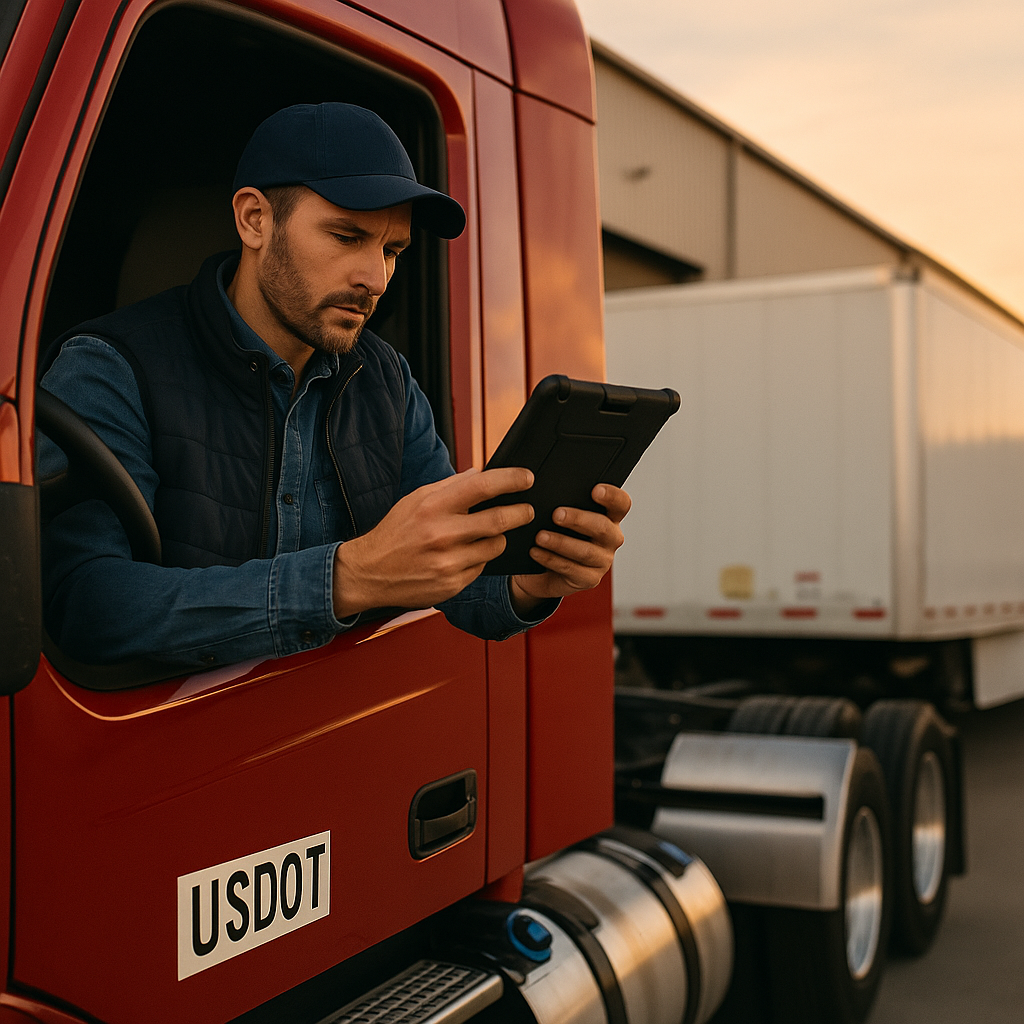
49 CFR § 390.21 requires carriers to display their legal name (or single trade name) and USDOT number on both sides of the power unit in a legible, contrasting manner; rule text: 49 CFR § 390.21.
Keep your FMCSA record updated
FMCSA requires carriers to update their MCS-150/registration information at least every 24 months (and sooner when key information changes) under 49 CFR § 390.19; overview: FMCSA Getting Started.
Be new-entrant ready
Even if you’re one truck, treat compliance like a system: build a simple folder (digital is fine) for insurance documents, maintenance records, inspection reports, ELD/HOS basics, and drug-and-alcohol program enrollment if your operation requires it. If you want to plan ahead for what FMCSA looks for, keep this handy: New entrant safety audit guide.
Common “what’s next” registrations (depending on your operation)
- BOC-3: Often required for operating authority; see BOC-3 filing guide.
- UCR: Commonly required for interstate carriers; see UCR registration guide.
- IFTA: Commonly relevant when operating interstate and meeting fuel tax reporting thresholds; see IFTA registration guide.
Frequently Asked Questions
You register for a USDOT number by applying through FMCSA’s Unified Registration System (URS), entering your legal business details and operation information, completing any required identity verification prompts, and submitting the application. FMCSA states you can register online and that the USDOT number is typically issued after successful submission (FMCSA FAQ: https://www.fmcsa.dot.gov/faq/how-do-i-register-usdot-number). Save the confirmation page, and keep your login information since you may need to update your record later under 49 CFR § 390.19.
You typically need your legal business name, EIN (or SSN if applicable), a consistent physical address, and accurate operation details (for-hire vs private, interstate vs intrastate, cargo categories, number of drivers, and power units). If URS triggers identity verification, you’ll also need a valid government-issued photo ID and the ability to capture clear ID/selfie images on a stable connection. Using mismatched names or differently formatted addresses is one of the most common reasons first-time applicants get stuck redoing steps.
If your URS submission is successful, the USDOT number often appears immediately after you submit the application. The longer timeline usually comes from what you need beyond USDOT—like operating authority (MC), required filings, and insurance readiness—because those items can have separate processing and compliance steps. If you’re unsure whether you need authority in addition to DOT, review: USDOT number vs. MC number differences, since “ready to haul” depends on both registration and permissions.
After you get your USDOT number, you should (1) mark the truck correctly under 49 CFR § 390.21, (2) set up a simple compliance folder (maintenance, inspections, insurance, ELD/HOS basics, and required programs), (3) confirm whether your operation also needs operating authority and related filings, and (4) complete any extra registrations tied to your lanes and size. One common next step many interstate carriers miss is UCR registration guide, which can affect compliance even if your USDOT number was issued quickly.
Conclusion: Get Your USDOT Number the Fast (and Correct) Way
Getting your USDOT number is straightforward when you use FMCSA URS, enter clean information, and handle identity verification without rushing. The bigger win is what you do next—marking, updates, and the extra registrations that keep you compliant and broker-ready.
Key Takeaways:
- Apply directly in FMCSA URS to avoid unnecessary third-party fees for the USDOT portion.
- Use consistent legal name and address formatting to prevent identity verification issues.
- After issuance, follow 49 CFR § 390.21 marking rules and keep your record updated under 49 CFR § 390.19.
If you’re building toward authority, filings, and audit readiness, keep these on deck: BOC-3 filing guide, New entrant safety audit guide, and IFTA registration guide.