Livestock hauling insurance for owner-operators: 7 key coverages, 2026 cost bands ($10K–$25K/yr), endorsements & broker limits. Get quotes.
Livestock hauling insurance owner operator coverage is a trucking insurance package built around live-animal cargo risk, broker/shipper requirements, and liability filings—not just “FMCSA minimums.” Answer: Owner-operators hauling livestock typically need primary auto liability, motor truck cargo written for live animals, physical damage, general liability, and (if applicable) trailer interchange; leased-on operators often add bobtail/non-trucking liability and occupational accident.
Livestock loads don’t forgive mistakes. A long delay at the auction, a heat-stress loss, a rollover, or a claim dispute over “who loaded/unloaded” can wipe out months of profit—fast. If you need the baseline rules first, start with insurance requirements for owner operators, then come back here to build the livestock-specific add-ons.
Table of Contents
Reading time: 9 minutes
What livestock hauling insurance means for an owner-operator (and why it’s different)
Livestock hauling insurance is a commercial trucking insurance package that combines auto liability, cargo, physical damage, and optional coverages with terms tailored to live animals, stockyards, and livestock contracts.
It isn’t one “special policy.” It’s the same building blocks as regular trucking coverage, but the details (especially cargo exclusions and certificate requirements) are what decide whether you’re paid—or denied—when something goes wrong.
If you want a straightforward overview of how the core pieces fit together, read trucking insurance 101 first, then use the livestock sections below to tighten up the parts that usually cause claim disputes.
Why livestock is different than general freight
Plain-English difference: You’re responsible for a live load that can be injured, stressed, contaminated, or lost—often without a “crash” being the main problem.
- Higher severity potential: A rollover can trigger large cleanup, disposal, and cargo-loss disputes.
- Time and temperature sensitivity: Dwell time, weather, ventilation, and delays matter—especially in summer.
- Biosecurity/contamination allegations: Washouts and contamination claims can turn into expensive finger-pointing.
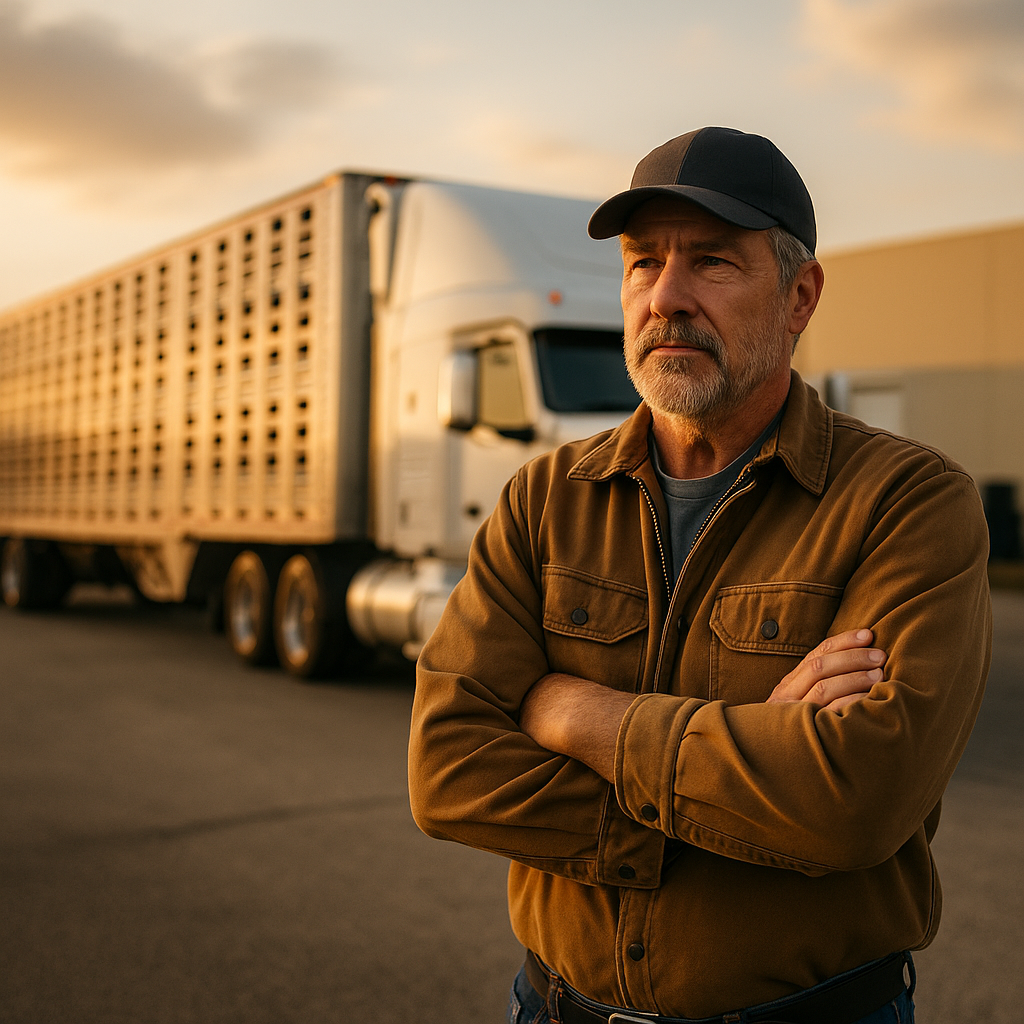
Who needs it: Any owner-operator hauling cattle, hogs, sheep, goats, poultry, or specialty breeding stock—under your own authority or leased-on (because you may still need physical damage, bobtail, occupational accident, and sometimes cargo depending on your lease).
Pro tip: If you haul mixed commodities (sometimes livestock, sometimes general freight), be accurate. Don’t list “any commodity, nationwide” if you run a tight lane—overbroad descriptions can raise premium and complicate claims.
The 7 coverages livestock owner-operators typically need (with practical limits)
Most livestock owner-operators end up with 7 core coverages—liability, cargo, physical damage, and a few add-ons—because brokers and facilities commonly require certificates that go beyond FMCSA minimums.
Think of this as “semi truck insurance + livestock-specific cargo details.” For a deeper explanation of how a tractor/trailer policy is typically built, reference the semi truck insurance guide.
Alt text: Table of 7 insurance coverages for livestock hauling owner-operators
Coverage quick table (owner-operator view)
| Coverage | What it protects | Who requires it | Common limit range (varies) |
|---|---|---|---|
| Primary auto liability | Injuries/property damage you cause to others | FMCSA + brokers/shippers | Often $750K–$1M+ (many brokers want $1M) |
| Motor truck cargo (livestock form) | Loss/damage to animals in transit (policy-specific) | Shippers/brokers; smart business | $100K–$250K+ depending on head count/value |
| General liability | Non-auto claims at facilities (slip/fall, property damage) | Stockyards/shippers often | Commonly $1M per occurrence |
| Physical damage (comp/collision) | Your tractor (and sometimes trailer) | Lender + you | Based on stated value; deductible strategy matters |
| Trailer interchange | Non-owned trailer you’re responsible for | Trailer owners/pools | $20K–$75K+ (match trailer value) |
| Bobtail / non-trucking liability | Off-dispatch liability (leased-on) | Many carriers require it | Usually $1M |
| Occupational accident | Medical/disability benefits for you | Your wallet; sometimes contracts | Benefit schedule-based |
1) Primary auto liability (the non-negotiable)
Definition: Primary auto liability pays for bodily injury and property damage you cause to others when you’re legally liable in a covered auto accident.
Why it matters for livestock: Even when FMCSA minimums apply, many brokers and shippers treat $1,000,000 liability as the practical “load access” standard.
2) Motor truck cargo — structured for live animals
Definition: Motor truck cargo insurance can pay for covered loss or damage to animals in transit, but livestock claims often hinge on the exact cargo form and exclusions.
This is where livestock haulers get burned. A “generic cargo” policy may not match real livestock exposures like heat/stress, suffocation, trample events, disease allegations, or loading/unloading disputes.
Practical limit check:
- Max head count you actually haul
- × realistic per-head value for your lane
- + cushion if you ever haul breeding stock or higher-value loads
3) General liability (GL)
Definition: General liability is non-auto liability coverage for third-party bodily injury or property damage claims that happen outside of driving-related accidents.
Stockyards and processors may require GL, and it can help when something happens on-site that isn’t a roadway crash (for example, certain property damage scenarios during loading/unloading—depending on facts and policy terms).
4) Physical damage (comp/collision)
Definition: Physical damage coverage (comprehensive and collision) can pay to repair or replace your tractor after a covered loss like a crash, theft, vandalism, or weather damage.
If your truck is financed, the lender will usually require it. If it’s paid off, it’s still often the difference between a bad month and going out of business.
Deductible reality check: Saving premium doesn’t help if a $5,000 deductible puts you behind on truck payments.
5) Trailer interchange (when you pull someone else’s trailer)
Definition: Trailer interchange covers physical damage to a non-owned trailer in your care, custody, and control under a written trailer interchange agreement.
If you borrow/lease/pull a trailer that isn’t yours, someone will want proof you can pay if it gets damaged. Match the limit to the trailer’s value, not the cheapest option on the quote.
6) Bobtail / non-trucking liability (leased-on)
Definition: Bobtail/non-trucking liability covers certain liability claims while you’re operating your tractor off-dispatch (personal use or not under the motor carrier’s control), subject to the policy’s definition of “non-trucking.”
This is a common misunderstanding area. If you’re leased-on, you need to know exactly when the carrier’s policy applies—and when it doesn’t.
7) Occupational accident (Occ/Acc)
Definition: Occupational accident is a benefits policy that can provide medical and disability benefits for owner-operators and independent contractors, often used as an alternative to workers’ comp.
If you get hurt, there’s no paid sick leave. A few weeks off the road can crush cash flow, so most one-truck businesses should at least price it.
FMCSA minimums vs broker/shipper requirements (what actually keeps you load-eligible)
FMCSA financial responsibility rules set minimum liability requirements for certain for-hire operations (often cited as $750,000 for many interstate property carriers), but brokers and shippers frequently require higher limits and specific certificate wording to tender loads.
This is the part that hits revenue: your minimums can be “legal,” but if you don’t meet the broker’s COI checklist, you still don’t have a load.
For how compliance, filings, and insurability connect, see DOT record and trucking insurance.
FMCSA: minimum financial responsibility + filings (not just “buying a policy”)
Definition: FMCSA requires certain carriers to maintain minimum financial responsibility and to have active insurance filings on record, and a filing lapse can affect authority status and load eligibility.
For the official overview, use FMCSA’s page on insurance filing requirements.
Pro tip: New authority timelines matter. Underwriting, filings, and COI requests can take longer than you think—plan it before you’re ready to roll.
Brokers/shippers: higher limits + specific certificate wording
Definition: Broker/shipper insurance requirements are contractual rules (not government rules) that commonly include higher liability limits, cargo minimums, and COI wording like additional insured or waiver of subrogation when requested.
Many shippers and brokers check your status using tools like FMCSA SAFER and may require:
- Higher liability limits (often $1,000,000)
- Cargo limits that match the load value
- General liability (GL)
- Specific COI wording (when requested by contract)
Bottom line: If your insurance meets FMCSA minimums but doesn’t meet shipper requirements, you still don’t have revenue.
How much does livestock hauling insurance cost in 2026? (realistic bands + what drives the price)
In 2026, many livestock-hauling owner-operators commonly land in the $10,000–$25,000 per year range for a full insurance package, while new authority and higher-risk profiles can push totals well above that band.
Insurance is consistently one of the biggest line items in trucking operating costs, and it can swing fast when claims rise. ATRI publishes trucking cost research at the American Transportation Research Institute.
For the base pricing levers (driver history, radius, equipment, operations), read what affects the cost of truck insurance, then apply the livestock-specific factors below.
Alt text: 2026 livestock hauling insurance cost table for owner-operators
2026 cost bands (use these as planning numbers, not promises)
Use these bands to budget and compare quotes, not as a guarantee—your state, authority age, loss history, equipment value, and cargo form can move pricing a lot.
| Scenario | Typical annual band (rough) | What’s driving it |
|---|---|---|
| New authority (0–12 months) | $18K–$35K+ | Limited underwriting options, higher uncertainty, filings/eligibility |
| Established (2+ years), clean record | $10K–$20K | Better markets, fewer surcharges, stable ops |
| Prior losses / tough lanes / high values | $22K–$45K+ | Loss severity, higher cargo limits, narrower carrier appetite |
Why livestock can price higher than general freight
- Cargo form limitations and claim-dispute risk (especially non-crash losses)
- Seasonality/heat risk
- Loading/unloading responsibility disputes
- Specialized trailer values and interchange needs
For broader market context on commercial auto insurance, NAIC publishes industry resources at NAIC (select the most relevant commercial auto market report at publish time).
Livestock-specific underwriting factors that move the needle
Underwriters care about the basics (MVR, CDL time, claims, radius, garaging, equipment value), but livestock-specific details can change pricing and even availability:
- Max head count and species, and whether you ever haul high-value breeding stock
- Seasonality and heat exposure (summer lanes, long dwell times)
- Who loads/unloads and how it’s documented in the rate confirmation / contract
- Routes and timing (overnight runs, rural roads, animal strike frequency)
- Biosecurity routine (washouts, documented practices)
Cost control without creating a coverage gap
“Cheap insurance” that doesn’t respond is usually the most expensive thing you can buy. Levers that can reduce premium without gutting protection include:
- Set a tight, accurate radius (don’t pay for nationwide if you don’t run it)
- Choose physical damage deductibles you can fund with a maintenance reserve
- Install dash cams and keep safety documentation (helps with claims and underwriting)
- Be accurate on commodities—don’t overstate, but don’t hide livestock either
Note on hotshot: If you’re running a dually/gooseneck setup for smaller ag-related loads, hotshot insurance is rated differently than a typical semi. Quote the correct class of business and equipment—don’t assume it’s interchangeable with a standard tractor setup.
Frequently Asked Questions
Most livestock haulers need primary auto liability, physical damage, and motor truck cargo written for live animals (not a generic cargo form). Many also need general liability for facilities, trailer interchange if pulling non-owned trailers, and—if leased-on—bobtail/non-trucking liability plus occupational accident. Broker/shipper requirements often exceed FMCSA minimums, so the practical “need” is whatever gets you load-eligible and paid on a claim. If you’re still building the basics, start with insurance requirements for owner operators and then tighten up cargo terms for livestock.
In 2026, many owner-operators hauling livestock commonly see $10,000–$25,000 per year, while new authority, prior losses, high cargo limits, and certain states can push totals higher (often $18K–$35K+ for first-year authority in many scenarios). The biggest drivers are usually liability pricing, authority age, claims/MVR, radius, equipment value, and whether cargo can be written on a livestock-appropriate form with acceptable exclusions. For a deeper breakdown of pricing levers, see what affects the cost of truck insurance.
FMCSA filing requirements apply based on your operation, but “special” livestock requirements usually come from shippers, stockyards, and brokers—not the government. In practice, facilities may require higher liability limits (often $1,000,000), general liability, and cargo coverage terms that match livestock risk. The most important “special” detail is often cargo exclusions (heat/stress, delay, improper handling, disease), so you should confirm those in writing before binding coverage. For filing basics, review FMCSA’s insurance filing requirements.
Common needs include a livestock-appropriate motor truck cargo form (where available), trailer interchange if you pull non-owned trailers under a written agreement, and certificate-driven wording like additional insured or waiver of subrogation when requested by contract. The “right endorsement” is the one that matches your real operation: your trailer ownership, who loads/unloads, and the facilities you enter. Refrigeration breakdown usually matters only if you also haul temperature-controlled commodities; it’s not a standard cattle-pot need in most setups.
If you’re leased-on, the motor carrier may provide primary liability while you’re under dispatch, but you may still need physical damage, bobtail/non-trucking, and occupational accident—confirm this in your lease and on the COI. If you have your own authority, you typically need your own liability policy plus the required filings and certificates to stay load-eligible. If you’re ready to shop coverage, start with truck insurance quotes so your options match your lanes and livestock exposure.
Sometimes yes and sometimes no—coverage depends on the cargo form and its exclusions, and heat/stress, delay, improper handling, and disease-related losses are common restriction areas. The practical step is to request the cargo exclusions in writing and walk through your real claim scenarios (summer lanes, dwell time at auctions, ventilation issues, loading/unloading responsibility) before you bind. With livestock, “I have cargo insurance” isn’t specific enough; you need to know what causes of loss are actually covered.
A practical cargo limit for cattle hauling is your true maximum exposure: (max head count you haul) × (realistic per-head value for your lane), then verify the broker/shipper minimum cargo requirements for those same lanes. If you ever haul breeding stock or mixed higher-value loads, you may need higher limits for those specific runs and you should disclose that during quoting. If your limit can’t cover the load value you actually pull, you’re exposed even if the certificate “looks fine.”
To get an accurate livestock hauling quote, you typically need MVRs, CDL experience, prior claims/loss runs, and your authority start date, plus your livestock specifics (species, max head count, lanes/radius, seasonality, and who loads/unloads). You’ll also need equipment details like tractor VIN, trailer type/value, garaging ZIP, and whether you pull non-owned trailers requiring interchange. Bring your safety controls (dash cam, inspection/maintenance routine) because those details can affect underwriting and eligibility as much as the price.
Conclusion: Insure the livestock details, not just the truck
Livestock hauling is simple to describe and hard to insure correctly: you need a standard trucking foundation plus cargo terms and certificates that actually fit live animals. Before you bind, get broker/shipper requirements in writing and confirm your filings and COIs match what they’re checking.
Key Takeaways:
- Livestock cargo isn’t “just cargo”: the form and exclusions can decide whether a heat/stress or delay-related loss is paid or denied.
- Load eligibility is usually contractual: brokers/shippers may require $1M liability, GL, cargo minimums, and specific COI wording beyond FMCSA minimums.
- Budget realistically: many livestock owner-operators land around $10K–$25K/year, while new authority and high-risk profiles can run higher.
If you’re setting up a new authority or trying to avoid delays that can trigger higher premiums, use how to prepare for the FMCSA authority application. If you’re trying to lower premium without creating a coverage gap, review affordable trucking insurance strategies.