
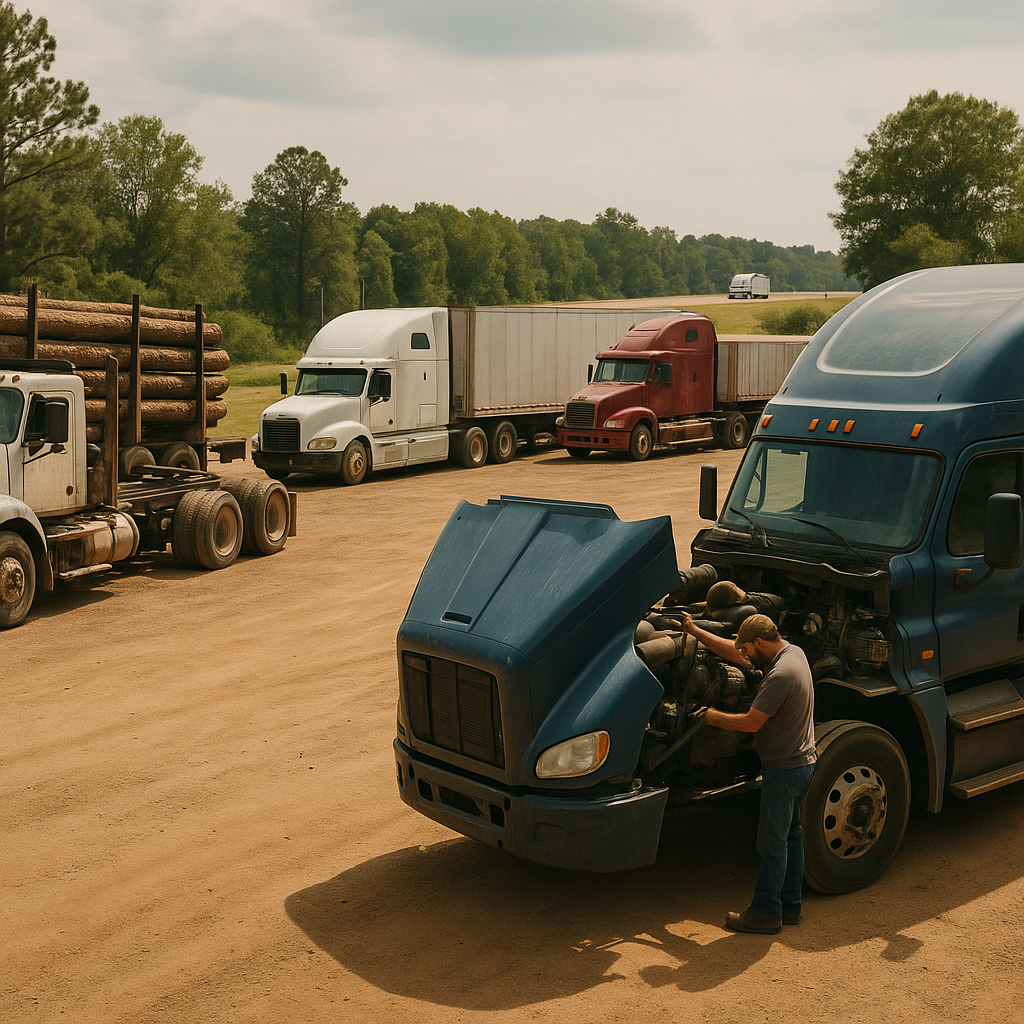

Log truck insurance in Mississippi is a package of commercial trucking coverages built around a working logging truck, not a personal auto policy. Under 49 CFR Part 387, for-hire interstate general freight carriers need $750,000 minimum public liability, while shippers often ask for $1,000,000.
If you’re shopping for log truck insurance in Mississippi, the biggest mistake is treating it like regular auto insurance or assuming one liability number fits every truck. Logging runs hard on equipment, routes, and drivers, so the right policy has to match how you actually operate.
This guide breaks down what log truck insurance covers, where Mississippi rules stop and FMCSA requirements start, what drives cost, and how to compare quotes without paying for the wrong thing.
What Log Truck Insurance Covers#
Log truck insurance is usually a package of commercial trucking coverages built around a working truck, not a personal auto policy. For a Mississippi log truck, the key question isn’t just “do I have insurance?” but whether the policy matches your hauling operation, equipment, drivers, and exposures.
Log truck insurance is a commercial insurance package for trucks used in business to haul logs, timber, or related materials. The NAIC is a good plain-language reference for basic insurance terms, but trucking policies add operation-specific rules that don’t show up in a standard car policy.
Core policies for log trucks#
Commercial auto liability pays for third-party bodily injury and property damage if your truck causes a crash. This is the coverage tied to state and federal operating requirements.
Physical damage covers damage to your own truck from collision, fire, theft, weather, and other covered causes. On a logging truck, that’s a big deal because rough roads, tight landings, and heavy use can turn a small incident into a major repair bill fast.
Motor truck cargo covers the freight you’re hauling if a covered loss damages it in transit. For logging, the exact cargo wording matters because the policy has to fit what you’re actually hauling and how the load is handled.
General liability covers certain non-driving business liability exposures, like some third-party injury or property damage claims that happen off the road. It’s different from auto liability, which applies to truck operation.
Non-trucking liability, often called bobtail by drivers, covers certain non-business use of the truck when you’re not under dispatch. It does not cover paid hauling.
Trailer interchange covers a trailer you use under a signed interchange agreement, while non-owned trailer physical damage is for trailers you don’t own when no interchange agreement applies. That distinction matters because many owner-operators buy the wrong trailer coverage.
What’s usually excluded#
Log truck policies can still leave real gaps. If the truck is rated or classed incorrectly, if the cargo type doesn’t match the policy, or if a claim falls into an exclusion, the fact that you “had insurance” may not help much.
Personal use mixed into business use, unlisted drivers, unpaid hauling assumptions, loading and unloading situations, and certain equipment left at a jobsite can all create disputes. A policy written for a general trucking class may not fit logging exposures cleanly.
If you’re looking at a quote and can’t tell whether it actually fits logging work, [](https://www.logrock.com/?utm_source=BLOG&utm_campaign=log-truck-insurance-in-mississippi).
Who the policy may cover#
Who is covered depends on the named insured and the policy wording, but usually the main insured is the business or owner-operator listed on the declarations. Listed drivers are the most important piece because carriers underwrite specific people, not just the truck.
Some policies may extend limited coverage to permissive users, but you should never assume that means “anybody I let drive it is fine.” For a one-truck operation or a small fleet, one unapproved driver can be the difference between a covered claim and a denied one.
👉 Need to save money on truck insurance in Mississippi?
Watch the video below for a quick overview of truck insurance in Mississippi requirements, how much it costs, and practical ways to save. Or give us a call: (704) 290-3630
Mississippi Rules vs. FMCSA Requirements#
Mississippi rules and FMCSA requirements are not the same thing, and a lot of owner-operators get tripped up by mixing them together. If you haul logs only inside Mississippi, one set of rules may control; if your operation is for-hire interstate, federal requirements and filings can take over.
State filing and operating rules#
Mississippi can have its own insurance and operating expectations for intrastate carriers, and state-specific compliance questions should be checked against the Mississippi Department of Insurance and the Mississippi Department of Transportation. Intrastate rules, registration issues, and state enforcement don’t automatically match what FMCSA requires for interstate authority.
That matters because a Mississippi operator may hear a state minimum from one source and a federal minimum from another, then assume both apply the same way. They don’t.
Federal minimums for interstate carriers#
For interstate trucking, FMCSA requirements depend on whether you’re for-hire or private, the vehicle weight, and what commodity you haul. Under 49 CFR Part 387, for-hire interstate carriers hauling general freight in vehicles over 10,001 pounds must carry at least $750,000 in public liability.
That doesn’t mean all truckers need $750,000. Under 10,000 pounds is a different threshold, auto haulers are different, and hazmat can require much higher limits. If you’re dealing with federal authority, you also need to think about your USDOT number, MC number if applicable, and insurance filings such as the MCS-90, which is an endorsement tied to federal financial responsibility requirements.
You can verify carrier status and filings through FMCSA and on SAFER. That’s the cleanest way to separate forum advice from your actual operating setup.
Shippers and motor carriers may also require more than the legal minimum. A common example is a $1,000,000 liability request in a contract even when the federal minimum for that operation is lower.
Why personal auto does not apply#
Personal auto insurance generally excludes business hauling with a commercial truck. A log truck used to generate revenue is not the same risk as a pickup used for errands, and carriers price and underwrite those risks completely differently.
That confusion gets expensive when someone assumes “full coverage” on a personal policy protects a loaded commercial unit. It usually doesn’t. If the truck, route, and hauling activity are commercial, the policy has to be written as commercial trucking insurance.

How Much Log Truck Insurance Costs in Mississippi#
Log truck insurance in Mississippi varies based on your truck, hauling profile, driver history, operating radius, and coverage choices. Two operators with the same liability limit can get very different pricing because underwriters rate the whole risk, not just the number on the certificate.
Main cost drivers#
A few factors move the premium more than others:
- Driver experience and motor vehicle record
- Loss history and prior claims
- Truck value and condition
- Operating radius and territory
- Cargo type and hauling class
- Garaging location
- Requested limits and deductibles
Logging can rate differently from general freight because the roads, loading conditions, and equipment stress are different. A truck that runs short rural routes to mills may look different to underwriting than one running broader for-hire lanes with mixed operations.
How quotes are built#
Underwriters look at the truck, the business, the driver, and the type of work being done. They also look at whether the quote is for auto liability only or a fuller package with physical damage, cargo, general liability, and trailer-related coverages.
That means a lower quote isn’t automatically the better quote. It may exclude a driver, raise the deductible, leave out cargo, class the operation wrong, or assume a narrower radius than the truck actually runs.
The cheap-looking option can become the expensive one the first time a claim hits and the carrier says the truck was doing something outside the stated operation. If you’re not sure how to compare the moving parts, [](https://www.logrock.com/?utm_source=BLOG&utm_campaign=log-truck-insurance-in-mississippi).
Why $1,000,000 liability gets discussed#
A $1,000,000 liability limit means the policy provides up to that amount for covered third-party bodily injury and property damage claims, subject to the policy terms. In trucking, it’s common because shippers, brokers, and motor carriers often want that limit even when the legal minimum may be lower for a specific operation.
But it doesn’t mean every loss is fully covered no matter what happened. It doesn’t replace cargo insurance, doesn’t fix an excluded driver issue, and doesn’t cover damage to your own truck unless you also carry physical damage.
So how much does it cost? There’s no universal number. Your actual premium depends on your operation, cargo, radius, driving history, truck value, and other factors.
Coverage Gaps Specific to Logging Operations#
Logging creates coverage gaps that don’t show up as often in standard dry-van trucking. The truck may be insured, but the real question is whether the policy fits rough-access roads, loading conditions, cargo handling, trailer use, and the drivers actually touching the unit.
Night driving and road-use concerns#
Night driving in Mississippi is mainly an operating and compliance issue, not a separate insurance substitute. A log truck can only run at night if the operation is lawful under the routes, safety rules, contract terms, and any employer or carrier restrictions that apply.
Insurance still has to match the real duty cycle. If a policy is quoted like a limited local daytime operation but the truck regularly runs dark rural roads, that mismatch can affect underwriting and claims scrutiny.
Cargo and equipment exposures#
Logs shift, chains fail, and rough roads beat up equipment. Physical damage becomes more important when the truck itself is expensive to repair, while motor truck cargo matters when you’re responsible for the value of what you’re hauling.
General liability can matter more around loading sites, yards, and customer property. And if you use trailers you don’t own, you need to know whether you need trailer interchange or non-owned trailer physical damage instead of guessing.
Who is and is not covered#
Named-driver and permissive-use issues are a major pain point in small logging operations. If a relative, helper, or backup driver uses the truck but wasn’t disclosed properly, that can create a serious coverage problem.
The same goes for business use that doesn’t match the application. If the policy says one thing and the actual operation says another, claims get harder fast.
How to Compare Quotes Without Overbuying#
The best quote for a Mississippi log truck is the one that fits your operation without leaving expensive holes. Comparing quotes by premium alone is how owner-operators end up underinsured in the places that matter and overinsured in places they don’t need.
Quote checklist#
When you compare quotes, check the same items across every option:
- Liability limit
- Covered drivers
- Vehicle classification
- Cargo type listed
- Operating radius
- Deductibles
- Physical damage included or not
- Trailer coverage included or not
- Key exclusions and endorsements
If one quote looks much lower, find out exactly what changed. A different hauling class, a missing coverage, or a driver restriction can explain the gap.
Questions to ask before binding#
Ask whether the policy is written for the correct operation: for-hire or private, interstate or intrastate, and logging or another trucking class. Also ask whether the insurer expects any filings, whether an MCS-90 is attached if needed, and whether all actual drivers are acceptable.
This is also the point to ask what isn’t covered. That’s where the real value is. A straight answer on exclusions is worth more than a vague promise that the policy is “full coverage.”
When to add extra coverage#
Physical damage makes sense when you can’t afford to absorb damage to your own truck. Cargo matters when you’re responsible for the load. General liability becomes more relevant when your work creates exposure beyond driving alone.
Non-trucking liability can make sense for owner-operators who need protection during certain non-business use, but it never covers paid hauling. Reefer coverage usually isn’t relevant to log hauling, so don’t buy add-ons just because they’re on a menu.
The goal isn’t the biggest package. It’s the right package for the way the truck actually works.
How to Get a Log Truck Insurance Quote in Mississippi#
Getting a log truck insurance quote in Mississippi goes smoother when you have the operational details ready up front. Underwriters price trucking based on facts about the truck, driver, route, and hauling work, so missing details usually means delays, revisions, or a quote that doesn’t reflect the real risk.
Information you’ll need#
Have these basics ready:
- VIN and truck details
- Garaging address
- Driver’s license information and driving history
- Operating radius
- Cargo type
- Prior insurance information
- Current or planned business structure
- USDOT or MC information, if applicable
What underwriting reviews#
Underwriting reviews the driver’s record, prior losses, truck value, type of hauling, territory, and whether the operation matches the requested policy. They also look at who needs to be listed, whether filings are required, and whether the requested limits fit the operation.
Next steps after approval#
Before you bind, review the filings, deductibles, endorsements, and driver eligibility carefully. Make sure the quote matches how the truck will really run, not just how it looked on a quick application.
FAQ#
How much is log truck insurance in Mississippi?
Log truck insurance in Mississippi varies based on the truck, driver, operating radius, cargo, loss history, and the coverages you choose. A one-truck owner-operator hauling logs locally can price very differently from a small fleet running broader routes or carrying higher limits. Physical damage, cargo, and deductible choices also change the total. The main thing to remember is that there isn’t one state average that tells you what your policy should cost. Your actual premium depends on your operation, cargo, radius, driving history, and other underwriting factors.
How much is insurance for a log truck?
Insurance for a log truck costs more or less depending on the commercial exposures attached to the operation, not just the truck itself. Underwriters look at how the truck is used, what it hauls, where it runs, who drives it, and whether the policy includes only liability or a broader package with physical damage and cargo. Logging can create different risk assumptions than other freight classes because of rough roads, loading conditions, and equipment use. That’s why two similar trucks can still get very different quotes if the operation profile is different.
Can log trucks drive at night in Mississippi?
Night driving is mainly an operating and compliance question, not a special type of insurance permission. Whether a log truck can drive at night in Mississippi depends on the routes used, the safety rules that apply, any employer or motor carrier restrictions, and whether the operation is being conducted lawfully. Insurance still needs to reflect the real use of the truck. If a policy is written as a limited local daytime operation but the truck regularly runs night routes, that mismatch can affect underwriting and create problems when a claim is reviewed.
How much does a $1,000,000 liability insurance policy cost?
A $1,000,000 liability policy doesn’t have one fixed price because the premium depends on the whole trucking risk. Insurers rate the driver history, truck type, hauling class, operating territory, loss record, and whether the policy includes only liability or other coverages too. In trucking, $1,000,000 is a common requested limit because contracts often ask for it, but the same limit can cost very differently from one operator to the next. It also only addresses covered third-party injury and property damage claims, not cargo, physical damage, or every possible uncovered situation.




