
Louisville truck insurance only makes sense when it matches how you actually run. A Louisville address by itself doesn’t tell you what coverage, filings, or limits may apply. The real questions are what you haul, where you run, whose authority you use, and how your truck is set up.
Start With How Your Truck Actually Operates#
A Louisville truck insurance policy should be built around the operation, not just the city on the mailing address. The right setup depends on where the truck is garaged, whether you run for-hire or private, what freight you haul, how far you travel, and whether you stay in Kentucky or cross into interstate work.
A quote starts with facts that change both eligibility and coverage design. Insurers usually need the primary garaging ZIP code, truck type, stated value, driver experience, loss history, commodity, operating radius, and whether the business is for-hire or private carriage.
The details an insurer needs before quoting#
A USDOT number is the federal identifier used to track a carrier’s safety and operating profile. An MC number is operating authority used for certain for-hire interstate operations.
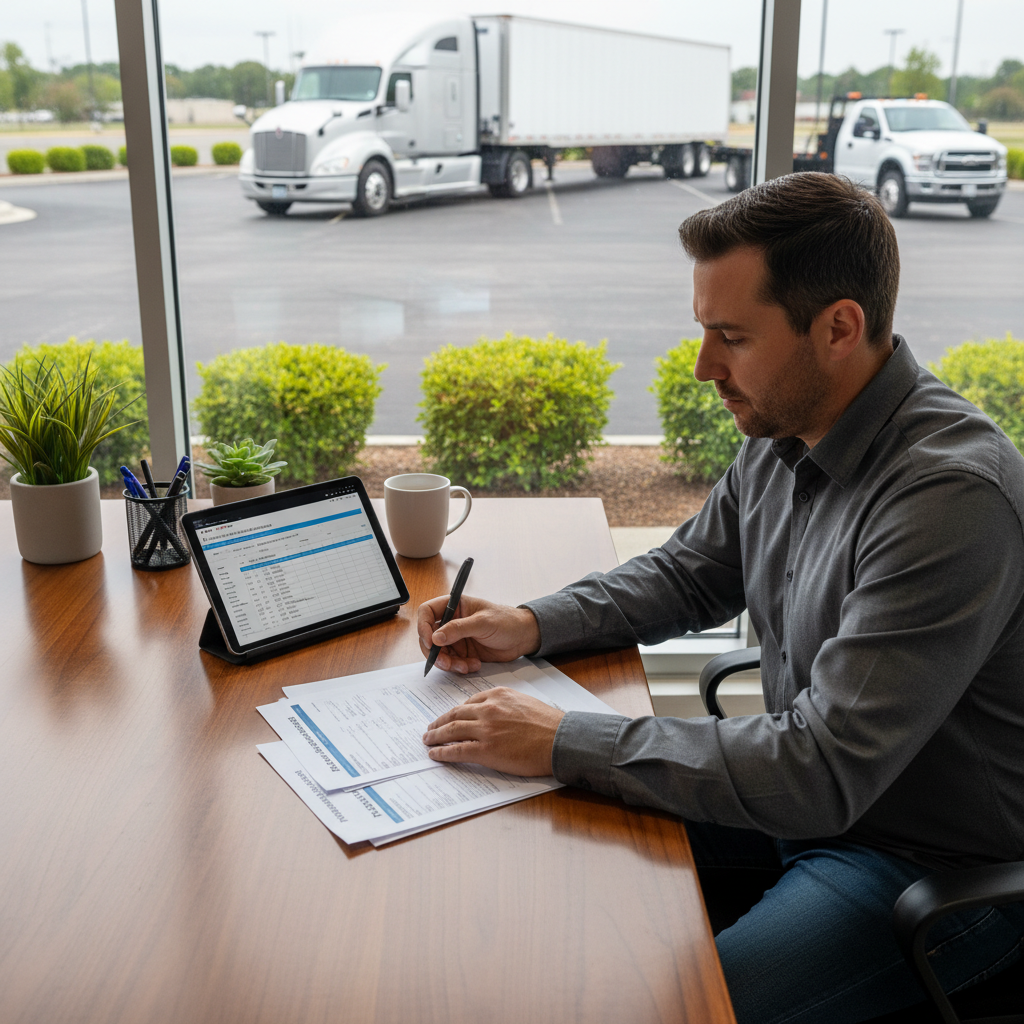
If you’re shopping coverage, be ready to give the exact named insured, the VIN, the truck value, the business type, and the driver list. If you’re leased on, say that. If you’re running under your own authority, say that too.
Louisville garaging versus where you run#
Garaging means where the truck is principally kept when it’s not working. That matters, but it doesn’t answer everything.
A truck garaged in Louisville might do short Kentucky-only runs, regional freight through Indiana and Ohio, or longer interstate lanes. Those are different risk profiles, and they can affect both underwriting and filings.
Authority, cargo, and operating radius#
Operating radius means the normal distance your truck runs from its base area. A wider radius, different commodity, or a switch from local to interstate freight can change what insurers are willing to quote and how they price it.
Be straight about brokered loads, trailer use, and any plan to add interstate work soon. It’s better to describe tomorrow’s operation now than discover after a claim that the policy was built for a different business.

Separate Commercial Truck Insurance From Personal Auto Coverage#
Personal auto coverage is not a substitute for commercial trucking insurance when you’re using a truck in a for-hire business. Owner-operators in Louisville often get tripped up by this, especially when they compare personal car limits, Kentucky minimums, and motor-carrier requirements as if they’re the same thing.
A personal auto policy is insurance designed for private driving, not a trucking business hauling freight for money. Commercial auto liability is coverage for bodily injury and property damage you cause to others in covered business vehicle operations, subject to the policy’s terms, exclusions, and limits.
Why a personal auto policy is not a substitute#
If the truck is being used in a commercial operation, the policy needs to reflect that operation. Personal auto thinking doesn’t fit a tractor under dispatch, a power unit leased to a motor carrier, or a truck hauling freight under contract.
That’s where people get burned. They assume “insured is insured,” but business use, named insured details, and vehicle type all matter.
Commercial auto liability and business use#
Kentucky state minimum ideas, broker contract requirements, and FMCSA financial responsibility rules are separate issues. One doesn’t automatically satisfy the others.
For example, a shipper or broker may require a higher limit than the legal minimum that applies to your operation. And federal rules may apply differently depending on whether you’re for-hire, interstate, over the weight threshold, or hauling a regulated commodity.
Owner-operator coverage gaps to avoid#
Check the named insured first. Then confirm the vehicle schedule, business use, listed drivers, and operating description all match the work you actually do.
That sounds basic, but a lot of quote confusion starts right there. The policy has to match the operation being insured, not the operation you used to run or hope to run later.
Know Whether Kentucky or FMCSA Rules Apply to Your Operation#
The rules for Louisville truck insurance depend on the operation, not just the Louisville location. If you stay intrastate in Kentucky, your requirements may look different from a for-hire interstate carrier running under federal authority, and the difference matters before you compare limits or filings.
Interstate commerce means transportation that crosses state lines or is part of a continuous movement between states. Financial responsibility means the liability coverage or other approved security required for a motor carrier operation under applicable law.
Kentucky-only operations#
If you operate only within Kentucky, start with the Kentucky Transportation Cabinet and confirm what intrastate registration and insurance rules apply to your specific business. Kentucky-only local work isn’t automatically governed the same way as interstate for-hire authority.
That includes checking whether your work is private carriage or for-hire carriage, what you haul, and whether any state-level filings or registrations apply. Louisville-based doesn’t always mean “simple.”
Interstate for-hire operations#
If you cross state lines, or haul freight that is part of an interstate movement, federal motor-carrier rules can come into play. That’s why a run that looks “local enough” on the map can still involve interstate considerations.
Under 49 CFR Part 387, for-hire interstate carriers hauling general freight in vehicles over 10,001 lbs must carry at least $750,000 in public liability. That is not a universal rule for all truckers. Requirements vary by carrier type, vehicle weight, cargo, and whether you operate interstate or intrastate. Auto haulers and certain hazmat operations can face different minimums under the same federal framework.
Federal financial responsibility and insurance filings#
The MCS-90 is an endorsement tied to certain federally regulated motor carrier financial responsibility obligations. It is not just “extra insurance,” and it doesn’t replace the need to match your policy to your actual operation.
FMCSA explains insurance filing requirements and the role of Form MCS-90 at FMCSA. If you’re operating interstate for-hire, confirm what filings actually apply instead of assuming your state-level setup covers it.
How to verify authority and operating status#
A good first step is checking your public profile in SAFER. SAFER is FMCSA’s public Company Snapshot system that shows basic carrier, USDOT, and operating-authority information.
Use it to review how your operation appears publicly, but don’t treat it as legal advice. The practical takeaway is simple: don’t assume one universal liability number fits every Louisville truck insurance setup. Verify your authority, commodity, and operating profile first.
Build Coverage Around Your Contract, Freight, and Equipment#
The right Louisville truck insurance package usually includes more than one coverage, because one policy part rarely handles every risk an owner-operator faces. Start with liability, then add cargo, truck damage, trailer responsibility, and any contract-driven coverages that fit your actual operation.
Commercial auto liability#
Commercial auto liability is the core coverage for third-party bodily injury and property damage arising from covered trucking operations. It’s the part most people mean when they say “truck insurance,” but it doesn’t cover every problem.
If your broker packet, authority status, or shipper contract requires certificates or filings, the liability setup has to align with those demands.
Motor truck cargo#
Motor truck cargo insurance covers covered freight being hauled, subject to the policy’s conditions, exclusions, valuation method, deductible, and limit. Cargo isn’t one-size-fits-all.
Freight type matters. So does how the cargo is valued after a loss, what exclusions apply, and whether the limit is enough for the loads you actually pull.
General liability for for-hire operations#
General liability covers certain non-driving business liability exposures, not auto accidents from operating the truck. Some contracts ask for it even though it’s separate from commercial auto liability.
That can matter for loading-related allegations, premises exposure, or other business activities outside the truck’s driving liability section. If a contract asks for it, compare the exact requirement instead of assuming your auto policy handles it.
Physical damage and collision choices#
Physical damage is coverage for your insured truck or scheduled equipment for covered causes of loss. It commonly includes collision and comprehensive, or fire and theft with combined additional coverage depending on the policy structure.
A deductible is the amount you pay out of pocket before the insurer pays the covered remainder of a loss. Pick that number based on cash flow, not just quote appeal.
Non-trucking liability and bobtail situations#
Non-trucking liability is coverage intended for certain non-business use of a tractor when it is not under dispatch or being used in business. It is not a replacement for primary commercial auto liability while hauling, deadheading for business, or otherwise working.
That distinction gets misstated all the time. If you’re unsure whether your use counts as business or non-business, get that clarified before you rely on the coverage.
Trailer interchange, non-owned trailer damage, and reefer breakdown#
Trailer interchange applies when you have a written interchange agreement and responsibility for a trailer you don’t own. Non-owned trailer physical damage addresses certain trailer damage situations when you use a trailer you don’t own, often without the same interchange agreement structure.
Most non-intermodal owner-operators should be clear on which setup they actually need before they compare quotes. Reefer breakdown covers certain loss scenarios tied to refrigeration unit breakdown when temperature-controlled freight is part of the operation.
A cheap-looking quote can turn expensive fast if one of these pieces is missing and you only find out after a trailer or cargo loss. If your current setup isn’t clear, use your authority status, contracts, cargo, lanes, equipment values, and declarations page to ask for a real coverage review instead of a generic price.
Understand What Can Affect Louisville Truck Insurance Costs#
Louisville truck insurance pricing is individually underwritten, so there is no single local average that tells you what your policy should cost. Your actual premium depends on your operation, cargo, radius, driving history, garaging, equipment, requested limits, and other factors.
Garaging location and local exposure#
The primary garaging location is one rating input, not the whole story. Louisville exposure can look different from a rural Kentucky base, but underwriters also care about theft exposure, traffic density, parking setup, and claims patterns.
Interstate lanes, radius, and freight type#
The lanes you run matter because distance, states traveled, and commodity type affect risk. A Kentucky-only local operation can underwrite differently from regular interstate freight through multiple states.
Truck value, deductibles, and prior losses#
Higher truck values can mean higher physical damage exposure. A higher deductible may lower premium, but it also means you retain more of a covered loss yourself.
That’s why deductible selection should be a cash-flow decision, not just a shopping trick. Prior losses also matter, especially if the operation has recent claims or gaps in coverage.
Driver experience and safety records#
Driver history, years in business, MVR issues, and safety profile all affect how a risk is viewed. New authority, new ventures, or inexperienced drivers can limit options even when everything else looks good.
Practical ways to reduce avoidable quote friction#
Keep current loss runs ready. Update truck values before renewal. Make sure driver lists, VINs, trailer details, and operating descriptions are accurate.
If your operation changes, report it before renewal instead of after a claim. Cost control usually comes from presenting clean, accurate information and comparing equivalent terms, not chasing a universally lowest price.
Compare Truck Insurance Quotes Without Missing Coverage Gaps#
The best way to compare Louisville truck insurance quotes is to make every insurer quote the same operation. If one submission says Kentucky-only dry van and another says regional interstate mixed freight, the prices are not truly comparable, even if both look like quotes for the same truck.
Compare the same operation on every application#
Use the same garaging address, authority status, driver list, commodities, operating radius, and equipment details on every application. If one quote uses a different story, you aren’t comparing insurance so much as comparing different risks.
Match limits, deductibles, and endorsements#
An endorsement is a policy amendment that changes coverage terms, conditions, or obligations. Compare liability limits, physical damage deductibles, required filings, and endorsements line by line.
If one proposal includes what your contract requires and another doesn’t, the lower number isn’t automatically the better value.
Review cargo terms and equipment schedules#
Compare cargo limits, cargo deductibles, covered commodity assumptions, valuation language, and exclusions. Then review the equipment schedule to make sure the right truck, trailer, and stated values are listed.
A lower-priced quote may simply leave out requested cargo, use a different deductible, or describe the operation more narrowly than you actually run.
Confirm claims contacts and documents before a loss#
Store the policy number, insurer claims reporting instructions, broker contact, current certificates, and equipment schedule where you can reach them fast. Keep truck and trailer photos, your bill of lading process, and an accident kit organized before something goes wrong.
Also ask what must be reported promptly after an accident, theft, cargo loss, or refrigeration event, and what documents the insurer may need. Claims readiness is part of buying coverage, not something to figure out on the shoulder after a bad day.
Choose a Louisville Truck Insurance Setup You Can Verify#
A solid Louisville truck insurance decision follows a simple order: define the operation, confirm whether Kentucky or FMCSA rules apply, match coverages to contracts and freight, compare equivalent proposals, and save your claims contacts and documents where you can reach them.
Before you buy, check that the named insured, truck schedule, drivers, cargo, radius, and authority status all match real life. Then think ahead.
If you add a driver, buy another truck, add a trailer, change cargo, expand your radius, get your own authority, or start interstate work, tell your insurance contact before the change becomes a claim problem. That’s the difference between having a policy and having a setup you can actually rely on.
FAQ#
Who is the cheapest truck insurance?
No insurer is universally the cheapest for every owner-operator or small fleet. Commercial truck insurance is priced around the details of the risk, including your Louisville garaging location, authority status, truck type, cargo, operating radius, interstate exposure, driver records, loss history, requested limits, and deductible choices.
The better question is whether two quotes insure the same operation on the same terms. A lower price is not really lower if it leaves out cargo, uses different deductibles, narrows the operating description, or misses a required filing. Compare equivalent proposals, not just carrier names.
Who has the cheapest car insurance in Louisville, Kentucky?
That question usually belongs to personal auto shopping, not commercial trucking insurance. If you’re using a truck for for-hire work, running under authority, or operating as an owner-operator, personal car insurance comparisons don’t tell you what commercial trucking coverage you need.
A personal auto policy is built for private driving, while trucking policies are built around business use, vehicle type, cargo, radius, and regulatory requirements. If the vehicle is part of a trucking business, shop commercial coverage that matches the real operation rather than relying on personal-auto pricing lists.
How much is a $1,000,000 liability insurance policy?
A $1,000,000 liability limit does not have one standard price. The premium varies depending on the operation, including whether you’re interstate or intrastate, for-hire or private, what vehicle you insure, where it’s garaged, what cargo you haul, and the experience and records of the drivers.
Other coverages also affect the total package. Physical damage, cargo, general liability, trailer-related coverage, and deductible selections all change the final cost. The only useful comparison is among quotes built on the same operating facts and the same coverage terms.
How much should I pay for truck insurance?
You should judge truck insurance by whether it gives your operation the coverage, limits, deductibles, cargo terms, and filings it actually needs. There is no one “correct” number because the right premium depends on the risk profile and the policy structure, not just the city you’re based in.
For a Louisville owner-operator, the smarter approach is to compare equivalent proposals and ask what each one includes or leaves out. A quote only makes sense if it matches your authority, lanes, freight, equipment, and contract obligations. Paying less for the wrong coverage can cost far more after a loss.