
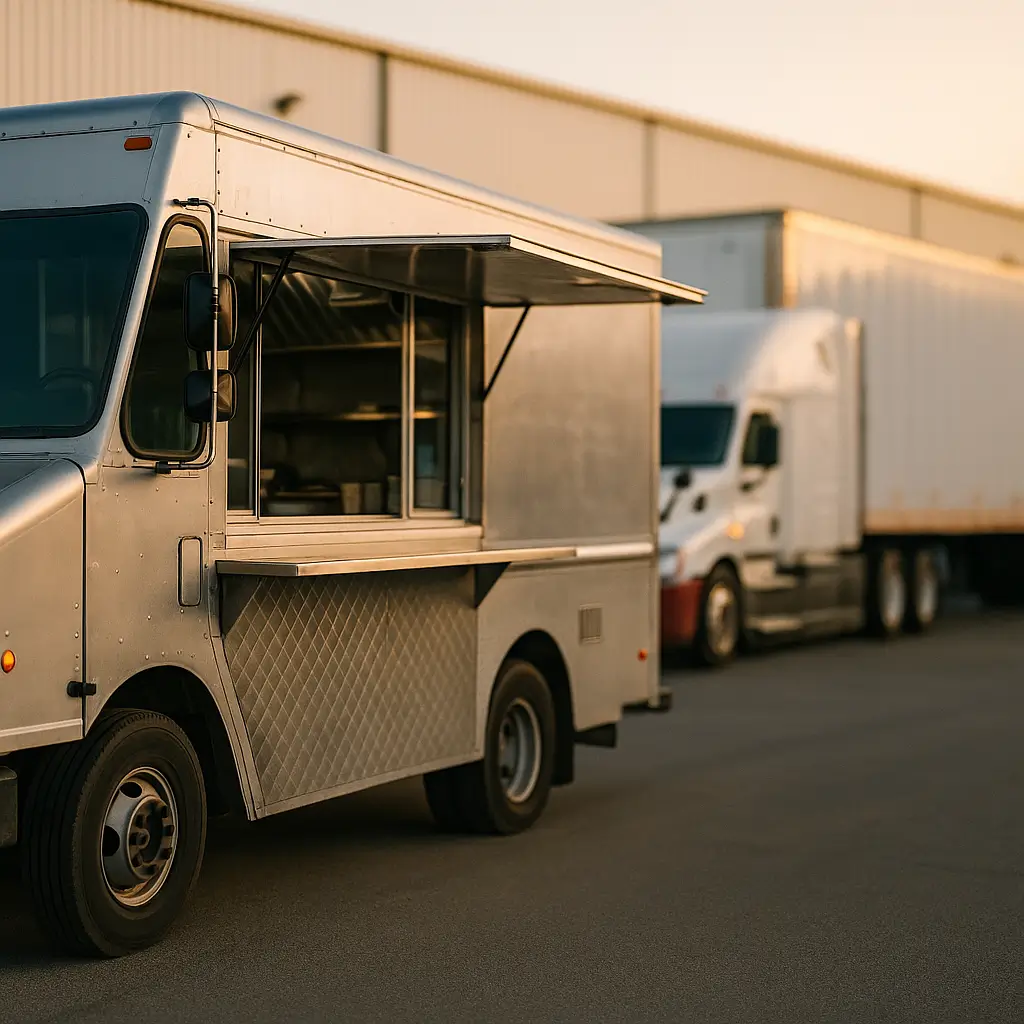

Learn 7 key mobile food van insurance coverages, 2026 costs from $100–$400/month, permit-ready COI requirements, and tips for comparing quotes.
Mobile food van insurance in 2026 typically costs $100–$400 per month for most operators, depending on whether you buy a basic package (commercial auto + general liability) or add equipment/property, spoilage, and workers’ comp for staff. If you want a fast, practical answer: you need coverage for the driving side, the customer side, and the kitchen-on-wheels side.
This guide gives you a permit/event-ready checklist, the cost levers that actually move your premium, and a clean way to compare quotes—so you’re not scrambling when a venue asks for a COI by Friday. For the bigger picture on how policies fit together, start with small business insurance fundamentals.
Table of Contents
Reading time: 8 minutes
- Key Takeaways (read this in 30 seconds)
- What Is Mobile Food Van Insurance (and Who Needs It)?
- The 7 Coverages Most Mobile Food Vans Need
- Permits, Venues, and Events: COI Requirements You’ll Actually See
- Mobile Food Van Insurance Cost in 2026: Real Ranges + a Simple Calculator
- Frequently Asked Questions
- Conclusion: A Permit-Ready Plan You Can Reuse

Key Takeaways (read this in 30 seconds)
Most mobile food vans need commercial auto plus general liability with common venue limits of $1M per occurrence / $2M aggregate, and many operators pay about $100–$400/month in 2026 depending on add-ons like equipment, spoilage, and workers’ comp.
- Baseline package: Commercial auto + general liability (often with product liability) is the starting point for most mobile food vans.
- Permits and venues set the real rules: Many organizers require $1M / $2M liability and specific COI wording (additional insured, primary/non-contributory, waiver of subrogation).
- Most expensive surprises: financed/newer vans (comp/collision), employees (workers’ comp), high-value equipment, refrigeration/spoilage exposure, and frequent events.
- Best way to save money: Buy only the limits you need, but structure the policy so you can issue COIs fast without last-minute endorsement chaos.
Use the COI checklist section below as your permit-and-event template.
What Is Mobile Food Van Insurance (and Who Needs It)?
Mobile food van insurance is a bundle of business policies that covers three core exposures—driving, serving the public, and protecting onboard equipment and inventory—so one claim doesn’t wipe out weeks of profit.
It’s built for a rolling kitchen: driving to events, parking to serve crowds, handling hot food/liquids, operating propane/electric equipment, storing inventory, and (often) employing staff.
It overlaps with what many people call “food truck insurance,” but underwriting can change based on vehicle type (cargo van, step van, trailer), cooking setup, and where you operate. If customers keep using the wrong term, it helps to understand the umbrella category—food truck insurance—so you and your agent are speaking the same language.
Mobile food van vs. food truck vs. catering van (plain English)
- Food truck: Purpose-built truck body, heavier equipment, often higher property values and higher fire exposure.
- Mobile food van: Commonly a cargo/step van conversion—still a kitchen risk, but vehicle class and build quality vary widely.
- Catering van: Prep may happen offsite; product liability and temperature control become the big story.
Who usually needs this coverage
- Solo operators: Pop-ups, breweries, markets, lunch routes.
- Event-based vendors: Organizers require COIs and endorsements to vend.
- Catering contracts: Venues demand higher limits and contract wording.
- Operators with employees: Even part-time staff handling prep, serving, or driving can trigger workers’ comp requirements.
The 7 Coverages Most Mobile Food Vans Need (Driving Side, Customer Side, and “Kitchen on Wheels” Side)
The seven most common coverages for mobile food vans are commercial auto, hired & non-owned auto, general liability/product liability, business property/contents, equipment breakdown, spoilage, and workers’ compensation.
Think of this like a “commercial truck insurance” mindset: you’re protecting the business from one bad day—not just checking a box.
Coverage #1: Commercial auto insurance (commercial truck insurance rules, not personal auto)
Commercial auto insurance covers business-use vehicle liability and can add comprehensive/collision for physical damage, which lenders commonly require on financed vans.
- What it is: A policy built for vehicles used in business—liability plus physical damage (comp/collision) if you choose/need it.
- Why it’s essential: If you’re driving to sell food, transport gear, or run deliveries, personal auto can be a bad bet.
- Helpful reference: NAIC consumer overview of auto insurance types and exclusions: https://content.naic.org/consumer/auto-insurance
- Pro tip: If your van is financed, expect the lender to require comp/collision.
For a deeper breakdown of options and limits, review commercial auto insurance explained.
Coverage #2: Hired & non-owned auto (HNOA)
Hired and non-owned auto (HNOA) helps protect the business if you rent/borrow vehicles or if employees use personal cars for business errands and your business gets pulled into a lawsuit.
- What it is: Protection for the business when the vehicle isn’t titled to the business.
- Why it matters: Even if the driver has their own insurance, your business can still be named after an accident.
- Who needs it: Anyone with helpers running errands, deliveries, or supply runs.
Coverage #3: General liability (GL) + product liability (the customer side)
General liability covers third-party bodily injury and property damage, and product liability addresses allegations tied to the food you sell, such as illness claims.
- What it is: “Slip-and-fall” plus damage you cause to someone else’s property; product liability is often included but should be confirmed.
- Why it’s essential: You’re operating around crowds, hot surfaces, and venues that want clean risk transfer.
- Who needs it: Anyone serving the public—especially at events.
If you want a quick explanation of how this differs from the liability that covers the vehicle itself, this LogRock video breaks it down:
Coverage #4: Business property/contents (equipment + inventory)
Business property/contents coverage insures items like POS systems, refrigerators, generators, smallwares, and sometimes inventory, depending on how the policy is written for mobile operations.
- Why it’s essential: A break-in, theft, or vandalism can shut down revenue instantly.
- Who needs it: Any operator with meaningful equipment value (even “just” $10k–$40k adds up fast).
Coverage #5: Equipment breakdown (especially for generator/refrigeration)
Equipment breakdown coverage helps pay for repair/replacement when equipment fails due to mechanical or electrical breakdown rather than fire, theft, or collision.
- Why it’s essential: A dead fridge/freezer in peak season isn’t a nuisance—it’s a shutdown.
- Who needs it: Anyone relying on refrigeration, generators, or onboard electrical systems.
Coverage #6: Spoilage / refrigerated property
Spoilage coverage can pay for food lost due to temperature excursions tied to covered causes, but triggers and exclusions vary by carrier and must be confirmed in writing.
- Why it’s essential: Spoilage is pure cash burn—product cost plus lost sales.
- Who needs it: Anyone with refrigerated/frozen inventory (and any menu that can’t “pivot” if the fridge dies).
Coverage #7: Workers’ compensation (and what to do if it’s “just you”)
Workers’ compensation pays medical costs and wage replacement for job-related injuries for employees, and many states require it once you have employees—even part-time in some cases.
- Why it’s essential: Injuries happen in food service and mobile operations; BLS injury and illness data provides context on workplace risk: https://www.bls.gov/iif/
- Who needs it: If you have employees, many states require it (see the SBA’s business insurance guide); even when not required, venues/contracts may still demand proof.
If you’re hiring even one part-time worker, get your baseline knowledge here: workers’ compensation insurance overview.
Trailer/tow exposure (important if you tow)
Towing a smoker trailer or freezer trailer increases severity and changes how liability and physical damage apply, so you should confirm whether the trailer is scheduled and covered while attached and while parked.
- Confirm the trailer is scheduled: If it’s not listed correctly, physical damage can be a surprise gap.
- Confirm liability follows correctly: Ask how coverage applies while attached and while parked at an event.
- Confirm your usage and radius: Frequent road exposure and longer radius can change underwriting.
Permits, Venues, and Events: COI Requirements You’ll Actually See
A certificate of insurance (COI) is proof of coverage dates and limits, and many venues require endorsements like additional insured and primary/non-contributory that must be added to the policy to satisfy the contract.
If you’ve ever been told “You’re approved once we get your COI,” you already know: the paperwork is the gate. A COI is a summary document that proves your limits and dates, but it does not change coverage by itself.
Use this reference when you’re requesting proof: certificate of insurance (COI) requirements.
Common venue/event requirements (realistic examples)
- General liability limits: Often $1M per occurrence / $2M aggregate (varies by organizer).
- Additional insured: The venue/city/event is named for that event (endorsement required).
- Primary & non-contributory: Your policy pays first (endorsement required in many cases).
- Waiver of subrogation: You agree not to pursue the venue after a loss (endorsement required).
How to check requirements fast (3-step process)
- Ask for the organizer’s insurance requirements page or COI template (don’t guess).
- Match your quote to that template (limits + endorsements + wording).
- Have your agent issue the COI and endorsements before you pay vendor fees.
To see how COIs are issued and sent in practice, watch this LogRock walkthrough:
Auto minimums and proof rules vary by state
State auto insurance minimums and proof rules are set by state agencies, so you should verify your state’s official requirements before you assume your policy meets a permit or registration rule.
Example (Florida—use this as a model for where to look, not as a national rule): https://www.flhsmv.gov/insurance/
Edge case (rare): when FMCSA filings could apply
FMCSA insurance filings can apply if you operate as an interstate for-hire motor carrier in a way that triggers federal registration and filing requirements.
Most mobile food vans are local retail operations, but if your business crosses into motor-carrier territory, verify with a qualified agent and review FMCSA’s filing overview: https://www.fmcsa.dot.gov/registration/insurance-filing-requirements
Mobile Food Van Insurance Cost in 2026: Real Ranges + a Simple Calculator
Mobile food van insurance commonly lands around $100–$400 per month in 2026, with pricing driven by van value (comp/collision), claims history, employees/payroll, cooking setup, and how often you need venue-specific COIs and endorsements.
There’s no single “correct” number because your setup matters, but you can still ballpark it with a clean model. For a scenario approach you can use when you request quotes, see business insurance cost calculator (small business).
Typical monthly ranges (what $100–$400/mo usually means)
- Lower end (~$100–$200/mo): Smaller/local operation, basic commercial auto + basic GL, clean loss history.
- Mid range (~$200–$300/mo): Financed van (comp/collision) + higher venue limits, meaningful equipment value.
- Upper end (~$300–$400+/mo): Employees (workers’ comp), frequent events, higher limits/endorsements, refrigeration/spoilage exposure, prior claims, higher-risk cooking setup.
Mini calculator (use these as quote “packages”)
| Scenario | Who it fits | Policies included | Rough monthly range |
|---|---|---|---|
| A: Solo + local route | 1 operator, limited events | Commercial auto + GL/product | $100–$220 |
| B: Financed van + real equipment | Newer van + $10k–$40k gear | Auto (comp/collision) + GL + property/contents | $180–$320 |
| C: Events + staff | Part-time helpers/servers | B package + workers’ comp + (maybe) HNOA | $250–$450+ |
| D: Refrigeration-heavy menu | Frozen/refrigerated inventory | B/C package + spoilage + equipment breakdown | $275–$500+ |
These are market-style ranges, not a quote; venue limits, state rules, and loss history can move pricing quickly.
What drives price the most (the levers that actually move premiums)
- Vehicle value + physical damage: Comprehensive/collision on a newer or financed van can be a major driver.
- Driving record + claims history: Business and personal MVRs can matter depending on carrier.
- Revenue, payroll, and headcount: Workers’ comp impact is real once you hire.
- Cooking setup: Propane, fryer, hood/suppression, generator, and electrical work affect fire exposure.
- Where you operate/store: Theft and vandalism risk changes by area and overnight storage setup.
- Limits and endorsement frequency: Events that require custom COIs every weekend add friction.
Keeping it affordable (without creating coverage gaps)
Affordable pricing usually comes from reducing predictable risk—maintenance, driver controls, and clean underwriting details—rather than simply cutting limits below what venues require.
- Documented maintenance: Generator, suppression system, electrical checks.
- Driver controls: Who drives, when, and with what record.
- Deductibles: Raise deductibles only if you have cash reserves to absorb losses.
- No coverage lapses: Carriers penalize gaps and last-minute placements.
- Renew early: Start shopping 30–45 days ahead to avoid “take it or leave it” pricing.
Shopping checklist (so you can compare apples-to-apples)
Quote accuracy improves when every agent receives the same vehicle, operations, and contract details, including VIN, equipment list, payroll, and your standard venue COI requirements.
- Van VIN, year, value, and whether it’s financed/leased
- Cooking equipment list (propane, fryer, hood, suppression)
- Revenue estimate + event frequency + operating radius
- Equipment value + refrigeration details (spoilage exposure)
- Payroll + headcount (even part-time)
- Your most common venue requirement (limits + endorsements)
Deal-breaker questions to ask:
- “Are my cooking operations allowed under this policy?”
- “Is property coverage written for mobile/off-premises exposure?”
- “Can you issue additional insured + primary/non-contributory endorsements quickly?”
- “Are spoilage triggers and exclusions clear in writing?”
Frequently Asked Questions
Most operators pay about $100–$400 per month for mobile food van insurance in 2026, depending on the coverages and limits you need. The low end is typically a baseline of commercial auto plus general liability (often including product liability). The high end usually adds comprehensive/collision on a financed van, property/contents for equipment, equipment breakdown, spoilage for refrigerated inventory, and workers’ compensation for employees. Your biggest price drivers are van value, driving/claims history, payroll/headcount, cooking setup (propane/fryer/hood), and venue-required endorsements on your COI.
A mobile food van typically needs commercial auto and general liability (often including product liability) as the minimum baseline to drive and serve the public. Many operators also add property/contents for equipment, equipment breakdown for generators/refrigeration, spoilage coverage for refrigerated inventory, workers’ compensation if they hire staff, and hired/non-owned auto if helpers use personal or rented vehicles for business errands. If you vend at events, you should also plan for COI endorsements like additional insured and primary/non-contributory to satisfy contracts.
Using personal auto insurance for a food van is usually risky because many personal policies restrict or exclude commercial use, and a claim can be denied or limited if the van is being used for business operations. Commercial auto is designed for business use, and it can also be structured to match how you operate (radius, drivers, deliveries, event travel). For a plain-language overview of why classification matters and how exclusions work, the NAIC provides a consumer reference here: https://content.naic.org/consumer/auto-insurance.
Liability requirements vary by city, state, and contract, but many venues and events commonly require $1M per occurrence and $2M aggregate for general liability. Organizers also frequently require endorsements shown on the COI, including additional insured, primary/non-contributory, and sometimes waiver of subrogation. The fastest way to avoid rework is to request the organizer’s written insurance requirements or COI template and match your policy limits and endorsements to that document before you pay vendor fees. For a practical walkthrough, see certificate of insurance (COI) requirements.
Not automatically. Spoilage coverage is usually an add-on, and it pays only for the causes the policy lists, such as a covered equipment breakdown or power failure. Many policies also set a dollar limit and exclude spoilage from simple neglect or a door left open. Before you buy, ask for the spoilage triggers, limit, and exclusions in writing, and pair spoilage with equipment breakdown if refrigeration is central to your menu.
Often yes, but the rule depends on your state. Some states require workers’ compensation as soon as you have one employee, including part-time or seasonal help, while others set a headcount threshold or treat certain workers differently. Because misclassifying a worker can be expensive after an injury, confirm the rule with your state workers’ compensation agency or your agent, and note that many venues ask for proof even when the law does not.
A COI is a summary document that shows your coverages, limits, and policy dates. An endorsement is a change to the policy itself, such as adding a venue as an additional insured or making your coverage primary and non-contributory. A COI that lists those terms is only reliable if the endorsement is actually on the policy, so ask your agent to add the endorsements first, then issue the COI.
Not always. A smoker or freezer trailer may need to be listed on the policy to have physical damage coverage, and liability can work differently while the trailer is attached versus parked at an event. Tell your agent about every trailer, its value, and how far you tow it, and ask for written confirmation of how coverage applies in each situation.
Conclusion: A Permit-Ready Plan You Can Reuse
The “right” mobile food van insurance is the policy that survives a real claim and passes venue paperwork, which usually means commercial auto + GL as a baseline plus the specific add-ons your equipment, refrigeration, and staffing require.
If you remember one thing: structure coverage around how you actually operate—driving, serving crowds, and protecting the equipment that produces revenue—then make COIs and endorsements easy to issue.
Key Takeaways:
- Start with the baseline: Commercial auto + general liability/product liability, then add equipment/property and spoilage based on your setup.
- Build around contracts: Many events want $1M/$2M and endorsement wording; don’t wait until the week of the event.
- Quote smarter: Send the same VIN, equipment list, payroll, and venue COI template to every agent for apples-to-apples comparisons.
Related reading to tighten your coverage fast: general liability insurance guide and business owners policy (BOP) basics.
If you’re trying to get a mobile food van on the road with the right coverage and a COI that venues will accept, LogRock can help you review your operation, coverage needs, and available options. Talk to our team to ask questions, identify possible gaps, and request a quote based on your business.





