
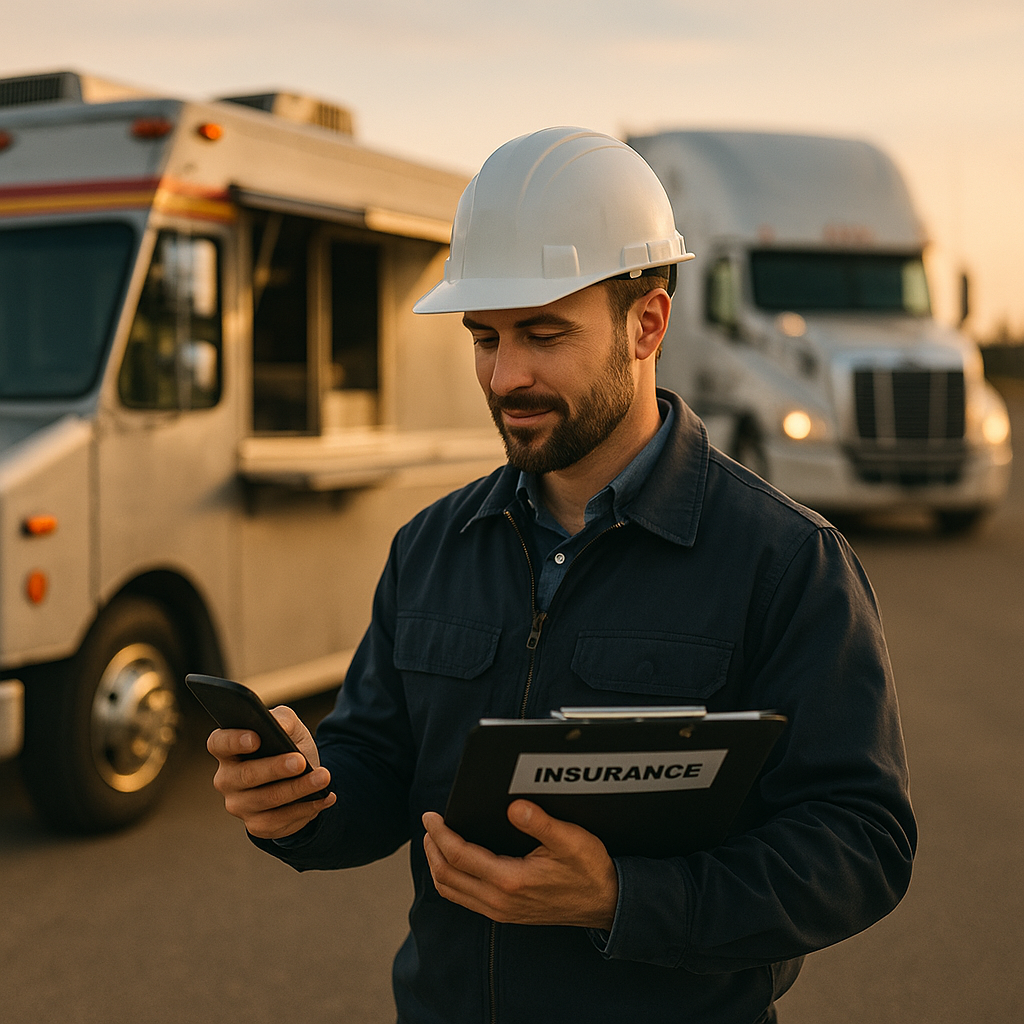

Mobile vendor insurance: 5 key coverages, 2026 cost ranges, COI checklist, and when commercial truck insurance applies. Get covered fast.
Mobile vendor insurance is typically a general liability policy (often with $1,000,000 per occurrence limits) plus add-ons like equipment and commercial auto, sized to your booth, pop-up, or vehicle setup. If you sell at markets or events, the fastest “featured snippet” answer is this: venues usually want a COI that shows general liability limits and lists them as Additional Insured—and they can turn you away if the wording doesn’t match.
Running a booth, pop-up, or truck is already a juggling act: inventory, payment apps, permits, weather, and making enough margin to justify the day. One small incident—someone trips on your extension cord, a candle scent triggers a reaction, or a venue says “no COI, no setup”—can wipe out a week (or a season) of profit. If you want a quick foundation on how liability, property, auto, and workers’ comp fit together, start with small business insurance basics for vendors (verify URL before publish).
Table of Contents
Reading time: 8 minutes
- Key Takeaways
- What Is Mobile Vendor Insurance (and Who Needs It)?
- What Mobile Vendor Insurance Covers: The Core 5 (Vendor Liability Insurance)
- Add-Ons That Actually Matter (Equipment, Cyber, and Affordable Trucking Insurance Choices)
- Mobile Vendor Insurance Cost in 2026: Per-Event vs Annual + Regional Ranges
- COI + Additional Insured + Venue Requirements (State & Local Reality)
- Frequently Asked Questions
- Conclusion: Get the Right Coverage (and the COI Your Venue Will Accept)

Key Takeaways
Most U.S. markets and venues ask mobile vendors for a COI showing $1,000,000 per occurrence / $2,000,000 aggregate general liability limits before setup, even when state law doesn’t explicitly require it.
- Most “mobile vendor insurance” starts with general liability, then you add coverage based on what you sell, where you set up, and whether you have a vehicle, staff, or expensive gear.
- Per-event coverage is great for 1–3 events/year; annual policies usually win if you vend monthly/weekly or you’re constantly issuing COIs.
- Your real “requirements” are usually venue-driven (COI + Additional Insured wording + limits), not something you discover in a state statute.
- If you operate a food truck, trailer, or mobile service vehicle, vendor liability won’t cover road risk—this is where commercial auto and sometimes “trucking insurance” categories come in.
Image idea: Mobile vendor setting up a booth at an outdoor market with signage and equipment.
What Is Mobile Vendor Insurance (and Who Needs It)?
Mobile vendor insurance is a bundle of business coverages—usually centered on general liability—built for vendors who change locations and need to show proof like a COI with venue-required limits (commonly $1M/$2M).
Mobile vendor insurance is designed for vendors who move locations: farmers markets, fairs, street vending, pop-ups, private events, corporate campuses, and brand activations. In plain terms, it’s how you protect your cash flow when you’re operating in public spaces and on someone else’s property.
Mobile vendor vs. event vendor vs. pop-up: what counts?
These labels overlap, but they usually point to the same reality: you’re operating temporarily in a place you don’t own and the venue wants you insured.
- Mobile vendor: You change locations and set up temporarily (tent/table/cart/trailer/truck).
- Event vendor insurance: Short-term coverage for a specific date/place.
- Pop-up retail: Often the same liability requirements as a booth vendor, especially in malls and shared retail spaces.
Why it’s essential: Your risk isn’t just your product—it’s the foot traffic, cords, signage, samples, heat sources, and crowded setups that create injury and damage claims.
Who needs it: Food trucks, coffee carts, snack stands, craft vendors (candles/soaps/jewelry/apparel), mobile services (grooming/repair/fitness/beauty), and merch/brand activation teams.
Pro tip: Before you pay booth fees, email the organizer and ask for requirements in writing (limits + Additional Insured wording + deadline). That one message prevents the last-minute scramble.
Do mobile vendors need insurance?
Mobile vendors often need insurance because venue contracts and permits commonly require a COI before setup, even when there’s no statewide “vendor insurance law” for your business type.
If you vend at organized markets or events, assume you’ll be asked for a COI at some point—especially if you’re indoors, cooking, using electricity, or working on city/county property.
What Mobile Vendor Insurance Covers: The Core 5 (Vendor Liability Insurance)
Most “vendor liability insurance” packages are built around general liability and commonly include (or bundle) five core protections: GL, products/completed ops, damage to rented premises, medical payments, and personal/advertising injury.
For a high-level consumer reference on what business liability is meant to cover (third-party injury and property damage), the NAIC overview is a helpful starting point: https://content.naic.org/consumer/business-insurance.
Image idea: Simple chart showing: GL, Products, Rented Premises Damage, Medical Payments, Advertising Injury.
1) General liability (GL)
General liability covers third-party bodily injury and property damage claims (and typically legal defense) arising from your operations.
This is what most venues mean when they say “vendor liability insurance,” and it’s the backbone of your COI. For a deeper breakdown, see general liability insurance explained (verify URL before publish).
- Who needs it: Almost every mobile vendor, including “low-risk” craft vendors.
- Watch-out: GL usually does not cover your own gear, your own injuries, or auto accidents.
2) Products & completed operations
Products and completed operations coverage addresses claims tied to something you sold after it leaves your booth, like an alleged allergic reaction, contamination allegation, or defective product claim.
Who needs it: Food, beverage, cosmetics/soaps, supplements, kids’ products, and many handmade goods sellers.
Pro tip: Be accurate about what you sell (ingredients, labeling, manufacturing method). Misclassification is a common reason claims get disputed.
3) Damage to rented premises
Damage to rented premises helps cover accidental damage you cause to a space you’re renting or using temporarily, and many venues look for this specifically on the certificate.
Who needs it: Indoor markets, malls, shared kitchens, event halls, and any vendor using heat sources or heavy equipment.
Pro tip: If you use propane, fryers, open flame, or heat guns, expect stricter requirements and higher limits.
4) Medical payments
Medical payments is limited “no-fault” coverage for minor injuries to a third party, and the exact amount and triggers vary by policy.
It can help resolve small incidents quickly without turning every scrape into a lawsuit. Even if you’re “not at fault,” you don’t want a $300 incident turning into a $30,000 legal problem.
5) Personal & advertising injury
Personal and advertising injury can cover certain claims like libel/slander and some advertising-related issues, depending on the policy form.
Who needs it: Vendors doing active marketing, brand activations, and collaborations.
Pro tip: Keep marketing clean: licensed images, permission for testimonials, and careful wording in competitor comparisons.
Add-Ons That Actually Matter (Equipment, Cyber, and Affordable Trucking Insurance Choices)
Most mobile vendors need more than liability because the most common real-world losses are theft, equipment damage, and vehicle accidents—none of which are fully handled by basic general liability alone.
Basic liability gets you into many events, but it may not protect the things that hurt the most financially: your gear, your vehicle, and your ability to keep operating.
Equipment, tools, and inventory (often “inland marine” coverage)
Inland marine (equipment) coverage is designed for property that moves, like tents, tables, signage, display racks, tools, generators, mixers, POS devices, and inventory while in transit or off-premises.
This is commonly handled via inland marine / equipment coverage (verify URL before publish).
- Who needs it: Anyone with more than a minimal setup—especially if gear lives in a vehicle overnight.
- Ask specifically about: theft-from-vehicle, storage coverage, and coverage at the event vs in transit.
Cyber liability (if you take cards, QR payments, or store customer data)
Cyber liability can help cover costs tied to certain data breaches, ransomware, forensics, and customer notification, but coverage varies widely by carrier and form.
Who needs it: Vendors using Square/Stripe readers, booking apps, Wi‑Fi hotspots, or building email/SMS lists.
Pro tip: Separate business and personal devices, use MFA, and keep software updated—cyber insurance is not a replacement for basic security.
Commercial auto and trucking insurance for vehicle-based vendors
Commercial auto is the policy designed to cover liability and physical damage tied to business vehicle use, and it’s typically required for food trucks, service vans, and vehicles titled or used commercially.
General liability usually does not cover crashes on the road. If you drive a food truck, step van, or branded service vehicle, you’ll likely need commercial auto; and if you haul a large trailer or operate heavier vehicles, you may hear terms like trucking insurance, hotshot insurance, or semi truck insurance. Those terms are often tied to for-hire hauling, but vendors sometimes get placed into “truck” categories based on vehicle class and use.
To get the auto side right, start here: commercial auto insurance for business (verify URL before publish).
- Who needs it: Food trucks and coffee trucks, mobile mechanics/repair vans, and vendors towing trailers regularly.
- Keep it affordable without cutting corners: Be clear about whether you’re selling at events vs hauling for-hire freight, who drives, where you park overnight, your annual mileage, and operating radius.
Mobile Vendor Insurance Cost in 2026: Per-Event vs Annual + Regional Ranges
In 2026, many low-risk mobile vendors pay roughly $50–$150 per event for liability-only or $300–$900 per year for annual general liability, while higher-risk food operations often run $900–$2,500+ per year depending on limits and add-ons.
Pricing varies by vendor type, limits, location, and claims history, so it’s best to plan in ranges—not promises.
Per-event (short-term) mobile vendor insurance cost
Per-event vendor insurance is coverage written for a specific event date and location (sometimes including setup/tear-down windows), and it’s often the best fit for vendors doing only a few events per year.
- Typical 2026 range (liability-only, common limits): $50–$150 per event for low-risk booth vendors
- Higher-risk range: $150–$400+ per event for higher-risk exposures (some food operations, very high attendance, special activities)
If you’re deciding between short-term and annual, see event insurance for vendors (verify URL before publish).
Annual mobile vendor insurance cost
Annual mobile vendor insurance is year-round coverage that follows you across multiple venues (subject to territory and policy terms), and it usually lowers your cost per event if you vend monthly or weekly.
- Typical 2026 range (GL baseline): $300–$900/year for many low-risk vendors
- Higher-risk vendors: $900–$2,500+/year for food vendors, higher limits, or broader add-ons
Regional pricing patterns (broad benchmarks)
Regional pricing is heavily influenced by claim frequency, required limits, and crowd density.
- Northeast / West Coast metros: often higher (higher claim frequency, higher required limits, more foot traffic density)
- Midwest / many Southern markets: often moderate
- Tourist-heavy areas anywhere: can price like a metro market during peak season
What pushes premiums up fast
- Cooking with grease, deep frying, open flame, propane complexity
- Alcohol service (often requires separate liquor liability)
- High attendance events
- Higher limits (or umbrella) and frequent Additional Insured requests
- Prior claims and discontinued operations history
- High-value equipment and inventory
COI + Additional Insured + Venue Requirements (State & Local Reality)
A Certificate of Insurance (COI) is proof of coverage—not the policy—and venues commonly require it with specific limits (often $1,000,000 per occurrence / $2,000,000 aggregate) plus endorsements like Additional Insured.
Most “requirements” come from the people who control the space: event organizers, municipalities, landlords, malls, and corporate campuses.
The reality: requirements are venue-driven
Your permit or vendor agreement usually tells you what to carry, and if you don’t match the exact COI wording/limits, you can lose your spot—even if you paid fees.
Pro tip: Get requirements in writing (email is fine). Don’t rely on a verbal “$1M should be fine.”
Typical liability limits venues ask for
Limits vary by organizer and risk, but these are common starting points for mobile vendors.
- Common request: $1,000,000 per occurrence / $2,000,000 aggregate
- Often higher for: food, alcohol, inflatables, very large attendance, or city-owned property
COI + Additional Insured checklist (copy/paste)
The NAIC explains the purpose and limitations of COIs here: https://content.naic.org/cipr-topics/certificates-insurance.
Use this checklist when a venue asks for proof:
- Legal name + address of the venue/organizer (exact spelling matters)
- Event date(s), location(s), and any setup/tear-down window
- Required limits (and whether they want aggregate/occurrence specified)
- Whether they need endorsements like:
- Additional Insured
- Waiver of subrogation
- Primary & noncontributory
- Deadline to receive COI (often 7–14 days before the event)
- A copy of your vendor agreement stored with that COI
If you want a deeper walkthrough, see certificate of insurance (COI) guide (verify URL before publish).
Frequently Asked Questions
These FAQs reflect common U.S. venue requirements like $1,000,000 per occurrence / $2,000,000 aggregate general liability limits and standard COI/Additional Insured requests.
Mobile vendor insurance typically covers third-party claims through general liability, including bodily injury, property damage, and legal defense, and many vendor policies also include products/completed operations, damage to rented premises, medical payments, and personal & advertising injury. Depending on your operation, you may add equipment coverage (often inland marine) for mobile gear and inventory, plus commercial auto for a truck or service vehicle. Venues usually care most that your COI shows the required limits (often $1M per occurrence) and the right wording for Additional Insured.
Mobile vendor insurance cost in 2026 commonly lands around $50–$150 per event for liability-only for low-risk booth vendors, or $300–$900 per year for annual general liability, with food and higher-risk setups often running $900–$2,500+ per year. Your price moves most with what you sell (food/alcohol costs more), required limits, location, attendance size, claims history, and add-ons like equipment coverage and commercial auto. If you’re issuing COIs often, annual coverage usually lowers the cost per event.
Mobile vendors often need insurance because markets, venues, and municipalities frequently require a COI showing general liability limits (commonly $1,000,000 per occurrence) before you’re allowed to set up. Even when it isn’t required by the venue, insurance protects your business from the most common financial hits: slip-and-fall claims, accidental damage to the location, and product-related allegations. If you sign a vendor agreement, treat the insurance section as a checklist—limits, Additional Insured wording, and the deadline matter as much as having a policy.
Yes, you can buy per-event (short-term) insurance, and many vendors use it for 1–3 events per year or to test a new market before paying for an annual policy. Typical 2026 ranges for liability-only are often $50–$150 per event for low-risk setups, and $150–$400+ per event for higher-risk exposures. The key is operational, not just price: confirm you can issue a COI quickly, list the organizer as Additional Insured when required, and cover the correct dates (including setup/tear-down if the contract demands it).
In most cases, yes—food truck operations typically need general liability for customer/venue claims at the vending site and commercial auto for crashes and road liability. General liability is built for third-party injuries and property damage tied to your operations at the event, while vehicle accidents are handled through auto coverage (and sometimes truck-class policies depending on vehicle type and use). If you’re unsure where GL stops and auto begins, start with commercial auto insurance for business (verify URL before publish) and confirm your vehicle use, drivers, and towing are accurately rated.
Conclusion: Get the Right Coverage (and the COI Your Venue Will Accept)
Mobile vendor insurance is a cash-flow protection tool: start with general liability, then add coverage based on your real setup (products, heat sources, equipment value, vehicles, and staff). The “right” limits are often dictated by the venue, so get requirements in writing and match them exactly to avoid last-minute cancellations.
If you’re vehicle-based, don’t confuse vendor liability with trucking categories: you may need commercial truck insurance, and some setups get quoted under trucking insurance, hotshot insurance, or semi truck insurance depending on vehicle class and use.
Key Takeaways:
- Start with GL: Most venues want $1M per occurrence on the COI, plus Additional Insured wording.
- Protect your gear: Add inland marine/equipment coverage if your setup is expensive or stored in a vehicle.
- Separate road risk: If you drive a truck/van or tow often, confirm commercial auto is in place and rated correctly.
Related reading (build your coverage stack):
- food truck insurance guide (verify URL before publish)
- professional liability insurance explained (verify URL before publish)





