
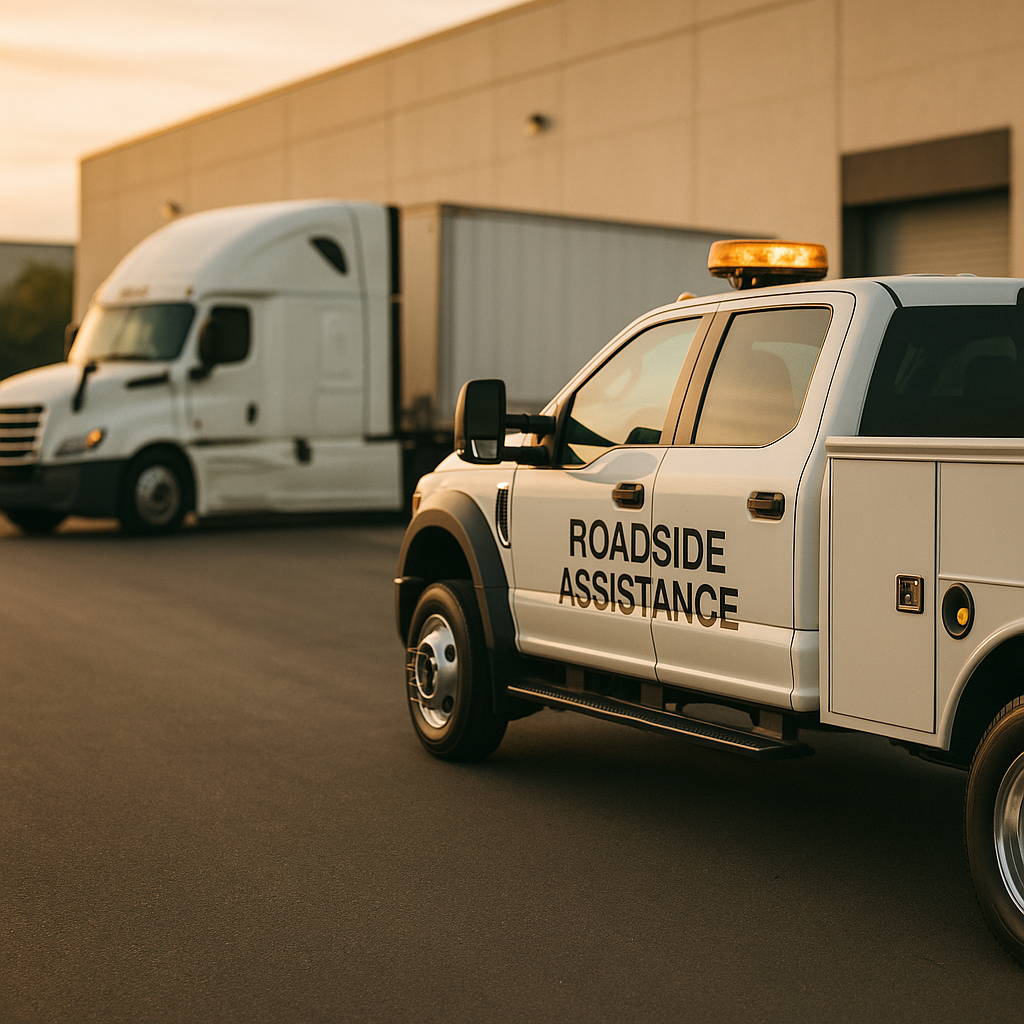

Learn what a roadside assistance service truck is, what it can fix, what still needs a tow, and 2026 cost options. Get the call checklist.
A roadside assistance service truck is a mobile repair unit sent to get a commercial truck or trailer moving again with on-site fixes like tire service, jump-starts, fuel delivery, and minor air/electrical repairs. If the truck can’t be made safe and roadworthy on the shoulder, the job escalates to towing or recovery.
Breakdowns don’t just cost money—they burn hours, appointments, and sometimes the load. If you’re comparing membership plans, pay-per-use calls, or an insurance add-on, start with how roadside dispatch actually works and how it fits next to commercial truck insurance.
Table of Contents
Reading time: 8 minutes
- Key Takeaways
- What Is a Roadside Assistance Service Truck (and What It’s Not)
- 9 Services a Truck Roadside Service Truck Typically Provides
- Dispatch, Technology, and Choosing the Right Provider
- 2026 Pricing: Pay-Per-Use vs Membership vs Insurance Add-On
- Frequently Asked Questions
- Bottom Line: Know What a Service Truck Can Fix—and What It Can’t

Key Takeaways
Roadside invoices for commercial vehicles are typically built from dispatch + travel + labor + after-hours multipliers + parts/tires, not a single flat fee, which is why two “simple” calls can price out very differently.
- Service truck vs tow truck: A service truck aims for on-site fixes/triage; a tow truck handles transport/recovery when you can’t be made roadworthy.
- Membership plans: They can reduce surprise billing, but many exclude tires, parts, recoveries, and long tows—the fine print matters.
- Insurance isn’t roadside: Roadside reduces downtime; trucking insurance is what responds to covered losses, liability, and claims.
What Is a Roadside Assistance Service Truck (and What It’s Not)
A roadside assistance service truck is a mobile commercial repair unit equipped to perform common on-site fixes (tires, batteries, fuel delivery, minor air/electrical work) so a truck can move without waiting on a tow and shop backlog.
Simple definition: service truck vs tow truck
What it is: “Road service” or “mobile tech” is usually a technician dispatched with tools, air, jack systems, and diagnostic basics to fix you where you sit.
Why it’s essential: If the issue is a tire, battery, minor air leak, lockout, or simple mechanical/electrical fault, a service truck can be the fastest path back to revenue.
What it’s not: It’s not automatically a heavy wrecker. A tow truck’s primary job is moving you (or recovering you). A service truck’s primary job is fixing you on-site.
Where the term shows up (apps, fleets, vendor networks)
On most dispatch platforms, “send a service truck” means “send someone who can attempt an on-site repair,” not just a hook-and-drag. That difference matters when you’re tight on HOS time or sitting somewhere you can’t legally park.
Important insurance clarity (avoid expensive assumptions)
If the truck is damaged in a crash or covered event, roadside assistance is not the same thing as coverage. Roadside might get you off the shoulder; insurance handles covered repair costs and claim handling. If you want a clean line between “emergency help” and “covered losses,” review how physical damage coverage works (especially on financed equipment).
9 Services a Truck Roadside Service Truck Typically Provides
Commercial truck roadside dispatches most often involve tires, batteries, fuel, lockouts, and air system leaks, because those failures can be diagnosed fast and sometimes repaired safely without towing.
Core roadside services (most common calls)
These are the “daily drivers” of heavy-duty roadside work:
- Tire repair / tire change (truck and trailer): Patch/plug when legal/possible, or mount a replacement.
- Battery jump-start / battery testing: Jump, test, and identify a weak battery or bad connection.
- Fuel delivery: Diesel is common; DEF availability varies by provider and location.
- Lockout assistance: Cab entry depends on the make/model and key type.
- Air line / gladhand / hose replacement: One of the most frequent “get-you-rolling” fixes.
“Get-you-rolling” fixes (where limits matter)
- Minor coolant hoses, clamps, belts, fittings: Only if parts are stocked or available locally.
- Basic electrical troubleshooting: Fuses, connectors, simple wiring faults.
- Aftertreatment triage: Sometimes coordination and safe next-steps more than a guaranteed on-site fix.
- Winch/pull-out coordination: Often subcontracted and frequently excluded from “basic” roadside.
Quick table: what’s usually included vs what becomes an extra charge
| Service | What the tech typically does | What you may pay extra for | Common limitations |
|---|---|---|---|
| Tire service | Patch/plug (when allowed) or mount a replacement | Tire cost, casing fee, disposal, after-hours | Some plans cover “service” but not the tire |
| Battery | Jump-start + test | Battery replacement | Access issues, multiple batteries, deeper electrical faults |
| Fuel/DEF | Deliver enough to reach a safe stop | After-hours, long distance, minimum call fees | Remote areas can get expensive fast |
| Air lines/gladhands | Swap common hoses/fittings | Parts markup, travel time | Major brake/air failures still need tow/shop |
| Electrical | Basic diagnosis and simple repair | Advanced diagnostics, specialized parts | Not a mobile dealership or full shop |
| Winch/recovery | Arrange proper vendor/equipment | Recovery cost, extra equipment, standby time | Soft ground, rollover risk, hazmat/cargo complications |
Cargo reality check: Breakdowns can create cargo exposure if a load has to be shifted, cross-docked, or a reefer can’t hold temperature. Make sure you understand how cargo insurance applies to your freight and your broker/shipper requirements.
Dispatch, Technology, and Choosing the Right Provider (Owner-Op, Hotshot, Fleet)
Most commercial roadside programs use the same five-step workflow—triage, vendor match, authorization, ETA updates, and invoicing—and the cost surprises usually happen at the authorization and invoice steps.
How dispatch works (call center or app)
Here’s what a “good” dispatch flow looks like in the real world:
- Triage: exact location (GPS pin + mile marker), direction of travel, symptoms, and whether you’re safely out of the lane
- Match: service truck vs heavy-duty tow vs specialty vendor (tires, recovery, mobile mechanic)
- Authorization: rate acknowledgement or a “not-to-exceed” approval before work starts
- ETA + updates: tracking links/texts (when the program is well-run)
- Invoice: itemized billing (best) vs vague totals (red flag)
Pro tip that reduces downtime and surprise fees: Before anyone rolls, ask four questions and write the answers down:
- Dispatch fee: What is it, and is it refundable if they can’t complete the job?
- Labor rate: Hourly rate and minimums (for example, a 1-hour minimum).
- Travel/mileage: How is it billed (miles, zones, or travel time)?
- After-hours: Any multiplier for nights/weekends/holidays, and what time it starts?
Questions to ask before you buy a plan
A roadside plan is only as good as its network coverage and billing discipline.
- Do you dispatch your own trucks or coordinate third-party vendors?
- Do you cover heavy-duty towing/recovery in my lanes, or outsource everything?
- Are tires/parts included, discounted, or fully separate? Do you disclose markups?
- Do drivers get ETAs and do you provide itemized invoices?
Owner-operator vs fleet vs hotshot: same problem, different risk
- Owner-operator (1–2 trucks): One breakdown can wipe out the week. You need fast triage and predictable billing.
- Fleet: You need consolidated billing, reporting (top failure causes), and consistent after-hours performance.
- Hotshot: You often run tighter delivery windows with smaller equipment, but downtime still hurts—and commercial exposure still applies. Make sure your hotshot insurance and roadside plan match your lanes, trailer type, cargo, and usage.
Safety + compliance matters while you wait. A breakdown that isn’t set up correctly can turn into an inspection problem. Keep a simple checklist, and use Logrock’s DOT compliance checklist as a practical starting point.
2026 Pricing: Pay-Per-Use vs Membership vs Insurance Add-On (Roadside Endorsement)
Roadside assistance costs in 2026 are driven by location, time of day, labor, travel, and parts/tires, and those cost drivers are why “cheap plans” can still produce expensive calls when exclusions kick in.
Repair and maintenance is consistently a major cost bucket in trucking operations, and downtime adds lost revenue on top of the invoice. ATRI’s operational cost research is a useful benchmark for how large that category stays year over year (ATRI resources: https://truckingresearch.org/).
Pay-per-use: the typical fee components
Pay-per-use roadside usually means one call turns into multiple line items.
- Dispatch/service call fee
- Labor (hourly)
- Travel time or mileage
- After-hours/weekend multiplier
- Parts and shop supplies
- Tire costs (often the biggest single line item)
- Tow charges if it escalates (hookup + mileage + storage)
Practical control: Ask for a written rate sheet or set a “not-to-exceed” authorization cap before work begins, especially in remote areas.
Membership: best when you run miles and want predictability
Membership plans usually sell access, coordination, and (sometimes) discounted rates, not “free repairs.”
Watch-outs: Many memberships exclude tires and major parts, recoveries/winching, long-distance tows, and anything “accident related.” Don’t guess—read the benefits page and the exclusions list.
Insurance add-on: roadside / towing & labor endorsement
Many carriers offer roadside or “towing and labor” as an optional endorsement with specific limits, and those limits can be too low for heavy-duty towing if you don’t match them to your operation.
- It can be affordable compared to pay-per-use if the limits match real costs in your lanes.
- It is not a maintenance plan; it’s an emergency tool with conditions and caps.
To see what typically counts as an add-on versus core coverage, review truck insurance endorsements. For consumer-level background on towing and labor as an optional coverage concept, NAIC materials are a helpful reference: https://content.naic.org/consumer/auto-insurance.
Comparison table: which model fits your operation?
| Model | Best for | Pros | Cons | Typical surprises to avoid |
|---|---|---|---|---|
| Pay-per-use | Infrequent breakdowns | No annual fee | Highest “bad day” cost | After-hours multipliers, travel time, vague invoices |
| Membership | High miles, predictable lanes, single-truck ops | More predictable access and pricing discipline | Exclusions are common | Tires/parts not included; recovery billed separately |
| Insurance add-on | A backstop tied to your policy | Often low incremental premium cost | Caps can be too low for heavy-duty towing | Assuming it covers every situation or unlimited tows |
If you’re trying to keep affordable trucking insurance without leaving big gaps, treat roadside as a budgeting and uptime decision, then align your limits and endorsements to what heavy-duty calls cost in your lanes.
Frequently Asked Questions
A roadside assistance service truck is a mobile repair unit dispatched to perform on-site fixes or triage for commercial trucks and trailers, including tire service, jump-starts, fuel delivery, lockouts, and common air line problems. A service truck focuses on getting you roadworthy where you sit, while a tow truck’s primary role is transporting or recovering a disabled vehicle. In practice, dispatch will attempt a service truck first when the failure is likely solvable on the shoulder, then escalate to towing when the unit can’t be repaired safely or quickly on scene.
Truck roadside assistance service usually includes dispatching a mobile tech for tires, batteries, fuel delivery, lockouts, and minor air/electrical troubleshooting, with billing based on dispatch, travel, and labor. What’s commonly excluded or billed separately are tires and major parts, recoveries/winching, storage fees, and long-distance towing. Always ask whether the plan covers the “service call” only (coordination) or also covers labor at a set rate, and request itemized invoices so you can spot markups and after-hours multipliers.
No, roadside assistance and towing are different services with different goals and cost drivers. Roadside assistance focuses on repairing or stabilizing the truck on-site (for example, fixing an air leak or swapping a tire) so you can continue the trip without a shop delay. Towing is for moving a unit that can’t be made safe or roadworthy where it sits, and heavy-duty towing can add separate hookup, mileage, storage, and recovery equipment charges. Many programs offer both, but they’re usually subject to different limits and exclusions.
Truck roadside assistance cost in 2026 depends on billing model, location, time of day, and call type, and a “simple” service call can still be expensive once travel and tires are added. A common heavy-duty invoice structure includes a dispatch/service call fee (often $75–$250), travel time or mileage, and hourly labor (commonly $150–$250+ per hour), with after-hours multipliers that can raise rates at night or on weekends. Before authorizing work, ask for the dispatch fee, labor rate, travel/mileage policy, and a written not-to-exceed cap.
Commercial truck insurance may include roadside assistance only if your policy includes a specific roadside or towing-and-labor endorsement, and those benefits are usually capped by limit and conditions. Many policies do not include it as a standard feature, so you should verify whether the limit is per disablement, per tow, or per policy term, and whether accident-related tows are excluded. Assuming roadside is “automatically included” is one of the easiest ways to get a surprise invoice—see common trucking insurance mistakes.
While waiting for roadside service, get to the safest available spot, activate hazard flashers, and deploy warning devices as required by 49 CFR §392.22, which generally requires warning devices within 10 minutes of stopping and placement patterns appropriate to the roadway (including typical 10 ft/100 ft/200 ft concepts). Use official text for the exact requirements: https://www.ecfr.gov/current/title-49/subtitle-B/chapter-III/subchapter-B/part-392/section-392.22. Roadside breakdowns can also trigger inspection attention; FMCSA’s overview is here: https://www.fmcsa.dot.gov/safety/inspections/roadside-inspections.
Conclusion: Know What a Service Truck Can Fix—and What It Can’t
A roadside assistance service truck is built to solve common breakdowns on-site—or get you stable enough to make the right next move. It’s not magic, and it’s not automatically towing, but it can save the hours that crush profit on a bad day.
Key Takeaways:
- Ask for dispatch, labor, travel, and after-hours rates before anyone rolls, and set a not-to-exceed cap.
- Don’t assume tires, parts, recovery, or long tows are included in memberships—confirm exclusions in writing.
- Align roadside choices with your coverage stack (including semi truck insurance) so uptime and risk planning match your lanes.
If you’re comparing endorsements, costs, and ways to control premiums, pair a realistic roadside plan with smart coverage decisions—then use proven steps from how to save on truck insurance to keep protection strong without overspending.





