
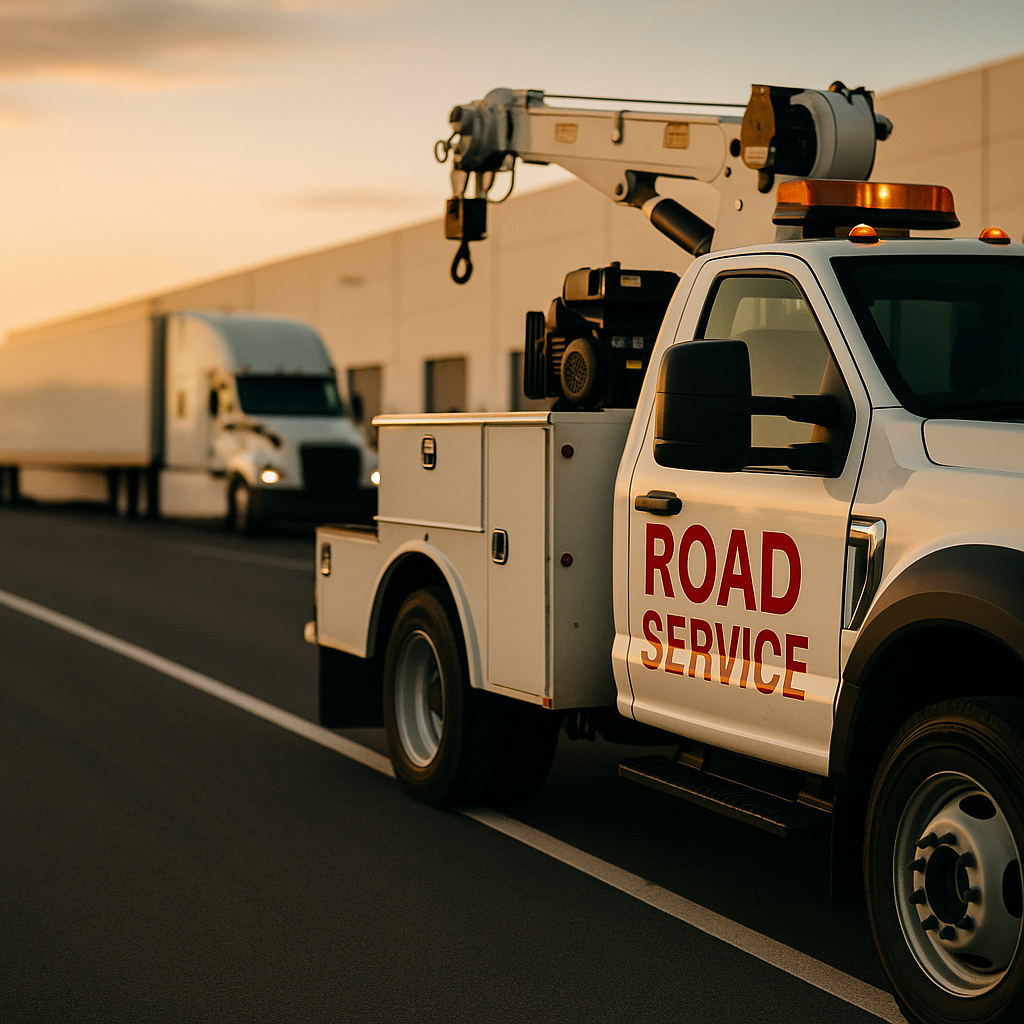

Roadside service trucks: 9 services, 2026 cost ranges, ETA checklist, and what commercial truck insurance may not cover. Save this guide.
If you’re down on the shoulder, roadside service trucks are usually the fastest way to turn “not moving” into “rolling again”—as long as you request the right kind of unit and give dispatch the right details.
Quick answer: Roadside service trucks typically handle tire repair/replacement, fuel delivery, jump starts and battery issues, air line/brake hose repairs, coolant hoses/belts, minor mechanical fixes, basic diagnostics, emissions/aftertreatment triage (DPF/DEF derate), and towing/recovery coordination when the truck can’t be safely repaired on the shoulder.
If you’re debating whether to limp to a shop or get someone out to you, start here: mobile truck repair vs shop repair.
Table of Contents
Reading time: 8 minutes
- Key Takeaways
- What Are Roadside Service Trucks (and What They Can Fix On-Site)
- Response Times, Dispatch, and Tracking (How to Get a Faster ETA)
- 2026 Heavy-Duty Roadside Costs + Membership vs Pay-Per-Call (Plus Semi Truck Insurance Considerations)
- Get the Right Roadside Service Truck Faster (and Avoid Repeat Dispatch)
- Frequently Asked Questions
- Conclusion: Get Rolling Faster by Calling the Right Unit (with the Right Info)

Key Takeaways
Roadside service trucks typically cover 9 high-frequency services—tires, fuel, batteries, air/brake lines, cooling hoses, lockouts, basic diagnostics, aftertreatment triage, and tow coordination—built to get Class 6–8 trucks moving again safely.
- Most breakdown calls are “service-truck fixable” (tires, air leaks, no-start), but steering, braking integrity, major drivetrain, and crash recovery usually mean towing.
- Your ETA depends on dispatch info (mile marker, direction, tire size, fault codes). Missing details can trigger a wrong unit and a second trip.
- 2026 costs are usually trip fee + labor + parts + surcharges, and rural mileage or after-hours can spike totals fast.
- Roadside memberships can stabilize cash flow, but they don’t replace smart coverage decisions in trucking insurance and semi truck insurance.
What Are Roadside Service Trucks (and What They Can Fix On-Site)
A roadside service truck (often called a road service truck) is a mobile repair unit equipped for fast, high-probability repairs on Class 6–8 trucks and trailers, especially tires, air system leaks, batteries/no-starts, and minor mechanical issues.
From a business standpoint, this is about controlling downtime. ATRI’s Operational Costs of Trucking reports consistently show repairs/maintenance and tires as major cost buckets—and downtime adds lost revenue on top of the invoice.
Source: ATRI (Operational Costs of Trucking)
9 services roadside service trucks provide (what’s realistic)
1) Tire service (repair, replacement, torque)
- Steer/drive/trailer tire help: plug/patch (when appropriate), mount/replace (capability varies), air-up, and torque guidance.
- What dispatch needs: tire size, position (steer/outer/inner), wheel type, and whether you’re loaded.
For the tire-specific info that prevents delays, use: roadside truck tire repair and replacement basics.
2) Fuel delivery (diesel; DEF in some areas)
- Running out happens during weather, detours, and parking hunts.
- Some providers deliver DEF; many don’t. Don’t accept DEF if you can’t confirm it’s clean and correctly handled.
3) Battery / starting / charging issues (jump starts, terminals, basic triage)
- Jump starts, terminal cleanup, basic battery and charging checks.
- Battery replacement may be available if the unit carries inventory (more common in metro areas).
4) Air system & brake airline repairs
- Common fixes include damaged/loose air lines, gladhands, fittings, and minor leaks.
- Line in the sand: if braking integrity is questionable, don’t gamble your CDL on a “maybe.” That’s tow or secure parking + shop.
5) Cooling system quick fixes (hoses, clamps, coolant top-off)
- Hoses and clamps are often roadside-fixable when the failure is obvious and accessible.
- Repeated overheating or unknown coolant loss can cook an engine fast—sometimes towing is cheaper than gambling.
6) Lockout / key issues (availability varies)
- Some networks can coordinate locksmith-type help; others can’t.
- Expect identity verification and documentation checks.
7) Basic diagnostics & minor mechanical fixes
- Some units arrive with scan tools to read codes, clear certain faults, and fix simple causes (loose connections, minor leaks).
- Many “engine problems” still require shop time, parts availability, and deeper diagnostics.
8) Emissions/aftertreatment triage (DPF/DEF/derate)
- Roadside techs can sometimes restore limited mobility with safe, basic checks and code readouts.
- Hard faults, repeat derates, or contamination usually means tow-to-shop.
9) Towing & recovery coordination
- When it’s not safe or possible to repair roadside, dispatch can coordinate towing/recovery.
- This is where the right information (location, load, axle/weight details) prevents expensive mistakes.
Quick decision table: roadside fix vs tow
| Problem | Typical roadside fix? | Notes |
|---|---|---|
| Single trailer tire blowout | Yes | Have tire size + position ready |
| Multiple blown tires / damaged rim | Maybe | Parts availability and safety dictate outcome |
| No-start / dead batteries | Yes | Could be batteries, cables, or charging system |
| Air leak at gladhand / hose | Yes | If it’s a clear hose/fitting issue |
| Brake system warning / poor braking | Tow/Shop | Don’t risk it—safety + violations |
| DEF/DPF derate | Maybe | Depends on fault codes and history |
| Overheating with major coolant loss | Tow/Shop | High risk of engine damage |
| Crash recovery / off-road | Tow/Recovery | Specialized equipment needed |
Response Times, Dispatch, and Tracking (How to Get a Faster ETA)
Semi truck roadside assistance ETAs often run 30–90 minutes in metro areas and 90–180+ minutes in rural lanes, with after-hours, weather, and mis-dispatches being the biggest delay multipliers.
For a deeper look at how networks triage calls and route the right equipment, read: semi truck roadside assistance dispatch process.
Typical ETA ranges (what changes them)
- Metro vs rural: rural calls add drive time and parts limitations.
- Time of day: nights/weekends can mean fewer available techs.
- Weather and closures: slow everybody down, including tow operators.
- Wrong unit dispatched: vague info (like “tire issue”) can trigger a second dispatch.
The 60-second dispatch checklist (copy/paste into a note)
Give dispatch this, in order:
- Exact location: mile marker, highway, direction (NB/SB), nearest exit/landmark
- Truck + trailer: tractor type, trailer type (dry van/reefer/flat), loaded or empty
- Issue + symptoms: what happened, warning lights, air pressure behavior, leaks
- If tire call: tire size + position + wheel type
- Fault codes: if you can safely retrieve them
- Access/safety: shoulder width, triangles out, safest approach side
- Payment/billing: card, fleet account, membership number, PO (if applicable)
While you wait: safety and legal basics (don’t improvise)
49 CFR §392.22 requires stopped commercial vehicles to place warning devices within 10 minutes (with placement distances varying by road type), so your first job is visibility and scene safety—not wrenching.
- Get as far out of the travel lane as possible (when safe).
- Use warning devices and follow your company policy and training.
FMCSA reference on emergency equipment/safety practices: https://www.fmcsa.dot.gov/safety/driver-safety/emergency-equipment
Move Over / Slow Down laws: Most states require drivers to move over or slow down for stopped emergency and service vehicles, and requirements vary by state. Example state resource (Florida): https://www.flhsmv.gov/safety-center/driving-safety/move-over/
2026 Heavy-Duty Roadside Costs + Membership vs Pay-Per-Call (Plus Semi Truck Insurance Considerations)
In 2026, heavy-duty roadside invoices are typically built from a trip/service-call fee + hourly labor + parts/materials, with common on-highway totals starting around $250 and spiking past $1,800+ when tires, rural mileage, or after-hours surcharges stack up.
If you’re searching “mobile truck repair near me” at 2:00 a.m., you’re not price-shopping—you’re damage-controlling. Still, understanding how the invoice is built helps you approve the right job and avoid repeat dispatch.
Common pricing models you’ll see
- Service call / trip charge (getting the unit to you)
- Hourly labor (often billed in increments)
- Parts & materials (tires, batteries, fittings, hoses)
- After-hours / weekend / holiday surcharges
- Mileage or zone fees (especially rural)
- Towing as a separate line item when required
Sample 2026 rate ranges (ranges, not promises)
These vary by region and equipment, but the ranges below are realistic “order-of-magnitude” planning numbers.
| Service | Typical total range (USD) | What swings it |
|---|---|---|
| Basic service call + minor fix | $250–$700 | Distance, after-hours, labor minimums |
| Jump start / no-start triage | $200–$500 | Battery access, electrical issues |
| Fuel delivery | $250–$650+ | Gallons, distance, priming, after-hours |
| Minor air line / fitting repair | $300–$900 | Parts, access, repeat leak location |
| Tire replacement (single position) | $700–$1,800+ | Tire price/availability, mount capability |
| DPF/DEF derate triage | $350–$1,200 | Codes, repeat faults, whether it becomes a tow |
Membership vs pay-per-call: what actually pencils out
Memberships can help you budget, reduce admin headaches, and sometimes improve dispatch priority. They tend to make the most sense when you run high miles, haul time-sensitive freight, or operate multiple trucks.
| Feature | Pay-per-call | Membership |
|---|---|---|
| Upfront commitment | None | Monthly/annual fee |
| Call pricing | Spot rates | Often negotiated/discounted |
| Dispatch priority | Varies | Often higher priority (not guaranteed) |
| Billing | Per incident | Consolidated billing + reporting |
| Best for | Low-mileage/seasonal | High-mileage, teams, small fleets |
How roadside plans interact with trucking insurance (commercial truck insurance, semi truck insurance, hotshot insurance)
A roadside membership is a service product, while commercial truck insurance and semi truck insurance are risk-transfer products, and they only overlap if your policy includes towing/roadside endorsements with defined limits and conditions.
To see what policies commonly cover (and what often stays out-of-pocket), read: commercial truck insurance towing/roadside coverage explained.
- If you’re chasing affordable trucking insurance, don’t “save” money by dropping coverage you can’t self-fund.
- If you run hotshot insurance (dually + trailer), you’ll see different failure points (tires, wheel ratings, trailer issues), but the same rule applies: know what’s covered before the breakdown.
Get the Right Roadside Service Truck Faster (and Avoid Repeat Dispatch)
Breakdowns are cash-flow events, and a clean dispatch package (location, tire specs, symptoms, codes, access, billing) is the simplest way to avoid a wrong unit, a second trip, and another hour on the shoulder.
If your issue is derate-related and you want to gather the right info before you call, use: DPF/DEF derate troubleshooting for drivers.
If the shoulder repair isn’t safe or you’ve already burned time on failed attempts, this is the next step: heavy-duty towing guide (when roadside can’t fix it).
Related reading (downtime prevention + safety)
Why LogRock (straight business value)
LogRock is built around what owner-operators and small fleets fight every week: unpredictable downtime, tight margins, and paperwork pressure. The goal is practical guidance that helps you control risk, control cost-per-mile, and keep the truck earning.
Frequently Asked Questions
Commercial truck roadside assistance typically supports Class 6–8 trucks and trailers with on-site repairs, dispatch coordination, and towing referrals, and many networks operate 24/7 with availability varying by region and time of day.
Commercial truck roadside assistance is on-demand or membership-based help for Class 6–8 trucks and trailers during breakdowns, usually available 24/7 through local providers and national networks. It commonly includes dispatch coordination, on-site service (tires, batteries/no-start, air leaks), and towing coordination when a repair isn’t safe roadside. The goal is to reduce downtime and get you moving safely, not perform a full shop rebuild on the shoulder. For call routing, ETA expectations, and what details speed up triage, see semi truck roadside assistance dispatch process.
Mobile truck repair response times often land in the 30–90 minute range in many metro areas and 90–180+ minutes in rural lanes, depending on technician availability and distance. ETAs also change based on weather, road closures, and whether the job needs a tire unit, a mechanic, or a heavy wrecker. The fastest way to cut delays is to give dispatch your exact location (mile marker + direction), the symptoms, tire size/position (if it’s a tire call), and fault codes when you can retrieve them safely.
Roadside service trucks can sometimes address DPF/DEF derates by pulling fault codes, checking basic issues (connections, obvious leaks, low DEF quality concerns), and attempting limited triage when it’s safe and appropriate. Hard faults, repeat derates, or suspected contamination often require towing to a shop because parts, deeper diagnostics, and controlled procedures aren’t realistic on the shoulder. To speed up the decision, have your fault codes, recent repair history, and symptoms ready, and use DPF/DEF derate troubleshooting for drivers to gather the right info fast.
Request towing when the truck can’t be safely repaired on the shoulder, when steering or braking integrity is questionable, after repeated failed roadside attempts, or when parts simply aren’t available. Crash recovery, off-road incidents, and load shifts also require specialized recovery equipment rather than a standard service truck. If you’re unsure, err on the side of safety and scene control, then use heavy-duty towing guide (when roadside can’t fix it) to understand recovery types, what drives cost, and what information prevents an expensive wrong hookup.
Conclusion: Get Rolling Faster by Calling the Right Unit (with the Right Info)
Using a 7-item dispatch checklist (location, equipment, symptoms, tire specs, fault codes, access, billing) reduces mis-dispatches and repeat calls, which is often the biggest controllable part of downtime.
Roadside service trucks solve the most common “down on the shoulder” problems fast when you request the right service and keep the scene safe. Memberships can help when your exposure is high, and insurance decisions matter when a roadside fix isn’t possible.
Key Takeaways:
- Ask for the correct unit (tire, mechanical, or recovery) by sharing tire size/position and symptoms up front.
- Plan for invoices as trip fee + labor + parts, and expect after-hours/rural distance to move the number.
- Know the difference between membership benefits and towing/roadside endorsements in commercial truck insurance.
Save the checklist, keep your warning devices ready, and when in doubt about brakes, steering, or safety, choose towing and live to haul the next load.





