
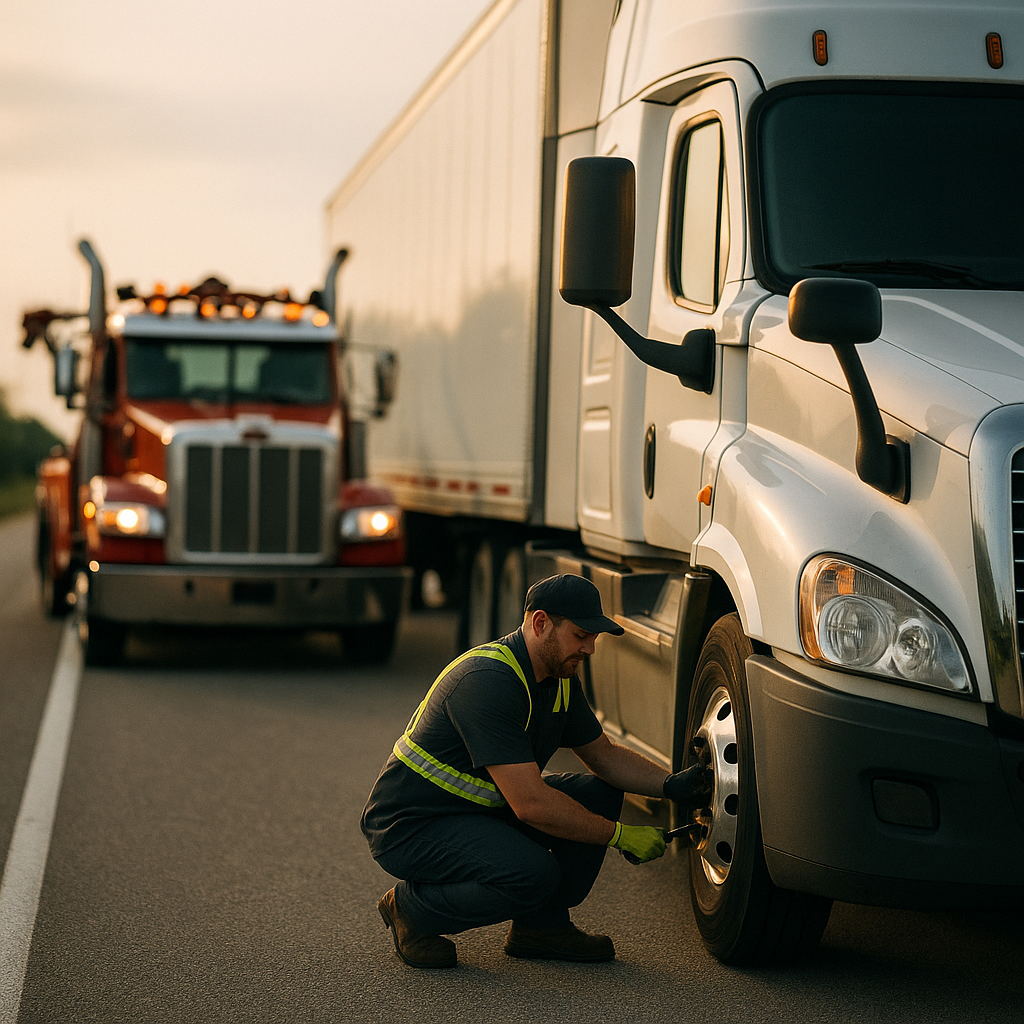
Semi roadside assistance explained: 7 services, what to say on the call, cost factors, response-time realities, and safety rules. Dispatch smarter.

Semi roadside assistance is a 24/7 dispatch service that sends (or coordinates) the right help—tire service, fuel, jump, lockout, mobile repair, or heavy-duty tow—so your truck can move again or get moved safely. If you’re broken down on the shoulder, the fastest “fix” usually starts with a better first call: exact location, truck details, and clear symptoms.
This guide focuses on real-world decisions drivers and dispatchers make under pressure: what to request, what to say, what’s typically included, what drives cost, and what FMCSA safety rules expect while you wait. For a deeper look at how urgent calls are routed, see 24/7 semi roadside dispatch help.
Table of Contents
Reading time: 8 minutes
- Key Takeaways
- Semi Roadside Assistance: What It Is, What It Isn’t, and What to Say on the Call
- What Services Are Included in Semi Truck Roadside Assistance?
- Semi Roadside Assistance Cost + Response Time: What’s Realistic (and How to Avoid Surprise Bills)
- Safety First: What to Do While Waiting for Roadside Assistance
- Frequently Asked Questions
- Conclusion: Get Back on the Road Faster
Key Takeaways
Semi roadside assistance is typically a dispatch-and-service solution that covers 7 common call types: tire service, jump start, fuel delivery, lockout, minor mobile repair, heavy-duty tow, and winch-out/recovery.
- It’s dispatch + service: Roadside help is not the same thing as filing an insurance claim.
- Speed comes from details: The best lever you control is giving the right info on the first call.
- Costs are itemized: Expect a service call fee, labor, parts/markup, and mileage/tow/recovery when applicable.
- Safety is regulated: FMCSA roadside warning device rules apply when you’re stopped on the roadway.
Semi Roadside Assistance: What It Is, What It Isn’t, and What to Say on the Call
Semi roadside assistance is on-demand dispatch that connects you with a local heavy-duty vendor for tire, fuel, battery, lockout, mobile repair, or tow/recovery so the truck can be repaired roadside or moved to a safe facility.
What it is (plain English)
Most providers cover a core list: tire service, jump starts, fuel delivery, lockouts, minor mechanical issues, and towing coordination. On the best calls, dispatch confirms the service type first (tire vs mechanic vs tow) so you don’t pay for the wrong truck to roll.
What it usually isn’t
Roadside is rarely a “full shop visit” on the shoulder. Expect limitations like major engine/aftertreatment teardown not happening roadside, parts availability issues, and recovery rules that depend on access and safety.
- Major repairs: Many failures require a tow to a shop, not a shoulder-side fix.
- Diagnostics: Some vendors can scan; others can only triage symptoms.
- Recovery: Winch-out and off-road recovery are often billed separately from a basic tow.
Why it’s essential (business, not comfort)
A breakdown often triggers a chain reaction: missed appointments, lost reloads, extra deadhead, and tighter ELD/HOS options. Repair and maintenance is also a major operating cost category industry-wide, which is why response time and decision speed matter as much as the repair itself (see ATRI’s operational cost reporting: ATRI operational costs overview).
Who needs semi truck roadside assistance?
- Owner-operators: Protect cash flow and uptime when you can’t “eat” a day of downtime.
- Small fleets: Nights/weekends are when thin vendor coverage hurts the most.
- Dispatchers: A repeatable SOP reduces mis-dispatch and billing surprises.
- Hotshot operators: Different equipment, same downtime problem—often tighter margins.
What to tell dispatch (copy/paste checklist)
Save this checklist in your notes app so you don’t rely on memory when you’re stressed, cold, or on a tight shoulder.
- Exact location: mile marker + direction of travel + nearest exit + GPS pin if possible
- Your position: shoulder, ramp, off-road, stuck, blocking a lane, etc.
- Truck/trailer: year/make/model, tractor + trailer type, and whether you’re loaded
- Symptoms: “steer tire blew,” “no crank,” “trailer air leak,” “derate + check engine”
- Tire info: size + position (steer/drive/trailer) and any collateral damage (air line, mudflap)
- Hazmat/securement: any special handling requirements
What Services Are Included in Semi Truck Roadside Assistance?
Most semi truck roadside assistance programs revolve around 7 repeatable service categories that cover the majority of breakdown calls across highway, shipper lots, and rural corridors.
1) Tire repair / replacement (steer, drive, trailer)
What it is: Roadside tire repair or replacement for blowouts, punctures, or sidewall damage.
What speeds it up: Share tire size and exact position immediately; that prevents “wrong tire” delays. For a tight prep list that reduces back-and-forth, use Roadside semi truck tire service checklist.
2) Jump start / battery service
What it is: Jumping a dead system, basic battery testing, and sometimes battery replacement if the vendor can source the right group size.
Common time-waster: Not stating whether the issue is “no crank,” “slow crank,” or “click/no start,” because each points to a different path.
3) Fuel delivery (emergency fuel)
What it is: Fuel drop to get you to the next safe fuel stop (and avoid a tow in a bad spot).
Dispatch detail that matters: Tell them diesel vs reefer needs, and whether you’re on a shoulder vs safely off the roadway.
4) Lockout / keys
What it is: Getting you back into the cab if keys are locked inside or a key fob fails.
Reality check: A lockout can burn a delivery window as fast as a tire blowout, especially after-hours.
5) Minor roadside mechanical help (mobile repair when possible)
What it is: Fixes that can realistically happen roadside—air line issues, hoses/clamps, minor electrical, and limited no-start troubleshooting.
Good dispatch question: “Is this a mobile repair attempt, or are we dispatching a tow?” Make them confirm scope before rollout.
6) Heavy-duty towing
What it is: Moving the truck when it’s unsafe or impossible to repair roadside, usually to a shop, yard, or another safe location.

Confirm upfront: destination options, after-hours shop availability, and whether storage fees can start if the shop is closed.
7) Winch-out / recovery
What it is: Recovering a truck that’s stuck off-road, in mud/snow, or otherwise needs specialized rigging beyond a standard tow.
Billing note: Recovery is often billed differently than a basic tow, so ask what triggers “recovery rates” before you authorize.
Which service do I ask for?
- Tire issue with a safe pull-off: request tire service
- No-start, air leak, derate: request a roadside mechanic attempt
- Unsafe location, major failure, stuck: request tow or recovery
Semi Roadside Assistance Cost + Response Time: What’s Realistic (and How to Avoid Surprise Bills)
Semi roadside assistance pricing is usually built from 4–6 line items—service call, labor, parts/markup, mileage, and (if needed) tow miles and recovery charges—so the “total” can change fast when conditions change.
Cost: what you’re actually paying for
Most invoices are components, not one flat number. If you want to see typical fee structures and what to confirm before authorizing, read Truck roadside assistance cost breakdown.
- Service call / dispatch fee
- Labor: sometimes portal-to-portal (travel included)
- Parts + markup: varies widely by region and urgency
- Mileage: especially in rural areas
- Tow/recovery: hookup, tow miles, winch-out, storage, after-hours
Pricing models: pay-per-use vs membership
| Model | Best for | What to read closely |
|---|---|---|
| Pay-per-use | Rare breakdowns and maximum flexibility | After-hours rates, cancellation fees, parts markup |
| Membership / plan | Budget predictability and repeatable processes | Tow-mile limits, number of tire events, exclusions for recovery/winch-out |
Response time: “near me” depends on where “me” is
Response time depends on provider density, weather, traffic, and whether heavy-duty vendors are available where you’re stopped.
- Metro areas: more vendors, but congestion can stretch ETAs.
- Rural stretches: fewer heavy-duty providers and longer travel time.
How to speed it up (without making it unsafe)
- Location: mile marker + direction + nearest exit beats “outside of (town).”
- Photos: send a photo only if you can do it safely and legally.
- Load details: confirm if you’re loaded and any height/clearance constraints.
Quick provider checklist (so you don’t get burned)
- ETA updates: “What’s the ETA, and how often will it be updated?”
- Estimate range: “What’s included, and what would increase it?”
- Cancellation: “If the truck starts, what do I owe?”
- Payment: card, comcheck/TCH, fleet authorization, etc.
- Scope: “Confirm: tire vs mechanic vs tow—say it back to me.”
Safety First: What to Do While Waiting for Roadside Assistance
FMCSA’s 49 CFR §392.22 requires warning devices to be placed within 10 minutes when a CMV is stopped on the traveled portion or shoulder of a highway in many scenarios, and 49 CFR §393.95 requires CMVs to carry emergency equipment like warning triangles.
Scene safety and warning devices (compliance matters)
Start with positioning and visibility, then get your warning devices out. The shoulder is still a live work zone, and the risk goes up at night, in rain, and near curves or crests.
- Get out of the traffic envelope: move as far from the lane as you safely can.
- Visibility early: 4-ways on and be predictable to traffic.
- Place triangles: follow your training, company policy, and applicable rules.
- Higher-risk spots: curves/crests need extra caution and spacing.
Regulatory references: 49 CFR §392.22 and 49 CFR §393.95.
Keep a breakdown kit you can reach fast
If triangles or a reflective vest are buried behind freight, they’re effectively not on the truck. Standardize your kit location across trucks so any driver can find it in seconds.
Use a consistent checklist: DOT breakdown kit and compliance checklist.
Hazmat / spill risk
If you’re running hazmat or you have a leak/spill risk, follow company procedures and escalate appropriately. Roadside assistance is not a replacement for emergency response or required hazmat protocols.
Frequently Asked Questions
Semi truck roadside assistance typically includes tire service, jump starts/battery help, fuel delivery, lockouts, minor mobile mechanical help, and towing coordination, with some plans adding tow-mile limits and basic recovery rules. Exact coverage depends on your provider, your location, and whether parts are available at the time of the call. Before authorizing dispatch, confirm the service scope (tire vs mechanic vs tow), the estimate range, and what conditions can increase the invoice, such as after-hours labor, long travel distance, or winch-out/recovery rates.
Semi roadside assistance response time depends on heavy-duty vendor availability, geography (metro vs rural), weather, and traffic, so ETAs can swing from under an hour to several hours in low-coverage areas. The fastest way to reduce delays is giving dispatch a precise location (mile marker + direction of travel + nearest exit), clear symptoms, and tire size/position when it’s a tire call. Ask how often the ETA will be updated, whether the vendor is already assigned, and what escalation looks like if the truck is in an unsafe position.
Many semi roadside assistance providers offer nationwide coverage by dispatching local subcontracted vendors, not by owning trucks in every region. Nationwide coverage can work well, but the results depend on vendor density, heavy-duty capability, and how the dispatcher manages communication and ETAs. Before you rely on a “nationwide” promise, verify how vendors are sourced, whether the network supports heavy-duty towing and recovery in your lanes, and how after-hours/holiday calls are handled. Strong providers also confirm scope and pricing before rolling.
Semi roadside assistance costs are usually a combination of a service call or dispatch fee, labor, parts (often with markup), mileage/travel time, and—when towing is involved—hookup, tow miles, storage, after-hours rates, and sometimes separate winch-out/recovery charges. The best way to avoid invoice shock is to request an estimate range and ask what specific conditions increase the bill (distance, after-hours, special equipment, recovery classification) before you approve. If you want a line-item explainer, see Truck roadside assistance cost breakdown.
Roadside assistance may cover semi truck towing depending on the plan, but tow-mile limits and exclusions are common, and winch-out/recovery is frequently billed separately from a basic tow. Always confirm whether your call is being treated as a standard tow or a recovery event, because that can change labor rates and equipment needs. Also confirm destination options (shop vs yard vs safe location), whether the receiving shop is open, and when storage fees can begin if the truck must be staged after-hours.
No, roadside assistance is a dispatch/service benefit, while commercial truck insurance pays for covered losses and claims under the policy terms, deductibles, and exclusions. Some insurance programs bundle limited roadside options, but coverage limits (tow miles, after-hours rules, recovery exclusions) can make “included” roadside very different from what drivers expect during a real breakdown. If you want a clear side-by-side explanation, read Roadside assistance vs commercial truck insurance and confirm what’s actually covered before assuming a call will be paid.
Conclusion: Get Back on the Road Faster
Semi roadside assistance works best when you treat it like an SOP: share precise location, confirm the service type, and lock down the estimate range before you authorize. When you combine smart dispatch details with basic FMCSA roadside safety steps, you cut downtime and reduce expensive surprises.
Key Takeaways:
- Dispatch faster: mile marker + direction + exit + symptoms prevents mis-dispatch.
- Authorize smarter: confirm what changes the estimate (after-hours, mileage, recovery classification).
- Plan for downtime: standardize your breakdown kit and keep your process consistent across runs.
If you’re building a longer-term uptime and risk plan, keep these resources handy: Reduce downtime for owner-operators, Affordable trucking insurance tips, and Hotshot insurance requirements.





