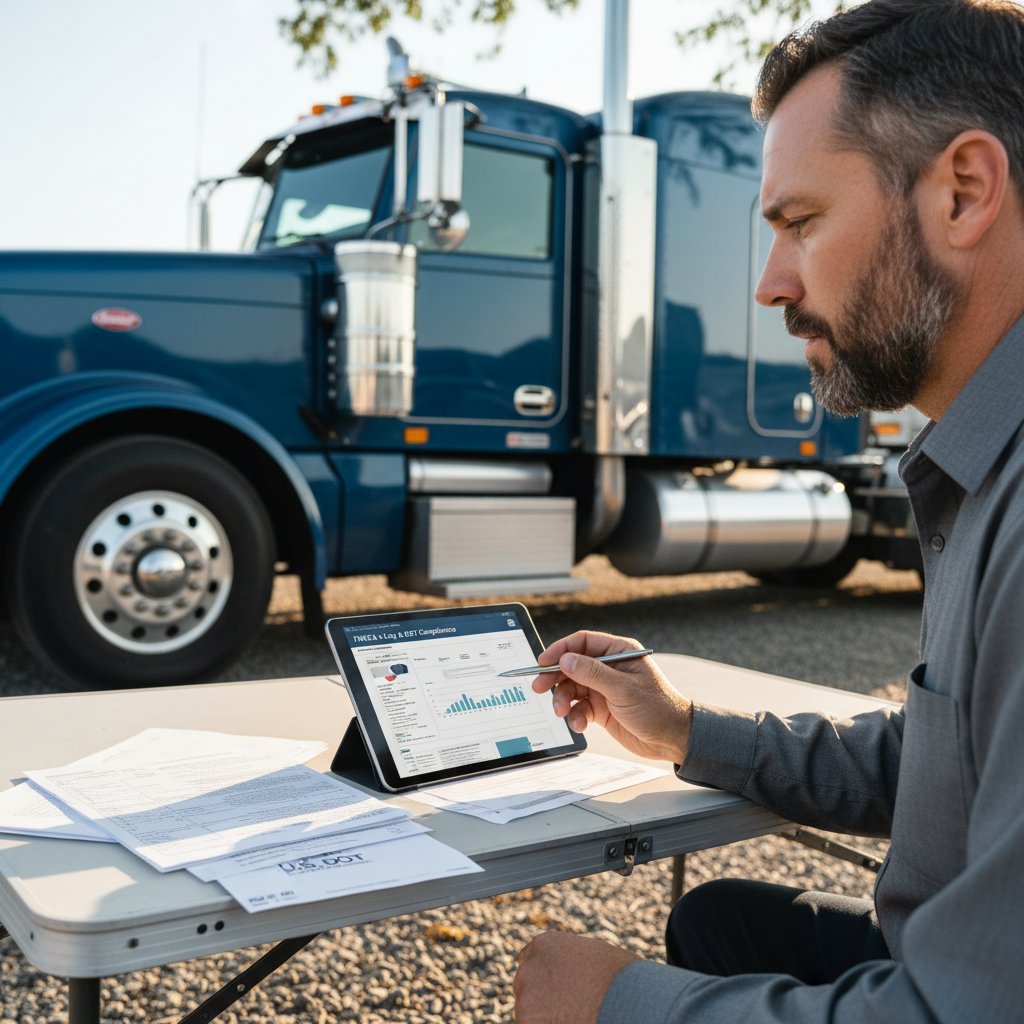
Single truck insurance costs vary by authority, cargo, and radius. Learn coverages, real 2026 price ranges, and savings tips—then get a Logrock quote built for your operation.
Single truck insurance isn’t “just another bill”—it’s the line between one bad day and a business-ending claim. Most owner-operators can budget around real 2026 ranges: $388–$1,240/month for $1M liability depending on truck type and operation, and often $900–$1,600+/month for a full working package once you add physical damage, cargo, and filings.
This guide breaks down what you actually need (and what you don’t), what drives the price, and how to shop commercial truck insurance like a business owner. If you want a deeper monthly benchmark by operator type, see how much truck insurance is per month.
Key Takeaways: Essential Single Truck Insurance
- Expect big price swings: Cargo, radius, and authority status can move your premium by thousands per year.
- Liability is just the entry fee: Most real-world setups also need motor truck cargo, physical damage, and broker-ready COIs/filings.
- Leased-on vs. own authority changes everything: Leased-on can be cheaper monthly, but your control (and load options) change.
- “Affordable” is usually built, not found: Deductibles, safety tech, clean MVR/PSP, smarter radius, and tight paperwork can reduce total cost.
Table of Contents
Reading time: 11 minutes
- What “Single Truck Insurance” Actually Means
- Single Truck Insurance Cost in 2026 (Monthly + Annual)
- Coverage Checklist: What Should Be Included
- Leased-On vs. Own Authority: Cost + Compliance
- What Drives Your Premium (Rating Factors)
- 12 Practical Ways to Lower Single Truck Insurance
- State/Region Reality Check: Why ZIP Code Matters
- Real-World Examples: 3 One-Truck Setups
- Frequently Asked Questions
- The Logrock Difference
- Conclusion & Get a Quote
What “Single Truck Insurance” Actually Means (and Why It’s Not One Simple Policy)
Single truck insurance is a commercial insurance program for one power unit that typically bundles $1,000,000 auto liability with optional coverages like cargo, physical damage, and required filings for your operating authority.
In real life, “single truck insurance” isn’t a single coverage. It’s the set of policies and endorsements that (1) keep you legal, (2) meet broker and shipper requirements, and (3) keep you solvent when something goes wrong.
If you’re running under your own MC/DOT, you’ll also deal with filings and nonstop COI requests—the stuff that eats time when you should be driving or booking better freight.
Who “single truck insurance” usually applies to
- Owner-operators with authority: The most common situation.
- New ventures starting with one truck: Semi, box truck, hotshot pickup + trailer.
- Small construction/contracting businesses: One commercial unit used for work.
- Hotshot operators: Often rated differently by carriers, but still “one-truck” operationally.
Single Truck Insurance Cost in 2026 (Monthly + Annual Ranges You Can Actually Budget Around)
In 2026, many one-truck operations budget roughly $250–$500/month when leased-on, and about $900–$1,600+/month for a full owner-operator-with-authority package that includes liability, cargo, physical damage, and filings.
The internet loves “average cost” numbers, but averages don’t pay bills—your operation does. Use ranges that match your authority status, cargo, radius, and truck value.
| Operation Type (1 Truck) | What You’re Usually Buying | Typical Monthly Range | Typical Annual Range |
|---|---|---|---|
| Leased-on (to a carrier) | Often cheaper; carrier may provide primary liability | $250–$500 | $3,000–$6,000 |
| Owner-op w/ authority (semi truck) | Liability + cargo + physical damage + filings | $900–$1,600+ | $10,800–$19,200+ |
| Box truck (local/regional) | Varies by GVW, class, and exposure | $400–$1,200 | $4,800–$14,400 |
| Hotshot (pickup + trailer) | Often rated as higher frequency exposure | $600–$1,500+ | $7,200–$18,000+ |
Two notes that matter for cash flow
- New venture/new authority pricing often starts higher until you build insurance history and loss-free time.
- A “cheap liability-only” quote can look good—until a broker requires cargo, or your lender requires physical damage.
A realistic way to think about cost: “liability-only” vs. “working package”
A lot of the low-end pricing you see online is essentially liability-only. But most owner-ops need the working package to keep freight moving:
- Primary auto liability (required for most for-hire authority setups)
- Motor truck cargo (commonly required by brokers/shippers)
- Physical damage (often required by lenders; smart if the truck pays the bills)
- Filings + COIs (required to operate under authority and satisfy brokers)
Coverage Checklist: What Should Be Included in Single Truck Insurance?
A “workable” single-truck insurance package commonly includes $1,000,000 auto liability and adds cargo (often $100,000–$250,000), physical damage (based on stated value), and any contract-required endorsements or filings.
This is where one-truck businesses either overpay (buying mismatched coverage) or underbuy (finding out after a claim that they had a gap).
1) Primary Auto Liability (required for most for-hire authority)
- What it is: Covers injuries and damage you cause to others while operating the truck.
- Why it matters: One severe accident can produce claims that dwarf your annual revenue.
- Practical reality: Federal minimums vary by operation, but brokers commonly expect $1M for standard freight.
- Pro tip: Budget for the limits the market demands—not just the minimum to turn the authority on.
2) Motor Truck Cargo (what brokers care about)
- What it is: Covers damage to freight you’re hauling (subject to exclusions and claim conditions).
- Why it matters: A cargo claim can cost you the customer and your next week of loads.
- Pro tip: Match cargo limits to your typical loads. If you occasionally haul higher value, ask about scheduled/spot options.
3) Physical Damage (collision + comprehensive)
- What it is: Repairs or replaces your truck after a wreck, theft, fire, hail, vandalism, and similar losses.
- Why it matters: If the truck doesn’t roll, revenue stops.
- Pro tip: Raising your deductible can lower premium, but only if you can cash-flow that deductible without missing payments.
4) General Liability (the “not driving” accidents)
- What it is: Covers third-party injuries/property damage not caused by operating the truck (dock incidents, slip-and-fall, unloading damage).
- Why it matters: Many shippers and facilities require it on a COI.
5) Non-Trucking Liability (NTL) vs. Bobtail (commonly confused)
- What it is: Coverage for certain off-dispatch scenarios (definitions vary by policy and lease).
- Why it matters: Claims get decided by dispatch status and policy wording, not your intent.
- Pro tip: Don’t assume NTL = bobtail. Get the definition in writing.
6) Trailer Interchange (if you pull other people’s trailers)
- What it is: Physical damage coverage for a non-owned trailer in your possession under an interchange agreement.
- Why it matters: Trailer damage bills can come fast, and they aren’t negotiable like detention.
7) Uninsured/Underinsured Motorist (state-dependent)
- What it is: Helps when a driver hits you and doesn’t have enough insurance to cover the damage.
- Why it matters: Not every four-wheeler on the road is properly insured.
8) Downtime add-ons (towing, rental, roadside)
- What it is: Optional coverages that reduce cash bleed when you’re down.
- Why it matters: A tow plus missed reload can erase a week’s margin.
A simple “cost share” way to think about your premium
Your split depends on the operation, but many one-truck packages roughly stack like this:
| Coverage Bucket | Typical Share of Total Premium (rule of thumb) |
|---|---|
| Primary Auto Liability | Largest share (often 40–70%) |
| Physical Damage | Meaningful (often 15–35%) |
| Cargo + GL + endorsements | Remainder (often 10–25%) |
The point: if you’re trying to build affordable trucking insurance, you usually lower cost by improving the liability story (risk profile) and right-sizing physical damage—not by chopping cargo and hoping nothing happens.
What Drives Your Single Truck Insurance Premium (The Big Rating Factors Underwriters Actually Price)
Underwriters price single truck insurance using measurable risk variables—like new venture status, MVR/PSP, radius, commodity, garaging ZIP, and truck value—and small differences can change premium by thousands per year.
If you want better rates, you need to understand what the underwriter is nervous about.
Top factors that move cost
- New venture / new authority: Less history = more uncertainty = higher pricing.
- Driver age, experience, and MVR/PSP: Tickets, preventables, and prior claims are expensive—period.
- Radius + lanes: Local can be higher frequency; long-haul can be higher severity. The “best” depends on your exact operation.
- Cargo type: Hazmat, auto hauling, high-value loads, and certain commodities rate differently.
- Truck value + deductible: Physical damage cost follows the value and repair economics.
- Where you garage and operate: Some states/metros price higher due to theft, litigation climate, and repair costs.
- Safety culture (even with 1 truck): Telematics, dashcams, and maintenance records can reduce “chaos risk.”
Practical example (how “same driver” can cost double)
Two owner-ops can both have clean CDLs, but if one runs higher-claim freight, parks in a high-theft ZIP, and has brand-new authority, their premium can be dramatically higher. Same driver, different risk story.
State/Region Reality Check: Why Your ZIP Code Matters for Commercial Truck Insurance
Garaging ZIP code is a core rating factor for commercial truck insurance because theft frequency, traffic density, repair costs, and litigation trends vary by region and directly affect loss costs.
You’ll hear this from every agent because it’s true: location affects pricing. Instead of pretending we can quote your state in a blog post, use state info the right way—as a business input.
Higher-cost signals vs. lower-cost signals
- Higher-cost signals: Dense metros, high-theft corridors, aggressive litigation climates, higher medical costs.
- Lower-cost signals: Rural garaging, consistent lanes, stable loss trends, secure parking.
If you’re considering where to base your authority
- Real margin = insurance + fuel + tolls + deadhead + broker rates
- A “cheap state” doesn’t help if your lanes force you into expensive claim territory anyway.
Real-World Examples: 3 Single-Truck Setups (What They Commonly Pay)
In 2026, many owner-operators with authority budget about $10,800–$19,200+ per year for a full single-truck package, while leased-on operators often land closer to $3,000–$6,000 per year depending on the lease and required coverages.
These are illustrative examples, not promises—your MVR, authority age, lanes, and cargo drive the final number.
Example 1 — Owner-Operator, Own Authority, Dry Van (Regional)
- Profile: 1 truck, clean MVR, regional lanes, standard broker freight
- Common package: $1M liability + cargo + physical damage + GL + filings
- Typical outcome: $900–$1,600+/month depending on truck value and history
- Where people get burned: Cargo exclusions and planning around an unrealistic physical damage deductible
Example 2 — Leased-On Owner-Operator (Carrier Provides Primary Liability)
- Profile: Leased to a carrier, steady dispatch, fewer COI demands
- Common package: Occupational accident / bobtail or NTL (as required) + physical damage
- Typical outcome: $250–$500/month (varies widely by lease requirements)
- Where people get burned: Assuming the carrier covers everything off-dispatch
Example 3 — Hotshot (Pickup + Trailer, Multi-State)
- Profile: Variable loads, time-sensitive freight, multiple states
- Common package: Liability + cargo + physical damage + trailer coverage as needed
- Typical outcome: $600–$1,500+/month depending on lanes, trailer, and cargo
- Where people get burned: Incorrect classification and cargo-limit mismatch
The Logrock Difference: Insurance Built for One-Truck Businesses
Logrock builds single-truck insurance programs around real owner-operator workflows—COIs, broker requirements, and filings like BMC-91/BMC-91X—so your coverage matches how you actually run.
We work with owner-operators who live in the real world: tight margins, downtime risk, and nonstop paperwork. The goal isn’t fancy promises—it’s staying insurable and profitable.
What “built for one-truck businesses” looks like
- Faster COIs that match broker and facility requirements
- Filings support for authority-based operations
- Coverage that matches your lanes and cargo (so you’re not paying for the wrong risk)
- A plan that can scale from 1 truck to a small fleet
If you’re also comparing policy types and limits, you can start at Commercial Truck Insurance and then build the right package from there.
Frequently Asked Questions
Single truck insurance commonly runs $388–$1,240/month for $1M liability depending on truck type and operation, and many owner-operators with their own authority pay roughly $900–$1,600+/month for a working package with cargo, physical damage, and filings.
New authority, higher-risk commodities, higher truck value, poor loss history, and certain garaging ZIP codes can push pricing above those ranges. For a cleaner comparison by operator type (leased-on vs. authority), use this benchmark: how much truck insurance is per month.
Yes—commercial truck insurance can be written for a single power unit, and it’s one of the most common setups for owner-operators and small businesses.
The key is matching the policy to your exact operation (for-hire vs. private carriage, leased-on vs. own authority, radius, and cargo). Many “bad surprises” come from exclusions or misclassification, not from the truck count. Your broker and shipper requirements (limits, additional insured wording, waivers of subrogation, and COIs) often set the “minimum workable” package more than the law does.
Single truck insurance usually starts with primary auto liability (often quoted at $1,000,000 for for-hire freight) and commonly adds motor truck cargo and physical damage.
Many one-truck operations also carry general liability for customer-site incidents, NTL/bobtail for off-dispatch scenarios (especially leased-on), trailer interchange when pulling non-owned trailers, and downtime add-ons like towing/roadside. What you “need” is a blend of legal requirements, lender requirements, and what brokers will accept on a COI.
You lower your single truck insurance premium by improving what insurers rate and audit: accurate radius and classification, clean MVR/PSP, loss-free history, smart deductibles you can actually pay, and documented safety (dashcam, ELD discipline, maintenance records).
Shopping early (about 30–45 days) typically increases carrier options and reduces “rush pricing.” The common mistake is cutting cargo or other contract-driven coverages to save premium and then losing broker access—or paying a claim out of pocket. Aim for the lowest total cost of risk, not the lowest line item.
Non-Trucking Liability (NTL) typically applies when you’re not under dispatch, while “bobtail” is commonly described as operating the tractor without a trailer, and the exact trigger depends on the policy wording and your lease agreement.
The difference matters because claims are often decided by business use/dispatch status, not by what you meant to be doing. A classic denial scenario is being between loads, looking for loads, or moving at the carrier’s direction while thinking you were “off duty.” If you’re leased-on, confirm what the motor carrier covers and what you must carry personally—get it in writing.
Conclusion: Get a Single Truck Insurance Quote Built for Your Operation
Single truck insurance is a business tool: the right trucking insurance program protects cash flow, keeps you booking freight, and prevents one claim from wiping out your year. When you match coverage to your authority status, cargo, and radius, you stop paying for guesswork.
Key Takeaways:
- Budget with ranges that fit your setup: leased-on often lands lower; authority usually requires a full stack (liability + cargo + physical damage + filings).
- Build for broker reality: COIs, limits, and endorsements can matter as much as the legal minimums.
- Lower cost by reducing risk signals: accurate radius/class, clean records, documented safety, and early shopping.
Related reading: How Much Is Truck Insurance Per Month? (2026 Cost Breakdown), Commercial Truck Insurance, and Get a Quote.