
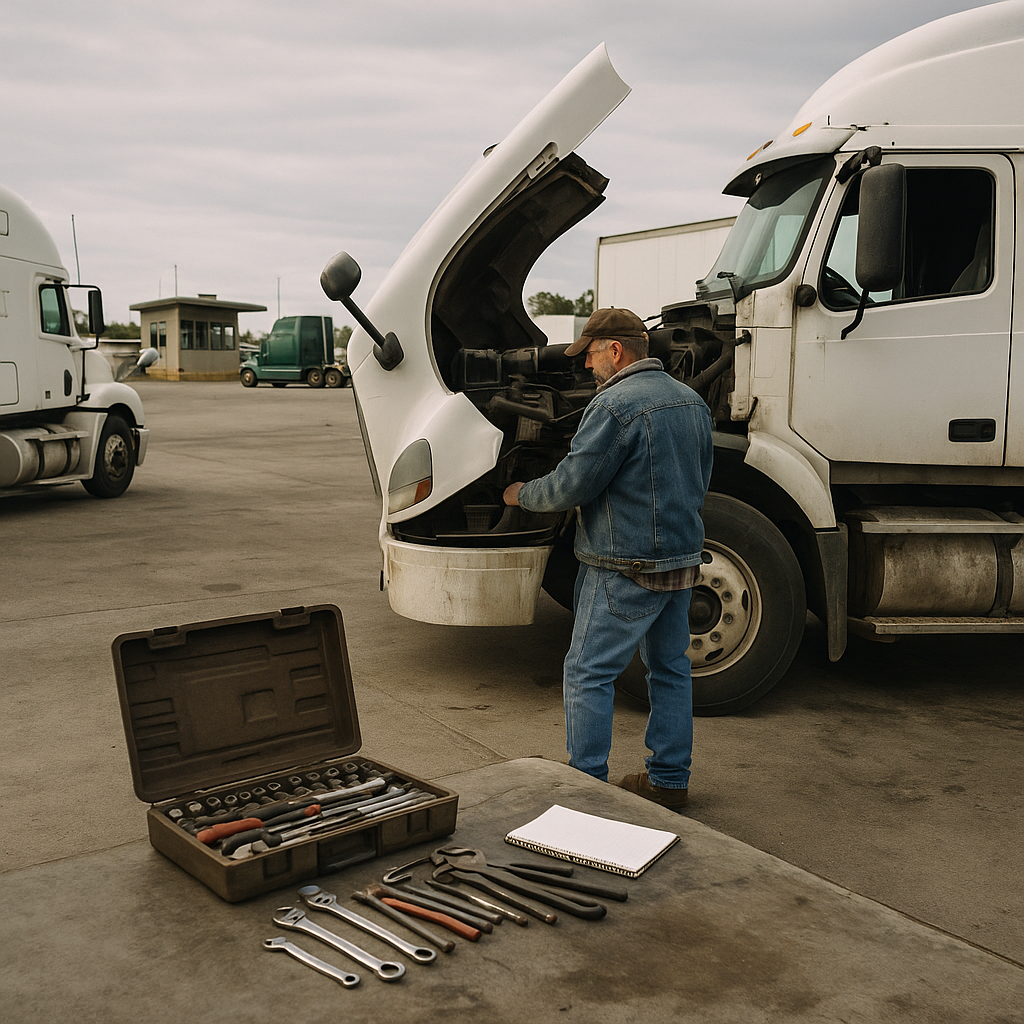

Truck equipment theft insurance helps protect business tools and gear that travel with your operation, but it usually does not mean your truck, your freight, and your loose equipment are all covered the same way. That’s where owner-operators get tripped up. This guide breaks down what coverage may protect stolen tools and gear, what usually falls out, and how to avoid filing the wrong claim.
What truck equipment theft insurance actually is#
Truck equipment theft insurance is usually a form of business property coverage that can help pay for stolen tools and equipment used in your operation. In many cases, that coverage sits under inland marine insurance, not under your truck’s liability policy or your cargo policy. The exact scope depends on the policy form, listed items, ownership, and where the gear is kept.
Tools and equipment insurance is coverage for business gear such as tools, safety equipment, electronics, and similar movable property. Inland marine insurance is a type of property coverage commonly used for business property that moves between locations or stays away from a main business premises.
That matters in trucking because the stuff you carry in the cab, side box, headache rack, or secured storage bin doesn’t always fit neatly into one insurance bucket. A set of chains, tarps, load bars, PPE, handheld scanners, jump packs, and diagnostic tools may be business equipment. They are not the same thing as the truck itself, and they are definitely not the same thing as the freight you’re hauling.
The NAIC and the Insurance Information Institute both describe this basic split: business property kept off-premises or moving around often needs a different coverage approach than property fixed at one location. In trucking, that usually means asking whether the item is mobile business equipment, part of the vehicle, or cargo belonging to someone else.
FMCSA rules come into play for trucking insurance, but not in the way many drivers think. FMCSA liability requirements under FMCSA and 49 CFR Part 387 deal with public liability for regulated carriers, not with replacing stolen tarps, tools, or PPE. So if your authority is active and your BMC filing is fine, that still doesn’t mean your truck-carried gear is insured for theft.
Tools and equipment insurance vs inland marine#
Tools and equipment insurance is often the plain-English name people use for inland marine-style coverage on movable business gear. Some policies blanket-cover many items up to a limit, while others require scheduled items listed with values.
For trucking operations, this is where the details matter. A contractor’s policy may talk about saws and compressors, while a trucking-focused need may involve binders, secure storage systems, straps, tarps, ELD-adjacent accessories, and roadside repair tools. Same basic coverage concept, different gear and different exposure.
What counts as tools and gear on a truck#
What counts as covered gear depends on the policy, but common examples include business-owned tools, tarps, PPE, securement gear, handheld electronics, and similar equipment used to operate the business. Coverage can get murkier when the item is permanently attached, rented, borrowed, or used partly for personal purposes.
A fixed truck component may belong under physical damage or another auto-related form, while a removable business tool may fit under tools and equipment coverage. That’s why the first question isn’t “Was it stolen from the truck?” It’s “What exactly was stolen?”
What it covers and what it does not cover#
Truck equipment theft insurance can cover stolen tools and gear, and some policies also cover vandalism, fire, and certain accidental damage to insured equipment. It usually does not cover wear and tear, freight you were hauling, or damage to the truck itself. The claim outcome depends on the covered peril, the item type, and the policy wording.
When this coverage applies, it commonly responds to losses like theft from a secured truck, vandalism to insured gear, and damage from named causes such as fire. Some forms may also cover accidental damage, but that’s not something to assume. You need to check whether the policy covers broad causes of loss or only specific named perils.
The Insurance Information Institute is useful here because it draws the line between mobile business property and other insurance categories. That helps explain why a stolen scanner might be one claim, while a stolen trailer full of customer freight is a totally different claim path.
Theft, vandalism, and accidental damage#
Theft is the loss most people care about, but some policies go beyond theft alone. Depending on the form, covered causes of loss may include:
- Theft
- Vandalism
- Fire
- Certain accidental damage
- Some weather-related losses
That said, insurers usually look closely at how the item was stored. An unlocked side box, gear left exposed in the bed, or vague proof that something “must have been there” can make a claim harder. If the policy has security conditions, you need to meet them.
Picture the real-world problem: you stop overnight, come back at dawn, and your side box is pried open. Your tarps, straps, cordless tools, and scanner are gone. The truck might still run, your cargo may still be there, and your liability policy is still active — but none of that automatically pays for the missing gear. If you’re not sure which bucket your equipment belongs in,
Wear and tear, cargo, and auto exclusions#
Wear and tear means gradual deterioration from normal use over time. Commercial auto insurance covers the insured vehicle and certain auto-related losses, while motor truck cargo covers freight you haul for others, subject to policy terms.
Those categories matter because stolen tools are not the same as stolen freight, and stolen freight is not the same as stolen truck parts. Common exclusions or non-covered situations often include:
- Wear and tear
- Rust, corrosion, or gradual deterioration
- Mechanical breakdown
- Unexplained loss with poor documentation
- Unsecured property
- Property covered better elsewhere under the policy structure
If someone steals customer freight from your trailer, that points toward cargo coverage, not tools and equipment coverage. If someone strips parts off the tractor, that may fall under physical damage or another auto-related form. If your load bars, PPE, and diagnostic kit disappear, that may be the tools-and-equipment question.
Who needs this coverage in trucking#
Owner-operators and small fleets may need truck equipment theft insurance when they keep business tools and gear in or around the truck and would feel the loss immediately. The need is highest when equipment travels often, gets stored overnight in the truck, or would be expensive and disruptive to replace. Owned, rented, and borrowed gear should be reviewed separately.
For a single-truck owner-operator, this often starts with the basics. Maybe you carry tarps, chains, binders, PPE, portable electronics, and a set of repair tools because downtime on the road costs more than the gear itself. If that equipment gets stolen, the hit is not just the replacement bill. It can delay your next load and keep you from operating safely.
Owner-operators with truck-based tools#
Owner-operators with truck-based gear are the most obvious fit for this conversation. If your business depends on the equipment riding with you, there’s a real exposure even if the truck itself is already insured.
This is especially true when the gear moves between the truck, home base, and shipper or receiver locations. Property that travels tends to fit more naturally into inland marine-style thinking than into basic premises-only property coverage.
Small fleets, rented gear, and mixed-use equipment#
Small fleets have an extra layer to sort out: whose gear is it, where is it kept, and who’s responsible if it disappears? One driver may have company-owned tarps, another may use personally owned tools for company work, and a third may have rented or borrowed gear.

Rented equipment is equipment you use but do not own, under a rental or lease arrangement. Borrowed equipment creates similar questions, but the insurance treatment can differ. Don’t assume a policy written for owned property automatically extends to every rented or borrowed item in the truck.
This topic applies to trucking, even though many policies are built from broader contractor or business-property forms. That’s why trucking operators need the contractor-style language translated into real truck use.
How theft coverage works in a claim#
If equipment is stolen, act fast: make sure the scene is safe, report the theft, document exactly what’s missing, and notify the insurer promptly. A solid claim usually depends on proof — police report, inventory, receipts, photos, serial numbers, and any signs of forced entry. Deductibles and valuation rules then shape what gets paid.
Start by confirming there isn’t an immediate safety issue. If locks are cut, doors are open, or the truck was entered, treat it like a crime scene before you clean up. Take photos and video before moving things around.
Then report the theft to local law enforcement. A police report is often one of the first things an insurer will ask for, and some state insurance departments also stress prompt reporting and documentation when business property is stolen. State-specific claim expectations can vary, so it’s smart to check your own state’s department of insurance or DMV guidance on theft reporting and claim handling.
Next, build your item list. Include what was taken, when you last saw it, where it was stored, serial numbers, purchase receipts, photos, and whether the item was owned, rented, or borrowed. If you have maintenance logs, app records, inventory sheets, or purchase emails, save those too.
Actual cash value is the item’s depreciated value at the time of loss. Replacement cost is the amount needed to buy a comparable new item, subject to policy terms. That difference matters because two policies can insure the same tool list and still pay very differently after theft.
Your deductible is the amount you pay out of pocket before insurance responds. A higher deductible can lower premium, but it also means a small theft loss may not clear the threshold in a meaningful way.
Fast reporting helps because facts go stale quickly. If you’re sorting through a mixed bag of truck damage, missing gear, and possible cargo issues,
before the claim gets pointed at the wrong policy.
How to decide whether you need it#
You may need truck equipment theft insurance if your gear travels often, stays in the truck overnight, or would be costly to replace out of pocket. You may not need separate coverage for every item if some property already fits under commercial property, inland marine, or a scheduled endorsement. The key is mapping each item to the right coverage bucket.
Start with three questions. What gear do you carry, where does it sleep, and how painful would it be to replace tomorrow? If the answer is “in the truck,” “all the time,” and “very,” then the exposure is real.
Then separate the equipment by use and storage. Gear that stays at a shop or yard may fit differently than gear that constantly travels. Equipment owned by the business may be treated differently from rented or borrowed property. Permanently attached items may not belong in the same bucket as removable tools.
This is also where people overbuy or underbuy. Some operators assume their commercial auto policy covers everything on or in the truck. Others buy extra coverage without checking whether a current property form or scheduled endorsement already addresses part of the risk.
The practical move is to make a simple inventory and assign each item to one of these buckets: truck, cargo, tool/equipment, or premises property. If you can’t tell which bucket fits, that’s the question to solve before buying anything else.
How to get the right policy for truck equipment#
Getting the right truck equipment theft insurance starts with a clear list of what you own, what it’s worth, where it’s kept, and how it’s secured. Insurers usually want to know whether items are owned, rented, or borrowed, whether they travel regularly, and whether any high-value equipment should be specifically scheduled. Limits, deductibles, and valuation method shape how useful the policy will be after a loss.
A good application usually starts with an equipment schedule or inventory. That means item descriptions, estimated values, serial numbers where available, and whether the property belongs to the business. You should also be ready to explain where the gear is stored during the workday, overnight, and off duty.
Security matters too. Locked boxes, alarmed yards, cameras, documented storage procedures, and proof that gear isn’t left exposed can all affect how an underwriter sees the risk. So can the type of operation, radius, and how often equipment moves between locations.
Limits are the maximum the policy can pay for a covered loss. If your limit is too low, a large theft may leave you short even if the claim is covered. Deductibles change the out-of-pocket hit, and the valuation method changes what “paid” actually means.
Focus less on chasing the lowest sticker price and more on getting the right form. A cheaper policy that excludes the way you actually store and use equipment can be expensive the day you need it.
FAQ#
Does insurance cover stolen equipment?
Yes, insurance can cover stolen equipment, but only if the item fits the right policy form and the theft falls within that policy’s terms. In trucking, that usually means separating business tools and gear from freight, truck parts, and general vehicle damage. A stolen tarp kit or scanner may point toward tools and equipment or inland marine-style coverage, while stolen customer freight points toward cargo and stolen truck components may point toward auto physical damage. The details that matter most are ownership, storage, documentation, and the exact cause of loss.
How much does a $1,000,000 liability insurance policy cost?
There isn’t one flat answer because liability premium depends on the operation behind the limit, not just the limit itself. For trucking, your actual premium depends on your operation, cargo, radius, driving history, equipment, filings, and whether you run interstate or intrastate. Under 49 CFR Part 387, FMCSA minimums vary by carrier type, weight, and commodity, so a $1,000,000 policy is not a universal requirement. The better question is whether that limit matches your operation and contractual needs, then price the full insurance structure around it.
Can I insure a piece of equipment for business?
Yes. A single piece of business equipment can often be insured, especially if it moves with the truck or between locations. Depending on the item and how it’s used, that may be done through tools and equipment coverage, inland marine insurance, commercial property, or a scheduled endorsement. The key details are whether you own it, where it’s stored, whether it travels, and how it would be valued after a loss. High-value items are often easier to insure correctly when they’re specifically listed rather than assumed under a broad unscheduled limit.
What kind of insurance covers the loss of a business’s equipment?
The most direct fit is usually tools and equipment coverage, often written through inland marine insurance for movable business property. If the equipment stays mostly at one location, commercial property insurance may be the better fit. If the loss involves freight being hauled for someone else, that points toward cargo coverage instead. If it involves the truck itself or attached vehicle parts, that may fall under commercial auto physical damage. The right answer depends less on the word “equipment” and more on what the item is, where it lives, and how the business uses it.
Is equipment kept in a truck covered the same as equipment stored at a business location?
Not always. Equipment stored at a fixed business location may fit under commercial property coverage, while equipment that regularly travels with the truck often fits better under inland marine or tools and equipment coverage. The same item can be treated differently depending on whether it’s mainly off-premises, regularly mobile, or specifically scheduled. That’s why trucking operators shouldn’t assume a shop policy automatically follows gear onto the road. If your operation runs from the cab, the mobile-property angle matters a lot more than it does for a business that keeps everything in one building.





