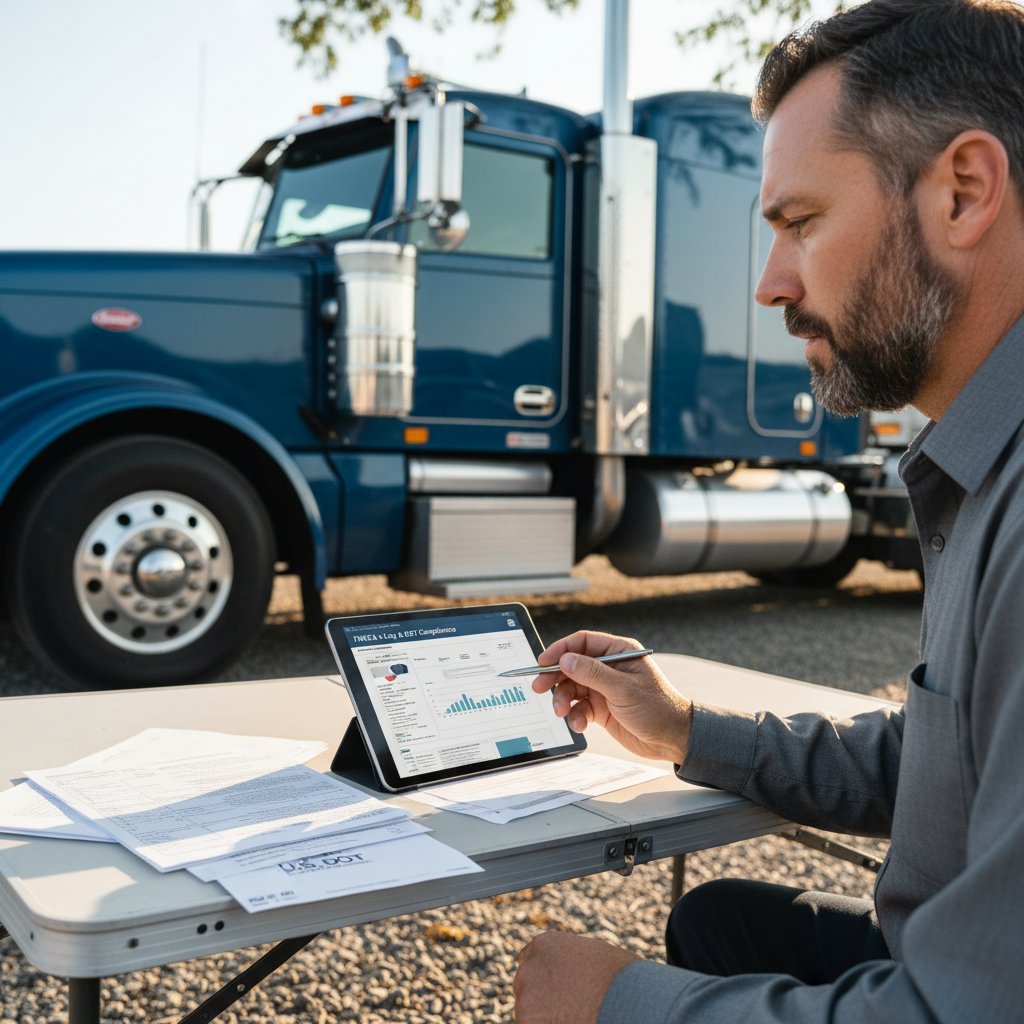
Don’t guess on trucking insurance or DOT compliance. Learn DOT requirements for trucks, USDOT/MC basics, equipment checklists, and HOS tips—then get a Logrock quote.
DOT requirements for trucks aren’t “red tape”—they’re the rules that decide whether you keep rolling or get parked with an out-of-service order. If your truck is 10,001+ lbs GVWR/GCWR and you operate interstate (or meet certain intrastate triggers), you’re typically subject to FMCSA safety regulations. Core DOT requirements include a USDOT number, driver qualification (CDL/med card as applicable), HOS/ELD compliance, regular vehicle inspections/maintenance, required emergency equipment, proper cargo securement, and correct operating authority/filings when for-hire.
If you’re lining up coverage while you’re getting compliant, this guide pairs well with commercial truck insurance requirements by authority type so your filings, COIs, and limits match what brokers actually request.
Quick takeaways (owner-operator reality check):
- The 10,001-lb trigger matters: many pickup + trailer (hotshot) combos fall under DOT rules faster than people think.
- USDOT ≠ MC: a USDOT number identifies you; MC authority is permission to operate for-hire interstate in many cases.
- Compliance protects your rates: violations and out-of-service events can raise commercial truck insurance costs at renewal.
- Most roadside issues are preventable: triangles, lights, annual inspection, and clean logs are all weekly-checklist items.
Table of Contents
Reading time: 9 minutes
- Step 1: Do DOT rules apply to your truck? (CMV test)
- Step 2: USDOT number vs. MC authority (and what brokers expect)
- Step 3: Driver compliance: CDL, medical card, Drug & Alcohol Clearinghouse, HOS/ELD
- Step 4: Truck + trailer requirements: inspections, maintenance, and required safety equipment
- Step 5: Cargo securement + weight limits (what gets drivers written up)
- What happens at a DOT roadside inspection? (Be ready in 2 minutes)
- How DOT compliance impacts affordable trucking insurance
- The Logrock Difference: Compliance-minded trucking insurance
- Frequently Asked Questions
- Conclusion: Stay legal, stay rolling
Step 1: Do DOT Requirements Apply to Your Truck? (The CMV Test)
FMCSA generally treats a vehicle as a commercial motor vehicle (CMV) for property hauling when it’s used in interstate commerce and has a GVWR/GCWR of 10,001+ lbs (49 CFR 390.5). The fastest way to get burned is assuming “I’m just one truck” means you’re under the radar.
Here’s the practical CMV test most owner-operators should memorize, because it matches how enforcement thinks at roadside.
| If you’re doing this… | DOT/federal compliance usually applies when… | Real-world example |
|---|---|---|
| Hauling property (cargo) | GVWR/GCWR 10,001+ lbs | 1-ton dually (14k GVWR) pulling a 20k trailer (hotshot) |
| Hauling passengers | 9+ passengers for compensation or 16+ not for compensation | Shuttle/charter operations |
| Hauling hazmat | Any quantity requiring placards | Placarded fuel/chemicals |
Interstate vs. intrastate: don’t assume you’re exempt
FMCSA rules are federal, but many states adopt similar thresholds for intrastate operations. If you only run in one state, check your state DOT guidance and enforcement patterns—especially if you run near state lines.
Pro tip (cash-flow protection): If you’re close to the 10,001+ threshold with a pickup + trailer combo, don’t guess your weights. Look at the door sticker GVWR on the truck and the VIN tag on the trailer—enforcement uses ratings, not what you think you weigh today.
Step 2: USDOT Number vs. MC Authority (and What Brokers Expect)
FMCSA uses a USDOT number to identify carriers in its safety tracking systems, while MC operating authority is required for many for-hire interstate carriers to legally haul regulated freight under their own authority. A lot of new authorities mix these up and end up paying for the wrong thing first.
1) USDOT number (identification)
- What it is (plain English): your business “ID number” for safety tracking and compliance.
- Why it matters: if you need it and don’t have it, you can get cited, parked, and rejected by shippers/brokers.
- Who typically needs it: many carriers operating CMVs interstate, and many intrastate carriers depending on state rules.
2) MC number / motor carrier authority (permission to operate for-hire interstate)
- What it is: authority to haul regulated freight for-hire interstate (common/contract carriage in many situations).
- Why it matters: without authority (when required), you can lose broker relationships and face enforcement actions.
- Who typically needs it: for-hire interstate carriers operating under their own authority.
3) The “other stuff” that trips up new authorities
These aren’t optional if you’re running your own authority in many setups:
- BOC-3 (process agent filing)
- UCR (Unified Carrier Registration)
- Insurance filings (often required to activate/maintain authority)
- State-specific permits (HVUT, KYU, NM, and others depending on lanes)
If you want an insurance-specific breakdown, see: commercial truck insurance requirements by authority type.
Don’t let a filing mistake park your truck: we’ll help line up coverages and filings so you stay compliant and broker-ready.
Step 3: Driver Compliance: CDL, Medical Card, Drug & Alcohol Clearinghouse, HOS/ELD
FMCSA driver compliance typically includes CDL qualification thresholds (often 26,001+ lbs GCWR for Class A setups), a valid medical qualification when required, drug/alcohol program obligations when applicable, and accurate Hours of Service records that match supporting documents. Your truck can be perfect and you’ll still get lit up at roadside if your driver file (even if that driver is you) is missing basics.
1) CDL requirements (the thresholds that matter)
Most confusion comes from combined ratings, especially in pickup + trailer and hotshot operations.
| License | Typical requirement | Common owner-op example |
|---|---|---|
| Class A CDL | GCWR 26,001+ lbs and trailer GVWR 10,001+ lbs | Tractor-trailer, many hotshot combinations |
| Class B CDL | GVWR 26,001+ lbs with trailer ≤ 10,000 lbs | Straight truck, some dump/box setups |
| Endorsements | Hazmat, tanker, doubles/triples, passenger (as applicable) | Placarded hazmat = higher compliance burden |
Pro tip: Enforcement uses rated GVWR/GCWR, not “scale weight today.” If your combo is rated over the line, plan like you’re over the line.
2) Medical card (DOT physical)
- What it is: medical qualification to operate a CMV under DOT rules.
- Why it matters: no valid medical qualification can trigger out-of-service on the spot.
- Who typically needs it: most CMV drivers, with some state/federal exceptions.
3) Drug & Alcohol Clearinghouse (FMCSA)
If you operate as a motor carrier subject to DOT drug testing rules, you’re dealing with compliance items like:
- Clearinghouse registration
- Consortium/third-party administrator (C/TPA) enrollment for random testing (when applicable)
- Pre-employment queries and annual queries (as required for your driver situation)
This is one of those areas where “I didn’t know” doesn’t matter.
4) Hours of Service (HOS) + ELD basics
Most roadside problems come from sloppy logs, wrong exemptions, or logs that don’t match supporting documents.
- If you’re required to use an ELD, use one that’s registered and compliant.
- Don’t “edit your way out” of bad planning—dispatch and trip planning matter more than log gymnastics.
- Keep supporting docs organized (fuel, BOLs, tolls, rate confirmations).
Real-world scenario: If you’re running spot market and detention burns your clock, you can’t safely “make it up” later without adding risk. Build detention into the rate confirmation and negotiate it—your clock is money.
For planning that protects your schedule and your CPM, pair this with: how to reduce deadhead and protect your cost-per-mile.
Step 4: Truck + Trailer Requirements: Inspections, Maintenance, and Required Safety Equipment
FMCSA requires carriers to systematically inspect, repair, and maintain CMVs and to document periodic inspections under 49 CFR Part 396, which is why brakes, tires, lights, and steering issues routinely trigger out-of-service decisions. This is where owner-operators can win, because equipment issues are often cheap to prevent and expensive to ignore.
1) Annual DOT inspection + maintenance records
- What it is: periodic inspection requirements (often annual) plus proof you’re maintaining the equipment.
- Why it matters: brakes, tires, lights, and steering are classic out-of-service triggers.
- Who needs it: CMVs under DOT rules—truck and often trailer, depending on configuration.
Pro tip: Keep a simple maintenance folder (digital is fine): annual inspection report, brake work, tire receipts, and a PM schedule. If you use an app, export PDFs monthly so you’re not scrambling when your phone dies.
2) Pre-trip/post-trip (DVIR) discipline
You don’t need a fancy process—you need a consistent one.
- Same walk-around route every time
- Fix light issues before night runs
- Don’t ignore air leaks “because it still builds pressure”
3) DOT-required emergency equipment (what they actually ask for)
At roadside, inspectors commonly check for emergency gear. A practical minimum kit includes:
- Fire extinguisher (properly charged and mounted)
- Warning devices (reflective triangles)
- Spare fuses (for older setups; modern equipment may vary)
Owner-op reality: This is cheap insurance against downtime. Keep it clean, accessible, and not buried under straps.
Step 5: Cargo Securement + Weight Limits (What Gets Drivers Written Up)
FMCSA cargo securement rules in 49 CFR 393 Subpart I require loads to be secured so they don’t shift under normal driving forces, and weight/axle limits are enforced by states and at many scales regardless of how “close” you are. Cargo securement is one of the fastest ways to turn a profitable load into a headache.
When freight shifts, you’re not just facing a ticket—you’re risking a claim that can spike trucking insurance rates.
1) Securement: the “performance standard” in plain English
Your securement must prevent the load from shifting under hard braking, swerving, and bumps. Practical takeaways:
- Use rated straps/chains and know your WLL (working load limit).
- Protect straps from edges (corner protectors are cheap).
- Re-check securement after the first 50 miles and at regular stops.
2) Commodity-specific rules (where people get burned)
Certain freight types get extra scrutiny:
- Machinery/equipment with high center of gravity
- Steel coils
- Lumber and building materials
- Vehicles and partials
If you run open deck or hotshot, build a standard securement kit per freight type and don’t “make it work” with random leftovers.
3) Weight: axles, GVW, and “close enough” isn’t a strategy
Even if your gross is legal, axle distribution can still be illegal. Use:
- CAT scales (or onboard/portable scales if you run consistent freight)
- A repeatable loading plan (especially for hotshot trailers)
Pro tip: If you’re frequently reworking loads to scale out, that’s a pricing problem. Add the time into your rate math or avoid those shippers.
What Happens at a DOT Roadside Inspection? (Be Ready in 2 Minutes)
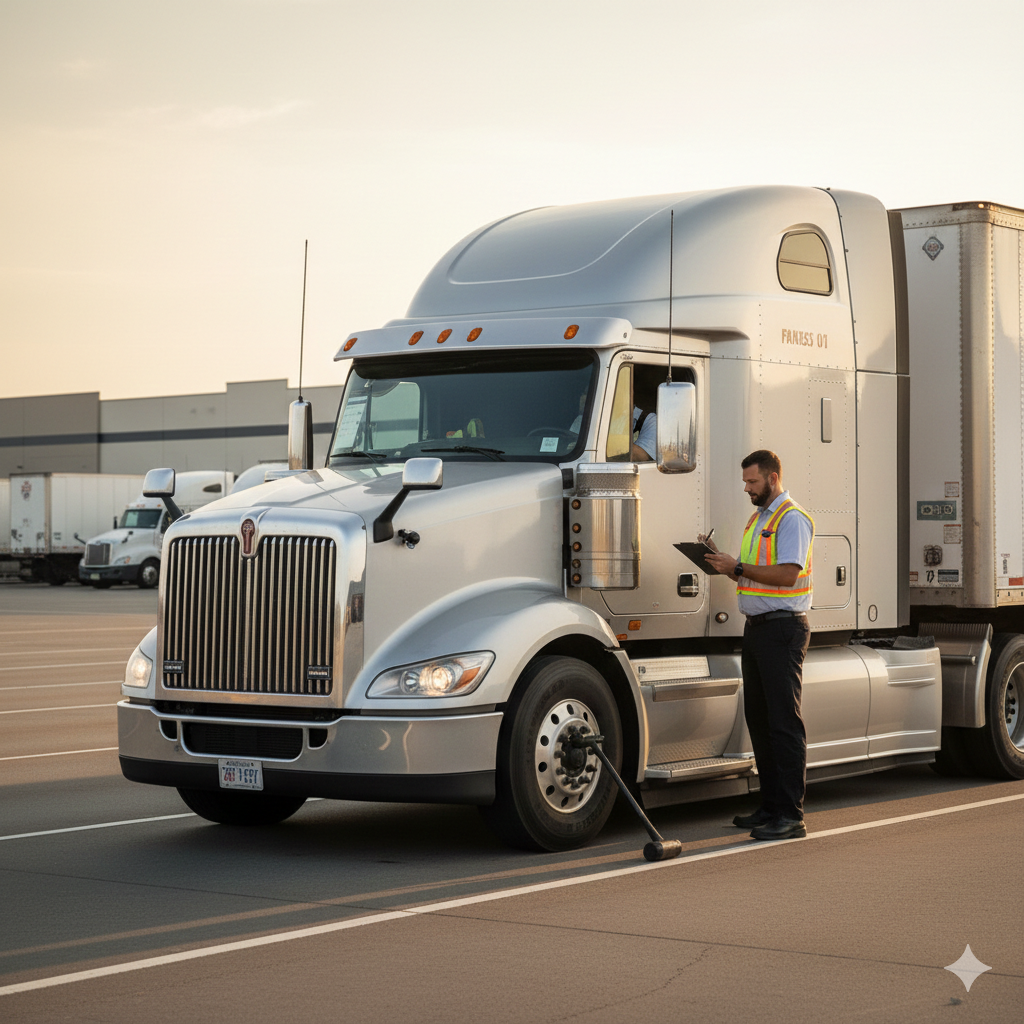
A DOT roadside inspection can follow CVSA North American Standard levels (commonly Level I–III) and can place a driver or vehicle out of service immediately for critical violations like HOS issues, unsafe equipment, or missing qualifications. When you pull into a scale or get pulled over, speed and organization keep it from turning into a 45-minute fishing expedition.
Have these ready (paper or digital, but accessible without fumbling):
- Driver’s license (and CDL if required) + medical card status
- Registration + cab card/plates as applicable
- Proof of insurance (ID cards/COI as needed)
- BOL/rate confirmation (matches what you’re hauling)
- ELD info / instruction packet (if required)
- Annual inspection documentation and basic maintenance proof
- Permits (oversize/overweight, trip permits, etc. if applicable)
Real-world note: A clean, calm, organized presentation often shortens the interaction. Inspectors see chaos all day—don’t be chaos.
How DOT Compliance Impacts Affordable Trucking Insurance (Yes, It’s Connected)
DOT violations and out-of-service orders can appear in FMCSA safety data and are commonly reviewed by underwriters, brokers, and shippers when pricing or approving commercial truck insurance. If you’re trying to find affordable trucking insurance, compliance is part of the pricing conversation whether you like it or not.
- Violations raise your risk profile: HOS issues, equipment violations, and out-of-service events can influence underwriting decisions.
- Claims get uglier when you’re non-compliant: a crash plus bald tires or falsified logs is a bad day in court.
- Brokers care: poor safety history can mean fewer load options or tougher onboarding.
What to do this week to protect your rates
- Fix “cheap” violations immediately (lights, reflective tape, tires).
- Run a weekly compliance reset: med card, ELD updates, permits, emergency kit.
- Document maintenance like a business owner (because you are one).
If you’re comparing coverages, start here: semi truck insurance coverages explained (plain English).
The Logrock Difference: Compliance-Minded Trucking Insurance for Owner-Operators
Many broker and shipper contracts commonly require $1,000,000 in auto liability and often $100,000 in cargo coverage, and they may require same-day COIs before dispatch. Logrock focuses on keeping you insurable, broker-ready, and profitable—because one bad claim or one compliance mess can wipe out a month of margin.
What that looks like in real life:
- Coverage guidance based on your operation (power unit, trailer, radius, cargo, hotshot vs. semi)
- Fast Certificates of Insurance (COIs) so you can book the load—not lose it
- Straight talk on limits brokers actually require (and where you can save money)
Whether you need hotshot insurance for a 1-ton + trailer setup or full commercial truck insurance for a tractor-trailer, the goal is the same: protect your authority and your cash flow.
Frequently Asked Questions
FMCSA and state DOT enforcement relies on objective thresholds—like 10,001+ lbs for many CMV triggers and 26,001+ lbs for many CDL thresholds—so these answers use those numbers to stay clear and citation-ready.
If you operate a CMV in commerce at 10,001+ lbs GVWR/GCWR and run interstate, you typically need a USDOT number under FMCSA rules, and many states apply similar requirements for intrastate operations. The safest way to confirm is to compare your truck and trailer rated weights (door sticker GVWR and trailer VIN tag) to the threshold, because roadside enforcement uses ratings, not “scale weight today.” Pickup + trailer (hotshot) setups often trigger USDOT requirements even when the driver thinks they’re “non-CDL.” When in doubt, verify with your state DOT and your operating lanes before your first load.
DOT-compliant CMVs must be operated with required safety equipment and maintained to pass inspection, and inspectors commonly check for a charged, mounted fire extinguisher and approved warning devices (reflective triangles). Beyond emergency gear, roadside focus is usually on what causes crashes: lights, brakes, tires, steering/suspension, and whether your load securement matches the freight. The most practical approach is to keep emergency equipment accessible (not buried), fix light issues before night runs, and document maintenance so you can show a consistent safety program if an inspection turns detailed.
A CDL is commonly required when the GCWR is 26,001+ lbs and the trailer is 10,001+ lbs (often Class A), or when a straight truck is 26,001+ lbs GVWR (often Class B), with additional triggers for passenger and hazmat operations. The key detail is that enforcement uses rated GVWR/GCWR, not just what you weigh on a scale that day. That’s why some “non-CDL” hotshot combinations still require a Class A CDL based on the truck and trailer ratings. Always verify endorsements if you haul hazmat, tank, doubles, or passengers.
You keep affordable trucking insurance by reducing preventable risk signals that underwriters and brokers can see, especially out-of-service violations, repeat equipment defects, and inconsistent HOS/ELD records. A simple weekly system works: fix lights/tires/brakes early, keep your annual inspection and maintenance records organized, and run logs that match supporting documents like fuel and BOLs. Cargo securement matters too—one load shift claim can raise premiums at renewal. If you want a practical playbook that ties operations to pricing, read affordable trucking insurance strategies for owner-operators.
Conclusion: Stay Legal, Stay Rolling (and Keep Your Rates Under Control)
For most interstate property operations, DOT requirements for trucks start at 10,001+ lbs GVWR/GCWR and expand into driver qualification, HOS/ELD compliance, inspections/maintenance, cargo securement, and the correct authority/filings when for-hire. DOT compliance boils down to knowing whether you’re a CMV, getting the right identifiers/authority, keeping your driver and equipment compliant, and not giving inspectors easy wins.
Key Takeaways:
- Know the 10,001+ lb CMV trigger and apply it using rated GVWR/GCWR (not guesses).
- Separate USDOT identification from MC authority and required filings like BOC-3/UCR when applicable.
- Treat maintenance, logs, and securement like profit-protection—not paperwork.
If you’re building a long-term operation, compliance isn’t optional—it’s how you protect your authority, your cash flow, and your ability to get commercial truck insurance that doesn’t crush your CPM.
Get a trucking insurance quote that matches your operation: tell us what you haul, where you run, and how you’re set up (hotshot, semi, power only). We’ll quote it straight and help you avoid coverage gaps that blow up at claim time.