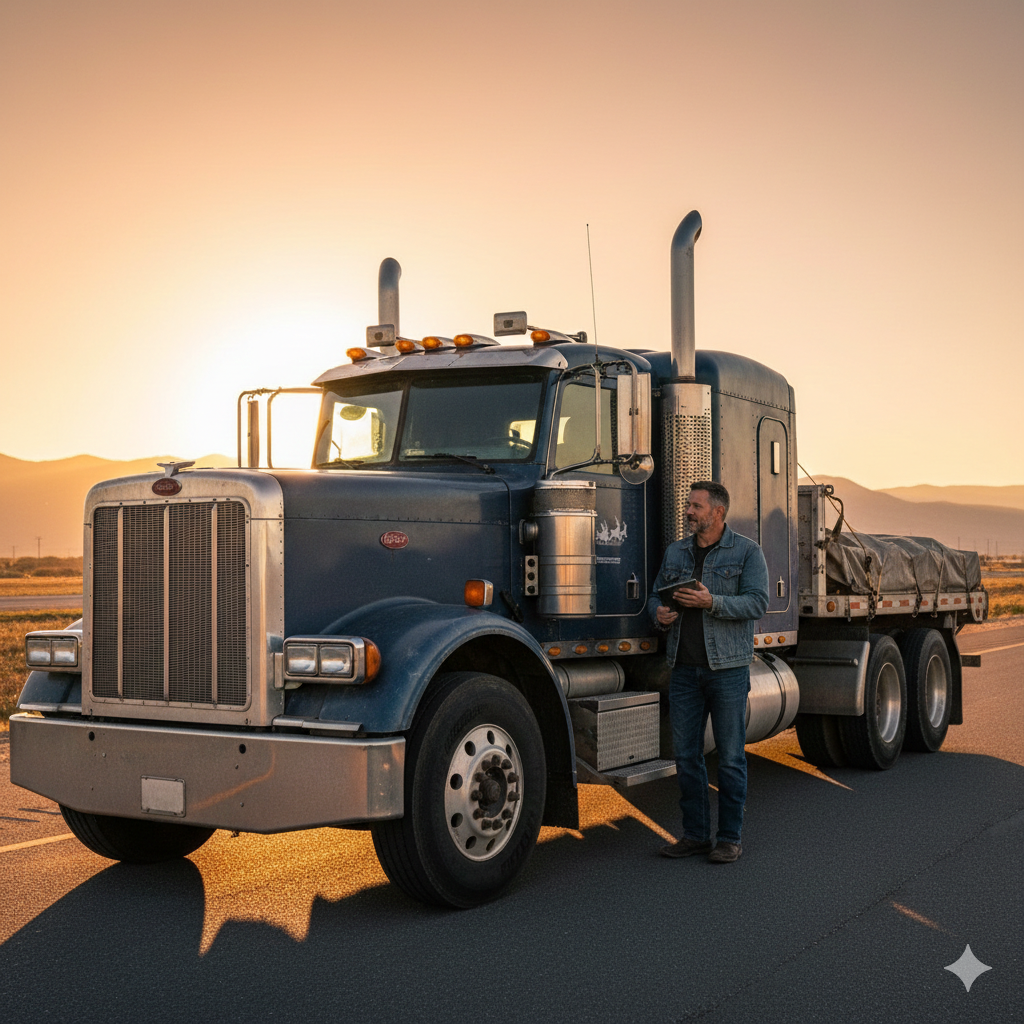
Buying a used semi-truck? Compare practical 2026-ready models by job type, avoid inspection red flags, and estimate commercial truck insurance costs before you sign.
Commercial truck insurance can change what the “best” used semi-truck is, because the deal isn’t real until the truck is insurable, financeable, and dispatch-ready. The best used semi-truck to buy in 2026 is the one that matches your lanes, has verifiable maintenance history (especially emissions/aftertreatment), and keeps your total cost of ownership (TCO) predictable.
Buying a used tractor is a cash-flow decision first and a comfort decision second. If you want to avoid the classic trap—cheap purchase price, expensive downtime—use the decision matrix, model picks, TCO math, and inspection checklist below, then confirm insurance pricing with the VIN and unit value before you commit.
Essential Used Semi-Truck Buying Rules
- “Best” depends on your operation: OTR, regional, and vocational work punish trucks differently—spec to your lanes, not your ego.
- TCO beats purchase price: A “cheap” truck can be your most expensive asset if it drives downtime, fuel burn, and repairs.
- Emissions era matters: 2010+ trucks (DPF/SCR/DEF) can be great when maintenance records are clean and aftertreatment risk is understood.
- Insurance and financing can make or break the deal: Lenders and insurers often require specific coverages and deductibles before you can roll.
Table of Contents
Reading time: 9 minutes
- The Best Used Semi-Truck to Buy Depends on Your Freight (Decision Matrix)
- Best Used Semi-Truck Models (Practical Picks by Category)
- Total Cost of Ownership (TCO): The Numbers That Decide If You’ll Profit
- Used Semi-Truck Inspection Checklist (Red Flags That Wreck Cash Flow)
- Where to Buy a Used Semi-Truck (Dealer vs Auction vs Private Sale)
- Don’t Ignore the Insurance Angle: How Commercial Truck Insurance Changes the “Best Truck” Decision
- Frequently Asked Questions
- The Logrock Difference: Insurance Built for Business Owners
- Conclusion & Get a Quote Before You Buy the Truck
The Best Used Semi-Truck to Buy Depends on Your Freight (Decision Matrix)
A practical way to choose the best used semi-truck is to match specs to your operation type (OTR, regional, vocational) and weekly mileage range (often 1,800–3,000+ miles for long-haul), because wear patterns and downtime risk change by duty cycle.
Before you pick a brand, pick a job. The “best used semi” for a dedicated regional route can be the wrong tool for OTR or heavy start/stop work.
| Your Operation | What You Should Prioritize | What Usually Hurts Profit |
|---|---|---|
| OTR / Long-haul (1,800–3,000+ miles/week) | Fuel economy, driver comfort, parts availability, clean maintenance history | High idle hours, neglected PMs, unknown aftertreatment history |
| Regional / Short-haul (more stops, home more) | Cooling system health, brakes/suspension, easy service access | Stop-and-go wear, regen issues if it never gets hot/steady |
| Owner-op leased on (carrier dispatch) | Simplicity, predictable uptime, specs your carrier prefers | Buying a “unicorn spec” that dispatch/brokers dislike |
| Vocational (dump, mixer, heavy start/stop) | Frame/suspension, PTO readiness, durability | Buying an aero highway tractor and expecting it to live in a quarry |
| Hotshot (1-ton/medium duty, not a semi) | Payload legality, brakes, maintenance discipline | Underinsuring and overloading—both end careers fast |
Practical move: If you’re unsure what lanes you’ll actually run, build your plan from real load history (DAT/Truckstop) and your parking reality (Trucker Path). The truck should serve the lanes—not the other way around.
Best Used Semi-Truck Models (Practical Picks by Category)
The best used semi-truck models for 2026 are typically high-volume fleet platforms with nationwide parts availability and documented maintenance, because fast repairs often matter more than brand loyalty when downtime costs $1,000+ per day in lost revenue.
These aren’t “fan favorites.” They’re commonly available, widely serviceable, and usually easier to keep on the road—assuming you buy the right unit.
1) Freightliner Cascadia (Most Practical All-Around OTR/Regional Choice)
- What it is (plain English): The most common modern fleet tractor on the road—parts and service are everywhere.
- Why it’s essential (business risk): Common trucks are easier to fix fast, and downtime is the real bill.
- Who it’s for: OTR and regional owner-operators who want max uptime and simpler sourcing.
- Veteran advice: Don’t fall in love with one listing—shop condition and records. A clean-maintained Cascadia beats a neglected anything.
2) Volvo VNL (Driver Comfort + Efficiency, Strong Choice When Maintained Right)
- What it is: A popular long-haul truck known for comfort and fuel economy.
- Why it’s essential: Comfort reduces fatigue and helps you run safe (and legal) under HOS/ELD pressure.
- Who it’s for: OTR drivers who value ride quality and stay disciplined on maintenance intervals.
- Veteran advice: Buy based on maintenance documentation, not dashboard shine. No paperwork usually means deferred maintenance.
3) Kenworth T680 / Peterbilt 579 (Premium Aero Spec for OTR/Regional)
- What it is: Aerodynamic highway tractors that can do very well on fuel and resale when spec’d right.
- Why it’s essential: Better aero and gearing can reduce fuel burn—fuel is often the biggest variable cost.
- Who it’s for: OTR/regional operators who run steady miles and want a truck that can hold value.
- Veteran advice: “Premium” doesn’t mean “maintenance-free.” Confirm aftertreatment service history and suspension/brake wear.
4) Kenworth T800 / W900 & Peterbilt 389/379 (Value-Holding Icons—But Run the Numbers)
- What it is: Traditional-style trucks that often hold value and have loyal buyers.
- Why it’s essential: Resale can be strong, but purchase price, fuel economy, and insurance can be higher.
- Who it’s for: Operators who know their lanes and want a truck that’s easier to sell later.
- Veteran advice: If your freight pays average rates, don’t buy a “statement truck” that requires “statement revenue.”
5) International ProStar (Budget-Friendly—Proceed Carefully and Inspect Hard)
- What it is: A common used-market truck that’s often priced attractively.
- Why it’s essential: Lower entry price can help cash flow—if it isn’t a deferred-maintenance trap.
- Who it’s for: Buyers with strong inspection discipline and a real repair reserve fund.
- Veteran advice: If you can’t afford a paid inspection, you can’t afford the truck.
Total Cost of Ownership (TCO): The Numbers That Decide If You’ll Profit
Total cost of ownership (TCO) for a used semi-truck includes fuel, maintenance/repairs, downtime, financing, insurance, and resale value over a 24–36 month horizon, not just the purchase price.
A used truck is a small business asset. Price is just the down payment on your operating costs.
| Cost Category | What to Estimate | Why It Matters |
|---|---|---|
| Fuel | MPG × weekly miles × fuel price | Fuel swings can erase profit faster than almost anything |
| Maintenance/Repairs | Tires, brakes, PMs, injectors, DEF/DPF items | Used trucks punish operators with no reserve fund |
| Downtime | Lost revenue per day × expected shop days | A “cheap” truck that’s down is expensive |
| Financing | Payment + required coverages | Lenders often require comp/collision and tighter deductibles |
| Insurance | Commercial truck insurance / trucking insurance premiums | New ventures, new authority, and certain cargo can spike rates |
| Resale/Depreciation | Expected value in 24–36 months | Exit strategy matters if you plan to upgrade |
Rule that keeps you alive: Build a repair reserve like it’s a bill. If you’re not setting aside money weekly, the truck will “set it aside” for you—at the worst possible time.
Simple truth: A higher payment on a more reliable truck can beat a lower payment on a downtime truck, because you can’t earn with a truck sitting behind the shop.
Used Semi-Truck Inspection Checklist (Red Flags That Wreck Cash Flow)
A defensible used semi-truck purchase requires an independent pre-purchase inspection plus ECM data review, because a walkaround finds leaks while data exposes abuse, high idle hours, and recently cleared fault codes.
If you do nothing else, do this: pay for an independent inspection and pull ECM data. A good walkaround catches leaks; data catches lies.
1) Paperwork You Must Verify (Before You Even Start It)
- Maintenance records: PM intervals, major repairs, and aftertreatment service.
- Engine hours + idle hours: High idle often means higher wear and more DPF headaches.
- Title/VIN checks: Salvage, flood, odometer issues.
- Warranties: Confirm what transfers (and what doesn’t).
2) Engine + Aftertreatment (Where Big Bills Live)
- Blow-by check and fluid condition (oil/coolant).
- Cooling system pressure and leaks (small leaks become tows + missed loads).
- DPF/SCR/DEF system service history (critical on 2010+ emissions trucks).
- Any active/cleared fault codes (don’t accept “we cleared it” as an answer).
3) Drivetrain + Chassis (The “It Drives Fine” Trap)
- Transmission behavior under load (not just empty yard driving).
- Differential leaks/noise.
- Suspension wear (bushings, airbags).
- Frame condition (especially if it ever did vocational work).
4) Tires, Brakes, and Alignment (Immediate Cash Outlay)
- Uneven tire wear can indicate alignment or suspension issues.
- Brake thickness and rotor/drum condition.
- Steer tires tell the truth—don’t ignore them.
5) Test Drive Like a Business Owner
- Get it to operating temp.
- Watch boost, temps, and regen behavior.
- Listen for vibration under load and during decel.
For a compliance-ready maintenance mindset, keep your documentation organized and easy to retrieve. In 2026, clean records help with resale, financing, and explaining maintenance decisions after roadside inspections.
Where to Buy a Used Semi-Truck (Dealer vs Auction vs Private Sale)
The safest place to buy a used semi-truck is the source that matches your risk tolerance and inspection process, because “sold as-is” terms are common at dealers, auctions, and private sales.
Each source has a different risk profile—like different shippers. There’s no universal “best,” only what you can manage.
| Source | Upside | Downside | Best For |
|---|---|---|---|
| Franchise/large dealer | More reconditioning, financing options | Higher price; still “sold as-is” in many cases | Buyers who want fewer surprises |
| Independent dealer | Deals exist; flexible | Quality varies widely | Buyers who can inspect hard |
| Auction | Lower prices; lots of inventory | Highest risk; limited test time | Experienced buyers with cash + a strict inspection process |
| Private sale | Sometimes best-maintained trucks | Limited recourse if problems show up | Buyers who can verify records and pay for an inspection |
Practical move: Before you travel, request photos of DOT inspection stickers, tire date codes, maintenance invoices, and the dash showing hours/miles. If a seller can’t provide basic proof, assume you’ll find surprises.
Don’t Ignore the Insurance Angle: How Commercial Truck Insurance Changes the “Best Truck” Decision
Commercial truck insurance pricing is driven by your authority status, driver experience, operating radius, cargo class, and vehicle value, and FMCSA requires at least $750,000 in interstate for-hire public liability for general freight under 49 CFR Part 387.
A used truck purchase isn’t approved when the seller takes your money—it’s approved when you can insure it, finance it, and get it dispatched.
1) New Venture / New Authority Often Pays More
If you’re starting fresh, trucking insurance is often one of your biggest fixed costs. Some truck specs and operations (certain cargo, radius, or inexperienced drivers) push premiums up enough that your “great deal” isn’t a deal anymore.
2) The Truck’s Value Affects Physical Damage (Comp/Collision)
If you’re financing, lenders usually require physical damage coverage (comprehensive and collision). Newer or higher-value trucks can mean higher premiums, but they can also mean fewer breakdowns—this is why you compare TCO, not just payments.
3) Cargo Type and Radius Drive Underwriting
Hauling general freight isn’t the same as hauling high-value electronics or regulated hazmat. The truck that fits the job must also fit what insurers are willing to write at a survivable price.
If you’re also running smaller equipment, hotshot insurance is its own lane (different vehicle class, different underwriting). Don’t assume your buddy’s numbers apply to your operation.
Want to know if that truck will be affordable to insure before you buy it?
Send the year/make/model, unit value, operating radius, and cargo type—then we’ll map the real-world commercial truck insurance cost so you don’t get trapped after you sign.
Frequently Asked Questions
You should verify maintenance records, engine/idle hours, and pay for an independent pre-purchase inspection with ECM data review, because those items reveal the most expensive risks (deferred maintenance and aftertreatment problems on 2010+ emissions trucks). Also confirm the business-side requirements before you commit: lender physical damage (comp/collision), your carrier’s preferred specs, and whether the VIN and unit value keep commercial truck insurance within your target CPM. A clean-looking truck without paperwork is a risk, not a bargain.
Used semi-trucks hold value best when they’re common-spec, well-documented units with steady demand, which often includes mainstream aero fleet tractors and “icon” platforms that have consistent buyer pools. In real life, resale is driven less by the badge and more by condition + records + common specs—because odd wheelbases, unusual gearing, or unpopular sleeper setups can narrow your buyer list and reduce sale price. If you plan to upgrade in 24–36 months, prioritize documentation and spec simplicity.
There’s no single “right” price for a used semi-truck because mileage, engine hours, maintenance history, and market cycles move the number quickly, so the better test is whether the payment plus a repair reserve and commercial truck insurance still leaves a safe margin per mile. Run a simple profit check: expected revenue per mile minus fuel, maintenance reserve, truck payment, and insurance. If it’s thin on paper, it usually turns negative after deadhead, detention, and one unplanned shop week.
Reliable used semi-trucks are usually the ones with proven maintenance history and strong parts support, which is why high-volume platforms from Freightliner, Volvo, Kenworth, and Peterbilt often feel like “safer bets” in the field. The brand matters less than the evidence: PM intervals, repair invoices, and aftertreatment service records—especially on 2010+ DPF/SCR/DEF trucks where one neglected system can create repeat downtime. If the seller can’t document maintenance, assume you’ll be paying to catch up.
The best place to buy a used semi-truck depends on how much risk you can manage: large dealers can reduce surprises with more reconditioning (usually at a higher price), private sales can be excellent when records are verifiable, and auctions are often the cheapest and riskiest. A smart middle ground is to shop widely online, then filter hard using documentation requirements before you travel. For a financing-and-insurance readiness checklist, see this planning guide.
The Logrock Difference: Insurance Built for Business Owners
Operationally accurate trucking insurance is built from underwriting inputs like radius, cargo, authority status, and driver experience, because quoting from “generic assumptions” is one of the fastest ways to get surprised after you buy a truck.
Logrock works with owner-operators who live in the real world: tight margins, volatile rates, and no patience for paperwork that doesn’t make money.
- Operation-first quoting: We quote based on your radius, cargo, and authority status—not a template.
- Fewer coverage surprises: We help you avoid gaps that only show up after a claim or when a broker requests a COI.
- Built to scale: Coverage structured for one truck today and a small fleet tomorrow.
If you’re trying to buy a used truck, the smartest move is to check insurance pricing before you sign—so your “deal” doesn’t turn into a monthly bill you can’t outrun.
Conclusion: Get a Quote Before You Buy the Truck
The best used semi-truck to buy in 2026 is the one that fits your lanes, has verifiable maintenance history, and pencils out on TCO—including semi truck insurance and commercial truck insurance costs.
Key Takeaways:
- Buy to your operation (OTR vs regional vs vocational), not hype.
- Use TCO to compare trucks: downtime and repairs beat purchase price every time.
- Verify records, pay for an inspection, and pull ECM data.
- Confirm commercial truck insurance costs with the VIN before you sign the bill of sale.
Related Reading: Trucking insurance checklist for owner-operators, Non-trucking liability vs bobtail insurance explained, and How to lower commercial truck insurance premiums.