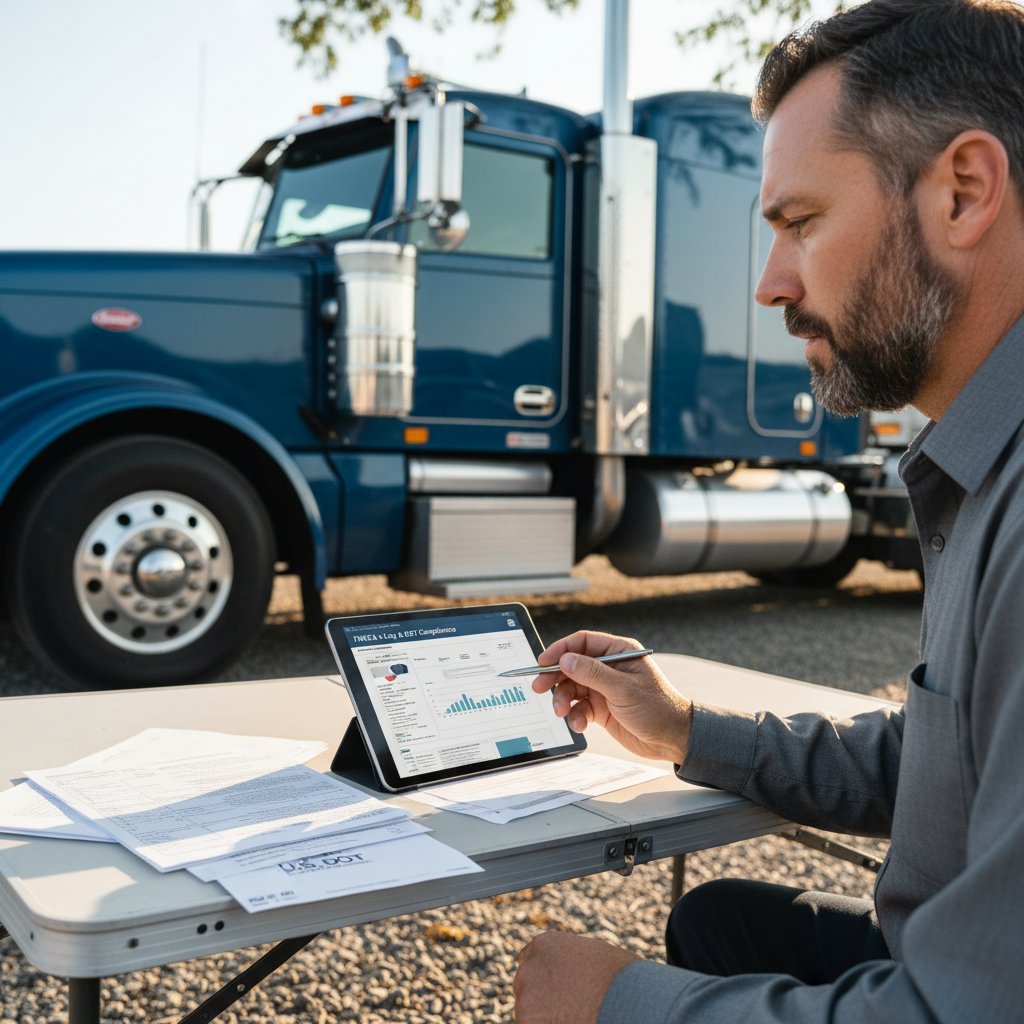
Find the best insurance for truck drivers in 2026: required coverages, real cost ranges, top companies by scenario, and discount tactics. Get a quote.
The best insurance for truck drivers in 2026 is the policy that meets FMCSA/state rules, satisfies broker/shipper COI requirements, and covers your real-world loss exposure (liability, cargo, and your truck). For most owner-operators, that typically means $1M auto liability, cargo limits matched to your highest-value load, physical damage on the tractor, and a few add-ons based on how you run (leased-on vs. own authority, trailer interchange, and more).
If you’ve ever had a load rejected because your COI didn’t match the rate confirmation—or you bought “cheap” coverage with exclusions that blow up at claim time—use this guide to shop apples-to-apples. For an early benchmark on what “cheap” really looks like (and how to pay less without underinsuring), start here: cheapest commercial auto insurance (2026) and how to pay less.
Key Takeaways: Essential Insurance for Truck Drivers
- Match coverage to your operation first (cargo, radius, trailers, leased-on vs. authority), then shop carriers.
- Most brokers effectively require $1M liability even when legal minimums are lower—your contract becomes the real “minimum.”
- Cargo limits should match your worst-case load, not your average load value.
- The best way to lower premiums in 2026 is clean underwriting + smart deductibles + documented safety, not cutting corners.
Table of Contents
Reading time: 10 minutes
- Quick Picks: “Best” by Driver Type (No Fluff)
- What Coverage Do Truck Drivers Need? (Required + Smart Add-Ons)
- FMCSA Minimums, Filings, and the MCS-90 (What Gets Confused)
- How Much Does Commercial Truck Insurance Cost in 2026?
- Best Commercial Truck Insurance Companies (How to Compare “Best”)
- Truck Insurance Discounts in 2026 (What to Ask on Every Quote)
- Frequently Asked Questions
- Why Logrock’s Approach Saves Money (and Headaches)
- Conclusion & Get a Quote That Matches Your Loads
Quick Picks: “Best” by Driver Type (No Fluff)
“Best” commercial truck insurance is determined by underwriting fit (cargo, radius, experience, loss history) because carriers price the same operation differently based on risk appetite.
A carrier that loves local dry van may price OTR reefer aggressively high, and a company that’s great for established authorities may price a new venture like it’s high risk from day one.
How to judge “best” without guessing
- Coverage fit: Your cargo, radius, and trailer setup are covered with no hidden exclusions.
- Financial strength: You need a carrier with the capital to pay claims consistently.
- Claims speed: A slow claim can turn into weeks of downtime.
- Discount depth: Telematics, safety tech, loss-free, and pay-in-full vary a lot by market.
- Admin reality: Fast COIs and correct filings keep you dispatchable.
| Driver type / operation | “Best” usually means… | What to compare (non-negotiables) |
|---|---|---|
| Owner-operator (own authority) | Strong cargo appetite + flexible deductibles + new venture program if needed | Cargo exclusions, radius, filing/COI turnaround time, physical damage valuation method |
| Leased-on owner-operator | Clean non-trucking liability (bobtail) option + occupational accident if you’re 1099 | What the motor carrier covers vs. what you must buy personally |
| Small fleet (2–10 trucks) | Consolidated billing + safety/telematics programs + loss control help | Driver eligibility rules, hiring requirements, claims handling reputation |
What Coverage Do Truck Drivers Need? (Required + Smart Add-Ons)
Commercial truck insurance for for-hire drivers typically includes primary auto liability, motor truck cargo, and physical damage, with add-ons like general liability, bobtail/non-trucking, trailer interchange, and occupational accident depending on your authority and contracts.
This is where most “cheap policy” problems show up: the limit looks fine on the declarations page, but an exclusion, radius mismatch, or missing add-on gets your COI rejected or your claim denied.
Coverage checklist (use this to shop quotes)
| Coverage | Who needs it | Typical limit range | Biggest “gotcha” |
|---|---|---|---|
| Primary liability | Anyone operating under authority | Often $750k–$1M+ (many brokers require $1M) | Contract requirements exceed legal minimums |
| Motor truck cargo | Hauling freight for others | Commonly $100k–$250k+ | Exclusions (theft rules, reefer breakdown, unattended vehicle) |
| Physical damage (comp + collision) | Anyone who can’t self-insure the tractor | Based on stated value/ACV | Too-low value = payout shortfall; high deductible hurts cash flow |
| General liability | Dock/shipyard exposure, some contracts | Often $1M | Not the same as auto liability |
| Non-trucking liability / bobtail | Many leased-on drivers off-dispatch | Varies | “Off-dispatch” definitions vary by policy and carrier |
| Trailer interchange | Pulling non-owned trailers under agreement | Often $20k–$50k | Only applies under a written interchange agreement |
| Occupational accident | 1099/independent contractors | Plan-based | Not workers’ comp; benefits and exclusions matter |
| Workers’ comp | If you have employees (varies by state) | State-based | Misclassification can trigger audits and penalties |
1) Primary liability (the foundation)
Primary liability pays for injuries and property damage you cause to others in an at-fault crash, and it’s the core coverage brokers look for on your COI.
Pro tip: Don’t compare quotes until the limit, radius, and deductible structure match. “Cheap” is often lower limits, tighter radius, higher deductibles, or uglier exclusions.
2) Cargo insurance (because one load can wipe you out)
Motor truck cargo pays for covered loss or damage to the freight you’re hauling, and many brokers require it before they’ll send a rate confirmation.
Pro tip: Ask for the cargo exclusions in writing. If you run reefer, ask specifically about temperature-related claims and documentation (downloaded reefer logs, seal policy, and “unattended vehicle” rules).
3) Physical damage (semi truck insurance for your own iron)
Physical damage (comprehensive + collision) repairs or replaces your tractor after a covered loss, and it’s typically required by lenders.
Pro tip: Pick a deductible you can actually pay without missing fuel, insurance, or a truck note.
4) Smart add-ons (the gap-fillers)
- Non-trucking liability / bobtail: Key for leased-on drivers when you’re truly off-dispatch.
- Trailer interchange: Needed if you pull someone else’s trailer under a written interchange agreement.
- General liability: Helps with non-auto claims (slip-and-fall, property damage at a customer site).
- Occupational accident: Adds injury protection for many 1099 setups.
FMCSA Minimums, Filings, and the MCS-90 (What Gets Confused)
FMCSA financial responsibility rules set federal minimum liability requirements for interstate for-hire carriers (commonly $750,000 for non-hazardous property), but brokers and shippers often require higher limits like $1,000,000 on your COI to haul their freight.
Most “insurance disasters” happen when drivers mix up legal minimums, broker requirements, and what the insurer actually filed.
1) FMCSA minimum liability limits (high level)
You can be “legal” and still be unloadable if the rate confirmation requires higher limits than the federal minimum.
Reality check: Your broker/shipper contract usually sets your real minimum. If the rate confirmation says $1M liability and $100k cargo, that’s what you need to get loaded and paid.
2) Filings vs. proof (what you carry vs. what gets filed)
Filings are what your insurer submits to regulators to prove coverage is in force, while your COI is what brokers use to approve you for loads.
A filing mistake can delay authority activation or trigger compliance issues, and both can kill revenue.
3) MCS-90 in plain English
The MCS-90 is an endorsement tied to certain federal financial responsibility requirements, and it is not the same thing as physical damage coverage for your truck.
If you’re not sure whether your operation triggers it or how it affects exclusions, ask your agent to explain it in writing for your authority, cargo type, and lanes.
How Much Does Commercial Truck Insurance Cost in 2026?
Commercial truck insurance cost in 2026 commonly ranges from roughly $9,000 to $30,000+ per year for liability+cargo for many for-hire owner-operators, with physical damage often adding $3,000 to $12,000+ depending on truck value, deductible, and location.
These are benchmarks, not quotes, because insurance is priced on risk: cargo type, operating radius, garaging ZIP, experience, and loss history can move you way up or down. For a benchmark-driven breakdown, see cheapest commercial truck insurance (2026).
Typical premium ranges (benchmarks, not quotes)
| Operation snapshot | Liability + cargo (annual) | Physical damage (annual) | Notes |
|---|---|---|---|
| Local / short-haul, dry van | $9,000–$18,000 | $3,000–$8,000 | Local can still be pricey in dense metro areas |
| Regional, mixed freight | $12,000–$24,000 | $4,000–$10,000 | Radius is a major rate driver |
| OTR, general freight | $14,000–$30,000+ | $4,500–$12,000 | New venture can push higher |
| Reefer / high-value | $18,000–$40,000+ | $5,000–$14,000 | Cargo claims and exclusions matter more |
| Hazmat / specialized | $25,000–$60,000+ | $6,000–$18,000 | Limits and filings get more complex |
Rate drivers (what moves your premium fast)
- New venture / new authority status
- Cargo type (reefer, high theft, hazmat, autos, household goods)
- Operating radius (local vs regional vs OTR)
- Truck value + physical damage deductible
- Loss runs + violations/claims
- State/ZIP (theft, litigation, catastrophe exposure)
- Driver experience and MVR/PSP
Apples-to-apples shopping (how to avoid “cheap” traps)
Get 3–7 quotes, but keep these constant:
- Liability limit (example: $1M)
- Cargo limit (example: $100k or $250k)
- Deductibles
- Same radius and garaging ZIP
- Same listed drivers and equipment schedule
Best Commercial Truck Insurance Companies (How to Compare “Best”)
The best commercial truck insurance company for you is the one whose underwriting appetite matches your operation (cargo, radius, experience) while offering broker-ready COIs, correct filings, and claim handling that minimizes downtime.
Instead of chasing a “top 10” list, use the table below to interview any agent and compare like-for-like.
Comparison table (use-case based)
| Carrier type | Often competitive for… | Discounts to ask about | Watch outs / verify |
|---|---|---|---|
| Large national carrier | Broad general freight, scalable programs | Telematics, safety tech, pay-in-full, multi-vehicle | Cargo appetite limits; endorsement specifics |
| Trucking-specialized carrier | Niche cargo (reefer, certain specialized freight) | Fleet safety programs, driver training | May be pickier on drivers and loss runs |
| Program/wholesale market | New ventures, harder risks | Varies widely | Read exclusions carefully; claims process quality varies |
What to verify with any “best” quote
- Cargo commodity list and exclusions
- Reefer claim requirements (if applicable)
- Theft requirements (parking rules, forced entry definitions)
- Rental / towing / downtime options
- COI turnaround time (dispatch and revenue impact)
- Cancellation terms and non-pay grace periods
Red flags (walk away or renegotiate)
- Cargo limit doesn’t match your peak load value
- Exclusions that conflict with your lanes (high theft) or operations (unattended vehicle rules)
- “Cheap” premium paired with a deductible you can’t realistically fund
Truck Insurance Discounts in 2026 (What to Ask on Every Quote)
Truck insurance discounts in 2026 commonly include telematics/safety tech credits, loss-free or safe-driver programs, pay-in-full options, and deductible adjustments, but the discount value depends on which line it applies to (liability vs physical damage vs cargo).
Use the list below as your quote script, then go deeper with Truck insurance discounts in 2026.
1) Discount categories that actually move the needle
- Safety tech / telematics: dash cams, GPS, braking data (varies by carrier)
- Loss-free / safe driver: clean loss runs plus documented safety processes
- Pay-in-full: can beat monthly finance charges if cash flow allows
- Higher deductibles: only if you can truly fund them
- Fleet safety programs: bigger impact once you add trucks/drivers
2) Questions to ask (so discounts don’t “disappear”)
- Is the discount applied to liability only, or also physical damage/cargo?
- What data is required, and how long until the discount is earned?
- Can the discount be removed after hard braking events or a claim?
- Does your ELD/dash cam qualify, or do they require specific vendors?
Frequently Asked Questions
These answers summarize common FMCSA/broker expectations (like $1M liability and $100k cargo) so you can confirm limits and avoid COI rejections before you bind a policy.
Most for-hire truck drivers need primary auto liability, and the FMCSA minimum is commonly $750,000 for interstate non-hazardous property, while many brokers require $1,000,000 to tender loads. If you haul freight, you’ll usually need motor truck cargo (often $100,000–$250,000+ depending on the load), and if you can’t self-insure the tractor you’ll want physical damage (comp and collision) based on the truck’s value and deductible. Add-ons like general liability, bobtail/non-trucking, trailer interchange, and occupational accident depend on your contracts and whether you’re leased-on or running your own authority.
Commercial truck insurance in 2026 often falls into broad annual bands like $9,000–$30,000+ for liability+cargo for many for-hire owner-operators, with $3,000–$12,000+ more for physical damage depending on truck value, deductible, and garaging ZIP. Your price swings fast based on new venture status, cargo type (reefer/high-value/hazmat), operating radius, and loss runs. The only fair way to compare quotes is to keep limits and deductibles identical (for example, $1M liability and $100k cargo), then compare exclusions and COI turnaround time. For monthly budget planning and “what affordable means,” see Affordable trucking insurance (2026) costs.
The companies that offer the best rates for truckers are usually the ones whose underwriting appetite matches your exact risk profile—your cargo, radius, experience, and loss history. Two drivers can both be quoted “$1M liability,” but one quote may be cheaper because it quietly tightens the radius, adds a higher deductible, or excludes the commodity you actually haul. To avoid that trap, shop multiple carriers and hold the coverage stack constant (same limits, same deductibles, same garaging ZIP, same drivers and equipment schedule). Then compare the parts that matter when you’re dispatched: cargo exclusions, claims handling reputation, and how quickly they issue COIs and endorsements.
Common truck driver insurance discounts in 2026 include telematics/safety tech credits (dash cams, braking data), loss-free or safe-driver programs, pay-in-full options, and pricing adjustments tied to deductible choices. The key is verifying which line the discount applies to—some credits hit physical damage but barely move liability, and cargo discounts can be limited. Also ask what you must do to keep the discount (data submission period, vendor requirements, or performance thresholds). If you want a practical checklist of what to ask on every quote, review truck insurance discounts 2026: proven ways to lower premiums.
Why Logrock’s Approach Saves Money (and Headaches)
Lowering trucking insurance costs without increasing claim risk comes from building the correct coverage stack first, then shopping identical limits and deductibles across multiple carriers so “cheap” isn’t hiding exclusions.
Most drivers don’t struggle because they can’t drive—they struggle because the admin side never stops: filings, COIs, renewals, audits, and one claim that can erase a year of profit.
- Build the right coverage stack first so brokers accept your COI.
- Shop apples-to-apples so you’re not comparing a real policy to a bait-and-switch quote.
- Control what you can control (documented safety, clean ops, smart deductibles).
Conclusion: Get a Quote That Matches Your Loads
The best insurance for truck drivers in 2026 is the policy that matches your cargo, lanes, equipment, and contract requirements while keeping you dispatchable with broker-ready COIs and correct filings.
If you set limits based on contracts and worst-case losses, then compare quotes with identical limits and deductibles, you’ll avoid the “cheap” traps that show up at claim time.
Key Takeaways:
- Set limits based on contracts + worst-case loss (not average loads or wishful thinking).
- Compare policies with identical limits/deductibles so the price difference is real.
- Use discounts and safety tech to cut premiums without cutting coverage.
Related reading: Affordable trucking insurance (2026): real monthly costs & how to pay less, Cheapest commercial auto insurance (2026) and how to pay less, and Truck insurance discounts 2026: proven ways to lower premiums.