
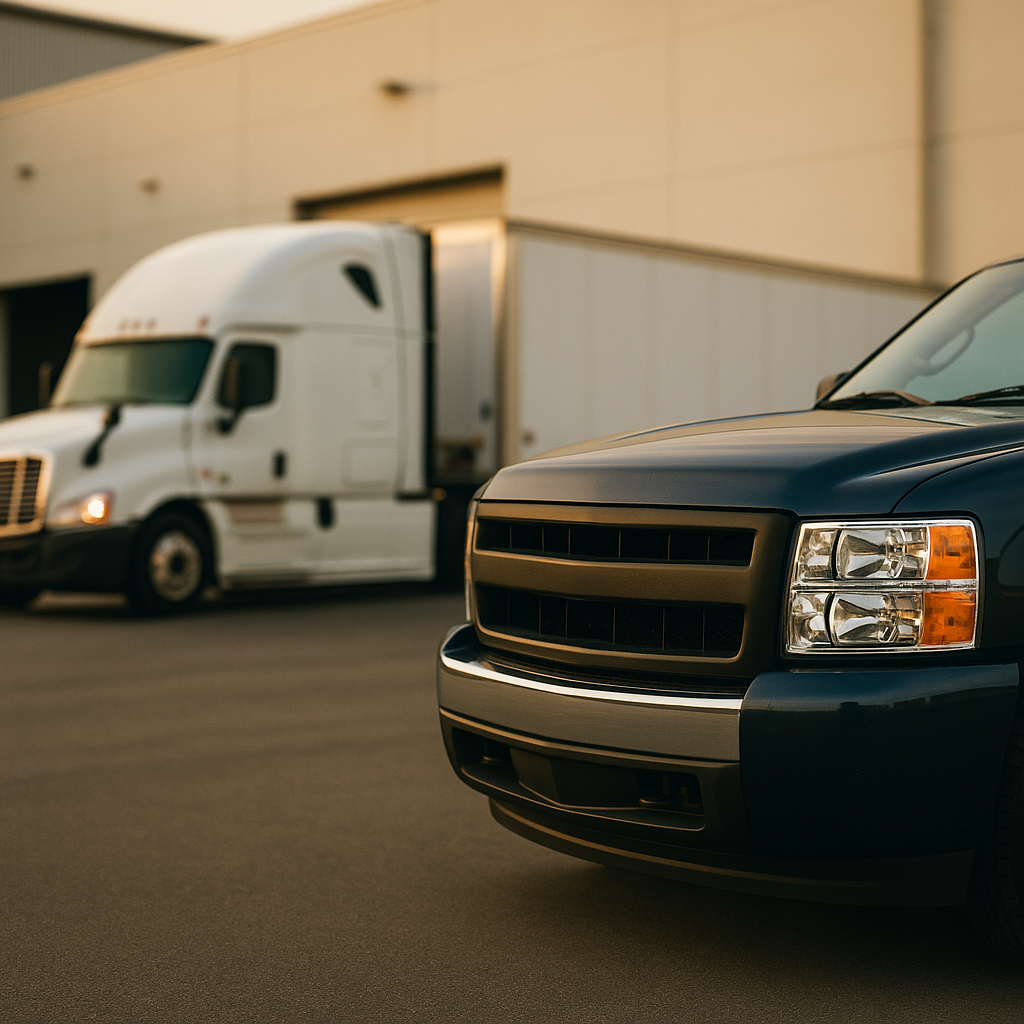

Compare commercial auto vs personal auto insurance in 2026—coverage, drivers, exclusions, costs, mixed-use options, and a decision checklist so you buy the right policy for how the vehicle is actually used.
Commercial auto vs personal auto insurance isn’t a “car vs truck” debate—it’s a risk and use decision that can decide whether a claim gets paid. If the vehicle is used for business (job sites, deliveries, tools, employee drivers, contracts), personal auto can run into restrictions that only show up after a crash.
Quick answer: Commercial auto insurance is built for business exposure (business use, business-owned vehicles, multiple or authorized drivers, and higher limits), while personal auto insurance is built for household driving and often limits many types of business use. The right policy depends on use, drivers, ownership/title, and contract requirements.
Table of Contents
Reading time: 10 minutes
- Quick Answer + Side-by-Side Table
- Commercial Auto vs Personal Auto: What’s the Real Difference?
- What Each Policy Typically Covers (and What It Often Doesn’t)
- When You Need Commercial Auto Insurance (Real-World Scenarios)
- Is Commercial Auto Insurance More Expensive Than Personal? (2026 Cost Context)
- Mixed-Use Vehicles: If You Use the Same Vehicle for Work and Life
- State-by-State Considerations (What Changes and What Doesn’t)
- Claims and Consequences: What Happens If You Have the Wrong Policy?
- Legal and Tax Angle (High-Level): Ownership, Deductions, and Recordkeeping
- Decision Tool: Commercial Auto or Personal Auto? (Flow + Checklist)
- Frequently Asked Questions
- Conclusion: Get Correctly Covered

Quick Answer: Commercial Auto vs Personal Auto (2026)
Commercial auto insurance is written for business driving and business liability exposure, while personal auto insurance is written for household/personal driving and often restricts business use based on the policy’s permitted-use language.
If you’re using the vehicle to make money—especially with tools, deliveries, job sites, employee drivers, or contract-required limits—commercial auto is usually the cleaner fit because it’s designed to match those real-world exposures.
Commercial Auto vs Personal Auto (Side-by-Side)
| Category | Personal Auto Insurance | Commercial Auto Insurance |
|---|---|---|
| Primary purpose | Personal/household driving | Business driving + business liability exposure |
| Typical drivers | Named insured + household members (policy-specific) | Named drivers and/or “authorized drivers” (policy-specific) |
| Business use | Often limited; varies by carrier and endorsements | Designed for business use |
| Liability limits | Selectable, but often purchased at lower limits | Selectable, often purchased at higher limits due to contracts/exposure |
| Ownership/title | Usually personally owned | Often business-owned/leased; can also cover certain personally owned vehicles used for business (policy-specific) |
| Best for | Commuting + errands | Jobsite travel, deliveries, hauling tools/equipment, employee driving, contract-required insurance |
Key takeaways (save these)
- The real difference is exposure, not the vehicle. Business use + business drivers + contract limits pushes you toward commercial auto.
- Misclassifying usage is a claims problem. It can look fine at billing time and blow up at claim time.
- “Occasional work use” isn’t a loophole. Permitted use is carrier- and policy-specific—confirm it in writing.
- For-hire trucking is a different lane. If you haul for-hire, you’re often dealing with commercial truck insurance requirements, not personal auto.
Commercial Auto vs Personal Auto: What’s the Real Difference?
Personal auto insurance is underwritten for a household driving pattern (commuting, errands, limited drivers), while commercial auto insurance is underwritten for business operations (work mileage, job sites, time pressure, more drivers, and higher third-party exposure).
Here’s what that looks like on the ground: you don’t “feel” misclassified when you pay a premium, but you can absolutely feel it when there’s a crash and the adjuster starts asking what the vehicle was doing, who was driving, and whether the trip was business-related.
The 4 questions that decide it
- Use: Is it commuting only, or is it doing the work (job sites, deliveries, hauling tools/equipment)?
- Drivers: Is it only you/household drivers, or do employees/helpers/partners ever drive?
- Ownership: Is the vehicle personally titled, or titled to an LLC/corporation?
- Contracts: Are clients, brokers, lenders, or platforms requiring specific limits or proof of insurance?
What Each Policy Typically Covers (and What It Often Doesn’t)
Both personal and commercial auto policies can include liability, comprehensive, and collision, but the difference is how the policy defines permitted use, handles drivers, and applies exclusions tied to business activity.
1) Personal auto insurance: built for non-business driving
Personal auto insurance is designed to cover a personally used vehicle for household activities, and many policies restrict business use unless it’s explicitly allowed by the carrier or an endorsement.
What it usually includes:
- Liability: Bodily injury and property damage you cause.
- Collision: Damage to your vehicle from a crash.
- Comprehensive: Theft, hail, vandalism, animal hits, etc.
- MedPay or PIP: Medical coverage depending on state rules.
- UM/UIM: Uninsured/underinsured motorist coverage (state-dependent).
Where people get burned: the policy may treat certain activities—like deliveries, transporting property for pay, or regular jobsite travel—as outside permitted use unless disclosed and accepted.
Questions to ask your agent (word-for-word):
- “Is jobsite travel covered under this personal policy?”
- “Are deliveries covered?”
- “Is carrying tools/equipment for work covered?”
- “Does an LLC on the title change eligibility?”
2) Commercial auto insurance: built for business risk and business drivers
Commercial auto insurance is written to cover vehicles used in business operations, including higher-liability scenarios, broader driver situations (as defined by the policy), and contract-driven insurance requirements.
Common commercial-friendly features (vary by carrier):
- Higher liability limits that better match business exposure and contracts.
- Broader driver structure (named drivers and/or authorized drivers depending on how it’s written).
- Business add-ons like hired and non-owned auto (HNOA) where applicable, plus options for equipment or upfits.
Trucking reality check: If you’re hauling for-hire in interstate commerce, FMCSA financial responsibility rules often come into play; for many for-hire motor carriers hauling non-hazardous property, the federal public liability minimum is commonly cited as $750,000 (with different requirements for certain operations and hazardous materials).
3) “Occasional business use” vs regular use
“I only do it sometimes” is not a coverage strategy, because claims decisions depend on the policy contract and the facts of the trip on the day of the loss.
After an accident, insurers often look at things like frequency of business use, mileage and territory, trip purpose, whether you were transporting property for business, and whether the driver and vehicle were accurately disclosed.
- Clean move: Track mileage (an app is fine) and keep your vehicle “work vs personal” story consistent.
- Cleaner move: Don’t let unlisted drivers “borrow it real quick” if the policy doesn’t allow it.
When You Need Commercial Auto Insurance (Real-World Scenarios)
You typically need commercial auto insurance when the vehicle is used to produce revenue, driven by non-household drivers, titled to a business, or subject to contract-required limits, because those exposures are exactly what commercial underwriting is built to handle.
1) The vehicle performs work (not just commuting)
If you drive to multiple job sites, visit clients all day, haul tools/materials, make deliveries, or run service calls, that’s business exposure—not just “commuting.”
- Who this hits: Contractors, service trades, mobile repair, delivery, property services, field teams.
- Underwriting tip: If you’re hauling equipment regularly (even with a pickup), disclose it—weight, cargo, and theft risk matter.
2) Employees or multiple drivers use the vehicle
When employees, helpers, partners, or rotating on-call staff drive, your risk profile changes fast because the “who was driving?” question gets complicated.
- Best practice: Treat driver screening like a carrier does—MVRs, experience, and violation history.
- Why it saves money: Preventing losses is cheaper than trying to shop your way out of a bad renewal.
3) You use rentals, employee cars, or non-owned vehicles for work
If your business rents vehicles, borrows vehicles, or has employees using personal cars for business tasks, the business entity can still get pulled into a claim.
- Who this hits: Teams without a fleet but with lots of errands, pickups, site visits, airport runs, etc.
4) You’re scaling (more vehicles, more miles, more exposure)
Growth usually makes commercial auto cleaner because it supports consistent limits, driver management, and fewer gray areas as you add units and territory.
Is Commercial Auto Insurance More Expensive Than Personal? (2026 Cost Context)
Commercial auto insurance usually costs more than personal auto insurance because it’s priced for business risk factors like higher liability limits, higher annual mileage, more drivers, and greater third-party exposure.
But the real business-owner math is simple: a “cheap” policy that doesn’t respond the way you thought it would is often the most expensive option you can buy.
Cost drivers (what moves the number)
| Pricing Variable | Why It Matters | What You Can Control |
|---|---|---|
| Vehicle type / class | A sedan, service van, and work pickup don’t produce the same loss patterns. | Choose the right unit for the job; keep maintenance tight. |
| Industry / use | Delivery, hauling, and jobsite driving carry different claim frequency and severity. | Be accurate; pick carriers that actually like your class. |
| Radius / territory | More miles and dense areas often increase exposure. | Tighten radius when possible; improve garaging security. |
| Drivers (MVR / experience) | Clean records and stable experience price better. | Hire for safety; coach early; don’t ignore patterns. |
| Limits & deductibles | Higher limits cost more; lower deductibles cost more. | Buy limits based on contracts/assets; set deductibles you can absorb. |
| Loss history | Claims follow the account and can impact eligibility and pricing. | Dash cams, training, policies, and documentation. |
| Garaging ZIP | Theft and accident rates vary by area. | Secure parking; lighting; anti-theft measures. |
The “apples-to-apples” rule
If you compare personal and commercial quotes, match the liability limits, UM/UIM, comp/collision deductibles, driver list, and truthful usage. If you don’t, you’re not comparing price—you’re comparing two different products.
Mixed-Use Vehicles: If You Use the Same Vehicle for Work and Life
Mixed-use means the same vehicle is used for both personal errands and business tasks, and that’s where many claim disputes start because the loss happens on a day that isn’t “purely personal” or “purely business.”
Option A: Personal policy endorsed/rated for limited business use (when allowed)
Some personal carriers allow certain types of business use (think light professional use), but the rules are carrier-specific and the details matter.
- Good fit: Occasional client visits, minimal equipment, no deliveries/for-hire work.
- Non-negotiable: Get permitted use in writing (endorsement, policy language, or documented carrier confirmation).
Option B: Commercial policy that allows incidental personal use
Many commercial auto policies still allow incidental personal errands because people don’t live in a separate universe from their businesses.
- Good fit: Regular jobsite travel, tools in the vehicle, deliveries, multiple drivers, contracts.
- Why it’s cleaner: It reduces “gray area” when the loss happens on a mixed day.
Option C: Separate vehicles (cleaner operations, cleaner claims)
Keeping one vehicle “work” and one “personal” reduces disputes, simplifies mileage and driver access, and is often worth it once the business is busy enough.
State-by-State Considerations (What Changes and What Doesn’t)
Auto insurance rules are partly state-driven (minimum limits and certain required coverages) and partly insurer-driven (eligibility and permitted use), so the state matters—but it doesn’t erase policy language.
What’s usually state-driven
- Minimum liability limits
- PIP/no-fault rules (where applicable)
- UM/UIM requirements (where applicable)
- Certain rating and form rules (varies widely)
What’s usually insurer-driven
- What counts as “business use” on a personal policy
- Whether business-titled vehicles are eligible on personal
- Driver acceptance rules
Practical compliance quick check
- Registration/garaging: Where is the vehicle registered and primarily garaged?
- Operations: Where is it actually driven (radius/territory)?
- Contracts: Do clients, brokers, lenders, or platforms require higher limits or specific wording?
- Ownership: Is the named insured correct (you personally vs LLC/corporation)?
Trucking note: If you operate for-hire (box truck, hotshot, semi), you may have state, federal, and contract requirements at the same time—don’t assume personal auto is even eligible for the exposure.
Claims and Consequences: What Happens If You Have the Wrong Policy?
Having the wrong policy means your claim can be delayed, disputed, or denied if the loss facts fall outside the policy’s permitted use, driver rules, or ownership disclosures, because insurance pays based on contract terms and underwriting representations.
What “wrong policy” looks like in real life
- You told the carrier “commuting only,” but you’re doing job sites all day.
- You didn’t list a driver, but a helper/employee drove “just this once.”
- The vehicle is used for deliveries or for-hire work that the policy restricts.
- The vehicle is business-titled but insured as personal without a carrier-approved structure.
What can happen after an accident
- Claim delays while the insurer investigates usage and driver facts
- Coverage disputes about permitted use or excluded activities
- Non-renewal or cancellation after underwriting review
- Out-of-pocket defense costs if coverage doesn’t apply the way you expected
What to do if your usage changed
- Update use/classification with your agent or carrier now (before a loss).
- Update driver lists as soon as someone has access to keys.
- Re-check liability limits if your contracts or assets grew.
- Document mileage and vehicle assignment so your story stays consistent.
Legal and Tax Angle (High-Level): Ownership, Deductions, and Recordkeeping
Vehicle ownership and documentation matter because insurers and tax professionals both rely on consistent records—title/registration, insurance applications, and real-world use should line up to reduce disputes.
Ownership and titling
If the vehicle is titled to you personally, a personal policy may be possible depending on use and carrier rules. If it’s titled to an LLC/corporation, commercial auto is often a cleaner fit and sometimes required by carrier eligibility.
Recordkeeping basics
Whether you track mileage or actual expenses, you want clean proof: mileage logs (apps work), maintenance receipts, and a clear story for mixed-use. Inconsistency across documents is what creates the “wait…which is it?” problem during a claim.
Decision Tool: Commercial Auto or Personal Auto? (Flow + Checklist)
A practical way to choose between commercial auto vs personal auto is to follow a yes/no flow on ownership, use, drivers, and contract requirements, because those are the factors that most directly affect eligibility and claim handling.
5-step decision flow (simple)
- Is the vehicle titled/owned by a business (LLC/corp) or primarily used for business?
Yes → Lean commercial auto
No → go to #2 - Do you deliver goods, transport people for pay, or do for-hire work?
Yes → Commercial auto (or a trucking/commercial truck program depending on operation)
No → go to #3 - Do you regularly drive to multiple job sites/clients as part of the job (not just commuting)?
Yes → Commercial auto or endorsed personal (carrier-dependent)
No → go to #4 - Do employees/other drivers use the vehicle for work?
Yes → Commercial auto
No → go to #5 - Do contracts require higher limits, additional insured wording, or specific proof of insurance?
Yes → Commercial auto is often the cleanest path
No → personal auto may be fine (confirm any business use in writing)
Coverage options checklist (copy/paste this)
- Liability limits: state minimum vs contract-required vs asset protection
- Collision/comp + deductibles: pick deductibles you can absorb
- MedPay/PIP: confirm what your state and policy include
- UM/UIM: don’t assume it’s automatic
- Downtime: rental reimbursement/towing (if it matters to your cash flow)
- Equipment/upfits: racks, toolboxes, custom parts (as needed)
- Named insured: you personally vs LLC/corp (match title and operations)
- Drivers: accurate driver list and updates when access changes
Frequently Asked Questions
The difference between commercial and personal auto insurance is that commercial auto is written for business use and business liability exposure, while personal auto is written for household/personal driving and often restricts business use by policy language. Commercial policies are commonly structured to handle business-owned vehicles, employee or authorized drivers (as defined by the policy), and contract-driven limits. Personal policies are usually priced for predictable household driving and may not be eligible for certain work uses like deliveries or for-hire activity. The safest move is to match the policy to use, drivers, ownership/title, and contract requirements before you bind coverage.
You need commercial auto insurance when the vehicle is used to produce revenue (job sites, service calls, deliveries, hauling tools), when employees/helpers drive it, when it’s titled to an LLC/corporation, or when a contract requires business-style proof of insurance and higher limits. Those factors change how risk is underwritten and how claims are evaluated. For for-hire trucking, you may also run into federal and contractual requirements; for example, FMCSA financial responsibility minimums for many for-hire interstate motor carriers hauling non-hazardous property are commonly cited at $750,000 (requirements vary by operation). If any of those apply, commercial is usually the cleanest fit.
Yes, commercial auto insurance is often more expensive than personal auto insurance because it’s priced for business risk, which can include higher annual mileage, more drivers, higher third-party exposure, and higher liability limits. The only fair comparison is “apples-to-apples”: match liability limits, deductibles, driver list, and the exact vehicle use description. If you compare a low-limit personal quote to a higher-limit commercial quote, you’re not comparing price—you’re comparing different products. For many business owners, the bigger cost isn’t premium; it’s the financial hit from downtime, a lawsuit, or a coverage dispute caused by misclassification.
Sometimes personal auto insurance can cover limited business use, but it’s carrier- and policy-specific and must be disclosed and accepted by the insurer. Light professional use (like occasional client visits) may be allowed, while deliveries, for-hire work, regular jobsite travel, or employee driving often requires commercial auto (or a different commercial program). The practical rule is to confirm the exact permitted-use language in writing—via endorsement, policy wording, or documented carrier confirmation—before you rely on it. If the vehicle is business-titled or routinely used to produce revenue, commercial auto is usually the cleaner way to reduce gray areas at claim time.
Who can drive a commercial auto policy depends on how the policy is written—some are set up for named drivers, while others allow authorized drivers under defined conditions, and underwriting rules still apply. Even when a policy allows authorized drivers, businesses usually must maintain an accurate driver schedule, follow eligibility rules, and update the insurer when driver access changes. If you have employees, helpers, or rotating drivers, commercial auto is typically a better structure than personal auto because it’s designed for business driver situations. The key is to align the driver list and driver access with the policy terms so there are fewer surprises after a loss.
Yes, you can get commercial auto insurance for just one vehicle, and single-vehicle commercial policies are common for contractors, service businesses, and owner-operators. The need for commercial coverage is driven by use, drivers, ownership/title, and contracts—not fleet size. If the vehicle is used to generate revenue, carries tools or equipment, visits multiple job sites, or is driven by non-household drivers, a one-vehicle commercial policy can be the most straightforward way to match coverage to exposure. Many businesses start with one unit on commercial auto and expand later without having to “re-teach” the insurer what the operation really is.
Conclusion: Get Correctly Covered (and Avoid Claim Surprises)
Commercial auto vs personal auto comes down to one thing: does the policy match real usage? If the vehicle makes you money, carries business exposure, involves non-household drivers, or has contract requirements, commercial auto is often the cleanest path.
If it’s truly personal use with minimal business activity, personal auto can work—but only if your carrier allows your actual use and you can prove what you disclosed.
Key Takeaways:
- Match coverage to reality: use, drivers, ownership/title, and contracts.
- Confirm business use in writing: endorsements/policy language beat verbal reassurance.
- Compare quotes apples-to-apples: limits, deductibles, drivers, and territory must match.
If you want a fast, practical answer, get quoted based on how the vehicle is actually used and who actually drives it—then you’re buying insurance, not hoping for it.





