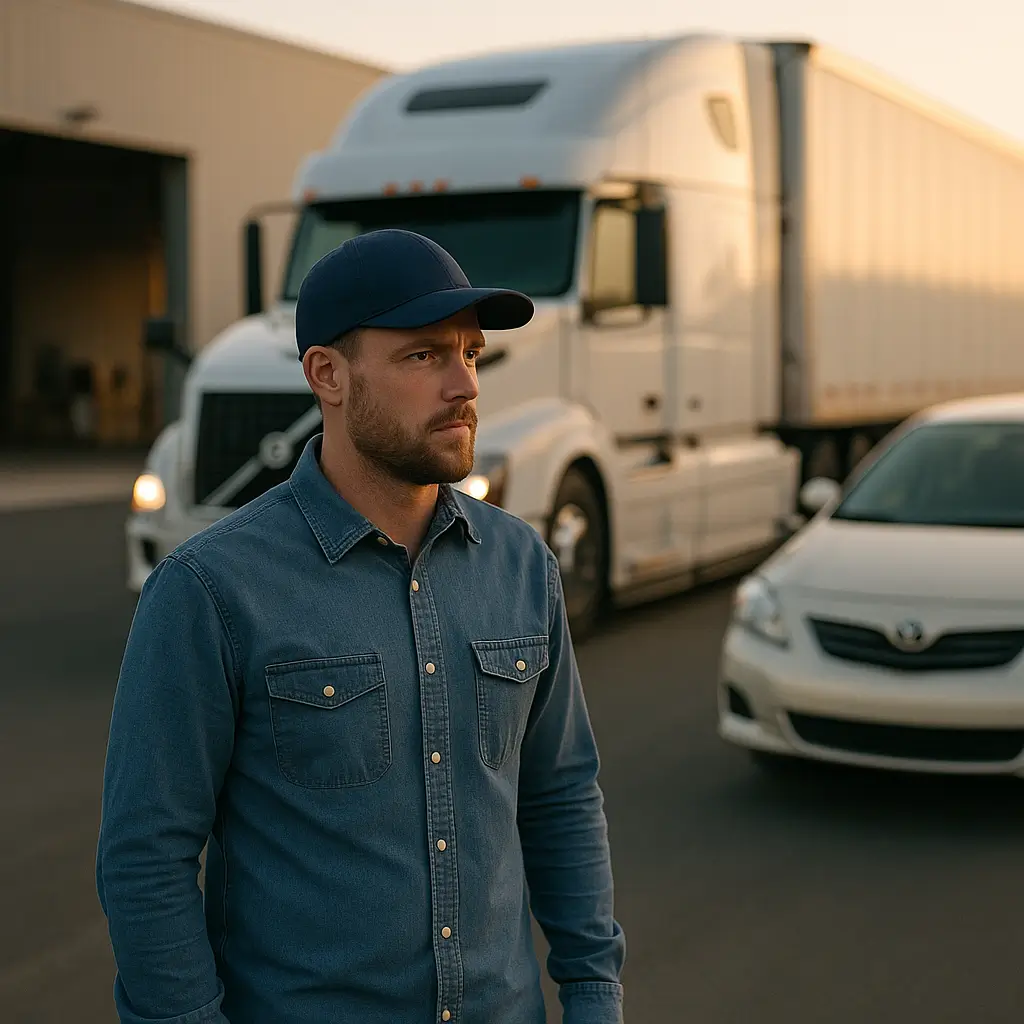
Learn when a personal vehicle needs a business-use endorsement, commercial auto, or Hired & Non-Owned Auto coverage.
Can I get commercial insurance on a personal vehicle? Yes—you often can, but the right setup depends on how you use the vehicle, who drives it, and what your customer contract (or platform) requires. In most cases you’ll land in one of three lanes: a business-use endorsement on a personal policy, a commercial auto policy that schedules your personally owned vehicle, or Hired & Non-Owned Auto (HNOA) to protect the business when people drive cars you don’t own.
If you pick the wrong lane, the problem usually shows up at the worst time: after a crash, when an adjuster asks what you were doing, or when a client refuses to onboard you because the COI doesn’t match their wording. This guide helps you choose the cleanest, most defensible option without paying for coverage you don’t need.
Table of Contents
Reading time: 9 minutes
- Key Takeaways
- Quick Decision Tree: What Coverage Do I Need?
- Does Personal Auto Insurance Cover Business Use?
- Can You Add a Personal Vehicle to a Commercial Auto Policy?
- What Is Hired & Non-Owned Auto (HNOA) Insurance?
- Step-by-Step: How to Get the Right Coverage (and Proof)
- State Rules & Contract Requirements (Why It Varies)
- How Much Does It Cost? (Typical Ranges)
- Common Pitfalls That Trigger Claim Headaches
- Frequently Asked Questions
- Why Logrock-Level Advice Matters (Even If You’re 1 Vehicle)
- Conclusion & Next Step
Key Takeaways: Commercial Insurance on a Personal Vehicle
Commercial insurance on a personal vehicle is usually possible through either (1) a business-use endorsement, (2) a commercial auto policy that “schedules” your vehicle, or (3) HNOA for liability on vehicles your business doesn’t own.
- Yes, it’s possible: Many insurers will write a commercial auto policy that covers a personally owned car or pickup, especially for sole proprietors and small contractors.
- Endorsements can work: A business-use endorsement can be enough for light-to-moderate work driving (carrier rules vary), but delivery/transport-for-hire often needs a different solution.
- HNOA isn’t “insurance for your car”: HNOA is typically liability coverage for the business when employees rent cars or drive their own cars for work errands.
- Contracts matter: Many commercial clients/platforms ask for $1,000,000 auto liability and specific COI wording, which a personal policy may not satisfy.

Can I Get Commercial Insurance on a Personal Vehicle? Quick Decision Tree
The fastest way to answer “can I get commercial insurance on a personal vehicle” is to sort your driving into commuting, business errands, for-hire delivery/transport, or non-owned/hired exposure.
Use this like a pre-trip inspection: quick, practical, and aimed at avoiding claim surprises.
Decision Tree (Text Version)
- Only commute (home → one workplace → home), no deliveries, no hauling for pay?
You’re usually in personal auto territory (still disclose tool/equipment carry and work use honestly). - Multiple job sites, client visits, samples/tools, regular business errands?
Ask about a business-use endorsement on your personal policy or compare it to a commercial auto quote. - Deliver food/packages, courier parts, transport passengers for pay, or haul “for hire”?
You likely need a commercial auto or a delivery/rideshare-specific solution. Many personal policies exclude transport-for-hire. - Employees/contractors use their own cars for your business—or you rent cars for work trips?
Add Hired & Non-Owned Auto (HNOA) so the business has liability protection. - Moving toward trucking/hotshot (pickup + trailer, paid hauling, bigger radius)?
Once you’re hauling for pay, underwriting and coverage requirements usually change quickly (often beyond personal lines).
Does Personal Auto Insurance Cover Business Use?
Personal auto insurance may cover limited business use if it’s disclosed and rated correctly, but delivery, rideshare/transport-for-hire, frequent job-site driving, and multiple drivers often require an endorsement or a commercial policy.
“Business use” sounds simple until a claims adjuster asks what you were doing, where you were going, and whether you were being paid for that trip.
For a deeper breakdown, see our guide on does personal auto insurance cover business use.
Common work scenarios that may be okay on personal auto (if disclosed)
Light business driving usually means your car supports your job, but the car itself isn’t the business.
- Driving to client meetings
- Driving between job sites
- Business errands (bank, post office, supply runs)
- Carrying light tools (laptop, hand tools, samples)
If your personal auto insurance is rated as “pleasure/commute only” while you’re actually running jobs all day, you’ve created a mismatch that can slow down a claim or trigger a coverage dispute.
Scenarios that often trigger exclusions or require commercial coverage
These uses change the risk profile because they increase time on the road, liability severity, and frequency.
- Delivery/courier work: food, packages, parts, same-day courier — these uses are commonly excluded under standard personal auto policies, as the Insurance Information Institute explains.
- Rideshare/transport-for-hire: transporting passengers for pay
- Heavier operational loads: tools/materials that raise theft and job-site exposure
- Multiple regular drivers: employees using the vehicle frequently
- Branded/wrapped vehicles: when the vehicle is used daily as part of operations
Before choosing between an endorsement and a commercial policy, it helps to understand what auto liability actually covers:
Option A: Add a business-use endorsement to a personal policy
A business-use endorsement is a personal auto add-on that tells the insurer the vehicle is used for work beyond simple commuting, subject to the carrier’s rules and exclusions.
This is often the simplest way to close a gap if your use is truly light-to-moderate and your carrier allows it.
Better questions to ask your agent:
- “How is the vehicle rated/classified right now: pleasure, commute, business, delivery, transport-for-hire?”
- “Are delivery or rideshare excluded under this option?”
- “Can you email the use classification you’re applying to my policy?”
Can You Add a Personal Vehicle to a Commercial Auto Policy?
Many insurers can place a personally owned vehicle on a commercial auto policy by “scheduling” it, but ownership rules and eligibility vary by carrier, state, and business type.
What it means to “schedule” a personal vehicle on commercial auto
A commercial policy can list your vehicle as a covered auto even if the title is in your personal name, especially for sole proprietors.
Some carriers prefer (or require) the vehicle to be owned by the business entity (like an LLC), but others will insure individually owned vehicles when the business exposure is clear.
Why commercial auto is often the cleaner option
See our full commercial vs. personal auto insurance comparison for a side-by-side breakdown.
- COI alignment: Many commercial clients want a COI that clearly shows commercial auto coverage and higher limits (often $1M).
- Operational clarity: Frequent job-site driving, multiple drivers, and business operations are easier to match to a commercial form.
- Less guesswork: You’re not trying to “stretch” a personal policy to fit a commercial risk.
What underwriting will ask (have this ready)
- Who owns the vehicle (you vs. LLC/corp)
- Business type and services (contractor vs. courier vs. rideshare)
- Driver list and motor vehicle records (MVRs)
- Annual mileage and operating radius (local vs. multi-state)
- Garaging address
- Any hired/non-owned exposure (employees using personal cars)
What Is Hired and Non-Owned Auto (HNOA) Insurance?
Hired and Non-Owned Auto (HNOA) insurance is typically business liability coverage for accidents involving rented vehicles or employee-owned vehicles used for work, and it usually does not pay to repair the driver’s car.
What HNOA covers (plain English)
HNOA helps protect the business if someone causes an accident while driving:
- a rented vehicle for business (hired auto), or
- their own personal vehicle while doing business errands (non-owned auto).
It’s commonly used for liability (bodily injury/property damage) and legal defense when the business gets pulled into the claim.
Why it matters in real lawsuits
If a worker is on a company errand and injures someone, attorneys often pursue both the driver and the business. HNOA is one of the most common ways small businesses avoid turning a “simple accident” into an out-of-pocket legal and settlement mess.
Who typically needs HNOA
- Businesses with employees using personal cars for errands, pickups, or job-site travel
- Companies that rent vehicles for business trips
- Operations where the business can be accused of responsibility for work-related driving
Important: HNOA is not a replacement for insuring your own vehicle correctly. It’s a backstop for vehicles your business doesn’t own.
Step-by-Step: How to Get the Right Coverage (and Proof)
A defensible auto insurance setup starts with accurate use details (miles, radius, drivers, and job type) because insurers rate and cover vehicles based on disclosed exposure.
Step 1: Write down how you actually use the vehicle (not your best case)
- Business miles per week
- Typical radius (local, multi-county, multi-state)
- Any deliveries, rideshare, or hauling for pay
- Tools/materials carried (and approximate value)
- Who drives it (just you vs. employees)
- Where it’s parked overnight (street, driveway, yard, job site)
Step 2: Pick the lane that matches the exposure
- Light business use: business-use endorsement (if your carrier allows it)
- Operational use / multiple drivers / contracts: get commercial auto insurance — it is often the cleaner path
- Employees using their own cars / rentals: add HNOA
Step 3: Use this script when you request quotes
- “How will the policy classify the use: commute, business, delivery, transport-for-hire?”
- “Are deliveries or rideshare excluded under this option?”
- “Can you issue a Certificate of Insurance (COI) that matches my contract wording and limits?”
- “If I add a driver or expand territory, what changes on the policy?”
Step 4: Match the policy to the contract before you pay
Many client/platform contracts require $1,000,000 auto liability and specific named insured wording, and they can reject your COI if it doesn’t match.
This is the part that hits cash flow: no approved COI, no onboarding, no dispatch, no paid job.
Step 5: Keep the file updated
If your operation changes (new service line, more miles, different territory, adding drivers), update the policy first. Explaining it after a loss is slower, messier, and riskier.
Tell us your miles, job type, drivers, and territory. We’ll point you to the cleanest lane: endorsement vs. commercial auto vs. HNOA.
Can I Get Commercial Insurance on a Personal Vehicle in Every State? (Why It Varies)
Commercial insurance availability and “business use” definitions vary by state and carrier underwriting rules, while contract requirements can demand higher limits than state minimums.
Two things can be true at the same time: your state’s minimum auto limits might be legal, and your customer’s contract might still require more (or require commercial auto specifically). For a state-level overview of personal auto coverage, review the NAIC personal auto insurance resources.
What commonly varies by state and carrier
- How “business use” is defined and rated on personal auto
- Whether endorsements exist for certain uses (delivery/rideshare rules can be strict)
- Underwriting appetite by class (contractor vs. courier vs. transport-for-hire)
- How carriers treat garaging, mileage, radius, and vehicle type
Contract reality (the part that affects eligibility)
Clients, brokers, and platforms often ask for items like:
- $1,000,000 auto liability — a limit aligned with FMCSA insurance requirements for for-hire carriers
- commercial auto (not personal)
- HNOA for non-owned exposure
- an umbrella to reach higher limits (when required)
It’s not theoretical—if your COI doesn’t match, you can lose the work.
How Much Does It Cost? (Endorsement vs. Commercial Auto vs. HNOA)
Pricing for business-use endorsements, commercial auto, and HNOA is driven mainly by driver history, business class, mileage/radius, location, and liability limits, so the same vehicle can price very differently across uses.
Exact cost depends on your state, driving record, vehicle type, industry, limits, and deductibles, but the pattern is usually consistent.
Typical cost patterns (high level)
- Business-use endorsement (personal): often a modest increase if the carrier allows the use and you’re not delivering/transporting for hire.
- Commercial auto policy on a personal vehicle: typically higher than personal, because liability exposure and required limits are often higher.
- HNOA: often affordable relative to the lawsuit risk it addresses, and usually priced based on operations and exposure.
Choosing the right liability limit is one of the biggest levers on cost and coverage fit. Here’s how to think about it:
The biggest drivers of price
- Driver MVR and prior claims
- Miles and operating radius
- Business type (delivery/transport-for-hire is typically higher risk)
- Location/garaging
- Liability limit selection (for example, $500k vs. $1M)
- Number of drivers
Practical move: quote two options side-by-side (endorsed personal vs. commercial auto) and compare the allowed use and coverage language, not just the premium.
Common Pitfalls That Trigger Claim Headaches
The most common claim problems come from misclassified vehicle use, assuming HNOA covers your owned car, and relying on platform/app coverage without understanding when it applies.
Pitfall 1: “I didn’t think it counted as business use.”
If you were on a job call, running paid deliveries, or hauling tools daily while insured as commute-only, you’ve created a dispute risk at claim time.
Pitfall 2: Assuming HNOA covers your vehicle
HNOA typically protects the business for liability on non-owned/hired vehicles. It usually doesn’t repair the employee’s vehicle or replace your owned vehicle’s physical damage coverage.
Pitfall 3: Counting on app/platform coverage to save you
Platform coverage is often phase-based and can be limited. If you don’t know when it starts/stops (and what it excludes), you can end up with a gap at exactly the wrong moment.
Pitfall 4: Buying “whatever gets a COI”
A COI is a summary. It doesn’t rewrite exclusions or expand coverage beyond what the policy actually says.
Realistic claim scenarios (generic examples)
- Dispute risk: crash during a paid delivery while insured as personal/commute.
- Clean handling: job-site travel disclosed and rated correctly; claim adjusts normally (subject to limits and terms).
- HNOA response: employee runs an errand in their own car; business gets named in the lawsuit; HNOA helps defend and pay covered liability.
Frequently Asked Questions
Yes, many insurers can insure (“schedule”) a personally owned vehicle on a commercial auto policy, especially for sole proprietors and small service businesses. Eligibility usually depends on your business type, driver list, mileage, operating radius, garaging address, and whether the vehicle is used for delivery or transport-for-hire. Some carriers prefer the vehicle to be owned by the business entity (like an LLC), but others will write it with individual ownership if the commercial exposure is clear. If you need a COI with $1,000,000 liability for a client or platform, commercial auto is often the most straightforward way to match the requirement.
Hired and Non-Owned Auto (HNOA) insurance is typically business liability coverage for accidents involving vehicles your business doesn’t own, like rental cars (hired) or an employee’s personal car (non-owned) used on work errands. HNOA usually helps pay covered bodily injury/property damage claims and legal defense when the business is named in a lawsuit. It generally does not pay to repair the driver’s car, and it is not a substitute for properly insuring a vehicle your business owns. Businesses commonly add HNOA when employees drive their own cars, when the company rents vehicles for trips, or when contracts require it.
Sometimes, but only when the insurer allows the use and it’s disclosed and rated correctly on the policy. Many personal auto policies can cover limited work driving like client meetings or trips between job sites, but delivery/courier work and transporting people for pay are commonly excluded unless you have a specific endorsement or a different policy. The biggest issue is misclassification: if a car is rated as “commute only” while it’s used all day for jobs or paid runs, you can create a claim dispute risk. The safest approach is to confirm the exact use classification in writing and match it to what you really do.
Often yes, commercial auto policies commonly allow incidental personal use, but the policy still needs accurate disclosure about the vehicle’s primary use, drivers, and garaging. The main underwriting focus is usually how the vehicle is used for business (miles, radius, job type, delivery/for-hire exposure), because that drives price and coverage terms. If a commercial policy is written correctly, grabbing groceries or taking the vehicle to dinner is typically not the issue. The issue is the reverse scenario: trying to use a personal policy for ongoing commercial operations that the personal policy doesn’t allow.
The most common option is a business-use endorsement on a personal auto policy, but availability and rules depend on the carrier and the type of work you do. For certain gig work, a delivery or rideshare endorsement may be required, and some uses still won’t be eligible on a personal policy at all. If the vehicle is part of daily operations, has multiple drivers, or must meet a contract requirement like $1,000,000 liability on a COI, switching to a commercial auto policy is often the cleanest solution. If employees use their own cars or you rent vehicles for business, HNOA is also a common add-on.
Usually, one vehicle is insured on one primary auto policy—either personal auto or commercial auto—based on how it’s used and what the insurer allows. The “both” situation typically comes from business add-ons, not two separate primary policies on the same car: for example, your business might carry HNOA for employee-owned vehicles and rentals even if your owned vehicle is on a commercial auto policy. Some owners also add a commercial umbrella to increase limits above the underlying auto policy when contracts require higher coverage. The right structure depends on your driving exposure, drivers, and contract/COI requirements.
Yes. Sole proprietors are among the most common applicants for commercial auto policies that cover personally owned vehicles. Because there is no formal separation between you and the business, many carriers will write a commercial policy with the vehicle titled in your personal name when the business use is clearly documented. You will typically provide your business type, annual mileage, operating radius, and driver history. If a client or platform requires a COI showing commercial auto limits, this is often the most direct path to qualifying.
If your policy is rated as commute-only and you were on a business errand or paid delivery run when the accident happened, the insurer may contest or delay the claim based on a use-classification mismatch. In serious cases, a coverage dispute can affect whether and how the claim is paid. Disclosing accurate use details before binding coverage is the cleanest way to avoid this risk.
Not always. Many insurers will write a commercial auto policy for a vehicle titled in your personal name, especially for sole proprietors or single-member LLCs. Some carriers prefer or require the business entity to be the vehicle owner because it simplifies underwriting and liability assignment. Be upfront with your agent about the title, business structure, driver list, and operating exposure before binding.
Yes. You can switch mid-term, and a personal policy may issue a pro-rated refund for unused premium when it is canceled. The new commercial policy can be bound as soon as you are approved, but the key is coordinating the change so there is no lapse. If your use changed because you started deliveries, added employees, or landed a contract requiring commercial limits, it is better to update coverage before the next job.
No. HNOA is designed to protect the business, not the individual driver of a personally owned vehicle. If you own the vehicle and drive it yourself, HNOA does not cover damage to your car or replace the primary auto coverage you need as the driver. Your personal or commercial auto policy is what responds to your owned vehicle; HNOA is a liability backstop for employee-owned vehicles, contractor-owned vehicles used for work, or rentals depending on the policy terms.
Why Logrock-Level Advice Matters (Even If You’re 1 Vehicle)
Small operators most often lose time and money from preventable insurance admin issues—misclassified use, wrong limits, wrong COI wording, or a coverage gap that shows up after a crash.
A good setup is less about buying “more insurance” and more about buying the right insurance for how the vehicle is actually used.
- Protect cash flow: fewer delays and disputes when a claim happens
- Stay eligible: meet client/platform onboarding and COI requirements
- Control cost: avoid paying commercial rates when an endorsement truly fits (and avoid underinsuring when it doesn’t)
Conclusion: Pick the Policy That Matches Real-World Use
You can often get commercial insurance on a personal vehicle, but the winning move is choosing the lane that matches your real driving: miles, radius, drivers, and whether you’re delivering or transporting for pay.
When the policy language matches the exposure, you’re far less likely to get a COI rejection or a claim headache.
Key Takeaways:
- Disclose real use (job type, miles, radius, deliveries, drivers) before you bind coverage.
- Don’t confuse HNOA with coverage for your owned vehicle; it’s usually liability for non-owned/hired autos.
- If a client requires a COI with $1,000,000 liability or commercial wording, commercial auto is often the cleanest path.
If you want it done quickly, gather your use details and have an agent quote the correct lane side-by-side.
Tell us your job type, miles, radius, and drivers. We’ll tell you whether an endorsement covers it or commercial auto is the cleaner call — and get you a quote either way.