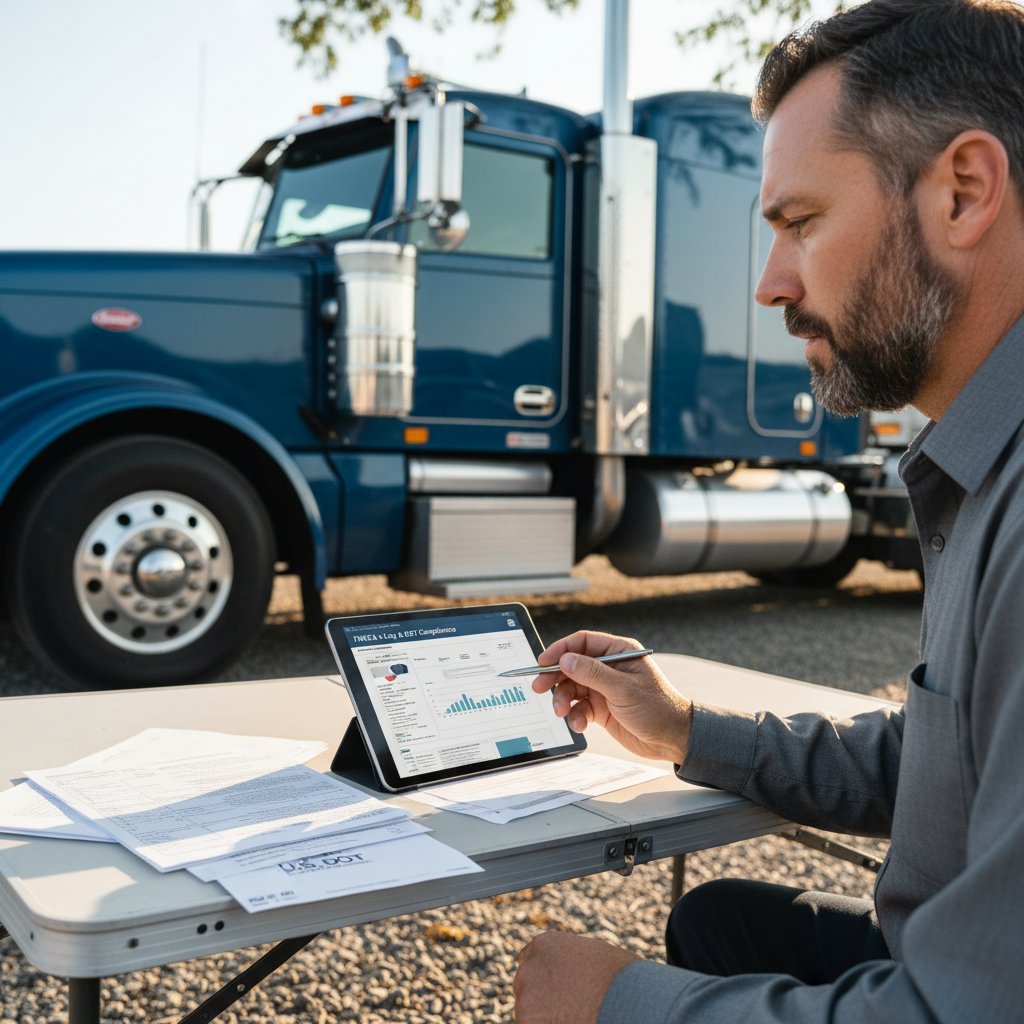
Commercial truck insurance in 2026 explained: coverages, FMCSA minimums, realistic costs, discounts, and filings (MCS-90/BOC-3)—so you stay compliant, book loads, and avoid claim surprises.
Commercial truck insurance is the coverage package that keeps your authority active and your truck rolling—because if your policy lapses or your COI doesn’t match what a broker requires, you’re parked. In most cases, it includes auto liability (often $750,000 to $1,000,000+ depending on operation) plus optional protections like physical damage, motor truck cargo, and general liability based on your contracts and how you run.
This guide breaks down what trucking insurance covers, what the FMCSA minimums mean in real life, what owner-operators typically pay in 2026, and how filings like MCS-90 and BOC-3 fit into day-to-day operations.
Table of Contents
Reading time: 9 minutes
- What does commercial truck insurance cover?
- Who needs commercial truck insurance?
- Commercial truck insurance coverage types
- FMCSA minimum requirements (and why minimum isn’t enough)
- State-by-state requirements snapshot
- Commercial truck insurance cost in 2026
- 2026 trends: telematics and UBI
- Filings & proof of insurance (MCS-90, BOC-3, COIs)
- Quick coverage decision tool
- Why Logrock’s approach is different
- Frequently Asked Questions
- Conclusion
What does commercial truck insurance cover? (Featured snippet answer)
Commercial truck insurance typically covers auto liability for injuries and property damage you cause, plus optional coverages like physical damage (collision/comprehensive), motor truck cargo, general liability, trailer interchange, bobtail/non-trucking liability, and towing/roadside based on your authority, cargo, and contracts.
If you only buy the cheapest policy that technically meets a minimum, you can still lose loads (COI mismatch) or eat a claim (wrong coverage terms). The goal is simple: match the policy to how you actually operate.
Key takeaways: essential commercial truck insurance
- Minimum legal coverage isn’t the same as “bookable freight” coverage: brokers and shippers often require higher limits than FMCSA minimums.
- Liability covers damage you cause to others—not your truck: protecting your tractor usually means adding physical damage.
- Premium is driven by risk signals: new authority status, cargo, lanes/radius, DOT/MVR history, and claims.
- Filings and proof matter operationally: if COIs or filings are wrong, you can lose loads even if you paid.
Who needs commercial truck insurance?
Any business operating a truck for business use typically needs commercial truck insurance, and interstate for-hire carriers commonly need proof of public liability coverage at $750,000 minimum for many general freight operations under FMCSA financial responsibility rules.
The real question isn’t “Do I need it?”—it’s what kind of operation you’re running, because that determines your limits, endorsements, and filings.
For-hire vs. private carrier (plain English)
- For-hire motor carrier: You haul freight that belongs to someone else, and brokers/shippers usually set strict insurance requirements (often $1,000,000 auto liability plus cargo and GL).
- Private carrier: You haul your own product (construction, manufacturing, etc.). You still face commercial risk, but the “insurance stack” can look different.
Owner-operator: leased-on vs. running your own authority
- Leased-on to a carrier: The carrier often provides primary auto liability while you’re under dispatch, but you may still need bobtail/non-trucking liability, physical damage, and occupational accident depending on the lease.
- Own authority (MC/DOT): You’re responsible for the full program—liability, cargo (contract-driven), filings, COIs, and compliance.
Commercial truck insurance coverage types (what’s required vs. add-ons)
Commercial truck insurance coverage types usually include auto liability as the core requirement for for-hire interstate operations, while coverages like cargo, general liability, and physical damage are often required by contracts, lenders, or your own risk tolerance.
Think of trucking insurance like a toolbox: you don’t need every tool for every job, but skipping the wrong one can shut down cash flow fast.
Coverage quick-view table (use this to sanity-check quotes)
| Coverage | What it protects | Who typically needs it | Typical limit approach | Common “gotchas” |
|---|---|---|---|---|
| Auto Liability (Primary) | Injuries/property damage you cause | Most for-hire + many commercial ops | Often $750K–$1M+ | Doesn’t fix your truck |
| Physical Damage (Comp/Collision) | Your tractor/truck value | Anyone with a truck note or real equity | Based on stated/ACV | Deductible choice matters |
| Motor Truck Cargo | Freight you’re legally liable for | For-hire carriers | $100K common (contract-driven) | Exclusions; unattended theft; temp claims |
| General Liability | Slip/fall, non-auto business claims | Many brokers require it | $1M common | Doesn’t replace auto liability |
| Trailer Interchange | Non-owned trailer in your care | Power-only / interchange situations | Value-based | Only under interchange agreement |
| Bobtail / Non-Trucking Liability | Liability when not under dispatch (varies) | Many leased-on owner-ops | $1M common | Definitions vary by policy/lease |
| Hired & Non-Owned Auto (HNOA) | Liability for rented/employee vehicles | Fleets or businesses with staff | $1M common | Not for your scheduled tractor |
| Towing/Roadside | Tow bills, service calls | Most operators | Per-event caps | Limits can be low vs real tow costs |
1) Auto liability (primary) — the non-negotiable core
Auto liability pays for injuries and property damage to others if you cause a crash, and FMCSA minimums are commonly referenced at $750,000 for many for-hire interstate general freight operations (higher for certain hazmat categories).
When you compare quotes, make sure you’re quoting the same liability limit and the same radius/cargo. Otherwise, it isn’t apples-to-apples.
2) Physical damage (collision + comprehensive) — protects your equipment
Physical damage typically includes collision (wrecks, rollovers) and comprehensive (theft, fire, hail, animal strikes), and lenders commonly require it when a truck is financed.
Pick a deductible you can actually float. A “cheap” deductible choice can turn into weeks of downtime if you can’t pay it when you need repairs.
3) Motor truck cargo — the coverage brokers actually care about
Motor truck cargo insurance covers certain freight damage or loss when you’re legally liable, and many broker setups commonly expect limits around $100,000 (higher for high-value commodities).
Ask about exclusions before you bind—especially unattended theft language, reefer temperature terms, electronics/high-value restrictions, and securement requirements.
4) General liability — “non-truck accident” business claims
General liability covers third-party claims that aren’t from driving the truck, and many brokers commonly require $1,000,000 limits for carrier onboarding.
GL isn’t a substitute for auto liability; it’s a separate bucket for non-auto exposures.
5) Trailer interchange — when you’re responsible for someone else’s trailer
Trailer interchange is physical damage coverage for a trailer you don’t own while it’s under a written interchange agreement, and limits are typically set to the trailer’s stated value.
If you do power-only or drop-and-hook, this can be the difference between a manageable claim and a five-figure surprise.
6) Bobtail vs. non-trucking liability — the most misunderstood “gap” coverage
Bobtail/non-trucking liability applies when you’re operating outside the carrier’s primary liability coverage, and what counts as “under dispatch” is defined by your lease agreement and the policy wording.
Don’t assume deadhead is covered. Some programs treat deadhead as business use, and some don’t.
7) Occupational accident — income and medical protection for the driver
Occupational accident is commonly used as an owner-operator alternative to workers’ comp in many setups, but state rules and contract requirements can change what’s acceptable.
If you’re out injured, fixed costs don’t stop. Occ/acc can help protect your household and keep the business alive.
FMCSA minimum requirements (and why “minimum” is usually not enough)
FMCSA public liability minimums are commonly referenced at $750,000 for many for-hire interstate general freight carriers, with higher minimums commonly referenced at $1,000,000 and $5,000,000 for certain hazardous materials classifications.
The legal minimum is the floor. The “real-world requirement” is whatever your target brokers and shippers demand to tender freight.
Federal liability minimums (quick reference)
| Operation/Cargo (simplified) | Common FMCSA minimum referenced | Real-world contract reality |
|---|---|---|
| Many for-hire general freight interstate carriers | $750,000 | Many brokers require $1,000,000 |
| Oil / certain hazmat classes | $1,000,000 | Shippers may require higher + extra scrutiny |
| Certain high-risk hazmat | $5,000,000 | Specialized underwriting + higher oversight |
Cargo requirements: legal vs. contractual
Cargo insurance is often contract-driven, and many brokers commonly request $100,000 as a baseline with higher requirements for reefer, high-value electronics, pharmaceuticals, and other high-theft commodities.
- Legal: what keeps you compliant.
- Contract reality: what keeps you bookable.
State-by-state requirements snapshot (intrastate vs. interstate)
Intrastate operations can have state-specific minimums and filings through state DOT/PUC agencies, while interstate operations follow FMCSA financial responsibility rules plus broker/shipper contract requirements for limits and COIs.
If you run “intrastate only,” be honest about it—one out-of-state load can move you into interstate exposure fast.
Mini snapshot (not exhaustive—verify before binding)
| State | Intrastate note (high level) | What to do |
|---|---|---|
| CA | Often stricter oversight for certain intrastate operations | Confirm requirements based on your operation and authority |
| TX | Rules can differ by weight and operation type | Verify based on GVWR and use |
| FL | High litigation environment can affect pricing | Match limits to broker requirements |
| IL/NJ/NY | Dense traffic can increase claim severity and frequency | Don’t shop on price alone—check terms and limits |
Practical move: decide your true radius and lanes before you bind. Underwriters price uncertainty, and claims get ugly when the application story doesn’t match reality.
Commercial truck insurance cost in 2026: realistic ranges + what drives your price
Commercial truck insurance cost for a 1-truck for-hire owner-operator commonly falls around $750 to $2,500+ per month per truck in many markets, with new authority and higher-risk freight or lanes often pricing above that range.
There isn’t a single “national average” that helps you. What matters is your commodity, your lanes, your garaging ZIP, and your safety history.
Typical cost ranges (what many operators actually see)
- For-hire owner-operator (1 truck): often $750 to $2,500+ per month per truck
- New authority: commonly higher because there’s less operating history
- Higher-risk freight or lanes: hazmat, high-theft commodities, coast-to-coast, dense metros → higher premiums
What moves the price the most (the “big levers”)
- Authority age: new venture vs. established
- Driving history: MVR, violations, reportables
- CSA/DOT profile: inspections, out-of-service rates, BASIC trends
- Cargo: general freight vs. high-value vs. hazmat vs. reefer
- Radius/operations: local vs. regional vs. OTR; cross-border
- Garaging ZIP: theft, weather, traffic density
- Truck value + deductible: higher values and lower deductibles cost more
- Payment plan: paid-in-full vs. monthly (financing fees add up)
Regional benchmarks (how to think about it)
| Operating environment | Pricing pressure | Why |
|---|---|---|
| Dense metro (high traffic) | Higher | More frequency + severity |
| High-litigation states | Higher | Large verdict risk drives severity assumptions |
| High-theft lanes | Higher | Cargo and tractor theft exposure |
| Rural/local-only | Often lower | Less exposure (not always—cargo and loss history still matter) |
Pro tip: the fastest “discount” is removing ambiguity—clean applications, consistent lanes, accurate radius, and documented safety habits.
2026 trends: telematics, usage-based insurance (UBI), and why your data matters
Telematics and usage-based insurance (UBI) programs increasingly price trucking risk using measurable driving signals like hard braking, speeding, time-of-day driving, and lane consistency, which can affect renewal premiums and claim outcomes.
In plain English: the cleaner your operational signals, the more leverage you may have—especially after you’re out of “new venture” territory.
What underwriters measure now (practical version)
- Hard braking / rapid acceleration events
- Speeding patterns
- Time-of-day driving (fatigue risk)
- HOS/ELD consistency
- Lane/radius consistency (does it match what you declared?)
- Dash-cam supported loss investigation (fault clarity)
Discounts to ask about (and the trade-offs)
| Discount type | What you may need | Trade-off |
|---|---|---|
| Telematics/UBI participation | Device/app + data sharing | Privacy and device costs |
| Dash cam program | Camera + install | Upfront cost |
| Safety program / coaching | Documented training | Time and consistency |
| Paid-in-full | Cash upfront | Cash flow hit |
Business view: if a program saves $150/month but costs $2,000 in downtime when it malfunctions, it’s not a win. Treat it like any other tool purchase.
Filings & proof of insurance: MCS-90, BOC-3, COIs, and a simple timeline
For new authorities, operational delays often come from proof-of-insurance issues like incorrect COIs, missing process agent filings (BOC-3), or misunderstandings about the MCS-90 endorsement rather than from the premium itself.
This is where trucks sit: the insurance exists, but the paperwork doesn’t match what FMCSA or a broker onboarding team needs.
Common documents (plain English)
- COI (Certificate of Insurance): the proof you send to brokers/shippers; incorrect certificate holder, limits, or endorsements can get you rejected.
- MCS-90 (endorsement): tied to financial responsibility for public liability in specific situations; it is not cargo coverage and it is not physical damage.
- BOC-3: a process agent filing for authority setup; it’s not insurance, but it is part of compliance workflow.
Simple timeline for a new authority (operational checklist)
- Before you bind: confirm cargo, radius, states, and trailer situation; pick limits based on the freight you want, not the cheapest option.
- Bind coverage: confirm filings were triggered; request COIs for broker onboarding and your common certificate holder setups.
- First 30–60 days: avoid preventable losses; if using telematics or cameras, install early so the data reflects stable operations.
- 60–90 days before renewal: review changes (lanes, commodities, drivers) and shop early if needed—last-minute renewals cost leverage.
Quick coverage decision tool (choose a baseline package in 60 seconds)
A practical baseline trucking insurance package usually includes liability plus the coverages required by your contracts and financing, such as cargo limits around $100,000 and physical damage if the truck is financed.
Answer these like a business owner—not like someone trying to “get the lowest monthly payment.”
Step 1: pick your scenario
| Scenario | Baseline you usually need | Add-ons that often make sense |
|---|---|---|
| Own authority, general freight, regional/OTR | Liability + cargo + physical damage | GL, trailer interchange (if applicable), towing |
| Leased-on owner-op | Physical damage (often) + bobtail/NTL (often) | Occ/acc, towing |
| Hotshot (for-hire) | Liability + cargo (as required) + physical damage | GL, trailer interchange, higher cargo limits |
| Reefer | Liability + reefer-capable cargo terms | Temperature endorsements, higher cargo limits |
Step 2: reality check (minimum vs. recommended)
- Minimum: what keeps you legal.
- Recommended: what keeps you bookable and protected when something goes sideways.
If your goal is to grow from 1 truck to 3, you want stability: fewer coverage gaps, fewer denied claims, and cleaner renewals.
Why Logrock’s approach is different (business-first, not sales-first)
A trucking insurance program that works in the real world needs correct limits, correct terms, and correct proof (COIs/filings), because brokers often won’t load you with mismatched certificates even if you paid the premium.
Owner-operators don’t need a lecture—they need a program that keeps freight moving and doesn’t blow up cash flow after a claim.
- Coverage built around how you actually operate (cargo, radius, trailer situation, authority status)
- COI support so brokers accept the paperwork without back-and-forth
- No “cheap now, expensive later” surprises from missing endorsements or wrong terms
Frequently Asked Questions
Commercial truck insurance covers auto liability for injuries and property damage you cause, and it can also include physical damage (collision/comprehensive), motor truck cargo, general liability, trailer interchange, and bobtail/non-trucking liability depending on your operation and contracts.
FMCSA minimums can be a starting point (often $750,000 for many for-hire interstate general freight operations), but brokers frequently require $1,000,000 liability plus cargo and GL to book loads. The “right” package is the one that matches your authority status, cargo type, radius, and how you dispatch.
Commercial truck insurance commonly costs about $750 to $2,500+ per month per truck for many for-hire owner-operators, with new authority, higher-risk cargo, and high-litigation or high-theft lanes often pricing above that range.
Your biggest pricing drivers are authority age, MVR/violations, prior claims, cargo type (general freight vs reefer vs hazmat), operating radius (local vs OTR), garaging ZIP, truck value, and deductible. To compare prices fairly, quote the same limits and terms across options—otherwise the “cheapest” quote may simply be less coverage.
Common commercial truck insurance types include auto liability, physical damage (comprehensive and collision), motor truck cargo, general liability, trailer interchange, bobtail/non-trucking liability, hired & non-owned auto (HNOA), and optional towing/roadside.
Which ones you need depends on who’s paying you (brokers/shippers), what you haul, whether you’re leased-on or running your own authority, and whether your truck is financed. As a quick benchmark, many broker setups expect $1,000,000 auto liability and cargo limits around $100,000, but higher-value freight can require more.
If you’re a leased-on owner-operator, you often need bobtail/non-trucking liability to cover certain times you’re operating outside the motor carrier’s primary liability coverage, and the exact trigger depends on how “under dispatch” is defined in your lease agreement and your policy wording.
This is one of the most misunderstood gaps in trucking insurance. Some programs treat deadhead as business use (so it may be excluded from non-trucking liability), while others handle it differently. The safest move is to review your lease, your dispatch rules, and your intended personal use so the coverage matches how you’ll actually drive.
FMCSA minimum public liability requirements are commonly referenced at $750,000 for many for-hire interstate general freight carriers, with higher minimums commonly referenced at $1,000,000 and $5,000,000 for certain hazardous materials classifications.
These are legal minimums, not a promise that you’ll be accepted by brokers or protected from contract exposure. Many brokers require $1,000,000 liability regardless of the FMCSA minimum, and cargo requirements are frequently contract-driven (often $100,000 as a baseline). Always confirm your exact requirement based on your authority and commodity before binding.
You can lower your commercial truck insurance premium in 2026 by reducing underwriting uncertainty and improving measurable risk signals, which includes quoting multiple options with the same limits, tightening your declared radius and cargo, and avoiding coverage lapses and preventable claims.
Ask about discounts tied to telematics/UBI, dash cams, and documented safety programs, but evaluate the ROI (device costs, downtime risk, and data-sharing trade-offs). Also review deductibles and truck values for accuracy—overstating value or choosing unrealistically low deductibles can inflate premium without improving your real-world outcome.
Conclusion: Build the right commercial truck insurance program (then protect your cash flow)
Commercial truck insurance is a system: coverages, limits, filings, and proof. When it matches your operation and your contracts, it protects your authority, your equipment, and your ability to book loads.
When it doesn’t match, it parks you—usually at the worst possible time.
Key Takeaways:
- Buy coverage for your operation, not the cheapest minimum: FMCSA minimums are a floor; broker requirements are often higher (commonly $1M).
- Liability protects others; physical damage protects your truck: don’t assume one replaces the other.
- Cargo and GL are often contract requirements: skipping them can cost you loads even if you’re “legal.”
If you want a clean, coverage-matched quote based on your cargo, radius, and authority setup, start here.