
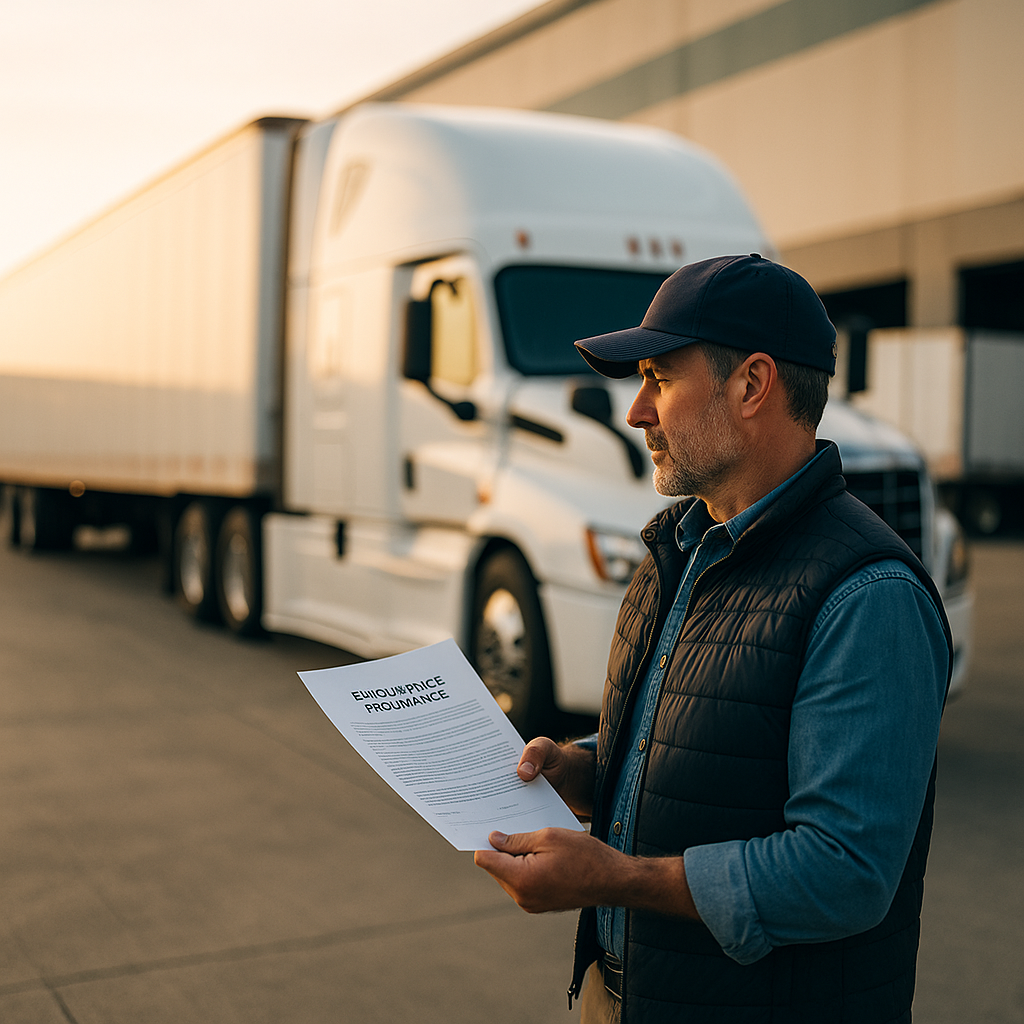

Do you need both commercial and personal auto insurance? Learn when one policy is enough, when business use triggers exclusions, costs, and 2026 gig rules—then get a quote.
If you’re asking “do I need both commercial and personal auto insurance?” the safest rule is simple: most people don’t need both on the same vehicle—you need one policy (or endorsement) that matches your highest-risk use (delivery, rideshare, multiple job sites, or LLC ownership).
Claims get messy when the adjuster finds out you were “working” on a policy priced for “personal-only.” The goal of this guide is to help you pick a setup that’s claim-proof, not just “cheap on paper.”
Table of Contents
Reading time: 8 minutes
- Quick Answer: Personal vs Endorsement vs Commercial (Decision Checklist)
- Why Personal Auto Often Doesn’t Cover Business Use (Common Exclusions)
- Can Commercial Auto Insurance Cover Personal Use?
- The Middle Option: Mixed-Use Solutions (Endorsements & Hybrid Setups)
- Business Liability Pitfalls: Employees, Borrowed Cars, and Contract Requirements
- 2026 Gig Economy & Rideshare: When You Need Separate Coverage
- 2026 Cost Comparison: What Changes Your Price (Without Making Up Numbers)
- State Rules & Legal Risk: What’s Actually “Required”?
- Real Claim Scenarios (Coverage-Gap Case Studies)
- How Logrock Helps You Avoid the “Wrong Policy” Trap
- Frequently Asked Questions
- Conclusion: Get Covered Before a Claim Tests You

Quick Answer: Do I Need Both Commercial and Personal Auto Insurance? (Decision Checklist)
Most drivers do not need both commercial and personal auto insurance for the same vehicle; you typically need one policy (or a policy plus the correct endorsement) that matches your riskiest use, because business-use mismatches are a common reason for claim disputes and non-renewals.
Think of it like this: insurance follows the risk, not your intentions. If you “mostly” use the car personally but occasionally do delivery or rideshare, the occasional trips can still be the trips that generate the claim.
You usually only need a personal auto policy if…
- You drive for commuting + personal errands.
- You go to one main workplace and aren’t running jobs all day.
- You’re not delivering, not carrying passengers for pay, and not transporting property for a fee.
You likely need commercial auto if…
- The vehicle is titled/owned by an LLC or corporation.
- You drive to multiple job sites daily (contractor/technician routes).
- You do delivery, rideshare, or other for-hire driving.
- Multiple drivers use the vehicle (employees or non-household drivers).
You might need both (less common) if…
- You have two different vehicles: one strictly personal, one strictly business.
- Your business needs commercial coverage, but your household still has personal cars on personal policies.
- A contract/employer requires proof of a personal policy for a personal car while your business vehicles are insured commercially.
Table: Personal vs Endorsement vs Commercial — which fits?
| Use case | Personal policy | Business-use endorsement | Commercial auto policy | Notes/risks |
|---|---|---|---|---|
| Commute + errands | Usually fits | Not needed | Overkill | Keep it simple |
| Real estate / sales client visits | Maybe | Often fits | Sometimes | Depends on mileage + carrier rules |
| Contractor with tools, multiple sites | Risky | Sometimes | Often | Misclassification is common here |
| Food/package delivery apps | Often excluded | Sometimes (if offered) | Often | High denial risk without correct coverage |
| Rideshare (app on) | Often excluded | Rideshare endorsement (separate) | Sometimes | Coverage “periods” matter |
| Vehicle titled to LLC | Often declined | Rare | Common | Named insured must match ownership |
Why Personal Auto Often Doesn’t Cover Business Use (Common Exclusions)
Many personal auto policies restrict or exclude for-hire activity (often described as “public or livery conveyance”) and may exclude or limit delivery and other revenue-driving use unless you add a specific endorsement approved by the carrier.
Personal auto is priced for personal risk. Turn the vehicle into a tool for revenue, and the exposure changes: more miles, more time in traffic, tighter schedules, and more lawsuit potential.
1) Business use vs. commercial use vs. “for-hire” use
Definition: Insurers don’t treat “work driving” as one bucket; “I drove to a client meeting” is not the same underwriting class as “I delivered a paid order” or “I carried passengers for pay.”
Why it matters: A claim can get delayed, partially denied, or fully denied if the vehicle use you disclosed doesn’t match what actually happened on the trip.
- Who’s at risk: Delivery drivers, rideshare drivers, contractors with routes, and anyone paid per trip/stop.
- How to avoid guessing: Ask your agent, “Is delivery / rideshare / for-hire explicitly covered?” and keep the answer in writing.
2) What happens if you crash “while working”
Claims fact-checking: Adjusters commonly verify trip purpose using app status, timestamps, job tickets, delivery logs, and whether you were transporting goods, tools, or passengers for compensation.
A denial isn’t just “no repair check.” It can mean you pay out-of-pocket, you get non-renewed, and the other party’s injuries become a personal financial threat.
Red-flag activities that trigger coverage disputes
- Delivery/for-hire driving (food, packages, parts, courier work)
- Rideshare with the app on (even “waiting for a request”)
- Vehicle titled to a business but insured on a personal policy
- Multiple non-household drivers using the vehicle regularly
Can Commercial Auto Insurance Cover Personal Use?
Commercial auto policies often allow incidental personal use, but coverage still depends on the named insured, the scheduled/eligible drivers, and the policy’s stated covered auto and use classifications.
In plain terms: commercial can be a “do-it-all” solution, but only if it’s written correctly for who owns the vehicle and who drives it.
Usually yes… but confirm drivers, ownership, and “named insured”
- Named insured: If the vehicle is owned by your LLC, the LLC typically needs to be the named insured (not you personally).
- Drivers: If your spouse or household member drives the vehicle, they may need to be listed/scheduled depending on the carrier.
- Permissive use: “Permissive driver” rules vary; don’t assume a friend/relative is covered without asking.
Proof requirements: Many businesses and platforms ask for a Certificate of Insurance (COI), and contracts often require specific wording and limits. Make sure your COI matches the contract language before you start the job.
The Middle Option: Mixed-Use Solutions (Endorsements & Hybrid Setups)
A business-use endorsement is a carrier-approved change to a personal auto policy that can expand coverage for limited business driving, but it often does not cover delivery/for-hire or rideshare unless separate endorsements are added.
This is the “sweet spot” for a lot of professionals: you’re driving for work, but you’re not doing high-frequency commercial stops or paid transportation.
4) Business-use endorsements on a personal policy
What it is: An add-on that can extend a personal policy to allow certain business driving (like client visits) when the carrier permits it.
What it usually won’t fix: Delivery/for-hire exposure, rideshare while the app is on, heavy commercial use, or multiple employee drivers.
- Good fit: Realtors, inspectors, sales reps, consultants—appointment driving, not deliveries.
- Bad fit: Anyone paid per trip/stop, or anyone whose day is “route-based.”
5) If the vehicle is owned by an LLC/corp
Ownership is a coverage trigger: When an LLC owns the vehicle, many personal carriers won’t write it because the policyholder and owner don’t align.
If you formed an LLC for tax/legal reasons and titled the vehicle to the business, a commercial policy is often the cleanest path—especially if you’ll ever need a COI for a contract.
Want the cheapest option that’s still claim-proof? The right answer is the setup that matches your real use (job sites, delivery, rideshare, LLC ownership), not the one that looks lowest on a monthly bill.
Business Liability Pitfalls: Employees, Borrowed Cars, and Contract Requirements
Hired and Non-Owned Auto (HNOA) liability is commonly added to a business policy to address lawsuits arising when employees use personal vehicles for work or when the business uses non-owned vehicles.
This is where small businesses get surprised: even if the vehicle isn’t owned by the business, the business can still get pulled into the lawsuit.
6) If employees drive their own cars for work (HNOA exposure)
What happens: If an employee rear-ends someone while running a work errand in their personal car, the injured party’s attorney often names the business as a defendant.
Why it matters: The employee’s personal auto may respond first, but defense costs and liability allegations can still target the business—HNOA is designed for that gap.
7) Client/vendor requirements (limits and proof)
Contract reality: Many vendor agreements require proof of insurance and specific liability limits, and it’s common to see $1,000,000 liability requirements in commercial contracts (often written as $1,000,000 CSL).
If the contract requires commercial coverage, “I have personal auto” may not satisfy the agreement—even if you think the use is light.
2026 Cost Comparison: What Changes Your Price (Without Making Up Numbers)
Commercial auto pricing is typically higher than personal auto because rating considers business-use frequency, annual mileage, driver count, territory, vehicle type, and higher contract-required limits such as $1,000,000 liability.
If you shop purely on price, you’re one claim away from learning what “excluded use” means. But yes—cost matters, so here’s what actually moves it.
10) Why commercial auto often costs more
- More annual miles: More time on the road means more claim opportunity.
- Denser territory: Urban stops and parking-lot claims add frequency.
- Use classification: Delivery/for-hire is usually rated higher than “incidental business use.”
- Multiple drivers: Employee drivers and non-household drivers change risk.
- Higher limits: Contracts often demand higher liability than a state minimum.
11) Cost direction table (not a quote)
| Option | Typical cost direction | Best for | Common reasons it’s declined |
|---|---|---|---|
| Personal auto (personal-only) | Lowest | Commute + errands | Business ownership/use not allowed |
| Personal + business-use endorsement | Low → moderate | Client visits, light business use | Delivery/for-hire/LLC ownership |
| Personal + rideshare/delivery endorsement | Moderate | App driving part-time | Not offered in some states/carriers |
| Commercial auto | Higher | LLC-owned vehicles, delivery, multiple drivers | Poor loss history, misaligned use details |
Trucking note: If you operate a truck (hotshot, straight truck, or semi), don’t confuse “commercial auto” for a car with commercial truck insurance. Trucking programs can involve filings and coverages beyond standard auto, but the same principle applies: the policy has to match the actual use.
State Rules & Legal Risk: What’s Actually “Required”?
State law generally requires minimum liability coverage to register/operate a vehicle (often as low as 25/50/25 in many states), but insurers can still deny a claim if you misrepresent or fail to disclose business use that violates the policy terms.
When people say “My state only requires liability,” they’re usually thinking about tickets and registration—not whether the carrier will honor a claim when the trip was revenue-related.
12) What’s state-required vs. what insurers require
State minimums: These are legal operating minimums and vary by state.
Insurer eligibility: Personal vs commercial is usually an underwriting and contract issue, not a DMV classification issue. The bigger day-to-day risk is a denial tied to excluded use.
13) Penalties and business consequences
- Registration or license issues: If a claim is denied and you can’t fix the vehicle or pay damages, your “practically uninsured” problem can snowball fast.
- Contract penalties: Losing a vendor slot, losing platform access, or breaching insurance requirements.
- Cash-flow hit: Repairs + downtime + legal exposure, all at once.
Real Claim Scenarios (Coverage-Gap Case Studies)
Claim investigations commonly review trip purpose, payment records, app status, vehicle ownership, and driver history, and mismatches between disclosed use and actual use are a frequent source of coverage disputes.
These simplified scenarios reflect how claims typically get investigated in the real world.
14) Case study: Delivery accident during an active order
Scenario: You’re delivering food, you rear-end someone, and you’re at fault.
What goes wrong: If your personal policy excludes delivery, you may be denied. If platform coverage applies, you may still face limitations and deductible surprises. Outcome: you’re paying out-of-pocket or fighting over coverage while bills stack up.
15) Case study: Contractor hauling tools to multiple job sites
Scenario: You drive a pickup loaded with tools from job to job all day, but you told your insurer you “just commute.”
What goes wrong: That mismatch can trigger a coverage dispute. Best case: surcharge or non-renewal. Worst case: denial and you eat the loss.
16) Case study: Employee in personal car hits someone on a work errand
Scenario: An employee runs a bank deposit in their personal car and causes an accident.
What goes wrong: The business can be named in the lawsuit even though it doesn’t own the vehicle. Without proper risk transfer (often including HNOA), the business is exposed.
How Logrock Helps You Avoid the “Wrong Policy” Trap
Most coverage gaps come from application answers that don’t match real operations, and insurers rate and pay claims based on disclosed use, ownership, listed drivers, and documented trip purpose.
We focus on what you actually do:
- How you get paid: delivery, for-hire, contractor routes, gig apps
- Who owns the vehicle: personal vs LLC/corporation
- Who drives: household members vs employees vs permissive drivers
- What proof you need: COIs for contracts and platforms
Frequently Asked Questions
Usually no—you typically don’t need both personal and commercial auto insurance on the same vehicle; you need one policy (or an endorsement) that matches the highest-risk use you actually do. Delivery, rideshare with the app on, multiple job sites, and LLC-owned vehicles are common triggers where a personal policy can be the wrong form. Carrying both is most common when you have separate vehicles (one strictly personal and one strictly business) or when a contract requires proof for different vehicles. The goal is simple: no excluded use on the trip that causes the claim.
Yes, commercial auto insurance often covers incidental personal use, but only if the policy is written correctly for ownership and drivers. The named insured should match the true owner (for example, your LLC if the LLC owns the vehicle), and the carrier may require household members to be listed or scheduled if they drive. “Permissive use” rules also vary by carrier, so you should confirm whether non-listed drivers are covered. If you need a COI for a contract, verify the limits and wording before you start work.
Sometimes, but personal auto insurance is commonly limited to personal driving and may restrict or exclude business uses like delivery, transporting property for a fee, or rideshare (often described as “livery” or “for-hire”) unless an endorsement is added. Many carriers will allow commuting and occasional client visits, but they may not allow route-based work, multiple drivers, or business-titled vehicles. If you’re paid per trip or per stop, assume you need a delivery/rideshare endorsement or a commercial policy until your carrier confirms coverage in writing.
Commercial auto insurance is typically required by insurers or contracts when the vehicle is owned by an LLC/corporation, when driving is frequent and business-heavy (multiple job sites or deliveries), when multiple drivers or employees operate the vehicle, or when a contract requires commercial proof and higher limits. Many commercial agreements commonly ask for $1,000,000 liability limits and a COI, which personal auto may not satisfy. Even if your state minimum liability is enough to register the car, the insurer can still deny claims tied to excluded or undisclosed business use.
Yes, one policy can cover both personal and business use if it’s the right form for your risk: either a commercial auto policy that allows incidental personal driving, or a personal policy with the correct business-use and/or rideshare/delivery endorsements (when offered and when your use qualifies). The key is that the policy language and underwriting class must match what you’re doing on the road—especially for for-hire activity, deliveries, and LLC-owned vehicles. One correctly classified policy is usually safer than two policies that still leave an excluded-use gap.
Conclusion: Get Covered Before a Claim Tests You
You usually don’t need both policies on the same vehicle—you need the right policy for the riskiest use you actually do. The expensive mistake is letting your insurance say “personal use” while your real life says “work vehicle.”
Key Takeaways:
- Match coverage to the highest-risk use (delivery, rideshare, multiple job sites, LLC ownership).
- Endorsements can work for light business driving, but they often don’t solve for-hire exposures.
- Contracts and employee driving can create business liability even without a company-owned vehicle.
If you want a quick, real-world coverage check, tell us how you actually use the vehicle and we’ll point you to the cleanest setup.





