
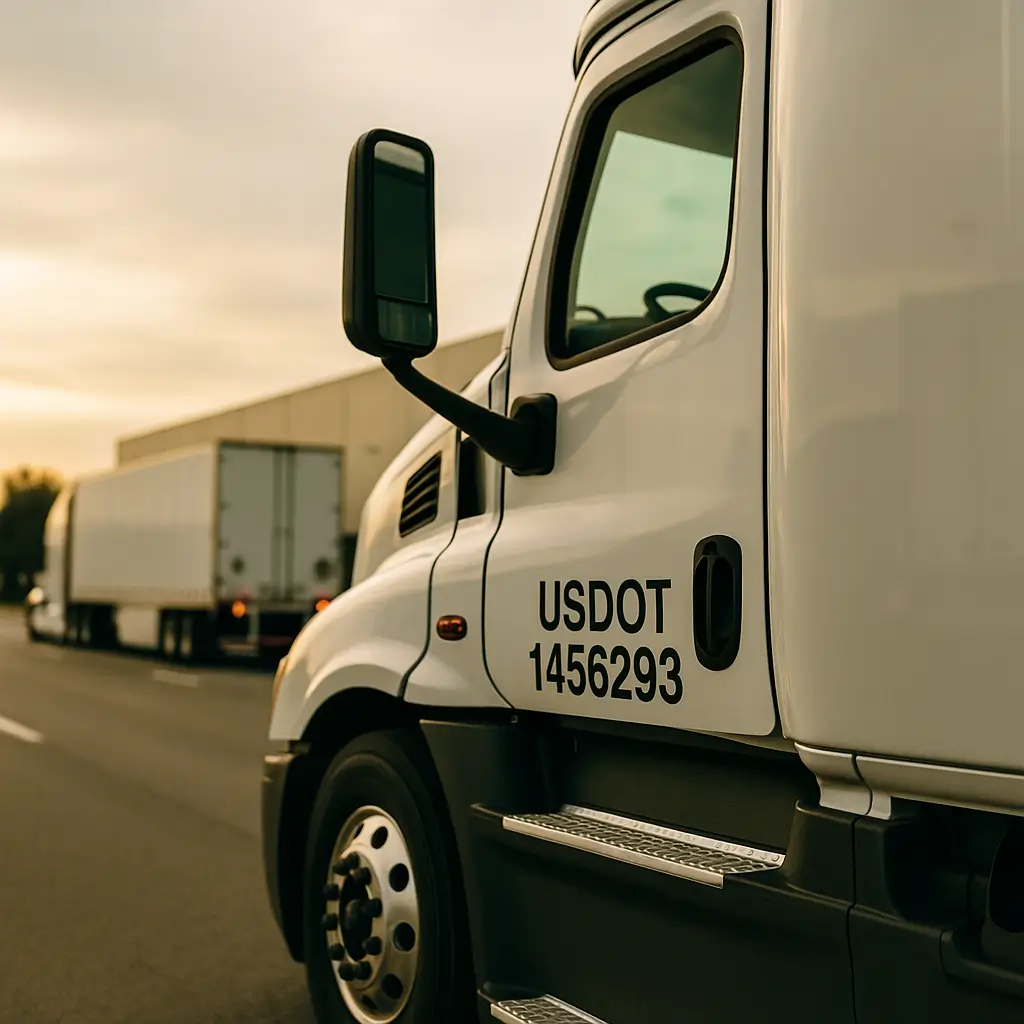

Learn who needs a USDOT number, how to apply, FMCSA rules, insurance ties, and how to avoid fines and delays.
An FMCSA DOT number (USDOT) is required for many owner-operators running interstate with a 10,001+ lbs GVWR/GCWR, placarded hazmat, or passenger trips over FMCSA thresholds—and getting it wrong can trigger fines, out-of-service time, and lost loads.
Featured snippet answer: You generally need a USDOT number if you operate a commercial vehicle in interstate commerce and you (1) have a GVWR/GCWR of 10,001 lbs or more, or (2) transport hazmat requiring placards, or (3) transport 9+ passengers for compensation (or 16+ not for compensation); many states also require DOT numbers for intrastate operations.
If you’re also sorting out coverage, start with commercial truck insurance basics so your registration details and your policy application match.
Key Takeaways: Essential FMCSA DOT Number Rules
- Weight triggers it fast: If your truck + trailer combo is 10,001 lbs GCWR or more and you’re interstate, you’re usually in USDOT territory.
- DOT number ≠ MC number: A USDOT number identifies your company for safety/compliance; MC authority is permission to haul certain freight for-hire across state lines.
- It’s free—but not “set and forget”: The USDOT number costs $0, but you must keep your registration data current (including MCS-150 updates) or risk inactive status.
- Insurance and filings can stop your launch: Even with a DOT number, your authority can’t go active without the right filings—this is where trucking insurance setup matters.
Table of Contents
Reading time: 9 minutes
- What an FMCSA DOT Number Is (and What It’s Not)
- Who Needs a DOT Number? (Interstate vs. Intrastate)
- How to Apply for a USDOT Number (Step-by-Step)
- DOT Number Display Requirements (Marking Rules)
- DOT Number Lookup: How to Verify Status Fast
- Ongoing Compliance After You Get Your DOT Number
- Insurance Tie-In: What DOT Registration Means for Commercial Truck Insurance
- Frequently Asked Questions
- The Logrock Difference: Insurance Built for Owner-Operators
- Conclusion & Get a Quote That Matches Your Authority

What an FMCSA DOT Number Is (and What It’s Not)
A USDOT number is a unique identifier issued by FMCSA to track a carrier’s safety and compliance record (inspections, audits, and crash history) across federal systems.
Enforcement officers, brokers, shippers, and insurance underwriters use your USDOT profile to verify who you are and whether your operation looks consistent with what you’re hauling.
USDOT vs. MC Number (Operating Authority): the clean breakdown
| Item | What it does | Who typically needs it |
|---|---|---|
| USDOT Number | Identifies a carrier for safety monitoring, inspections, and audits | Many interstate carriers; also intrastate in some states |
| MC Number (Operating Authority) | Permission to operate for-hire in interstate commerce (varies by operation) | For-hire carriers, brokers, freight forwarders (depending on model) |
| Authority status | Shows whether your authority is Active or Inactive in FMCSA systems | Anyone running loads under their own authority |
Real-world example: You can have a USDOT number and still not be legally ready to haul for-hire interstate if your operation requires MC authority and your filings aren’t in place.
Official FMCSA references (bookmark these)
Who Needs a DOT Number? (Interstate vs. Intrastate)
FMCSA generally requires a USDOT number for interstate carriers operating CMVs at 10,001+ lbs GVWR/GCWR, hauling placarded hazmat, or transporting passengers above federal thresholds, while intrastate DOT-number rules are set by each state.
If you’re unsure, verify with FMCSA and your state DOT—because “I only stay in-state” doesn’t always mean exempt, especially when the freight is part of an interstate movement.
1) Interstate commerce (crossing state lines or “interstate” freight)
- What it is: You cross state lines or your freight is part of an interstate movement (even if you personally stay in one state).
- Why it matters: Operating without required registration can lead to citations, out-of-service orders, and broker onboarding failures.
- Common triggers:
- GVWR/GCWR 10,001+ lbs (truck, trailer, and combined ratings matter)
- Hazmat requiring placards
- Passengers: 9+ for compensation, 16+ not for compensation
2) Intrastate commerce (staying in-state): state rules can still trigger a DOT number
- What it is: You only operate inside one state.
- Why it’s tricky: Many states require DOT numbers for intrastate operations, sometimes with different thresholds or vehicle categories.
- Pro tip: Hotshot setups (pickup + flatbed/gooseneck) often trip the 10,001 GCWR line quickly—don’t assume “it’s just a pickup” protects you at roadside.
3) Quick weight reality check (hotshot, Sprinters, box trucks, straight trucks)
Enforcement commonly looks at ratings (GVWR/GCWR) and may compare them to actual scale weights, so you should know both.
- A 1-ton dually + a 40’ gooseneck can push you over 10,001 GCWR even if the load feels “light.”
- If you’re building a quoting plan, match the operation to the right category: hotshot insurance guide and semi truck insurance explained.
How to Apply for a USDOT Number (Step-by-Step)
FMCSA issues a USDOT number through its online registration process, and the government fee for the USDOT number itself is $0 (free), even though paid “filing services” may charge for help.
If you’re going under your own authority, it’s smart to line up insurance in parallel so you don’t lose days waiting on filings; here’s a practical overview of how trucking insurance filings work.
Watch this quick breakdown before you start your application:
1) Get your info together (before you touch the application)
- Legal business name / DBA, EIN (or SSN if sole prop)
- Physical address (not just a PO box)
- Vehicle details (power unit count, trailers)
- Driver info and expected mileage / states of operation
- Cargo categories (general freight, auto hauler, reefer, etc.)
- Hazmat status (if applicable)
2) Apply through FMCSA (Registration / URS process)
- What it is: FMCSA’s online registration pathway where you request a USDOT number and, if needed, operating authority.
- Cost: USDOT number is free (watch for ads that imply a “required fee”).
- Where to start: FMCSA: “Getting Started with Registration”
Pro tip: If someone charges “$300 to get your DOT number,” they’re charging for paperwork assistance—not a government filing fee. Sometimes that help is worth it; just know what you’re paying for.
3) Know what comes next (if you’re going under your own authority)
A USDOT number identifies you, but it doesn’t automatically make you load-ready as a for-hire carrier.
- MC authority application (if your operation requires it)
- BOC-3 (process agent filing)
- UCR (Unified Carrier Registration)
- Insurance filings (often required to activate authority)
If your operation requires it, start with our guide on how to get operating authority. For a complete walkthrough of all post-DOT filings, see our step-by-step guide to how to get trucking authority.
If your next step is MC authority, here’s the full application walkthrough:
DOT Number Display Requirements (Marking Rules)
FMCSA marking rules, codified in 49 CFR § 390.21, generally require carriers who must have a USDOT number to display it on the power unit in a legible, contrasting format, commonly described as readable from 50 feet in daylight.
Even when you’re legal on paper, bad markings can earn you an avoidable roadside stop or a “fix-it” situation.
Reference: 49 CFR § 390.21 — Marking of commercial motor vehicles
1) What must be displayed (typical requirements)
- Legal name or DBA name
- USDOT # (and MC # if applicable/used)
- Markings on both sides of the power unit (common practice)
2) Visibility standard (practical version)
- Plain English: Readable from about 50 feet in daylight, contrasting color, not blocked by tanks/steps/strap boxes.
- Pro tip: Cheap vinyl that peels turns into a repeat problem. Good material costs less than downtime.
3) Common marking mistakes that waste your time
- DOT number placed where it’s blocked by a fuel tank fairing
- Font too small (looks fine up close, fails at distance)
- Using someone else’s numbers while running under your own authority (creates compliance confusion fast)
DOT Number Lookup: How to Verify Status Fast
FMCSA’s SAFER “Company Snapshot” is the most common tool brokers and shippers use to review a carrier’s USDOT profile, including basic status indicators, inspection history summaries, and authority snapshots.
You should check your own profile anytime you change addresses, add units, renew a policy, or update operations—because catching issues early prevents “we can’t load you” calls.
For a workflow that doesn’t eat your Sunday, keep compliance docs in one place (COIs, filings, cab card, etc.): trucking paperwork guide.
1) Use FMCSA SAFER / Company Snapshot
- USDOT number status
- Operating authority status
- Insurance/authority snapshots (varies by display)
- Inspection and crash data summaries
Start from FMCSA and follow their official links to the snapshot tools to avoid lookalike sites.
2) What to look for (red flags)
- Inactive / Out of Service indicators
- Mismatches in company name, address, power units, or cargo classification
- Authority not active due to missing insurance filings
Pro tip: Finding a status problem on Tuesday morning beats learning about it when a broker rejects you at dispatch.
Ongoing Compliance After You Get Your DOT Number
FMCSA requires carriers to keep their registration information current, and failing to update your USDOT profile (including MCS-150) can contribute to inactive status and avoidable broker/insurance friction.
Owner-operators who stay organized treat compliance like maintenance: small, scheduled work that prevents expensive breakdowns.
1) Update your MCS-150 (don’t let your DOT number go stale)
- What it is: Your company “census” data (mileage, units, operation type) in FMCSA systems.
- Why it matters: Outdated info can trigger status problems and underwriting delays.
- Who needs it: Anyone with a USDOT number, especially after changes (address, units, operation).
2) New Entrant Safety Audit (if applicable)
FMCSA’s New Entrant Safety Assurance Program often comes with extra oversight, and auditors commonly check your basic compliance files and programs.
- Driver qualification files (if you hire)
- ELD/HOS compliance
- Maintenance records (PM schedules matter)
- Drug & alcohol program enrollment (if required)
3) UCR, IRP, IFTA: the “paperwork taxes” of growth
As you expand lanes and states, these registrations and reporting obligations show up fast.
- UCR: annual registration for many interstate carriers
- IRP: apportioned plates for multi-state operations
- IFTA: fuel tax reporting for qualified vehicles
If those acronyms already irritate you, you’re normal. Put them on a calendar and automate reminders. If the acronyms are piling up, our trucking paperwork guide covers what to keep, how to organize it, and what inspectors look for.
Insurance Tie-In: What DOT Registration Means for Commercial Truck Insurance
Your USDOT profile and authority details affect underwriting because carriers rate based on declared operation type, mileage, radius, garaging, power units, and later your inspection/violation history.
This is where owner-operators lose time: the “registration story” and the “insurance story” don’t match, so filings get delayed and brokers won’t onboard you. For a complete breakdown of what filings and coverage types FMCSA requires, see our FMCSA insurance requirements for owner-operators guide.
1) DOT number vs. authority: why insurance gets confusing
- Plain English: A DOT number identifies you; operating authority determines whether you’re for-hire interstate and what filings you need.
- Business risk: The wrong policy type (or wrong named insured) can mean no load, no authority activation, or coverage gaps after a claim.
2) Common insurance policies owner-operators run into
- Primary Auto Liability (the one brokers care about most)
- Physical Damage (protects your truck and your cash flow)
- Cargo (often required by brokers/shippers; varies by commodity)
- Non-Trucking Liability / Bobtail (depends on whether you’re leased-on and when you’re off-dispatch)
If you’re chasing affordable trucking insurance, cheap-but-wrong is expensive. The best price is the one that still matches your operation and keeps you compliant. If you’re brand new, our best trucking insurance for new authority breakdown covers carriers, costs, and the filing timeline so you know what to expect.
Here’s how auto liability and new authority insurance fit together:
3) Hotshot and light/medium duty setups still need real coverage
Hotshot work often means tight receivers, job sites, and cargo that brokers scrutinize (equipment, building materials), so your coverage has to match how you actually run.
- Reality: Claim frequency can be higher in job-site and multi-stop environments.
- Underwriting detail: Cargo type and radius matter; don’t “downplay” operations to get a lower premium.
The Logrock Difference: Insurance Built for Owner-Operators
Logrock helps owner-operators keep coverage and filings aligned so your authority can go active and your broker onboarding doesn’t stall on paperwork.
That means we focus on the parts that hit your cash flow: correct named insured, correct operation classification, fast certificates when brokers ask, and fewer “surprise” delays tied to mismatched details.
What that looks like in practice
- We align your trucking insurance with your authority and operation so you’re not paying for the wrong setup.
- We help you avoid common launch delays tied to filings and inconsistent information.
- We move fast on COIs so you can book the next load when the market is moving.
Frequently Asked Questions
A USDOT number is your safety identification — it’s how FMCSA tracks your inspections, audits, and crash history. MC authority is the permission to operate for-hire in interstate commerce. Many owner-operators need both: the DOT number first, then MC authority if they plan to haul freight for hire under their own name.
If you’re leased to a carrier and hauling under their authority, you may only need the DOT number. The safest move is to confirm your specific situation with FMCSA’s registration tool before you apply. You can also review our guide on how to get operating authority.
A USDOT number is a unique identifier issued by the Federal Motor Carrier Safety Administration (FMCSA) to track a carrier’s safety and compliance activity, including inspections, audits, and crash reporting.
A USDOT number is not the same thing as an MC number: the MC number relates to operating authority for certain for-hire interstate operations, while the USDOT is your safety ID. If you want the official definition and triggers, use FMCSA’s guidance: Do I Need a USDOT Number?
You generally need a USDOT number if you operate in interstate commerce and your commercial vehicle is 10,001+ lbs GVWR/GCWR, or you haul placarded hazmat, or you transport 9+ passengers for compensation (or 16+ not for compensation).
Many states also require DOT numbers for intrastate carriers, sometimes with different thresholds. If your loads originate in-state but the freight is part of an interstate movement, you can still fall under interstate rules—verify with FMCSA and your state DOT.
Operating a CMV in interstate commerce without a required USDOT number can result in a citation, an out-of-service order at roadside, and civil penalties. Carriers operating without registration may also face issues getting paid by brokers who verify SAFER status before releasing loads.
Beyond the immediate penalties, a compliance gap on your safety record can affect your insurance rates down the road. For broader compliance context, see our Department of Transportation compliance guide.
You get a USDOT number by applying through FMCSA’s online registration process, and the USDOT number itself is free ($0) as a government fee.
Costs usually come from related requirements like operating authority fees (if applicable), BOC-3 service, UCR registration, and getting insurance in place for filings. If a company charges you, they’re charging for assistance and processing—not because FMCSA charges for the USDOT number.
FMCSA typically issues a USDOT number immediately or within a few business days when you apply online through the URS (Unified Registration System). The number itself is fast — the delays usually come after, when you’re waiting on MC authority to activate.
Authority activation can require insurance filings, BOC-3, and a protest period, so plan your timeline around those downstream steps, not the USDOT number itself. For the broader process, see our guide on how to get trucking authority.
If you’re required to have a USDOT number, you generally must display it on the power unit in a visible and legible way, commonly described as readable from about 50 feet in daylight with good contrast.
Clean markings reduce inspection friction and can speed up facility check-ins because some sites verify carrier identity at the gate. For the most current marking guidance, confirm with FMCSA resources and your state’s requirements if you also run intrastate.
Your USDOT number doesn’t have a traditional expiration date, but it can go inactive if you don’t update your MCS-150 biennial update on schedule, or if FMCSA flags your record for other compliance issues.
An inactive USDOT number can show up on SAFER Company Snapshot, which brokers, shippers, and insurance underwriters may check before working with you. Keeping your MCS-150 current and your registration data accurate is the simplest way to avoid inactive status.
Yes—your USDOT profile affects truck insurance pricing indirectly because underwriters rate based on what your registration says about your operation (radius, mileage, states, units, cargo) and, over time, your inspection and violation history.
A registration profile that doesn’t match reality (wrong cargo, wrong unit count, wrong address/garaging) can slow underwriting, trigger extra questions, or create disputes during claims. If you’re shopping semi truck insurance or commercial truck insurance, align the FMCSA details with how you actually run.
Conclusion: Get a Quote That Matches Your Authority
Your FMCSA DOT number is the start of compliance—not the finish line. Get the DOT/authority side correct, display it properly, keep it updated, and make sure your commercial truck insurance matches how you actually operate.
Key Takeaways:
- Know whether you need USDOT, MC authority, or both—don’t guess.
- The USDOT number is free, but staying active takes ongoing updates (including MCS-150) and clean records.
- Insurance isn’t just a bill—it’s part of what makes authority activation and broker onboarding work.
Getting your DOT number right is only the first step — making sure your insurance setup matches your authority, operation type, and filing requirements is what actually keeps you moving. If you want a quick sanity check on your coverage before your authority goes active or before your next renewal, LogRock can help you align the details and avoid the delays that stall new carriers at dispatch.
Talk to LogRock and request a quote.
Related reading: Commercial Truck Insurance Basics, Hotshot Insurance Guide, and Semi Truck Insurance Explained.





