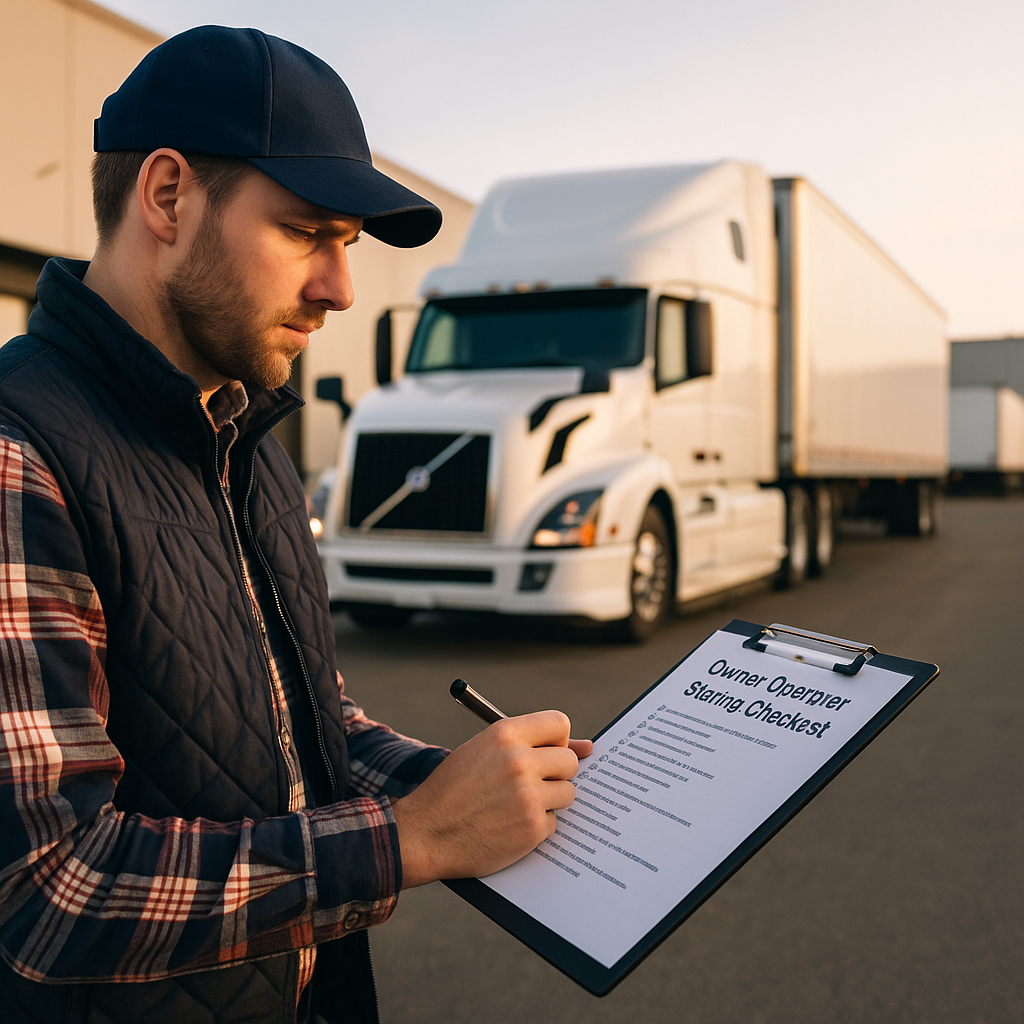

Use this owner operator startup checklist to set up compliance, permits, and trucking insurance without wasting cash. Start smart—get a Logrock quote.
Starting with an owner operator startup checklist keeps you from learning the hard way: one missed filing, one bad broker, or the wrong trucking insurance setup can shut you down before you ever build momentum.
First steps (quick answer): The first steps to launching as an owner-operator are (1) pick your lane (lease-on vs. own authority), (2) price your startup cash needs, (3) set up your business + compliance accounts, (4) secure commercial truck insurance, (5) get your registrations (USDOT/authority, UCR, IRP/IFTA if needed), and (6) lock in a maintenance plan before you book your first load.
This guide is built like a real-world pre-trip: practical, in order, and focused on cash flow, compliance, and cost-per-mile (CPM) so you can start strong without overpaying or getting sidelined at the first chicken coop.
Essential owner-operator startup moves
- Decide “Lease-On vs Own Authority” first: It changes your paperwork load, insurance cost, and how fast you can start earning.
- Budget for the ugly weeks: Tires, DEF issues, and slow pay are normal—build a cash buffer and a maintenance plan.
- Get trucking insurance structured correctly: Wrong filings/limits can get you load-rejected or authority-delayed.
- Build a compliance routine early: ELD, DQ file, and drug program readiness matter because new-entrant audits don’t care that you’re “new.”
Table of Contents
Reading time: 11 minutes
- Step 1–3 — Big business decisions
- Step 4–6 — Entity, authority, and compliance
- Step 7 — Trucking insurance you actually need
- Step 8–9 — Equipment, maintenance, and tech
- Step 10–11 — Taxes, plates, IFTA/IRP, and state gotchas
- Step 12 — Freight strategy
- Frequently Asked Questions
- The Logrock Difference
- Conclusion

Step 1–3 — Make the Big Business Decisions Before You Spend a Dollar
Choosing lease-on vs. own authority is the first owner-operator decision because it changes your legal responsibility for FMCSA compliance, your insurance structure, and how quickly you can haul freight.
If you want to stay independent and profitable, treat your launch like a business acquisition—because that’s what it is. Before permits and plates, map your operating model (and your risk). For related planning, see trucking compliance basics.
1. Pick Your Path: Lease-On vs Own Authority (Your “Paperwork vs Control” Trade-Off)
- What it is (plain English): Lease-on means you operate under another carrier’s authority; own authority means you are the motor carrier responsible for filings, safety, and compliance.
- Why it matters: The wrong choice can put you underwater in admin costs or limit your rate control and customer options.
- Who needs this: Every new owner-operator—before you quote insurance or buy plates.
| Decision | Best for | What you give up | What you gain |
|---|---|---|---|
| Lease-on to a carrier | Fast start, less admin | Some control; sometimes forced dispatch/fees | Carrier handles much of compliance; sometimes better insurance rates |
| Get your own authority | Long-term control and brand building | You own the audit risk and paperwork | Control lanes, customers, rates, and growth |
Pro tip (veteran advice): If you’re undercapitalized, lease-on can be your “paid apprenticeship.” If you’ve got reserves and systems discipline, authority can pay—but only if your freight plan is real.
2. Define Your Operation (This Determines Your Insurance, Permits, and Rates)
Your operating profile—cargo type, radius, states, GVW/GCW, and trailer type—directly changes underwriting, required filings, and broker requirements.
Insurance and compliance aren’t one-size-fits-all. Hotshot insurance for a 1-ton plus a 40’ gooseneck is priced and underwritten differently than semi truck insurance hauling refrigerated freight.
- Power unit: 1-ton/5500 hotshot vs. day cab vs. sleeper
- Trailer: flatbed, step deck, dry van, reefer
- Cargo: general freight, auto parts, hazmat (higher requirements), high-value
- Radius: local, regional, OTR
- Driver plan: team or solo (HOS realities)
3. Price Your Startup Cash Needs (So One Breakdown Doesn’t End the Business)
A realistic cash plan for your first 60–90 days should include insurance down payment, registration timing, fuel float, and a maintenance reserve so a single repair doesn’t park you.
The #1 killer isn’t “lack of hustle.” It’s cash flow timing: insurance down payments, plates, repairs, and fuel happen before invoices clear.
| Cost bucket | Typical timing | What to estimate |
|---|---|---|
| Truck payment / purchase | Day 1 | Monthly payment or cash price + taxes |
| Insurance down payment | Day 1 | Often 20–35% down (varies by carrier/risk) |
| Plates/registration | Day 1–30 | IRP plate, permits as needed |
| ELD + device | Day 1 | Hardware + monthly subscription |
| Maintenance reserve | Ongoing | Target $0.10–$0.25 CPM (depends on truck age) |
| Fuel float | Weekly | Enough for 1–2 weeks of fuel |
| Factoring/quick pay fees (optional) | When invoicing | % of gross revenue (if used) |
Rule that keeps you alive: If you can’t comfortably float 30 days of operating expenses, you’re one surprise DPF issue away from parking the truck.
Step 4–6 — Entity, Authority, and “Must-Do” Compliance Setup (No Guessing)
Operating under your own authority generally requires an active USDOT/MC setup plus BOC-3 and insurance filings before you can legally haul for-hire interstate freight.
This is the part that gets people in trouble because it’s boring—and expensive when done wrong. Build it like a checklist, not a vibe. If you want help understanding the paperwork stack, see USDOT and motor carrier authority explained.
4. Set Up the Business (EIN, Bank Account, Bookkeeping) Before Revenue Hits
Separating business and personal finances is one of the fastest ways to see your true CPM and keep tax and claims documentation clean.
- EIN: Get one even if you’re a sole prop (it simplifies banking and vendor setup).
- Business checking + savings: Use savings as a maintenance reserve account.
- Bookkeeping workflow: QuickBooks, TruckLogics, or a disciplined spreadsheet.
- Receipt capture: Phone app for repairs, tolls, scales, parking.
5. Register the Right Way (USDOT/Authority, UCR, BOC-3, State Accounts)
Carrier registrations and filings must match your insurance and operation type, or your authority may not activate and brokers may reject your COI.
Core items to expect (varies by operation):
- USDOT registration: Federal identifier used for safety and compliance tracking.
- Operating authority (MC): For-hire authority if applicable to your operation.
- BOC-3: Process agent filing.
- UCR: Unified Carrier Registration (annual).
- State accounts: Tax/withholding accounts if you’ll have employees later.
2026 reality check: FMCSA systems and requirements get updated. Don’t rely on an old forum post—verify current requirements with FMCSA before you pay anyone.
6. Join a Drug & Alcohol Consortium + Build Your DQ File (Even if It’s Just You)
FMCSA-regulated CDL operations typically need drug and alcohol program compliance and a driver qualification (DQ) file that can be produced quickly during a new-entrant audit.
- Consortium enrollment: Keep enrollment documentation and contact info accessible.
- Testing process: Have a written pre-employment/random process (confirm what applies to your exact situation).
- Medical card tracking: Track expiration dates and upload copies.
- MVR/PSP checks: Run what’s required and keep proof.
- DQ file organization: Simple cloud folders work if they’re consistent.
Step 7 — Trucking Insurance You Actually Need (And the Expensive Mistakes to Avoid)
FMCSA public liability minimums for many for-hire property carriers are commonly $750,000, but many brokers and shippers require $1,000,000 auto liability and often $100,000 cargo (or more) to tender loads.
Insurance is not a box to check—it’s a contract that decides whether your business survives a wreck, a cargo claim, or a broker requirement. For a deeper breakdown, see commercial truck insurance coverages explained.
7. Build Your Commercial Truck Insurance Stack (Liability, Cargo, Physical Damage + Gaps)
A trucking policy package typically includes primary auto liability plus optional coverages like cargo and physical damage, and the “right” stack depends on your lane, equipment, and contracts.
| Coverage | What it protects | Why it matters in real life |
|---|---|---|
| Primary Auto Liability | Other people’s injuries/property | Required for for-hire ops; brokers often expect $1M |
| Motor Truck Cargo | The freight you’re hauling | Common shipper/broker requirement; protects against cargo claims |
| Physical Damage | Your truck/trailer | Keeps a crash from becoming bankruptcy |
| Non-Trucking Liability | Off-dispatch use | Helps cover gaps when you’re not under a load (depends on situation) |
| Bobtail | Driving tractor without trailer | Often required depending on lease/operation |
| General Liability | Slip/fall at shipper, etc. | Sometimes required for contracts/warehousing |
| Trailer Interchange (if applicable) | Non-owned trailers in your care | Common for power-only and certain drop/hook work |
Pro tip (veteran advice): Don’t chase “cheap” if it means you can’t get a COI turned around fast. Lost loads cost more than a small premium difference.
Goal check: If you’re shopping for affordable trucking insurance, the goal isn’t the lowest premium—it’s the right limits + correct filings + fast COIs so you can book loads and protect cash flow.
Step 8–9 — Equipment, Maintenance, and Tech (Where Profit Gets Won or Lost)
Owner-operators commonly target a maintenance reserve of about $0.10–$0.25 per mile depending on truck age and downtime risk, because one tire set or aftertreatment repair can erase weeks of profit.
A truck can gross money and still lose money. Your maintenance plan and dispatch tech decide if you’re running a business—or gambling. For maintenance planning and documentation, see preventive maintenance for owner-operators.
8. Choose Truck + Trailer With an ROI Lens (Not Just the Monthly Payment)
Equipment choice should match your freight plan, your cash buffer, and your tolerance for downtime and repair spikes.
| Factor | Older paid-off truck | Newer financed truck |
|---|---|---|
| Payment | Low/none | High monthly |
| Downtime risk | Higher | Lower (usually) |
| Repair spikes | More common | Less common early |
| Insurance (physical damage) | Often lower | Often higher |
| Best for | Strong wrench skills + cash reserve | Stable freight + consistent cash flow |
Reality: If you’re not setting aside a maintenance reserve every week, you’re borrowing from future you at credit-card interest.
9. Set Up Your Tech Stack (ELD, Routing, Scales, Parking, Invoicing)
A lean tech stack reduces HOS mistakes, improves documentation, and helps you invoice faster so cash flow doesn’t lag behind miles.
- ELD you’ll actually use: Bonus if it supports IFTA mileage reporting.
- Parking/routing apps: Parking is a business problem now, not a convenience.
- Fuel network + discounts: Track savings per gallon and per week.
- Document capture: Scale tickets, lumper, BOL/POD—same-day upload.
- Rate con + invoice storage: Simple cloud folders, consistent naming.
Step 10–11 — Taxes, Plates, IFTA/IRP, and State “Gotchas” (Avoid Fines and Delays)
IRP and IFTA generally apply to interstate operations at 26,001+ lbs GVW/GCW or with 3+ axles, and IFTA filings require accurate state-by-state mileage and fuel records each quarter.
This is where a lot of good operators get hit: they run hard, then get crushed by IFTA mistakes, plate problems, or state mileage taxes they didn’t plan for. For a dedicated walkthrough, see IFTA reporting for owner-operators.
10. Know When You Need IRP + IFTA (And Build a Weekly Mileage Routine)
IRP is apportioned registration for interstate operations, and IFTA is fuel tax reporting across states/provinces for qualified vehicles.
Pro tip: Make IFTA a weekly habit. Waiting until quarter-end is how you end up guessing miles—and paying for it.
11. Watch State-Specific Requirements (Examples You Must Verify)
State-specific permits, weight-distance taxes, and emissions programs can add accounts and fees that affect routing and profitability.
| State/Region | Example “gotcha” | Who it hits |
|---|---|---|
| California | CARB/emissions compliance and strict enforcement | Anyone operating into CA |
| New York | Highway-use tax (HUT) requirements can apply | Carriers running NY |
| New Mexico / Oregon / Kentucky (examples) | Weight-distance or mileage-based programs may apply | Carriers crossing these states often |
Bottom line: Your lane choice should consider compliance friction, not just rate per mile.
Step 12 — Freight Strategy: How You’ll Actually Get Paid (And Not Get Burned)
A basic freight playbook should include your break-even CPM and a deadhead cap (often 10–15%) so you don’t accept loads that look good but lose money after costs.
The fastest way to fail is booking “good-looking” loads that pay slow, short you on detention, or crush you with deadhead. For help building a broker-ready packet, see how to set up a carrier packet.
12. Build a Simple Freight Playbook (Rates, Lanes, Broker Screening, Detention)
A repeatable booking and billing process protects cash flow, reduces disputes, and makes your operation easier to scale.
- Know your break-even CPM: fuel, insurance, payment, maintenance, tolls, and your wage.
- Set a deadhead rule: example “no more than 10–15% deadhead on average.”
- Screen brokers: check credit, reputation, and payment terms before you roll.
- Put detention in writing: rate con or contract terms, not a phone promise.
- Keep clean documents: signed BOL/POD, lumper receipts, scale tickets.
Pro tip: If you’re always “too busy to invoice,” you’re not too busy—you’re under-systemized.
Frequently Asked Questions
Owner-operator startup FAQs below answer common 2026 questions about cost, required documents, CDL thresholds, permits, lease-on vs. authority, and what drives semi truck insurance pricing.
Many new owner-operators should plan on $10,000–$30,000 to start leased-on and $20,000–$50,000+ to start under their own authority, depending on truck payment, plates, and insurance terms.
The biggest early hits are usually an insurance down payment (often 20–35%), registration/plates, initial maintenance, and fuel float while you wait on net-30 (or longer) payments. A practical survival target is a 30-day operating cushion plus a maintenance reserve of $0.10–$0.25 per mile so one tire set or aftertreatment issue doesn’t shut you down.
To start owner-operator trucking, you typically need proof of operating registration (USDOT and, if applicable, MC authority), current insurance/COIs, and a compliance file you can produce during roadside inspections or audits.
At minimum, keep: insurance declarations and broker-ready COIs; vehicle registration and plate paperwork (IRP if applicable); IFTA records if you’re a qualified vehicle; and operational documents like rate confirmations, BOLs, PODs, and lumper receipts. If you run under your own authority, you’ll also need filings like BOC-3 and UCR, and you should keep drug/alcohol program documentation and a DQ file organized digitally from day one.
You don’t always need a CDL to be an owner-operator, but a CDL is typically required if your combination is 26,001+ lbs GCWR with a trailer over 10,000 lbs GVWR (a common Class A threshold).
Most Class 8 semi setups are CDL operations, and many hotshot combinations also cross CDL thresholds once you add trailer ratings and payload. The safest move is to verify your exact truck GVWR, trailer GVWR, and intended loaded weights before buying equipment or quoting hotshot insurance, because a “non-CDL plan” can collapse when your real weights and lanes don’t match the assumption.
Common owner-operator requirements include USDOT, operating authority (MC) if you’re for-hire under your own authority, BOC-3, UCR, and—if you qualify—IRP plates and IFTA fuel tax reporting.
IRP/IFTA commonly applies when you run interstate at 26,001+ lbs or with 3+ axles, but your exact requirement depends on your state, weights, and operation. Oversize/overweight and hazmat add major layers (extra permits, higher insurance expectations, and route restrictions). Because rules and state programs change, confirm your exact list before you roll—one missed account can mean citations, downtime, or being forced to re-route.
Lease on if you want to start faster with less compliance responsibility, and get your own authority if you want maximum control and can manage insurance, filings, and audit readiness like a business owner.
Leasing on often reduces your admin load because the carrier handles much of the compliance structure, and you may access their established insurance and freight relationships. Operating under your own authority can improve long-term earning control, but it adds tasks like COI management, UCR/BOC-3 coordination, and staying ready for audits and broker compliance checks. A common middle path is leasing on for 6–12 months to build lane knowledge and reserves, then transitioning once your CPM and cash buffer support it.
Semi truck insurance cost per month can vary by thousands of dollars because pricing is driven by authority age, driving history, cargo, radius, equipment value, and required limits like $1M liability and cargo requirements set by brokers.
New authority, limited experience, certain cargo (high-value or hazmat), and some states can push premiums higher fast—sometimes comparable to a truck payment. If you’re trying to keep commercial truck insurance affordable, focus on clean underwriting data (accurate garaging, radius, and vehicle details), consistent operations (no last-minute lane changes), and choosing coverages that match your contracts. The goal is “bookable and protected,” not “cheap and rejected by brokers.”
The Logrock Difference: Insurance Built for Business Owners
Getting booked often comes down to speed and accuracy—many brokers require same-day COIs with specific wording like additional insured or waiver of subrogation, and delays can cost you the load.
Most “insurance talk” ignores what you care about: uptime, cash flow, and not getting stuck in paperwork when you should be driving or booking the next run.
- Coverage that fits your operation: hotshot, reefer, flatbed, power-only, and more.
- Fewer gaps: avoid mismatched filings/limits that lead to denied claims or contract issues.
- Fast COIs: so you can stay booked (and paid).
When you’re juggling dispatch, maintenance calls, ELD/HOS compliance, and IFTA/IRP paperwork, you don’t need more noise—you need clean coverage and fast execution.
Conclusion: Protect the Business Before the First Load
Launching with an owner operator startup checklist works best when you sequence decisions—lane, cash plan, compliance, insurance, then freight—so you’re legal, insurable, and ready to get paid.
If you do the boring steps early, you’ll avoid the expensive version later (downtime, rejected COIs, fines, and surprise cash crunches).
Key Takeaways:
- Decide lease-on vs. authority first: it changes compliance responsibility, insurance structure, and speed to revenue.
- Build cash defenses: aim for a 30-day cushion and fund maintenance at $0.10–$0.25 per mile.
- Buy “bookable” insurance: correct limits, correct filings, and fast COIs matter more than a tiny premium difference.
Related reading: Commercial Truck Insurance Coverages Explained, IFTA Reporting Guide, and Preventive Maintenance for Owner-Operators.