Dump truck insurance Tennessee buyers need usually isn’t one single policy. It’s a commercial insurance setup built around how the truck actually works, where it runs, and whether Tennessee rules, FMCSA rules, or both apply.
What Dump Truck Insurance Covers#
Dump truck insurance is usually a bundle of commercial coverages, not a single named policy. Most Tennessee dump truck operators need commercial auto liability first, then add physical damage and other coverage based on truck value, hauling work, and contract requirements. The biggest mistake is assuming coverage applies just because the truck is listed on a policy.
Core liability coverage#
Commercial auto liability is the coverage that pays when your truck causes bodily injury or property damage to other people. For a dump truck, that’s the foundation of the policy.
If you’re hauling for work, personal auto coverage isn’t built for that exposure. A commercial dump truck used on jobsites, public roads, or hauling material needs insurance designed for commercial truck use. That’s true whether you’re an owner-operator with one truck or running a small fleet.
General liability is coverage for non-driving business claims, like certain third-party injury or property damage claims that don’t come from operating the truck itself. It can matter if you work on jobsites, deal directly with contractors, or need it for contracts.
Physical damage and equipment#
Physical damage is coverage for damage to your own truck, usually through collision and comprehensive coverage. Collision pays for crash damage, while comprehensive covers things like theft, fire, vandalism, or some weather losses.
If the truck has serious value tied up in the chassis, body, or attached equipment, this matters fast. The same goes for financed trucks, since lenders usually require it. Your deductible affects how much you pay out of pocket before insurance responds.
Common endorsements and exclusions#
Some dump truck operations also need cargo-related protection, but this is where people get tripped up. Coverage for hauled material can be narrow, and exclusions may apply depending on what you’re carrying, who owns it, and how the policy wording treats the load.
Policy wording matters more than the label on the quote. A carrier may rate the truck differently based on whether it’s an end dump, hopper, local hauling unit, or part of a mixed operation with road trucks.

Who Needs Dump Truck Insurance in Tennessee#
Any dump truck used commercially in Tennessee needs commercial truck insurance, not personal auto coverage. The right setup depends on who owns the truck, what the truck hauls, how it operates, and whether the policy accurately reflects that operation. Truck configuration can change underwriting more than many owners expect.
Owner-operators and small fleets#
An owner-operator is a driver who owns and runs their own truck business, often with one truck under their own name or company. If that truck is earning money, the insurance has to match business use.
That includes one-truck operators, family-run businesses, and fleets with a few units. Underwriting looks at radius, jobsite exposure, driver history, truck value, and whether you’re hauling your own material or hauling for others.
End dump vs. hopper setups#
An end dump is a dump body that lifts from the front so material slides out the back. A hopper setup usually unloads material differently and may fit a different type of hauling operation.
That difference can matter because insurers look at the work being done, not just the truck class. A truck hauling aggregate on short local routes may be treated differently from a unit tied to broader road work or mixed commercial hauling.
When one policy may or may not fit mixed trucks#
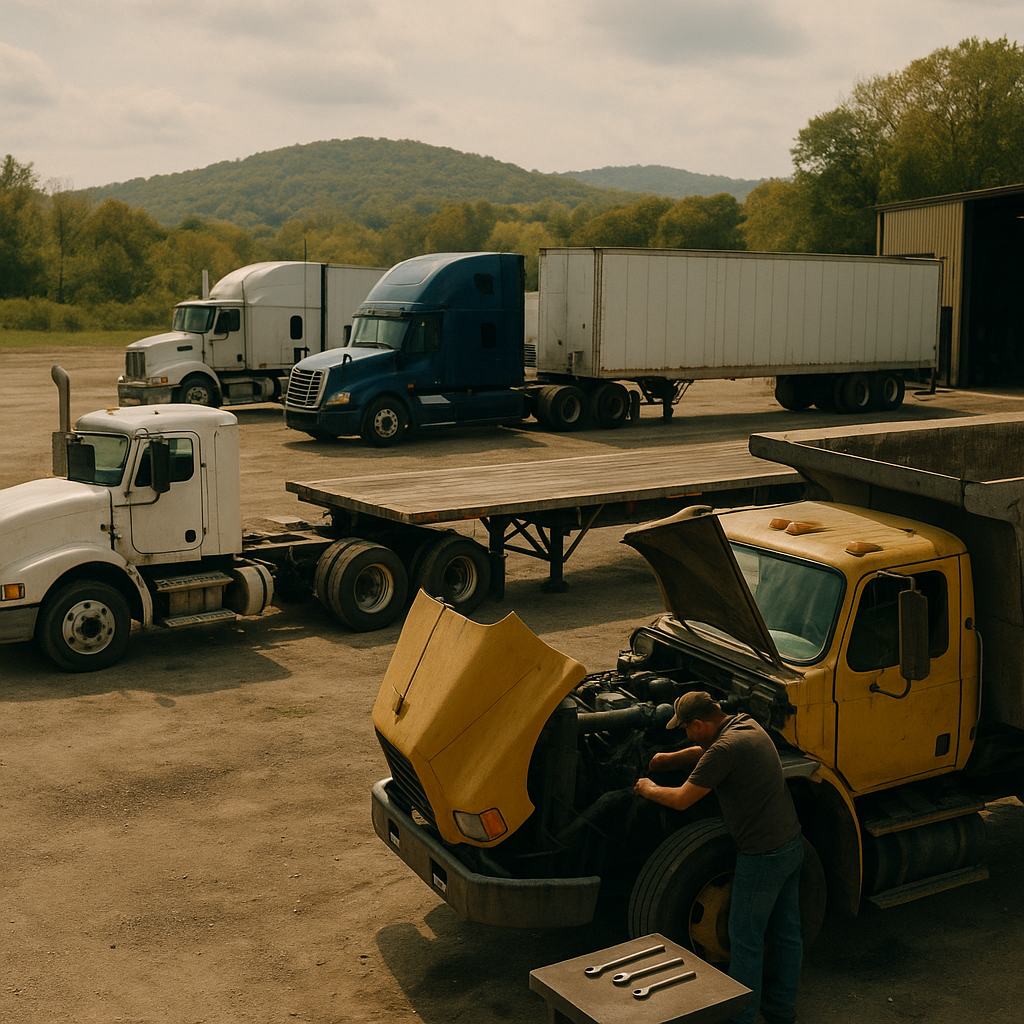
A dump truck and a road truck can sometimes sit on the same policy, but only if the insurer allows the mix and the operation is disclosed correctly. The key is accurate scheduling of each truck, correct VIN information, and a clear description of what each unit does.
This is where bad assumptions get expensive. If a policy is built for one kind of operation and a loss happens during another, the claim denial risk goes up. If you’re not sure how to classify mixed trucks, [](https://www.logrock.com/?utm_source=BLOG&utm_campaign=dump-truck-insurance-tennessee).
Tennessee Rules vs. FMCSA Requirements#
Tennessee rules and FMCSA requirements are not the same thing. Tennessee may have state-level registration or insurance expectations for commercial vehicles, while FMCSA rules apply to certain interstate motor carriers based on carrier type, vehicle weight, and what they haul. A state minimum does not automatically make you federally compliant.
State minimums and registration-related rules#
Tennessee sets its own rules around vehicle titling, registration, and certain commercial vehicle compliance issues through state agencies like the Tennessee Department of Safety and Homeland Security. For an intrastate dump truck that stays within Tennessee, state requirements may be the starting point.
But “starting point” is the key phrase. A basic state minimum may be legally relevant for registration, yet still be too thin for your actual operation, lender, contract, or jobsite access.
Federal trucking requirements that may apply#
FMCSA is the Federal Motor Carrier Safety Administration, the agency that regulates interstate commercial motor carriers. If your dump truck operation crosses state lines or falls into a federally regulated for-hire setup, federal rules can apply on top of state rules.
Under 49 CFR Part 387, for-hire interstate carriers hauling general freight in vehicles over 10,001 lbs must carry at least $750,000 in public liability. That doesn’t mean all truckers need $750,000. Federal minimums vary by carrier type, vehicle weight, and commodity, and some operations require more.
You can also verify interstate operating status and carrier details through SAFER, which is often the fastest reality check when someone’s not sure how their authority is showing up.
Why the two are not the same#
State minimums, FMCSA minimums, and shipper or contractor requirements can all be different. A Tennessee intrastate operator may face one set of rules, while an interstate for-hire operator in a heavier truck faces another.
That mismatch causes a lot of confusion. Plenty of owner-operators hear a number from another driver and assume it applies to everyone. It doesn’t. Requirements vary by carrier type, vehicle weight, cargo, and whether you operate interstate or intrastate.
How Much Dump Truck Insurance Costs#
Dump truck insurance cost depends on the risk profile of the truck and the business, not just the word “dump truck.” The biggest drivers are truck value, operation type, driver history, radius, liability limits, deductibles, and how the insurer classifies the work. Two similar-looking trucks can price very differently.
What drives the price#
Underwriting is the insurer’s process for evaluating risk before offering a policy and premium. For dump trucks, underwriting usually looks closely at:
- Truck value and age
- Driver experience and motor vehicle records
- Garaging location in Tennessee
- Operating radius
- Type of material hauled
- Whether the truck is owner-operated or fleet-run
- Loss history
- Requested deductibles and limits
A newer truck with physical damage coverage and broader use usually costs more to insure than an older paid-off truck with narrower use. A clean driving record also matters a lot.
Why liability limits matter#
A $1,000,000 liability limit may be required by a contract or preferred for business reasons, but the premium is never based on the limit alone. The same $1,000,000 limit can price very differently depending on radius, jobsite exposure, driver history, truck type, and whether the operation is intrastate or interstate.
That matters when you’re comparing quotes. One policy may look cheaper until you notice different deductibles, tighter exclusions, or a narrower description of the truck’s actual work.
Ways quotes can change from one carrier to another#
Each insurer has its own appetite for dump truck risks. One may be comfortable with end dump work, while another may price it harder. One may like mixed fleets, while another may want a cleaner separation between dump units and road trucks.
That’s why quote shopping can feel messy. The cheapest-looking option on page one may be the one most likely to leave a gap when a claim hits. If the quotes you’re seeing don’t line up, [](https://www.logrock.com/?utm_source=BLOG&utm_campaign=dump-truck-insurance-tennessee).
How to Compare Quotes Without Missing Coverage#
The fastest way to get an accurate dump truck insurance quote is to provide complete, consistent operation details up front. To compare quotes correctly, match the same limits, deductibles, endorsements, and truck descriptions across each option. The premium matters, but the policy wording decides whether a claim gets paid.
Information you need before requesting quotes#
A VIN is the vehicle identification number that uniquely identifies the truck. Have these details ready before you ask for quotes:
- VINs for each truck
- Garaging address
- Business name and operating structure
- Operating radius
- Truck type and configuration
- What the truck hauls
- Driver history
- Prior insurance details
- Requested effective date
- Current limits and deductibles, if replacing coverage
This speeds up underwriting and cuts down on revisions later.
How to compare apples to apples#
Don’t compare premium only. Compare liability limits, physical damage deductibles, listed drivers, scheduled vehicles, exclusions, and endorsements.
If one quote describes the truck as local dirt hauling and another describes broader contractor hauling, those are not the same product. The lower quote may simply be built on a narrower risk assumption.
Misrepresentation risks that can hurt a claim#
A claim denial is when an insurer refuses payment because the loss isn’t covered or the policy terms weren’t met. Misstating truck use, hiding mixed operations, or classifying a road truck like a dump unit just to force a fit can create real problems later.
This is especially common when operators switch between end dump work, hopper hauling, and more general road use. If the policy wording doesn’t match the operation, the most painful surprise usually comes after an accident, not before.
Coverage Gaps to Avoid#
The most common dump truck insurance gaps come from wrong assumptions, not rare edge cases. Personal auto doesn’t cover a commercial dump truck operation, liability doesn’t fix damage to your own truck, and hauled material isn’t automatically covered just because you’re transporting it. The denied claim is often more expensive than the premium you were trying to avoid.
Cargo and hauled-material misunderstandings#
Not every load is covered the same way. Material type, ownership, and policy wording all matter.
Physical damage versus liability#
Liability protects you against damage or injury you cause to others. Physical damage protects your truck.
Policy wording that does not match the operation#
Make sure the policy actually reflects end dump work, hopper work, mixed-fleet use, or any road-truck exposure. If the description is off, the coverage may be too.
How to Get a Tennessee Dump Truck Insurance Quote#
Getting a Tennessee dump truck insurance quote goes faster when you bring complete truck, driver, and operation details from the start. Gather VINs, garaging location, driver information, hauling details, and current coverage first. Then request multiple quotes built on the same limits and deductibles, and review the policy wording before binding.
Check that the quote matches how the truck really works. It also needs to line up with both Tennessee requirements and any federal obligations that apply to your operation.
FAQ#
What kind of insurance do I need for a dump truck?
A dump truck usually needs commercial auto liability at minimum, because that’s the core coverage for bodily injury or property damage you cause to others while operating the truck for business. Beyond that, many operators also need physical damage coverage to protect the truck itself, especially if it’s financed or has significant value.
Depending on the job, you may also need general liability, cargo-related coverage, or specific endorsements tied to the work you perform. The right setup depends on whether you’re intrastate or interstate, what the truck hauls, and how the truck is described in the policy.
How much is insurance for a dump truck?
Dump truck insurance pricing varies widely because the premium depends on the truck, the driver, and the operation. Insurers usually look at truck value, driver history, garaging location, operating radius, hauling type, requested limits, deductibles, and prior losses.
That’s why two Tennessee operators with similar trucks can still get very different quotes. One may run locally with a clean record and lower physical damage values, while another may have broader use, higher limits, or a tougher underwriting profile. Your actual premium depends on your operation, cargo, radius, driving history, and other factors.
How much does a $1,000,000 liability insurance policy cost?
A $1,000,000 liability policy doesn’t have one standard price. The limit is only one part of the quote, and the actual premium depends on how the insurer views the total risk.
For a dump truck, that means underwriting will consider things like interstate or intrastate operation, jobsite exposure, driver record, truck type, business use, and deductibles. A cleaner operation may price differently than one with a broader radius or a more complex hauling profile. If you’re comparing $1,000,000 quotes, make sure the truck description, exclusions, and endorsements match across each option.
What are the requirements for commercial insurance in Tennessee?
Tennessee commercial insurance requirements depend on the type of operation. For intrastate use, state-level insurance and registration rules may control the starting point. For interstate or certain for-hire operations, FMCSA rules can also apply.
The big point is that Tennessee state minimums are not automatically the same as federal trucking requirements. Under 49 CFR Part 387, federally regulated minimums vary by carrier type, vehicle weight, and commodity. Contract requirements can also exceed both state and federal minimums. If you’re not sure which bucket your operation falls into, verify your status before you bind coverage.
Can a dump truck and a road truck be on the same policy?
Sometimes yes, but only if the insurer accepts that mix and the policy accurately reflects what each truck does. The trucks need to be properly scheduled, the VINs must be correct, and the operation has to be disclosed clearly during underwriting.
This is where owners get into trouble by assuming one label fits everything. If the dump truck does one kind of work and the road truck does another, the insurer may rate them differently or want different terms. A mixed policy can work, but only when the policy wording matches the real-world operation.