
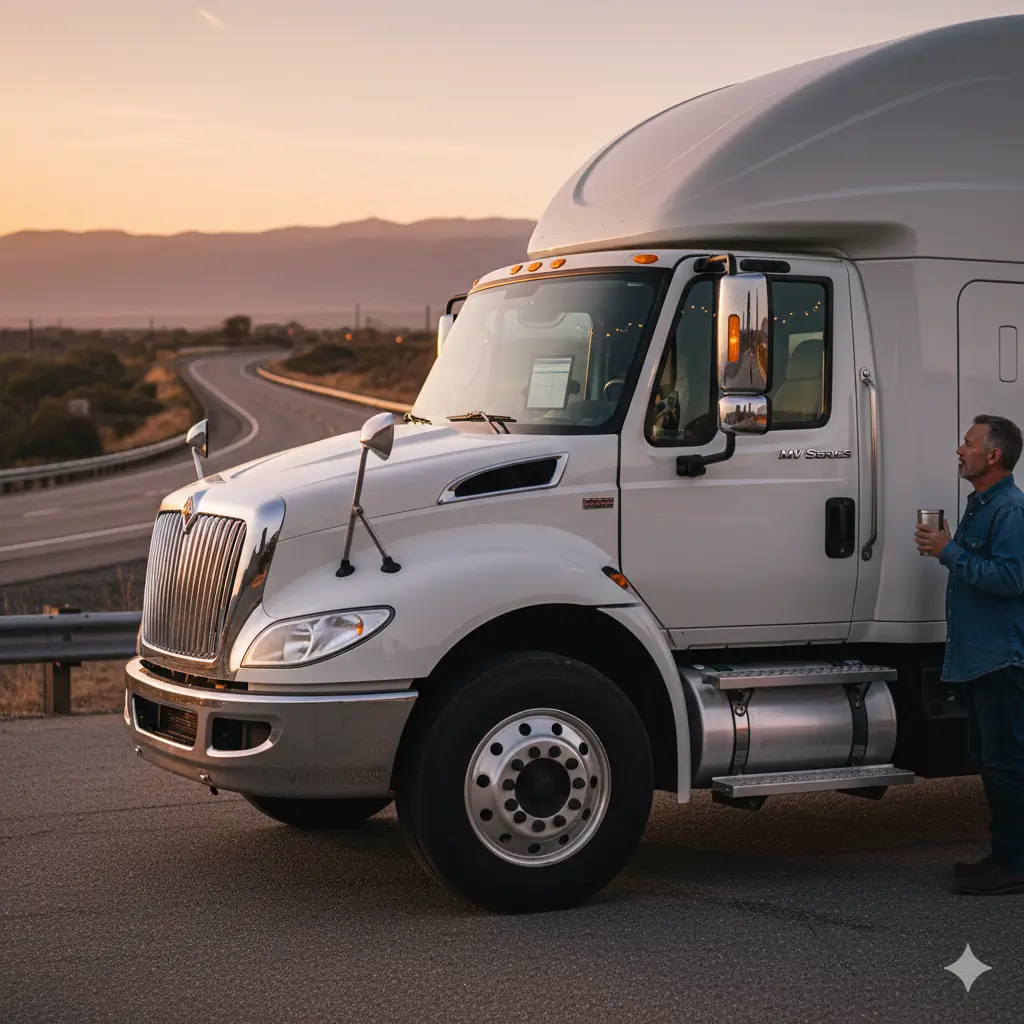

Learn what qualifies as a medium duty truck, Class 3–6 GVWR ranges, common examples, CDL rules, and factors that affect commercial truck insurance costs.
Medium duty truck usually means a Class 3–6 vehicle with a GVWR of 10,001 to 26,000 lbs (about 4,536 to 11,793 kg). That “door-sticker” number isn’t trivia—it drives CDL thresholds, DOT compliance expectations, what loads you can legally haul, and what you’ll pay for commercial truck insurance when a broker needs a COI today.
Most listings toss around “medium-duty” and “heavy-duty,” but regulators and underwriters care about the GVWR on the VIN/door label, not today’s scale weight. If you’re speccing a truck for a contract or an insurance quote, start with GVWR and then match the body (box, flatbed, service body, rollback) to your real operation. For a practical setup checklist, see this understanding truck classes and GVWR.
Key Takeaways: Essential Medium Duty Truck Facts
- Medium-duty usually means Class 3–6: 10,001–26,000 lbs GVWR (4,536–11,793 kg).
- CDL isn’t automatic: Many medium-duty trucks don’t require a CDL unless you cross 26,001 lbs GVWR/GCWR (or meet hazmat/passenger rules).
- Your use-case drives your risk (and insurance): Local box truck delivery rates differently than towing/recovery or certain construction support work.
- The fastest way to get burned: Buying “cheap” trucking insurance that doesn’t match radius, cargo, or for-hire/private use is how claims get messy.
Table of Contents
Reading time: 9 minutes
- Definition: What Makes a Truck “Medium Duty”?
- Medium Duty Truck Classes (GVWR) With Examples
- Common Medium Duty Truck Uses (What They’re Built For)
- CDL, DOT, Weigh Stations, and Compliance: What Actually Applies
- Medium-Duty vs. Light-Duty vs. Heavy-Duty (Quick Comparison)
- How Medium Duty Impacts Commercial Truck Insurance Costs
- Emerging Trends: EV Medium-Duty and Telematics
- Your Questions Answered: “People Also Ask” FAQs
- The Logrock Difference: Insurance Built for Business Owners
- Conclusion & Get a Quote That Matches Your Operation

Definition: What Makes a Truck “Medium Duty”?
A medium duty truck is typically defined as a Class 3–6 vehicle with a GVWR of 10,001 to 26,000 lbs, and GVWR is the manufacturer-rated maximum loaded weight of the vehicle. GVWR includes the truck, body, fuel, driver, passengers, and cargo—so it’s the number that DOT and insurance usually anchor to.
Two owner-operator realities matter here:
- GVWR is not your scale weight today: It’s the rating on the VIN/door sticker, and that’s what shippers, regulators, and underwriters typically use.
- Listings can be sloppy: “Medium-duty” in a sales ad is marketing; the class and GVWR are the facts.
If you’re quoting insurance or bidding a lane, confirm the GVWR first, then work backward into payload, axle ratings, and the upfit (box, flatbed, rollback, service body).
Medium Duty Truck Classes (GVWR) With Examples
Medium duty truck classes in the U.S. are most commonly Class 3, 4, 5, and 6, which together span 10,001–26,000 lbs GVWR. These classes cover everything from heavier commercial pickups to large straight trucks used in delivery, utility, and towing.
For a full breakdown of how regulators classify trucks by GVWR, see Classifying Medium and Heavy-Duty Trucks.
| Truck Class | GVWR (lbs) | GVWR (kg approx.) | Common Examples |
|---|---|---|---|
| Class 3 | 10,001–14,000 | 4,536–6,350 | Heavy pickups (commercial trims), smaller box trucks, utility bodies |
| Class 4 | 14,001–16,000 | 6,351–7,257 | Delivery/landscaping trucks, small dumps, service trucks |
| Class 5 | 16,001–19,500 | 7,258–8,845 | Larger box trucks, tow trucks, flatbeds, small wreckers |
| Class 6 | 19,501–26,000 | 8,846–11,793 | Big box trucks, beverage trucks, rollback wreckers, stake/flatbeds |
Where the confusion comes from (Class 7)
Some sources stretch “medium-duty” into Class 7 (26,001–33,000 lbs), but 26,001 lbs is also a common CDL tipping point, so Class 7 often behaves like “heavy” risk for compliance and insurance decisions.
Common Medium Duty Truck Uses (What They’re Built For)
Medium duty trucks are commonly used for revenue work like delivery, towing, and job-site support because Class 3–6 trucks can carry meaningful payload while still fitting city streets and tighter docks. That “sweet spot” is why box trucks and straight trucks show up everywhere from final-mile to municipal fleets.
Typical medium-duty applications (real world)
- Local & regional delivery: box truck routes, retail replenishment, final-mile
- Construction support: flatbed/stake body hauling materials, small dump work (see dump truck insurance for construction-support setups)
- Towing & recovery: rollback carriers and light/medium wreckers (often higher liability exposure — wrecker insurance rates accordingly)
- Utility/municipal: bucket trucks, service bodies, maintenance fleets
- Reefer straight trucks: local temperature-controlled delivery
- Hotshot-adjacent setups: Class 3–5 pickups with goosenecks (often discussed alongside hotshot insurance)
If you’re running or planning a towing operation with medium-duty equipment, this walkthrough covers what you need to get set up right:
Profit check before you buy (not just the monthly note)
Spec choices that look small on paper can change your margins fast—especially when you add liftgates, PTO-driven gear, or start towing. Before you commit, run basic operating numbers:
- Revenue per loaded mile (or per stop/day for local work)
- Deadhead percentage (especially for regional lanes)
- Maintenance per mile (tires, brakes, emissions/DEF, hydraulic/liftgate wear)
- Insurance cost per mile (it’s real even on “smaller” trucks)
CDL, DOT, Weigh Stations, and Compliance: What Actually Applies
FMCSA generally treats vehicles as commercial motor vehicles in interstate commerce at 10,001+ lbs GVWR/GCWR, which is why many Class 3–6 operations still trigger USDOT compliance even when they’re “non-CDL.” The details depend on how you operate (interstate vs. intrastate, for-hire vs. private, cargo type), but “medium-duty” does not automatically mean “under the radar.” According to FMCSA registration guidance, the 10,001+ lbs GVWR/GCWR threshold is a key trigger for federal registration review.
1) Do you need a CDL to drive a medium-duty truck?
A CDL is commonly required at 26,001+ lbs GVWR/GCWR for many commercial configurations, and separate CDL triggers can apply for certain hazmat or passenger operations. In plain terms: CDL rules follow weight rating and use, not the “medium-duty” label.
- Typically CDL required: many setups at 26,001+ lbs GVWR/GCWR, including some combination/trailer configurations
- CDL can be required regardless of weight: certain hazmat/passenger operations (requirements vary by state and endorsement)
- Practical trap: a “non-CDL” straight truck can become CDL-required if you add a heavier body, liftgate, equipment, or a trailer and your GCWR crosses the threshold
For a full breakdown by weight, use, and state, see LogRock’s CDL requirements guide.
Not sure how GCWR changes the CDL equation? This quick breakdown covers the key distinction:
2) DOT and “for-hire” rules still matter
If you run for-hire (especially interstate), you may need a USDOT number and possibly MC authority, and you’ll likely be expected to maintain basic compliance items like inspections and maintenance records. Depending on your operation, HOS/ELD rules under 49 CFR Part 395 may apply, with limited exemptions for certain short-haul scenarios.
Roadside reality: weigh stations and inspections aren’t impressed by “I didn’t know.” A clean file and accurate insurance filings are cheaper than an out-of-service day.
Medium-Duty vs. Light-Duty vs. Heavy-Duty (Quick Comparison)
Truck duty categories are most consistently separated by GVWR classes, with light-duty typically Class 1–2 (up to 10,000 lbs), medium-duty Class 3–6 (10,001–26,000 lbs), and heavy-duty Class 7–8 (26,001+ lbs). For insurance and compliance, that break at 26,001 lbs matters because it often aligns with CDL and higher-limit expectations.
| Category | Typical Classes | GVWR Range | Business Use | Practical “Gotcha” |
|---|---|---|---|---|
| Light-duty | 1–2 | Up to 10,000 lbs | Small service, small cargo | Looks cheap until payload needs grow |
| Medium-duty | 3–6 | 10,001–26,000 lbs | Delivery, utility, towing, regional | Compliance and insurance vary wildly by use |
| Heavy-duty | 7–8 | 26,001+ lbs | Big freight, heavy vocational, semis | CDL + higher limits expected |
How Medium Duty Impacts Commercial Truck Insurance Costs
FMCSA’s federal minimum public liability for many for-hire interstate carriers hauling non-hazardous freight is $750,000 (49 CFR 387.9), and higher limits apply for certain hazmat categories. Even when your truck is “only” Class 3–6, contracts and brokers often push limits higher than minimums, and your actual operation can price like a higher-risk account.
Medium-duty can be cheaper than a Class 8 semi in some lanes, but it can also cost more when the risk profile is rough (dense urban delivery, towing/recovery, high claim frequency, inexperienced drivers, or certain cargo).
1) The biggest pricing factors underwriters care about
Commercial truck insurance pricing is mainly driven by exposure—how often you’re in traffic, what you haul, where you run, where you park, and who’s driving. A strong application that matches reality (radius, cargo, garaging, driver history) is one of the fastest ways to avoid overpaying.
- For-hire vs. private carriage
- Operating radius (local metro vs. multi-state)
- Cargo (general freight vs. higher-risk categories)
- Loss history and MVR
- Vehicle value (physical damage cost to insure)
- Garaging location (theft/vandalism patterns vary by ZIP)
- Hired/non-owned exposure if you use other drivers or rent/borrow vehicles
2) Coverages that matter for medium-duty operations
Most for-hire medium duty truck operators build a policy around auto liability, then add cargo and physical damage based on contracts and equipment. Cargo insurance isn’t universally required by federal law for all carriers, but many shippers/brokers require it (often $100,000+ for general freight) to load you.
- Auto Liability: the core coverage that supports filings and contracts
- Motor Truck Cargo: protects the customer’s freight (policy terms and exclusions matter)
- Physical Damage: comp/collision for the truck
- General Liability: often required by warehouses/job sites (separate from auto)
- Non-Trucking Liability / Bobtail: depends on use and dispatch structure (more common with tractors, but still relevant in some setups)
Auto liability is the foundation of any medium-duty policy. Here’s exactly what it covers:
If you’re shopping “semi truck insurance” but you’re operating a straight truck or a hotshot-style pickup, classification matters—misclassification can mean wasted premium or missing coverage where you actually need it. If you’re running a hotshot-adjacent setup, see non-CDL hotshot insurance specifically.
3) “Affordable trucking insurance” vs. “cheap insurance”
Affordable means right-sized—limits match contracts, deductibles match cash reserves, and cargo/radius match how you really run. Cheap usually means the application is wrong (or incomplete), and that’s the kind of mistake that shows up at claim time.
Emerging Trends: EV Medium-Duty and Telematics
Medium-duty fleets are one of the most common early adopters of EVs and telematics because return-to-base routes make charging and driver coaching easier to control. If you run predictable daily miles and park at a consistent yard, you can often evaluate new tech without breaking dispatch.
Electric medium-duty (EV) reality check
EV medium-duty trucks are showing up most in local delivery, municipal fleets, and yard/port-style operations where uptime planning is predictable. The business trade-off is straightforward: higher upfront cost and planning around charging versus potential fuel and maintenance savings.
- Operational impact: range and charging time become part of dispatch
- Insurance impact: some carriers look closely at repair networks, battery replacement costs, and parts availability before pricing aggressively
Telematics and safety tech (insurance tie-in)
Forward-facing cameras, speed governance, and telematics can reduce claim frequency and support a stronger underwriting story, especially in high-traffic delivery and towing exposures. It also helps defend claims when the loss wasn’t on you.
Your Questions Answered: “People Also Ask” FAQs
Most commonly, 10,001 to 26,000 lbs GVWR (Class 3–6) is considered medium-duty in the U.S. Some sources include Class 7 (26,001–33,000 lbs), but 26,001 lbs is a major CDL and compliance threshold in many situations, so it’s usually smarter to treat Class 7 separately when you’re quoting insurance or bidding contracts.
For compliance and insurance, use the GVWR on the door/VIN plate, not an estimate or a current scale weight.
Class 3, Class 4, Class 5, and Class 6 are widely considered medium-duty classes, covering 10,001–26,000 lbs GVWR. In real terms, that includes everything from heavier commercial pickups with utility bodies to large straight trucks built for delivery, municipal work, or towing.
If a listing just says “medium-duty,” verify the GVWR and class—mislabeling is common, and it can change CDL requirements and insurance pricing.
You do not always need a CDL for a medium-duty truck because many Class 3–6 vehicles can be driven without a CDL if the GVWR/GCWR stays at 26,000 lbs or less and you don’t trigger hazmat or passenger rules. The CDL requirement is based on weight rating and use, not whether the truck is marketed as “medium-duty.”
State rules and combination weights matter, so confirm the exact GVWR/GCWR on your equipment and check your state CDL manual if you’re close to the threshold.
Common medium-duty truck examples include box trucks, stake/flatbeds, utility service trucks, bucket trucks, beverage trucks, and rollback tow trucks, typically in Class 3–6 (10,001–26,000 lbs GVWR). These are the workhorses for local delivery, municipal fleets, and vocational jobs that need payload without a Class 8 tractor.
A simple filter is “bigger than a standard pickup but smaller than a Class 8 semi tractor,” then confirm the GVWR to know the class.
Medium-duty trucks are commonly used for local/regional delivery, construction support, towing/recovery, utilities, and municipal work, and that use-case is a major driver of trucking insurance pricing because it changes exposure (traffic density, stop frequency, loading environments, and claim patterns). Towing and dense urban delivery often rate differently than predictable rural routes.
To keep coverage clean in a claim, your policy must match reality—radius, cargo, garaging, and drivers. For limits guidance, see commercial truck insurance limits explained.
GVWR is the manufacturer-rated maximum weight of the truck alone, including body, fuel, driver, and cargo. GCWR — Gross Combined Weight Rating — adds the trailer to that equation. If you haul a trailer, GCWR is the number that matters for CDL thresholds and compliance: even a truck with a 24,000 lb GVWR can trigger CDL requirements if the trailer pushes your GCWR over 26,000 lbs. Always check both numbers before you add a trailer. See LogRock’s CDL requirements guide if you’re close to the threshold.
In many cases, yes. FMCSA generally requires a USDOT number for vehicles operating in interstate commerce at 10,001+ lbs GVWR, which covers most Class 3–6 trucks used for for-hire work. Some intrastate operations also require one depending on state rules. If you’re unsure, review the FMCSA registration guidance and LogRock’s USDOT number application guide before you start hauling.
For a local or regional box truck operation, expect roughly $250–$1,600 per month depending on operating radius, cargo, driver history, and whether you’re running for-hire or private. Urban delivery and for-hire routes typically price higher than private fleets in rural areas. The fastest way to get an accurate number is to match your application to your real operation — radius, cargo, and garaging all move the price significantly. For a deeper breakdown, see box truck insurance cost.
Federal law doesn’t require cargo insurance for all carriers, but most shippers and freight brokers require it before they’ll load you — often $100,000 or more for general freight. If you’re hauling for-hire, assume cargo insurance is effectively required by the market. If you’re running private carriage, it depends on your contracts and risk tolerance. Either way, a policy without cargo insurance can leave you exposed for freight losses.
For-hire means you’re paid to transport someone else’s goods, which can trigger FMCSA authority requirements and usually means higher insurance limits because you’re moving public freight. Private carriage means you’re hauling your own company’s goods in your own truck. Underwriters rate these differently: for-hire operations carry more liability exposure and usually require a more involved application. Misrepresenting your operation type is one of the fastest ways to create claim problems.
The Logrock Difference: Insurance Built for Business Owners
Logrock focuses on helping owner-operators and small fleets place trucking coverage with accurate classifications and fast COIs, because small mistakes (wrong radius, wrong cargo, wrong use) can cause big problems later. The goal is simple: get you compliant, protect cash flow, and avoid wasted premium.
- Accurate applications: truck class, use, radius, and cargo that match how you actually run
- COIs that move fast: so you can get loaded without chasing paperwork
- Coverage that fits the job: delivery, towing, utility, or regional—rated and structured correctly
Conclusion: Get a Quote That Matches Your Operation
A medium duty truck is typically Class 3–6 (10,001–26,000 lbs GVWR), and that one number drives CDL thresholds, compliance expectations, and how commercial truck insurance is priced. If you know your GVWR and describe your operation accurately, you’re already ahead of most bad quotes.
Key Takeaways:
- Verify GVWR on the door sticker before you quote insurance or sign a contract.
- Respect the 26,001 lbs GVWR/GCWR line before you add weight, equipment, or a trailer.
- Buy insurance based on real operations (radius, cargo, drivers, garaging), not the cheapest number.
If you want coverage that protects the business and doesn’t waste premium, get a quote built around how you actually operate.
If you’re speccing or already running a medium-duty truck — delivery, towing, construction support, or anything in between — LogRock can help you place coverage that actually matches your operation. Get your GVWR, radius, and cargo right on the application, and we’ll help you find the policy that fits.
Related Reading: Commercial Truck Insurance Explained, Hotshot Insurance Basics, and Box Truck Insurance Guide.





