
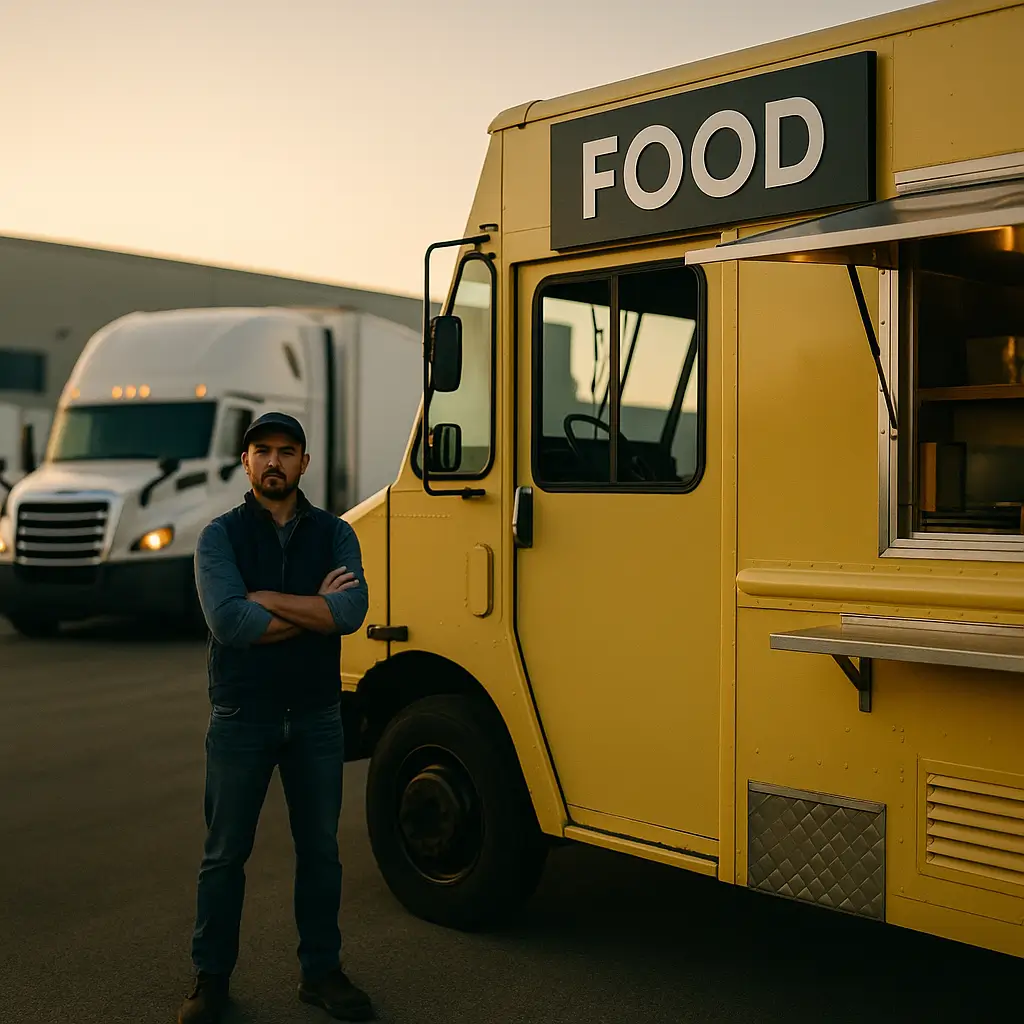

Food truck insurance can cost $300–$700/mo. See required and optional coverages, COIs, event rules, and quotes.
Food truck business insurance is usually a package of general liability, commercial auto, and property coverage (often through a BOP), and many 2026 programs land around $300–$700 per month depending on truck value, payroll, and where you operate. Most trucks also add workers’ comp if they have employees, plus optional coverage for equipment breakdown/spoilage, inland marine for mobile gear, liquor liability (if serving alcohol), and an umbrella for larger venue contracts.
If you need a quick foundation on how policies fit together, start with The Definitive Guide to Commercial Trucking Insurance. Then use the cost table and the “required vs. contract-required” checklist below to build a coverage stack that actually gets accepted at events.
Table of Contents
Reading time: 8 minutes
- Introduction: Insurance is what keeps one bad day from killing your season
- Key takeaways (save this)
- 2026 food truck insurance costs (monthly + annual table)
- What food truck business insurance usually must include (law vs. contracts)
- Workers’ comp, permits, and COIs: the paperwork that gets you booked
- Optional coverages that actually matter (plus real claim scenarios)
- Frequently asked questions
- Conclusion: Build the right coverage stack—then make COIs easy

Introduction: Insurance Is What Keeps One Bad Day From Killing Your Season
Food truck business insurance is typically built around general liability, commercial auto, and property coverage (often via a BOP), with workers’ compensation added when you have employees under your state’s rules. If you’re running a food truck, you’re juggling thin margins, weather, equipment that fails at the worst time, and venues that won’t let you park unless your paperwork is perfect.
Insurance isn’t “nice to have”—it’s what keeps a fender-bender, a burn injury, or a generator failure from turning into a cash-flow emergency.
What insurance does a food truck need?
Most food truck programs include:
- General liability (GL): Customer injury and third-party property damage claims.
- Commercial auto: Liability plus physical damage for the truck as a road-going vehicle.
- Property (often via a BOP): Equipment, inventory, and sometimes business interruption.
- Workers’ comp (if employees): Medical and lost wages for work injuries (rules vary by state).
- Common add-ons: Equipment breakdown/spoilage, inland marine, liquor liability, and umbrella/excess liability.
For a full breakdown of what each coverage type actually requires, see our food truck insurance requirements guide.
This guide is built like a buying checklist: see the cost table first, then build your coverage stack, then make your COI process painless.
Key Takeaways (Save This)
In 2026, many U.S. food truck operators pay $300–$700 per month for a combined liability + auto + property insurance stack, with workers’ comp added when they have employees. Here are the takeaways most owners wish they’d saved before their first big event:
- Expect $300–$700/month in 2026: Your number moves most based on truck value, payroll, claims history, and city/state.
- “Required” often means contract-required: Venues and commissaries can be stricter than state law, and COI wording (additional insured, primary/noncontributory) matters as much as limits.
- Commercial auto is non-negotiable: If the kitchen is on wheels and driven for business, personal auto typically won’t respond correctly.
- Equipment breakdown/spoilage saves profit: Generator, compressor, or fryer failures are common season-wreckers.
2026 Food Truck Insurance Costs (Monthly + Annual Table)
The cost of food truck business insurance in 2026 commonly breaks into line items—GL ($40–$120/mo), BOP ($80–$200/mo), and commercial auto ($150–$450/mo)—that often total $300–$700 per month when bundled together. Before the table, here’s the plain truth: the “starting at $25/month” offers you see online are often general liability only, which won’t cover the biggest checks (auto claims, employee injuries, or a totaled truck).
For a granular breakdown of what affects your number, see our food truck insurance cost page.
| Coverage Type | Typical Monthly Range (2026) | Typical Annual Range | What It’s Protecting |
|---|---|---|---|
| General Liability (GL) | $40–$120 | $480–$1,440 | Slip-and-fall, customer injury, property damage to others |
| Business Owner’s Policy (BOP) | $80–$200 | $960–$2,400 | GL + some property/business interruption (when eligible) |
| Commercial Auto | $150–$450 | $1,800–$5,400 | At-fault accidents, physical damage, UM/UIM, more |
| Workers’ Comp (if employees) | $60–$250 | $720–$3,000 | Employee medical + lost wages from work injuries |
| Equipment Breakdown / Spoilage add-on | $10–$60 | $120–$720 | Generator, refrigeration, electrical/mechanical failure |
| Inland Marine (mobile tools/gear) | $10–$50 | $120–$600 | Tents, POS tablets, signage, catering equipment |
| Liquor Liability (if serving alcohol) | $30–$120 | $360–$1,440 | Alcohol-related injury/property claims |
| Umbrella/Excess Liability | $25–$100+ | $300–$1,200+ | Extra limits over GL/auto when contracts demand more |
What changes the price the most
- Truck type + value: Step van vs. trailer kitchen; theft risk and repair costs can drive pricing.
- Where you park overnight: Fenced/secured storage usually looks better than street parking.
- Payroll + crew size: More hands usually means more workers’ comp exposure.
- Cooking setup: Open flame, fryer use, and propane systems can change underwriting appetite.
- Alcohol + catering + festivals: Bigger crowds and longer service windows increase severity risk.
- Claims history: One loss can affect pricing for multiple renewal cycles.
Food-truck owners commonly save money by bundling the liability + property side into a BOP when eligible — qualifying operators often get a lower combined rate for property + GL than buying them as separate policies.
If you’re building your food truck coverage stack — or trying to figure out why a venue rejected your last COI — LogRock can help you review your operation, confirm the right limits, and compare quotes across programs that actually cover mobile food businesses. Talk to our team before you bind, not after a claim.
Speak with LogRock and request a food truck insurance quote.
What Food Truck Business Insurance Usually Must Include (Law vs. Contracts)
Food truck insurance requirements usually come from state law (most often auto liability minimums and, in many states, workers’ comp rules) and contracts that commonly require $1M per occurrence / $2M aggregate general liability plus specific COI endorsements. The SBA’s business insurance guidance covers baseline liability expectations for small business owners. The phrase “required insurance” trips people up because it mixes two different realities:
- Required by law: Varies by state; auto liability is the most common baseline.
- Required by contract: Commissaries, festivals, campuses, downtown property managers, airports, and corporate clients.
General Liability (GL)
General liability insurance pays when a third party says your business caused bodily injury or property damage, and the most common venue limits are $1M/$2M (but some contracts require more). A single claim—hot food spill, slip near the service window, damaged venue property—can wipe out months of profit.
For limit benchmarks and claim examples specific to food trucks, see food truck liability insurance.
- Who needs it: Every food truck, even if you “only do lunch” and “don’t have seating.”
- Typical limits: Often $1M per occurrence / $2M aggregate, plus additional insured wording for venues.
- Underwriting tip: Ask about exclusions tied to open flame, fryer use, and propane.
For general consumer-oriented coverage concepts, NAIC resources can help you understand policy types and claim response: https://content.naic.org/consumer
Commercial Auto (Your Biggest Dollar Risk)
Commercial auto insurance covers business-use vehicles for liability and physical damage, and a single at-fault crash can create six-figure exposure when injuries are involved. If the truck is registered and driven on public roads for the business, you need commercial auto; personal auto usually won’t correctly cover a food truck used for business. The NAIC consumer resources explain how coverage types and claim response generally work.
To connect the keyword world: food truck auto coverage sits under commercial auto, which is part of broader commercial truck insurance and trucking insurance. The rating logic (vehicle liability + physical damage + driver exposure) is similar to what you see in semi truck insurance, and even lighter commercial setups like hotshot insurance—the vehicle is a business asset, and the liability is commercial.
If you want a deeper breakdown of what to request (liability, comp/collision, UM/UIM, towing, hired/non-owned), start with this commercial auto insurance guide.
For food-truck-specific auto coverage breakdowns, see food truck auto insurance.
- Gap to watch: If staff run errands in personal cars (ice runs, supply pickups), ask about hired and non-owned auto.
Before requesting quotes, it helps to understand how auto liability and general liability interact — this video breaks it down:
Property / BOP (Protecting the Stuff That Makes You Money)
Property coverage protects business-owned equipment and inventory, and a BOP can bundle property + GL into one policy when you qualify. Theft, vandalism, and fire losses are common pain points, but the bigger hit is often downtime (missed events, canceled catering, refunds).
- Who needs it: Anyone with meaningful built-in equipment value (hoods, fryers, refrigeration) or inventory risk.
- Claims tip: Keep an equipment list with replacement cost and photos; it speeds up claim handling.
Workers’ Comp, Permits, and COIs: The Paperwork That Gets You Booked
A certificate of insurance (COI) is a one-page proof-of-coverage summary, and many venues require it in 24–48 hours with endorsements like additional insured and sometimes primary/noncontributory wording. This is where food-truck owners lose time and money: you can have “insurance,” but still get rejected because workers’ comp status is unclear or the COI wording isn’t right.
Workers’ Compensation (When It’s Required—and When It’s Still Smart)
Workers’ compensation insurance generally pays for employee work injuries (medical costs and lost wages) and is often required by state law when you have employees, though the exact rules vary by state. Food service work has real injury exposure—burns, cuts, slips, and lifting in tight spaces—and workplace injury/illness statistics are tracked by the U.S. Bureau of Labor Statistics: https://www.bls.gov/iif/
Start by confirming your state’s workers’ compensation rules if you’re hiring or using part-time event help.
- Audit risk: Misclassifying workers as “1099” when they function like employees can create claim and premium audit problems.
State vs. Venue Requirements (Why “Affordable” Depends on Compliance)
Insurance compliance for food trucks varies by state for workers’ comp rules and auto minimums, but venue contracts often set stricter GL limits and COI wording than any statute. What commonly changes by venue or contract:
- Minimum GL limits (often $1M/$2M)
- Additional insured requirements
- Primary/noncontributory wording
- Waiver of subrogation
- Tight COI deadlines (often 24–48 hours)
Workers’ comp rules and employer thresholds vary by state — the U.S. Department of Labor workers’ compensation overview is a broader starting point for understanding state programs and requirements.
Certificate of Insurance (COI): Make It Easy for People to Say “Yes”
A certificate of insurance (COI) is typically required for festivals, commissaries, campuses, and corporate catering, and it must match the contract’s limits and endorsement wording to be accepted. If you’re constantly being asked for “additional insured” changes, review how catering insurance for a day can support event-specific COI needs.
- Speed tip: Ask for the venue requirement sheet before you bind coverage; endorsements added later can be slow and expensive.
Here’s how to send a COI quickly when a venue or commissary requests one:
Optional Coverages That Actually Matter (Plus Real Claim Scenarios)
Optional food truck coverages like equipment breakdown/spoilage ($10–$60/mo) and umbrella liability ($25–$100+/mo) often determine whether a failure is a manageable repair or a season-ending cash hit. Optional doesn’t mean “fluff”—it means you choose whether to pay a smaller premium now or a bigger check later.
Equipment Breakdown + Spoilage (The Downtime Killer)
Equipment breakdown coverage can help when mechanical or electrical failure (generator, compressor, refrigeration) causes direct loss, and spoilage coverage can help with ruined inventory when covered causes trigger the add-on. One failure can cost you twice: repair cost plus lost product and canceled service days.
Review your equipment breakdown terms carefully so you understand covered causes, waiting periods, and any spoilage sublimits before a failure happens.
- Limit-setting tip: Set limits based on your maximum inventory exposure (prep days, festival weekends) and realistic restock time.
Inland Marine / Tools & Equipment (Mobile Gear)
Inland marine (tools and equipment) coverage is designed for movable gear that leaves a primary location, such as tents, signage, POS tablets, portable warmers, and catering setups. Theft and damage often happen in parking lots, event sites, and during loading/unloading.
- Claims tip: Store photos and receipts in a shared folder; documentation makes claims smoother.
Liquor Liability (If You Serve Alcohol)
Liquor liability insurance covers certain alcohol-related liability claims when you sell or serve alcohol, and it commonly changes both pricing and contract requirements. Clarify whether you’re selling alcohol vs. “host liquor” situations because coverage and exclusions can differ.
Umbrella/Excess Liability (When Contracts Want Bigger Numbers)
Umbrella insurance adds extra liability limits above GL and/or auto (depending on structure) and is a common way to meet higher venue requirements without constantly rewriting primary limits. Price it both ways: meet contract minimums and cover realistic catastrophic exposure.
Not sure whether standard $1M/$2M limits are enough for your operation? This video walks through how to think about the right number:
Real claim scenarios: which policy pays?
- Customer slips near the service window: Typically GL (and umbrella if the loss pierces primary limits).
- Rear-end accident driving to an event: Commercial auto (liability + comp/collision if carried).
- Generator dies, refrigeration warms, inventory is trashed, and you cancel two days: Equipment breakdown/spoilage (and possibly business income if included and triggered).
- Employee burns a hand on the fryer: Workers’ comp.
If your goal is affordable trucking insurance-style pricing, the same logic applies here: you get “affordable” by managing risk (maintenance, training, storage, documentation) and choosing deductibles and limits intentionally—not by stripping coverage until the policy is meaningless.
Frequently Asked Questions
These FAQs summarize the most common food truck insurance questions, including typical 2026 cost ranges, common contract limits, and what’s usually required by law versus required by venues.
In most cases, yes — or at least simultaneously. Many cities and counties require proof of general liability insurance as part of the food truck permit application — the SBA’s business insurance guidance is a useful starting point for understanding baseline requirements before you file. Commissaries often require the same before granting access. It’s common to apply for your permit and bind your insurance in parallel so you have a COI ready when the application asks for it. Check your specific city or county permit requirements early, as some also specify minimum limits and additional insured language.
Yes — most standard food truck policies are annual, and carriers generally require continuous coverage regardless of how often you operate. Running the truck without insurance, even on a single weekend, exposes you to liability if anything happens while it’s in use or parked. Some programs allow you to reduce certain coverage levels (such as physical damage) during off-season storage periods, which can lower your monthly cost without leaving you fully uninsured. If seasonal gaps or reduced coverage windows are a concern, ask your agent about storage endorsements or seasonal rating options before binding a standard annual policy.
In almost all cases, no. Personal auto policies are written for personal use, and insurers routinely deny claims when the vehicle was being used for business purposes at the time of a loss. If your truck is registered, driven, or parked as part of your business operation, you need commercial auto coverage. The gap matters most in accidents — a six-figure injury claim denied because the vehicle was on a personal policy is a real scenario.
Most commercial auto and general liability policies for food trucks include U.S.-wide coverage territory, but you should confirm your policy’s territory language before operating cross-state regularly. Some policies carry geographic restrictions, and certain states — particularly those with unique workers’ comp thresholds or higher auto liability minimums — may require endorsements or separate compliance filings. If you do events or festivals in multiple states, review your coverage territory with your agent before accepting out-of-state bookings, and check whether any venue contracts in those states require different limits or additional insured wording than what you currently carry.
A Business Owner’s Policy (BOP) bundles general liability and commercial property into one policy, often at a lower combined cost than buying them separately. Eligibility typically depends on your revenue, number of locations, and industry — some food truck programs qualify for BOP treatment, while others require standalone GL and property policies. If you qualify, a BOP simplifies billing and can reduce your total premium for the property + liability side of your stack.
Notify your insurer before the swap, not after. When you replace the truck — or significantly upgrade it with a new generator, hood system, or kitchen buildout — the vehicle’s value, VIN, and equipment specs all change, and so does your coverage and premium. Your existing policy may need to be rewritten rather than simply amended, and there can be a gap between the day you take possession of the new truck and the day the policy officially updates to cover it. Have the replacement VIN, purchase price, and an updated equipment list ready to share with your agent so your coverage is continuous from the moment the new truck is yours.
With a properly structured policy and an agent or carrier that supports digital COI delivery, you can typically get a COI in minutes to hours. The delay usually comes from needing to add an additional insured endorsement or change wording — endorsements can take 24–48 hours, sometimes longer. The fix is to collect venue insurance requirement sheets before your policy binds and make sure the endorsements are already in place before you need them on short notice.
Possibly. Your existing GL policy may extend to catering events, but coverage depends on how the policy defines your business operations and whether the event location is within your covered territory. If you’re serving a venue that requires you to be named as an additional insured, or if alcohol is involved, you may need a specific endorsement or a separate event policy. Always confirm with your agent before accepting a catering contract — the liability exposure at a private event can be just as significant as at a public festival.
Not automatically. Commercial auto typically covers the tow vehicle under its physical damage section, but a trailer — particularly one with custom kitchen equipment built in — usually needs to be separately scheduled on the policy or covered under a trailer endorsement or inland marine policy. Liability exposure created by the trailer (for example, if it detaches and causes damage) may fall under the tow vehicle’s auto liability, but the trailer’s contents and equipment value typically require separate coverage. Disclose the trailer, its value, and its equipment details to your agent at quote time so coverage gaps are addressed before you ever hook it up.
Equipment breakdown coverage can pay for the repair or replacement of the failed equipment itself when a mechanical or electrical breakdown is the cause. If your policy also includes spoilage coverage, you may be able to recover the cost of ruined food inventory. Business income or business interruption coverage may reimburse lost revenue during the downtime — but coverage triggers, waiting periods, and sub-limits vary. Review your policy before a breakdown happens, not after, so you know what documentation is needed.
Most food trucks need general liability, commercial auto, and property coverage (often through a BOP), and many venues also require a COI showing those coverages before you can operate onsite. If you have employees, workers’ comp may be required by state law depending on your location and staffing structure. Common add-ons are equipment breakdown/spoilage for generator or refrigeration failures, inland marine for mobile tools and catering gear, liquor liability if you serve alcohol, and umbrella liability when contracts ask for higher limits than the standard $1M/$2M GL.
Many food truck operators pay around $300–$700 per month in 2026 once they combine liability + commercial auto + property, but the true price depends on truck value, payroll, claims history, and where you operate. Commercial auto is often the largest line item at $150–$450/month, while general liability commonly runs $40–$120/month depending on limits and risk factors. Be careful comparing against ultra-low “GL-only” offers, because they typically don’t include commercial auto or workers’ comp, which are the coverages that generate the biggest claims.
General liability is commonly required by contracts (permits, commissaries, landlords, and events), while workers’ comp is often required by state law when you have employees, and the exact rule set varies by state. Many venues ask for $1M per occurrence / $2M aggregate GL plus endorsement wording like additional insured and sometimes primary/noncontributory. If you’re unsure how venue language translates into acceptable paperwork, review how catering insurance for a day can support event-specific COI needs so you don’t get bumped for missing wording.
Many festivals and venues require $1M per occurrence / $2M aggregate general liability plus additional insured wording shown on the COI (often backed by an endorsement). Some venues require higher total limits—commonly solved with an umbrella—based on crowd size, alcohol exposure, or the venue’s internal risk policy. Always request the venue’s insurance requirement sheet and match the limits and wording exactly, because a “close enough” COI is a common reason vendors get rejected the week of an event.
Conclusion: Build the Right Coverage Stack—Then Make COIs Easy
A solid food truck insurance setup usually means GL + commercial auto + property/BOP (plus workers’ comp when required), with add-ons like equipment breakdown and umbrella when your operations and contracts demand them. The win isn’t buying “the cheapest policy”—it’s buying the right stack so one accident, one injury, or one equipment failure doesn’t wipe out working cash.
Key Takeaways:
- Use the $300–$700/month range as a planning number, then refine it with your VIN, truck value, payroll, and locations.
- Contract compliance is part of the product: limits, additional insured, and COI turnaround time can decide whether you get booked.
- Protect downtime with equipment breakdown/spoilage if refrigeration and generators are mission-critical.
Before you request quotes, prep your VIN, usage radius, equipment list with replacement cost, payroll estimate by role, alcohol details (if any), and the venues that need COIs. If you’re trying to keep premiums under control, start with affordable trucking insurance: how to save big on coverage and consider whether a small business umbrella policy is cheaper than constantly reworking primary limits for big events. If you’re ready to compare carriers, start with our picks for the best food truck insurance programs in 2026, or go straight to request a food truck insurance quote.
If you’ve got a clear picture of what your food truck operation needs — or you’re still untangling why your COI keeps getting rejected or what limits your venues actually require — LogRock can help. We work with mobile food businesses on coverage stacks that hold up at real events, with programs that write food trucks and the COI turnaround that gets you booked. Talk to our team to ask questions, close coverage gaps, and request a quote built around how you actually operate.
Speak with LogRock and request a food truck insurance quote.





